
AMD's Trillion-Dollar Mark Rests on the CPU Inside Personal Agents
AMD closed at $649.42 on 6 October 2026 and passed a trillion dollars in market value while both flagship personal agents disclose the CPU underneath them: two cores per Muse sandbox, nine p

TL;DR
- A personal agent is a software assistant that runs continuously for one user, executes tasks through tools and files, and needs its own machine; AMD is the chip company whose EPYC processors are among the CPUs that host those machines.
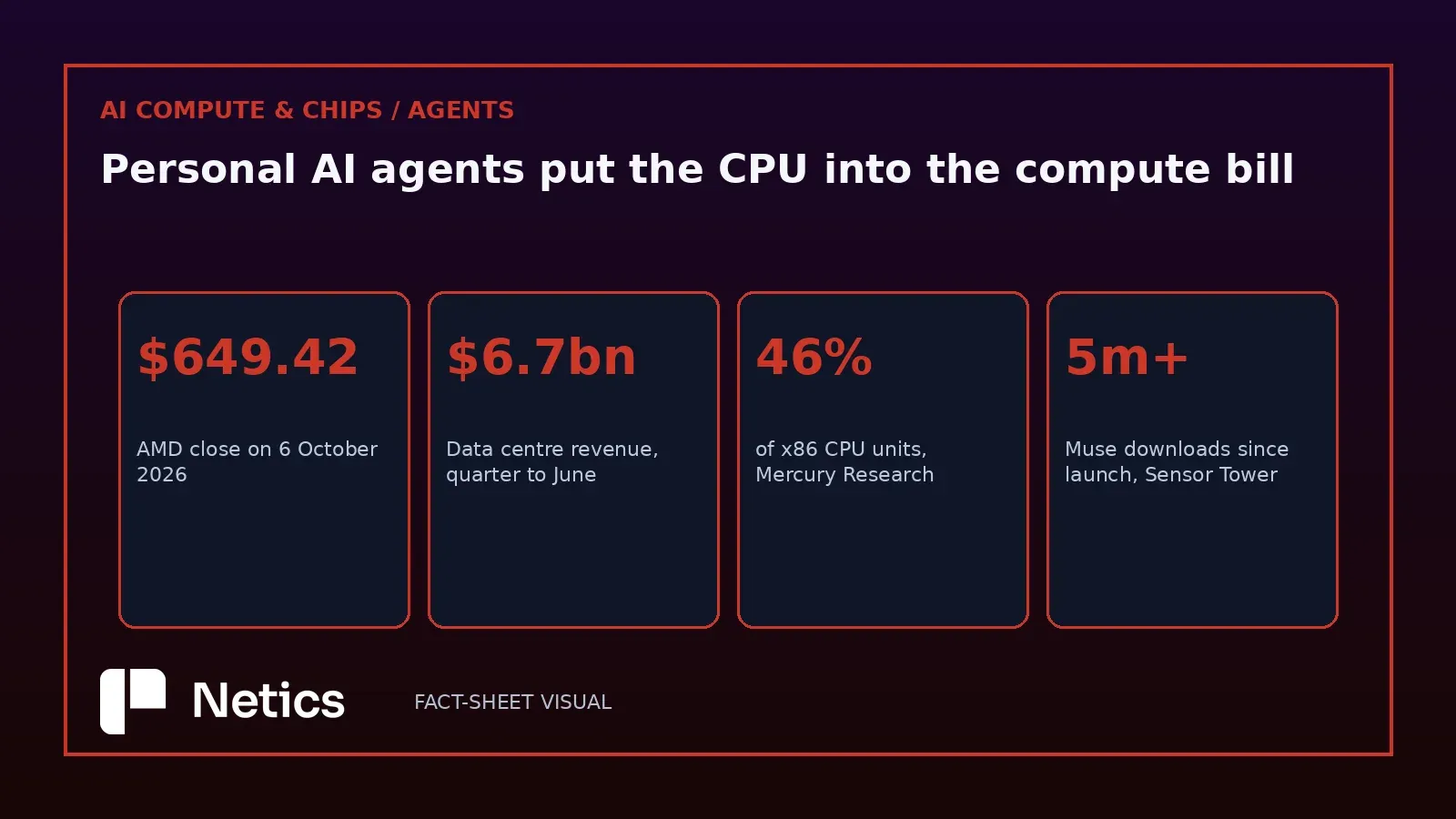
- AMD closed at $649.42 on 6 October 2026 after a move of almost 3%, carrying the company past a trillion dollars in market value on demand for general-purpose server processors.
- Both flagship personal agents publish the hardware they run on. Meta's Muse reports an AMD-powered computer; OpenAI's Dots reports a virtual computer powered by AMD's EPYC-branded CPU.
- The measured shape of an agent machine is small: two cores for a Muse sandbox, nine cores for a Dots virtual machine, against AMD EPYC parts that carry up to 192 cores.
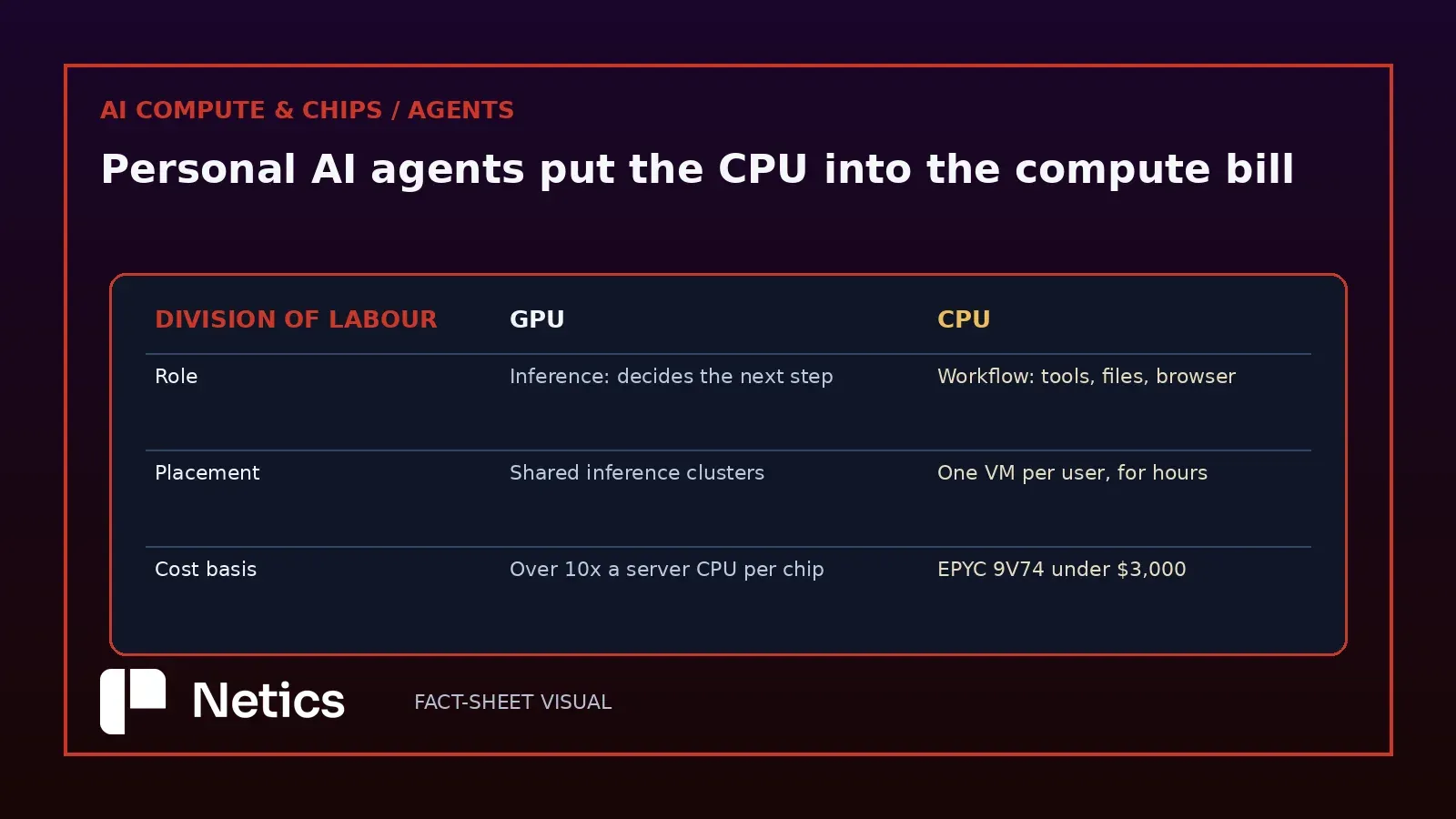
- The division of labour is the mechanism. GPUs run the model that decides the next step, and CPUs execute the workflow that follows: tools, files, browser sessions, credentials.
- Futurum estimates $118 billion of CPU sales in 2027, close to double its own May forecast, and AMD forecasts a $220 billion CPU market by 2030.
- For a team running agents internally, the planning question is how many concurrent user machines a cluster holds and how much of the day each of them sits idle.
- Both vendors describe their CPU suppliers as replaceable: Meta says it is largely CPU-agnostic by design and OpenAI uses multiple CPU providers, which keeps the agent layer written against a portable target.
AMD reached a trillion dollars on server CPU demand
CNBC reported on 6 October 2026 that AMD jumped almost 3% to a fresh high of $649.42, enough to put the company into the trillion-dollar market capitalisation club. The run is not a single day: over the past month, AMD gained 32% and Intel 21%, ahead of every megacap technology peer. Revenue from AMD's data centre business more than doubled to $6.7 billion in the quarter ended in June, accounting for almost 60% of total sales.
The reason the market re-rated two CPU vendors is visible in the products. OpenAI released its agent Dots in the week before the report, following Meta's Muse, which debuted in early September and, according to Sensor Tower figures cited by CNBC, topped the Apple App Store in less than two weeks with more than five million downloads. When users asked the agents what they were running on, both answered with AMD silicon: Muse reports an AMD-powered computer, and Dots reports a virtual computer running on an EPYC-branded CPU.
Meta's own announcement describes that machine from the product side, and its security architecture is covered in our reading of Muse Secure VM: a general-purpose Linux computer per user, held open for hours, is the workload profile a server CPU is built for.
The agent virtual machine is the unit to size for
Tom's Hardware worked out what one of those machines contains. A pre-launch Geekbench 7 result for Dots showed a multi-core score of 9,435 and a single-core score of 1,667, and the hardware behind it appears to be a single nine-core slice of an AMD EPYC 9V74 with 9.73GB of memory, running Ubuntu for the pre-launch run and Debian afterwards. The publication found six runs on that configuration in Geekbench's public database uploaded since launch, and put the post-launch medians at 1,570 single-core and about 8,550 multi-core.
The same analysis gives the comparison point. Muse runs on AMD EPYC Turin with two cores and 8GB per sandbox, and ten Muse runs in the database have median scores of about 1,041 single-core and 1,394 multi-core. Dots sits at roughly 1.5 times the single-core score and six times the multi-core score of Muse, on a slice four and a half times the size.
That difference matters more than the benchmark. Nine cores out of 192 on one socket, or two cores out of 192, is the arithmetic of thin slicing: an operator with a 192-core part and a nine-core virtual machine has a ceiling of a few dozen concurrent users per socket before memory and storage become the constraint. The alternative reading is just as useful. A two-core Muse sandbox leaves an enormous amount of a modern server idle, which is why the same hardware can host a very large number of these machines concurrently and why the CPU bill scales with users rather than with model size.
What the two vendors say about the choice
Neither company describes the relationship as exclusive, and both statements are worth reading closely. A Meta spokesperson told CNBC that the company designed its system to use whatever kind of CPU is available: "We take a diverse approach to our hardware and are largely CPU-agnostic by design, which gives us the most flexibility in acquiring capacity." OpenAI uses multiple CPU providers as well. That is a procurement position rather than a product position, and it tells an infrastructure team something concrete: the agent layer is being written against a portable CPU target, which keeps a second supplier qualified.
The competitive layer above is also moving. Most servers at the large clouds use Intel or AMD processors, and nearly every major cloud provider is developing custom silicon, typically on Arm. Arm announced its own CPU for agents in March with Meta as the debut customer, and Nvidia has released Vera, a redesigned CPU built specifically for agents, alongside a rack filled only with CPUs. Nvidia expects CPUs to be a $200 billion market by 2030. AMD's own forecast puts the total CPU market at $220 billion in 2030, up from a 2025 forecast of $60 billion, with the company expecting to take more than half of it.

The economics that put a CPU inside every agent
The cost difference is the part that decides where this capacity gets planned. CNBC reports that the EPYC 9V74 used by Dots is available from resellers for under $3,000, and that the EPYC 9D25 reportedly used by Meta costs less again on the secondary market, while a single Nvidia GPU can cost more than ten times one of those CPUs and is normally sold in clusters of hundreds or thousands of chips. The GPU is still doing inference work in every one of these deployments, and Daniel Newman of Futurum Group framed the split at CNBC's event: "CPUs are actually performing the workflows while GPUs are doing the thinking."
Where the money then accumulates is a modelling question. Morgan Stanley estimates Muse serving costs at $3 to $130 per month per user, averaging $37, depending on inference usage, and suggests Meta's agent could account for 20% of AMD's 2026 chip sales. Those two numbers describe different cost pools: inference capacity priced by token volume, and a per-user machine priced by how long it stays switched on.
What this changes for a team with its own agents
An internal agent deployment is the same shape at a smaller scale: a machine per user, held open, running tools against real systems. Four planning numbers follow from the sources above. Concurrency is set by how many virtual machines a host can hold rather than by accelerator count. Memory and storage for each sandbox belongs in the same calculation as cores, because 8GB to 10GB per machine is the same order as the slice itself. Idle time dominates, since a personal agent spends most of its life waiting for a person. And the CPU is the part that carries the per-user cost, which makes CPU generation a refresh decision with a direct line to monthly spend.
For teams weighing where that capacity should live, the same reasoning applies to a sovereign infrastructure and cloud exit plan: the unit of capacity is the long-lived machine, and the question is whether it sits in someone else's account or in one you can size yourself. The commercial half of the same buildout is visible in the capacity economics of the CPU serving layer, and the physical limits that decide how much of this fits on one floor are documented in our reading of rack power density.
Sources
Source: Meta Muse popularity lifts AMD stock to fresh highs as AI agents juice CPU sales — cnbc.com/2026/10/06/meta-muse-gives-amd-a-boost-as-ai-momentum-shifts-to-personal-agents-.html, CNBC, published 6 October 2026, retrieved 2026-10-06 (AMD closing at $649.42 after a move of almost 3%, AMD and Intel up 32% and 21% over the past month, Muse topping the Apple App Store in less than two weeks with more than five million downloads according to Sensor Tower, Muse and Dots disclosing AMD hardware, the Meta spokesperson statement on being largely CPU-agnostic by design, Arm's agent CPU launched in March with Meta as debut customer, Nvidia's Vera CPU and its $200 billion 2030 CPU market expectation, AMD data centre revenue of $6.7 billion in the quarter ended June at almost 60% of total sales, the Ryan Shrout quotation on workloads shifting from GPUs to CPUs, Dan McNamara on agentic usage changing the conversation over the last eight to ten months, Daniel Newman's description of CPUs performing workflows while GPUs do the thinking, up to 192 cores on some EPYC processors with Muse using two and Dots using nine, EPYC 9V74 under $3,000 from resellers with the EPYC 9D25 cheaper on the secondary market, Morgan Stanley's $3 to $130 per month and $37 average serving-cost estimate and its view that Muse could account for 20% of AMD's 2026 chip sales, Futurum's $118 billion 2027 CPU sales estimate, AMD's $220 billion 2030 CPU market forecast, and AMD's approximate 46% share of x86 CPU units per Mercury Research). Source: Geekbench 7 results suggest OpenAI's dots agent runs on nine-core AMD EPYC VMs with nearly 10GB of memory — tomshardware.com, published 30 September 2026, retrieved 2026-10-06 (the pre-launch single-core score of 1,667 and multi-core score of 9,435, the nine-core slice of an AMD EPYC 9V74 with 9.73GB of memory, Ubuntu and Debian as the reported operating systems, six post-launch runs ranging from 1,512 to 1,61x, post-launch medians of 1,570 single-core and about 8,550 multi-core, Muse on AMD EPYC Turin with two cores and 8GB per sandbox, ten Muse runs with medians of about 1,041 and 1,394, and the resulting 1.5x single-core and 6x multi-core relationship). Source: Introducing Muse: The World's First Personal AI Agent Built for Everyone — about.fb.com/news/2026/09/introducing-muse-personal-ai-agent/, Meta, published 8 September 2026, retrieved 2026-10-06 (Muse running on Muse Secure VM, the dedicated secure computer with its own browser, the separate Sentinel agent that approves network egress, credentials stored outside the agent's view, and the audit trail of actions taken and planned).
Source: CNBC reporting on AMD, Meta Muse and OpenAI Dots — cnbc.com, 6 October 2026; Tom's Hardware analysis of the Dots Geekbench 7 runs — tomshardware.com, 30 September 2026; Meta's Muse announcement — about.fb.com, 8 September 2026. All retrieved 2026-10-06. Figures: AMD EPYC processor family image from amd.com and the official Meta Muse launch image from about.fb.com, plus two Netics editorial diagrams rendered from the same sources.