
Anthropic's $11.6B Akamai Commitment: The Commercial Economics of the CPU Serving Layer
Akamai's $11.6 billion, seven-year commitment with Anthropic on September 24, 2026 is for CPU workloads — serving, orchestration, agents, delivery — not GPU training. The warrant ties Anthro

TL;DR
- On September 24, 2026, Akamai announced a significantly expanded relationship with Anthropic: $11.6 billion of contractual commitment over seven years, with an option for up to an additional $9 billion — a total potential commitment of roughly $20 billion.
- The commitment is explicitly for Anthropic's "accelerating CPU workload demands" on Akamai Cloud's distributed infrastructure. Serving applications, orchestrating agent tasks, processing data — not GPU training.
- Akamai issued Anthropic a warrant for up to approximately 5% of its common stock (7.7 million shares as-converted at $111.33), with ~2% vesting on today's commitment and the rest tied to expansion.
- Akamai puts total capex for the deal at approximately $5.5 billion, including a ~$1.7 billion increase in 2026 spending to pre-purchase supply-chain components — memory first.
- The sentence to read twice is "CPU workloads" — not GPU training. Company guidance has first revenue in the second half of 2027 and an annualized run rate of about $1.7 billion by the end of 2028. This is a bet on the serving layer, made seven years ahead.
- For a European SME the takeaway is architectural: the CPU serving tier is where recurring cost and control are decided, not the model itself.
The deal, in the numbers that matter
Akamai's press release is short, and most of the money detail is in three sentences most coverage skipped. The commitment is $11.6 billion over seven years for CPU workloads. It adds to more than $2.8 billion in multi-year Cloud Infrastructure Services commitments Akamai had already announced this year. And Akamai issued a warrant: non-voting convertible Series B Preferred Stock representing 7.7 million shares of common stock on an as-converted basis — up to about 5% of outstanding shares, at an exercise price of $111.33. Two percent of the company vests with today's commitment; the remaining ~3% vests as the relationship expands toward the extra $9 billion, at roughly 1% per additional $3 billion of cloud services.
The warrant structure is the part that changes how to read the deal. Anthropic does not pay cash for equity; it earns it by spending more with Akamai. Every additional $3 billion of purchases vests another ~1% of the company. That is a revenue-sharing agreement dressed as a warrant: Akamai's shareholders are paying Anthropic in equity for a guarantee that the relationship scales, and Anthropic's incentive to keep workloads on Akamai is now literally priced in stock. For a company whose business was content delivery and edge security, this is the strongest possible statement of intent about where AI infrastructure revenue comes from.

Why "CPU workloads" is the sentence to read twice
The AI-infrastructure story of the last three years has been told in GPUs: training clusters, accelerator shipments, hyperscaler capex. This deal is the counterweight. Anthropic's CPU-side work — serving applications, orchestrating agent tasks, processing data between calls — is the layer that actually touches every user and every agent at scale. A training run consumes a datacenter for weeks; a production agent fleet consumes ordinary compute continuously, everywhere, for the life of the product.
Akamai Cloud's pitch is a "continuum of compute from core to edge" across a network spanning thousands of points of presence, built on diversified hardware — the phrasing of the press release matters here: "optimize how they are served to their users and agents." Users and agents. The serving layer is where latency, cost, and data locality are decided, and it is precisely the layer a distributed CDN company is built to operate. Anthropic is effectively saying the layer that determines user experience is too important to rent from a region-locked hyperscaler.
This is the same observation we made when looking at Meta's Muse personal agent: persistent agents change the compute profile. A chatbot answers; an agent acts — continuously, across workloads. The infrastructure that carries that work is CPU-shaped, distributed, and always-on. The Akamai deal is the market pricing that shift at the largest scale yet.
One scope note, because this framing keeps colliding with our own archive: Arm's AGI CPU and CSS N4 is a silicon story — what CPU chip architecture must do to carry agentic workloads. This piece is the commercial half: the economics of an $11.6 billion commitment to cloud-serving compute, who buys it, for how long, and at what equity price. The chip design is Arm's job; the services contract is Akamai's.
What it says about the market for inference serving
Reading it as a pure procurement story misses the signal. Viewed through the warrant and the capex, this is a structural claim about where AI compute economics land:
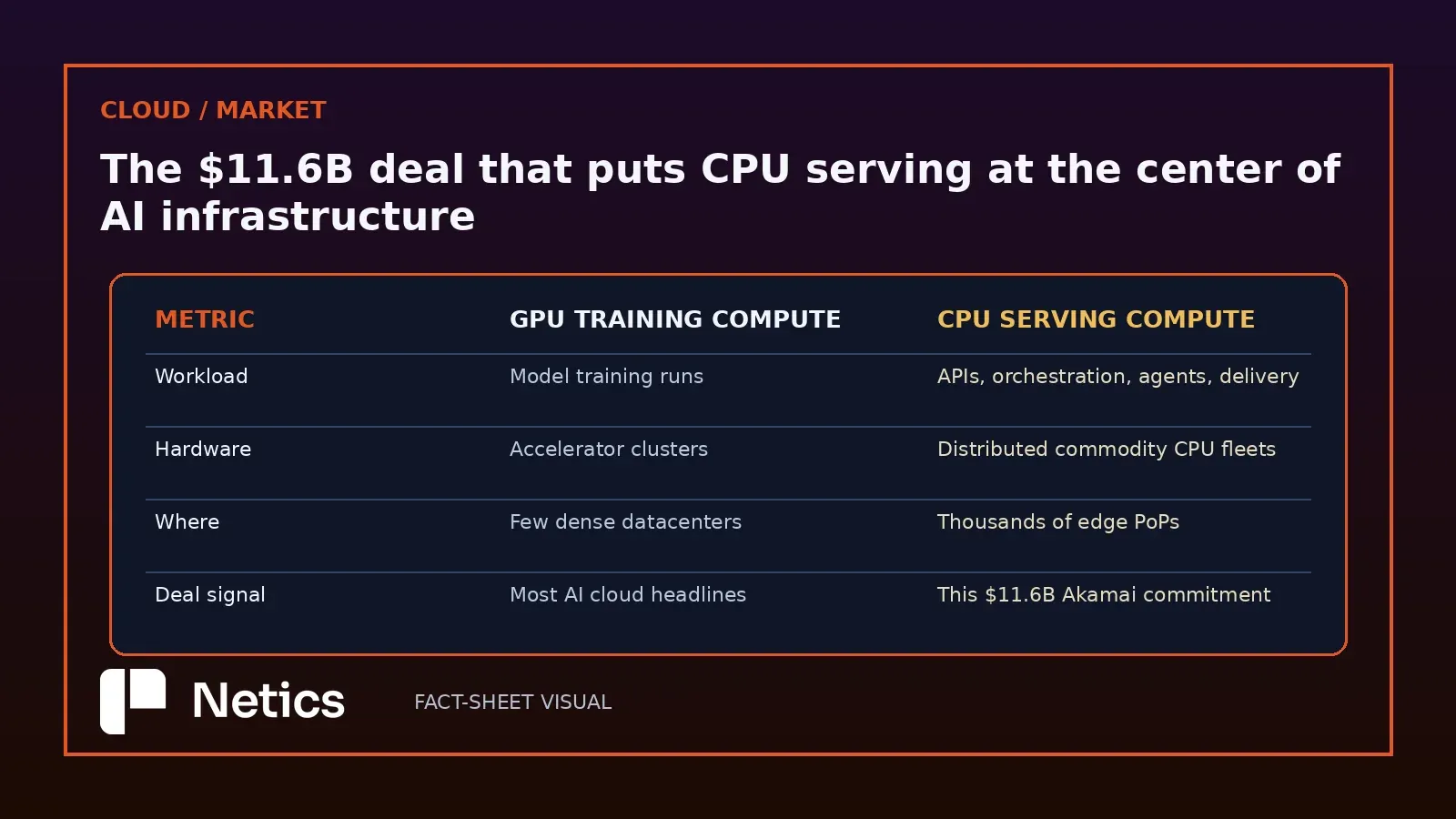
- The serving layer is becoming a market of its own. $11.6 billion committed seven years ahead, with revenue starting only in 2H 2027, is a forward buy of capacity that does not yet exist at scale. Akamai's ~$5.5 billion capex program — including the ~$1.7 billion 2026 increase to pre-purchase memory — is the counter-bet: build the distributed CPU fabric now, because the demand curve is visible.
- Memory, not just GPUs, is the constraint being hedged. Pre-purchasing supply-chain components, memory first, is the same play hyperscalers ran on GPUs in 2023-2024. A seven-year CPU commitment needs memory supply certainty; the pre-purchase is how Akamai buys that certainty today, before the market reprices it.
- Distributed beats dense for the agent era. Agents do not want to be in one region; they want to be near the systems they act on. Akamai's thousands of points of presence are a topology the hyperscaler-centric view of AI infrastructure has systematically underweighted.
The counterpart risk deserves equal airtime: CPU serving at this scale is heavily dependent on what the models themselves do. If agent orchestration consolidates into fewer, smarter hops, or if inference moves to radically more efficient hardware, a seven-year CPU commitment is a long position on today's architecture. The warrant's expansion terms are Akamai's hedge — equity vests when Anthropic spends more, not when it spends less. Both sides have priced the risk of the other side's promise failing.
What a European SME should take from this
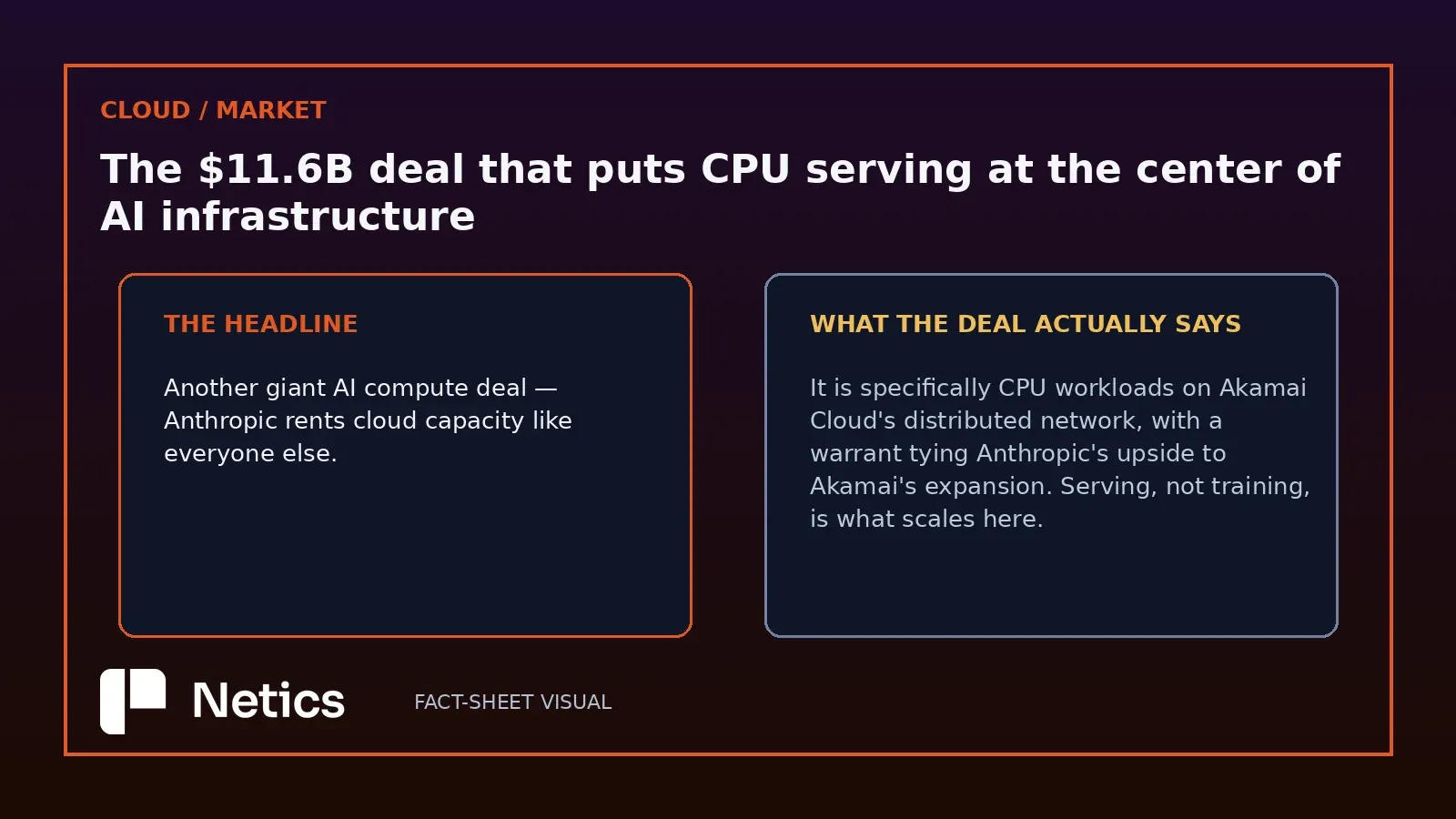
None of this is only about companies the size of Anthropic. The deal compresses, into one number, a lesson that applies to any organization buying or building AI infrastructure today: the compute that matters for users is the serving tier, and the serving tier is where cost and control are decided.
For a French or Moroccan SME running AI-assisted processes, the practical translation is boring and useful: the GPU question is a one-time procurement decision; the CPU question is a recurring architecture decision. Where does the agent run, how many hops to the data it needs, what does a request cost when you serve hundreds of them per user per day — these are the costs that recur, and the layer that decides them is the layer this deal priced at $11.6 billion. When the market's largest AI infrastructure commitments are about the ordinary compute around the model, your own architecture decisions should stop pretending the model is the whole infrastructure. If this is the layer where your own recurring costs live, it is exactly the kind of architecture conversation we take on in our free audit.
The regional-infrastructure angle we drew from Google's Finland investment applies here with a twist: where Google built sovereign compute in a new geography, Akamai is selling proximity to the user's existing geography. Distributed CPU capacity is the sovereignty-adjacent option — data stays close to where it is processed, without a new region build-out. For European buyers that is a procurement consideration as real as any hyperscaler region decision. The CPU turn is not a headline; it is the layer most conversations about AI infrastructure have been skipping.
Sources
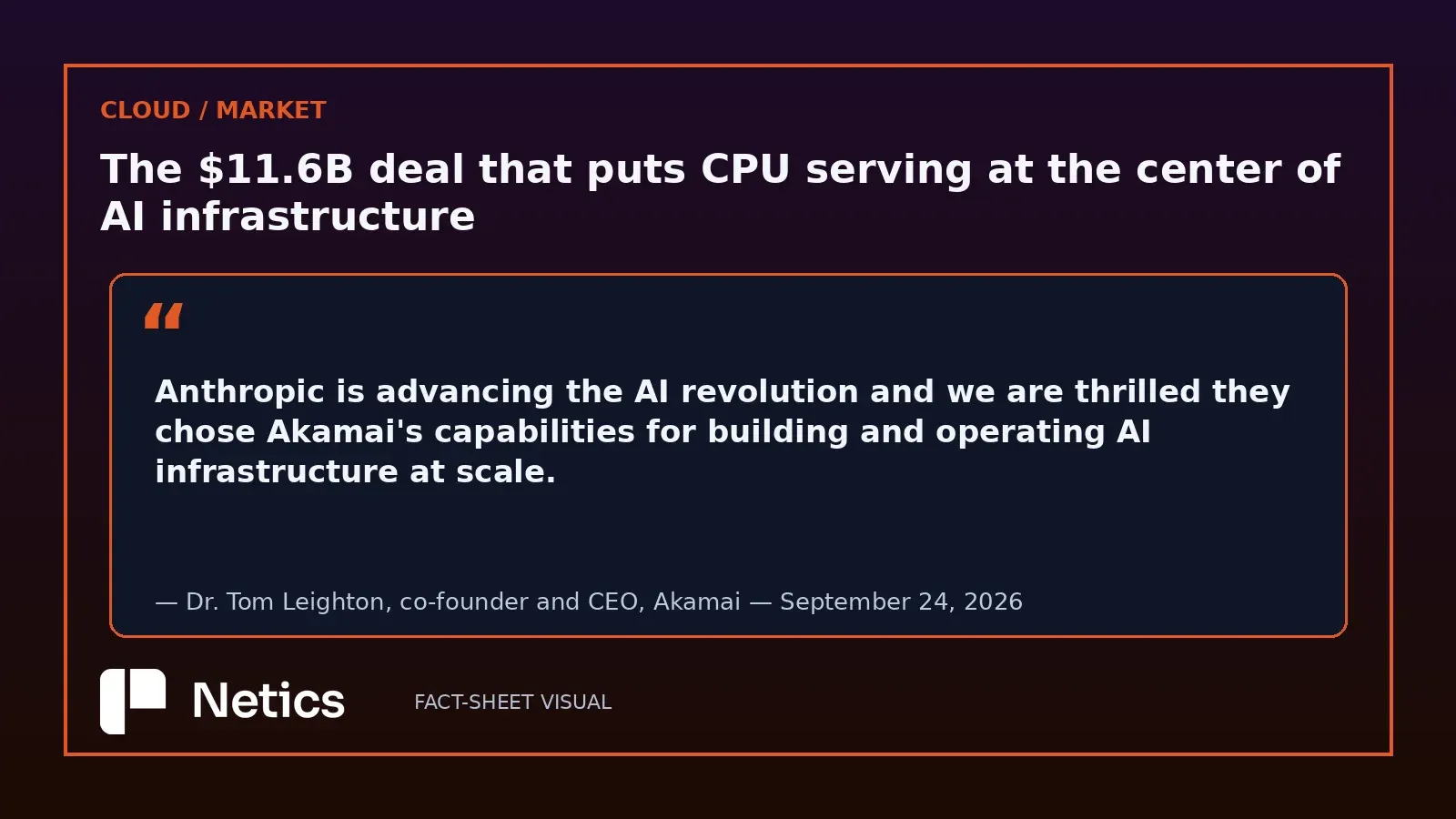
Source: Akamai Announces $11.6 Billion Multi-year Agreement with Anthropic to Support Growing Demand — akamai.com/newsroom press release, 2026-09-24 (captured 2026-10-01; all deal figures, warrant mechanics, capex numbers, and the Leighton quote verbatim from the release). Source: Akamai signs $11.6bn compute deal with Anthropic — datacenterdynamics.com, 2026-09-28. Source: Anthropic's $11.6B Akamai Deal Marks a CPU Turn in AI Compute — pulseofnations.lol, 2026-09-25 (company-guidance revenue timing: 2H 2027, ~$1.7B annualized run rate end-2028). Internal linkage: Meta's Muse personal agent, Google's Finland AI investment. More infrastructure analysis on neticslabs.com.
Source: Akamai press release, 2026-09-24. Images: official Akamai press-kit assets, captured 2026-10-01.