
Meta's Muse Tries to Make the Consumer Agent a Secure Computer
Meta's Muse personal agent ships with a dedicated Secure VM and a separate Sentinel approval agent. Netics explains what the architecture gets right and what it still leaves open.

TL;DR
- Meta's Muse personal agent runs on a dedicated Secure VM, with a separate Sentinel agent approving every internet-facing action and a full audit trail visible to the user.
- Credentials go into secure storage so Muse can use them without seeing them; a Confidential VM with user-held keys is planned for later this year.
- Netics' take: this is a real step toward treating consumer agents as systems with boundaries, but the trust model still depends on Meta's own enforcement until the user-held-key VM ships.
The consumer agent finally gets a boundary story
Meta introduced Muse on September 8: a personal AI agent that works across the apps people already use, sends emails, books travel, and pays through Link. The feature list is familiar. What is not familiar is the security framing: Muse runs on a dedicated virtual machine in the cloud — the Muse Secure VM — that contains both the agent and the person's data, with a separate Sentinel agent on the same machine that approves anything Muse does on the internet.
This matters because most consumer agents are still described as models with permissions attached. Muse is being described as a computer with a boundary. That is the correct framing, and for Netics it is the most interesting part of the announcement — not because it is perfect, but because it is the first mainstream attempt to give a consumer agent an operating envelope instead of a prompt-level promise.
What the Secure VM design actually gives
The three properties that matter are isolation, mediation, and non-repudiation. Isolation: Muse runs on its own dedicated computer in the cloud, contained so no other agent can reach it, and that is where the data and credentials for connected services are stored. Mediation: nothing Muse does reaches the internet unless the Sentinel approves it, and the Sentinel asks the person for permission when needed. Non-repudiation: Muse shows a complete audit trail of everything it has done and plans to do.
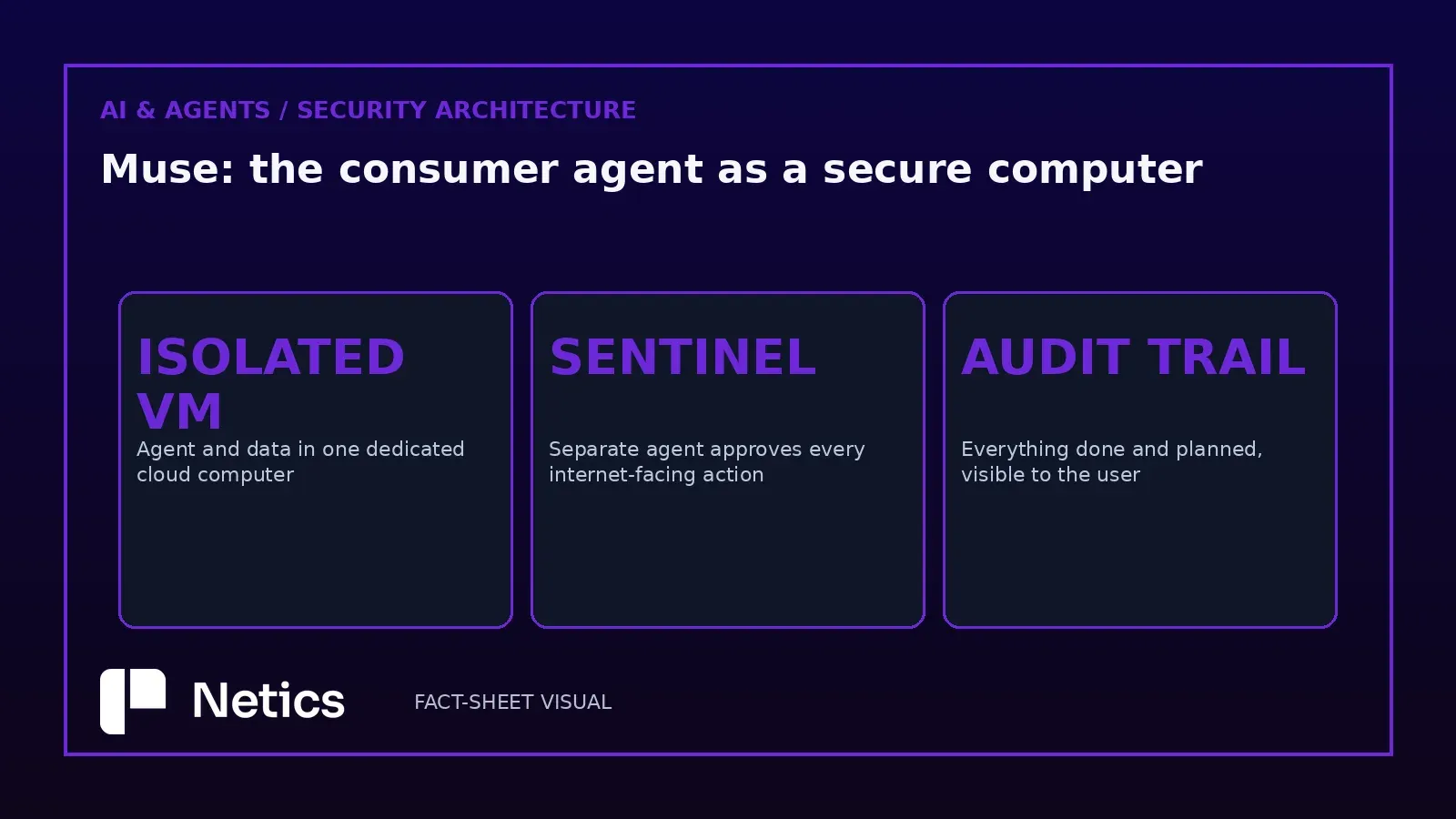
The credentials design is worth singling out. Muse has no visibility into people's passwords or payment methods; credentials a person shares go into secure storage so the agent can use them without seeing them — including passwords typed into the browser. That is a genuinely good pattern: the agent gets a usage capability, not the secret. In enterprise terms, it is the difference between granting a workload scoped credentials and handing it the master key. Laypeople get the benefit without needing to understand the architecture.
The user gets real controls, and that is the point
Muse's announcement gives the person the controls a security engineer would ask for. People choose which apps Muse connects to and how much access it gets — for email, they choose whether Muse reads mail or can also send on their behalf. They can change access or disconnect at any time, opt out of their interactions being used to train Meta's models, and tell Muse to forget specific things it has learned. The announcement states that Muse does not share a person's conversations or VM data with Meta's ads systems.
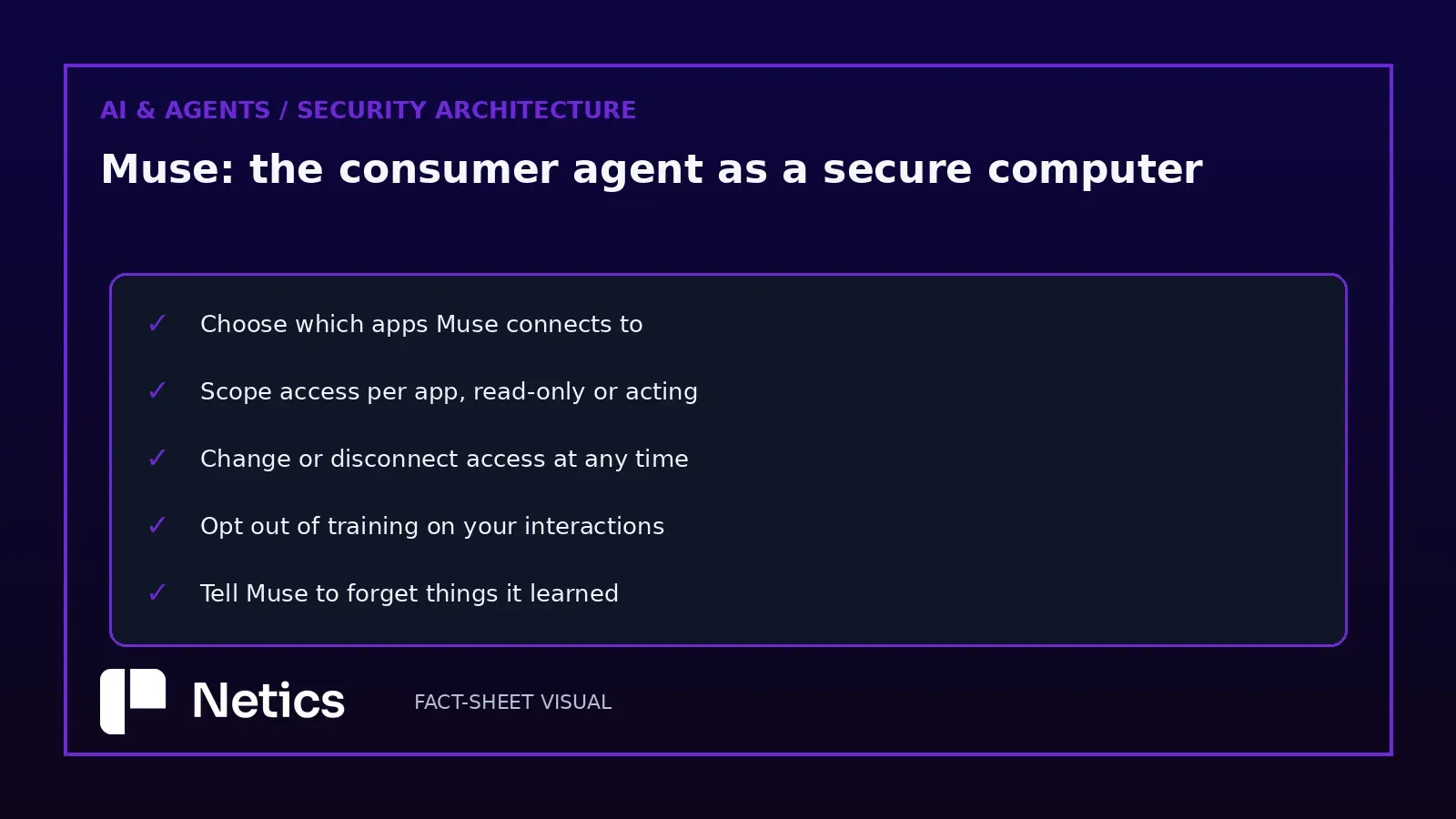
For a Netics reader, these are the same controls we would specify for a business agent: least privilege by default, scope choices per capability, revocation, and an audit record. The consumer version is simpler and less configurable, but the direction is right, and the pattern is transferable. Any team building a customer-facing agent should be able to show they have built these four things: isolation, mediation, revocation, and audit.
What the announcement still leaves open
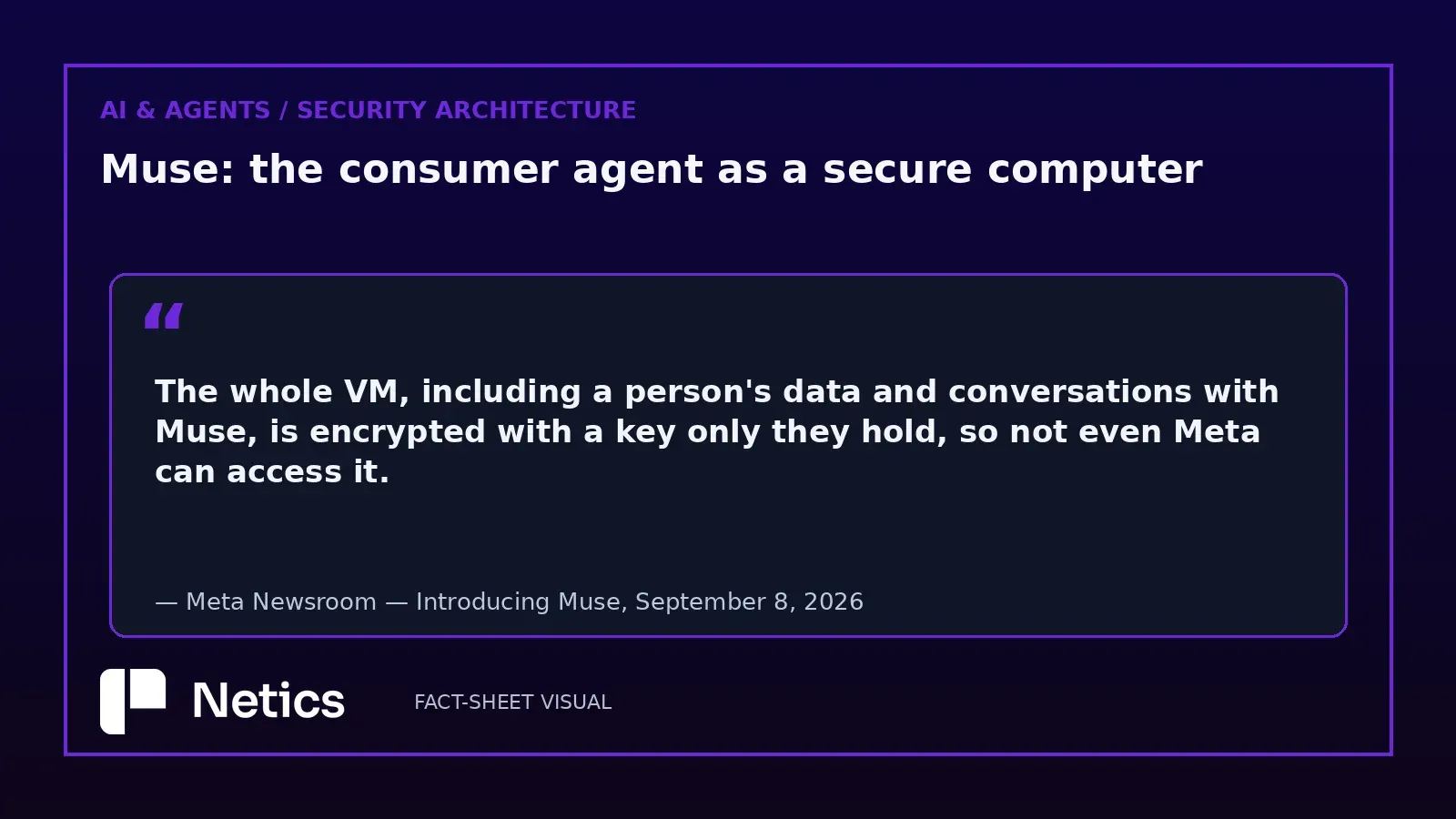
The honest reading requires naming the gaps. The strongest privacy claim — the Confidential VM where the whole machine, including data and conversations, is encrypted with a key only the person holds, so not even Meta can access it — is planned for later this year. Until it ships, the trust model runs on Meta's own enforcement of the Secure VM boundaries. That is a reasonable interim position, but it is not the same claim.
Second, the Sentinel is a safety agent, but its policy scope is not published in this announcement: what counts as sensitive, whether the person can override the Sentinel, and how third-party connections are audited remain open questions. Third, the announcement does not detail the model side — what Muse learns, where it is stored, and what happens on opt-out. These are exactly the details a stakeholder in the European market will ask about under GDPR and the EU AI Act, and they deserve a technical follow-up, not a press answer.
What Netics would copy, and what it would audit
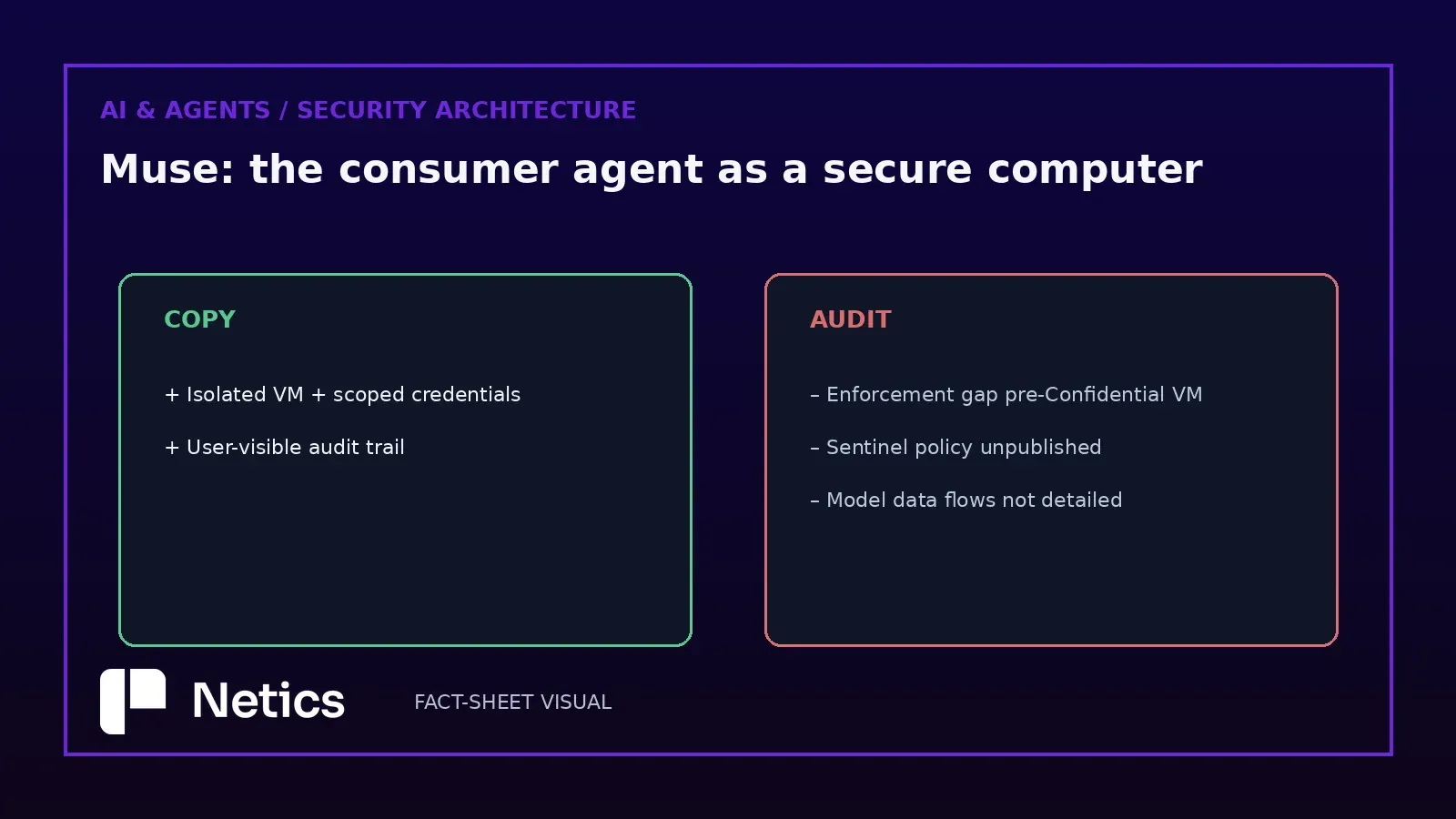
Copy: the isolation pattern. A consumer agent that runs in a contained VM with credentialed access to services, mediated egress, and a user-visible audit trail is a blueprint that applies directly to enterprise agents — the difference is scope, not architecture. Audit: the enforcement gap before Confidential VM, the Sentinel's policy details, and the model-side data flows. Those are the three areas where the announcement's claims are ahead of its evidence.
For a practical conversation about agent security architecture — consumer or enterprise — book a free 30-minute audit with Netics or start from the Netics homepage.
Sources
- Introducing Muse: The World's First Personal AI Agent Built for Everyone — Meta Newsroom, September 8, 2026. Primary source for Muse Secure VM, the Sentinel agent, credentials handling, user controls, and the Confidential VM plan.
Source: "Introducing Muse: The World’s First Personal AI Agent Built for Everyone" — about.fb.com, September 8, 2026.