
Ruby2Shell Lands in the Interpreter, Which Makes the Patch an Inventory Problem
"Ruby 3.3.14, 3.4.13 and 4.0.10 shipped on 18 November 2026 with fixes for seven flaws, including the CVE-2026-132825 one-byte heap overflow. The fix sits in the interpreter, so every image,

TL;DR
- Ruby is a programming language that runs web frameworks such as Rails and a large amount of self-hosted software, and its interpreter handles the string operations those applications perform on user input.
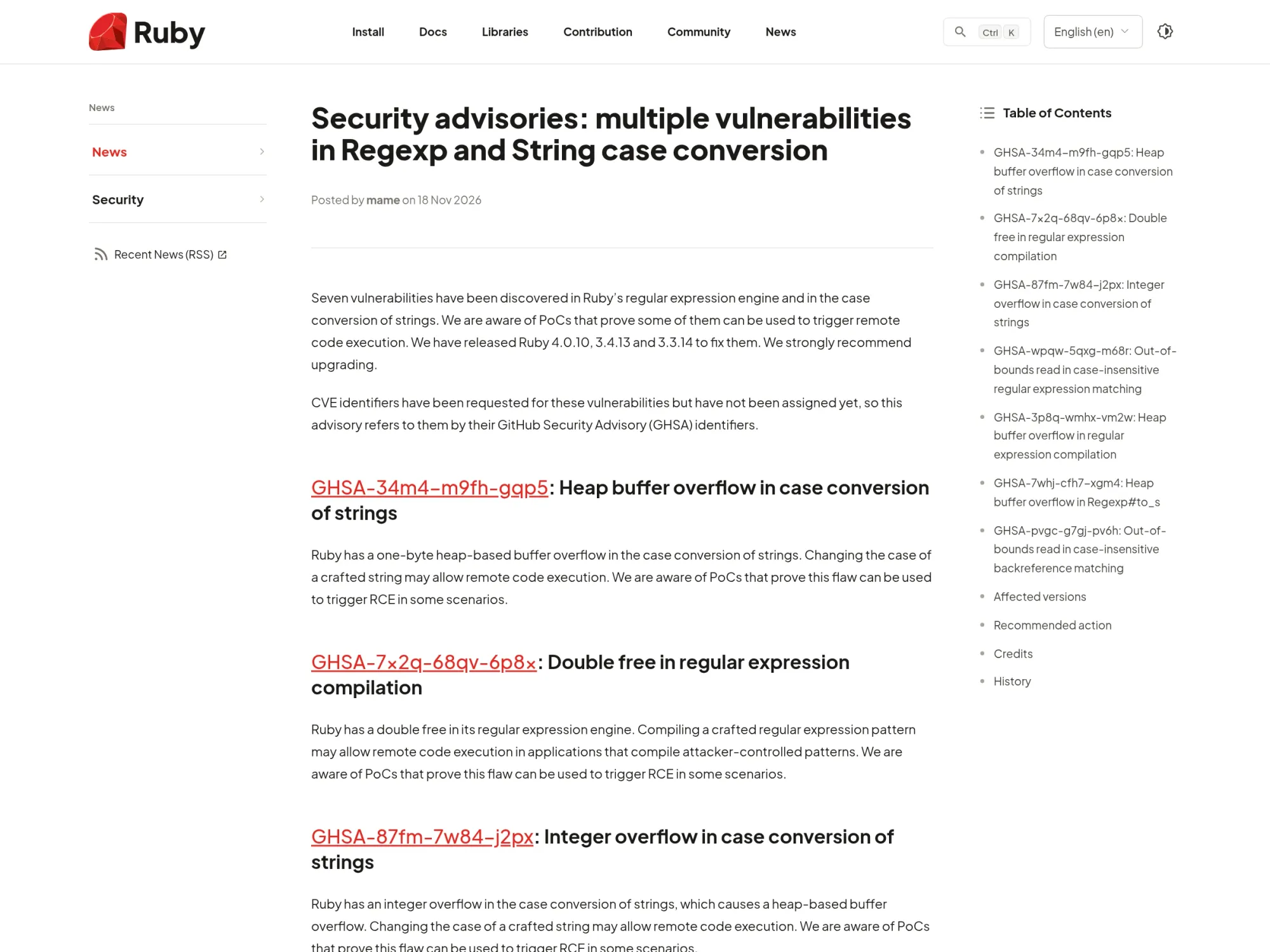
- On 18 November 2026 the Ruby team published an advisory for seven vulnerabilities in the regular expression engine and in string case conversion, and released 4.0.10, 3.4.13 and 3.3.14 to fix all of them.
- GHSA-34m4-m9fh-gqp5, named ruby2ßhell by Veria Labs, is a one-byte heap overflow: legacy single-byte encodings turn the sharp s into two letters when upcased, and the loop checked for one byte of room. Ruby said CVE identifiers were pending on 18 November, and Censys reported MITRE's assignment of CVE-2026-132825 on 19 November.
- The UTF-8 path stays clear of that encoding code, and Veria Labs reports pre-authentication reach in default Rails and classic-style Sinatra because those frameworks change the case of request text in legacy encodings.
- The fix sits in the interpreter, so gems, frameworks and a
bundle updateachieve nothing, and every product that ships its own Ruby needs a vendor release or a rebuilt image. - Censys read roughly 4,500 WEBrick hosts on 19 November 2026, found 285 on a branch the Ruby team still patches and about 2,000 on an end-of-life branch, and found none on a fixed release.
- The flaw has two published severity readings: the Ruby team rates it critical and knows of PoCs; MITRE scored it 7.4, and Ox Security says exploitation requires heap grooming tailored to each target.
- The week's work starts with an inventory, and Veria Labs said it planned to publish its proof of concept about a week after disclosure.
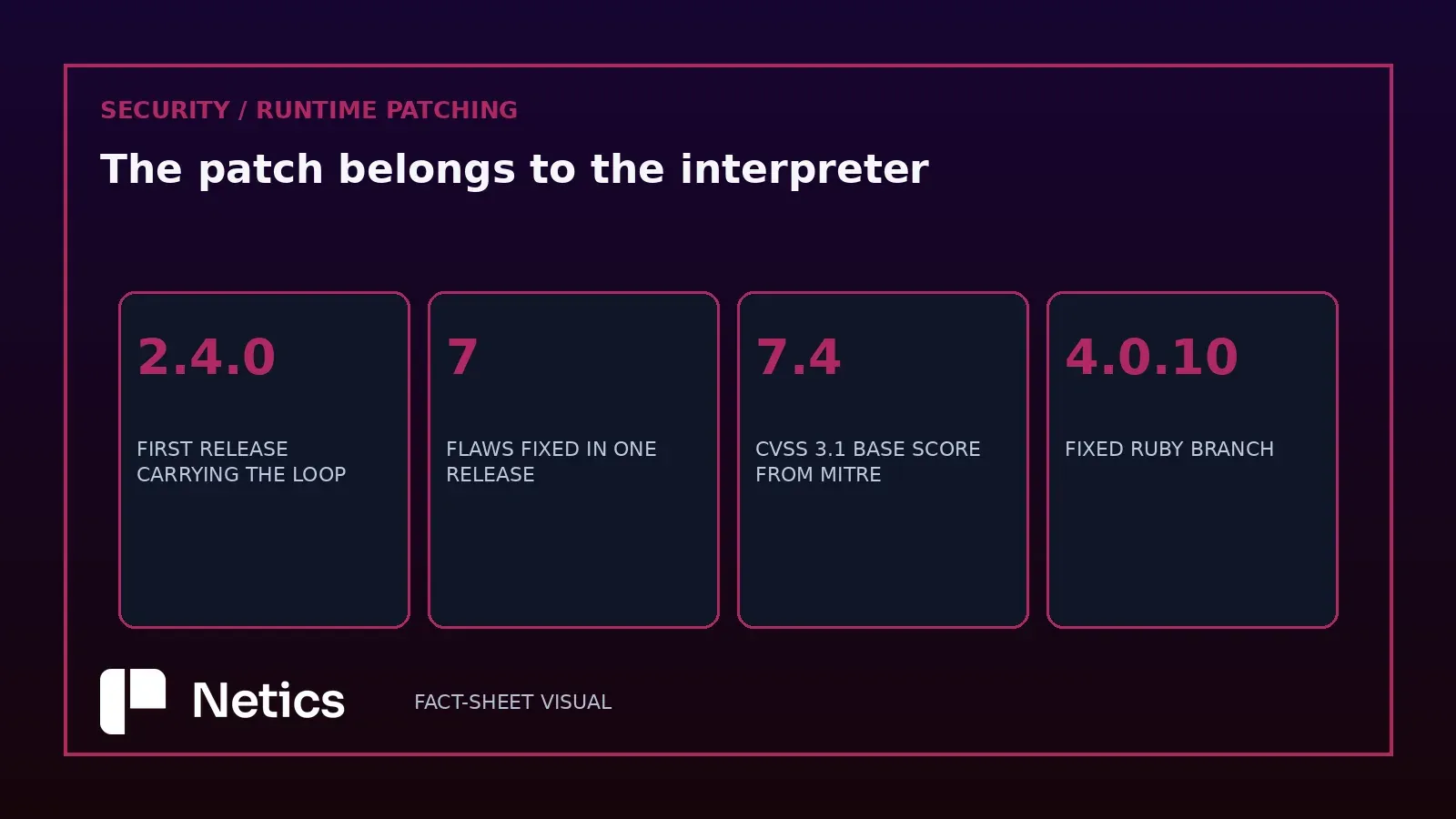
Ruby published 4.0.10, 3.4.13 and 3.3.14 on 18 November 2026 with fixes for seven vulnerabilities in the regular expression engine and in the case conversion of strings. Ruby's advisory identified the flaw worth planning around as GHSA-34m4-m9fh-gqp5 because CVE identifiers were still pending on 18 November; Censys reported MITRE's assignment of CVE-2026-132825 on 19 November. It is a one-byte heap overflow that the project rates critical and MITRE scores 7.4; Ox Security questions its practical exploitability.
One byte, and always the same byte
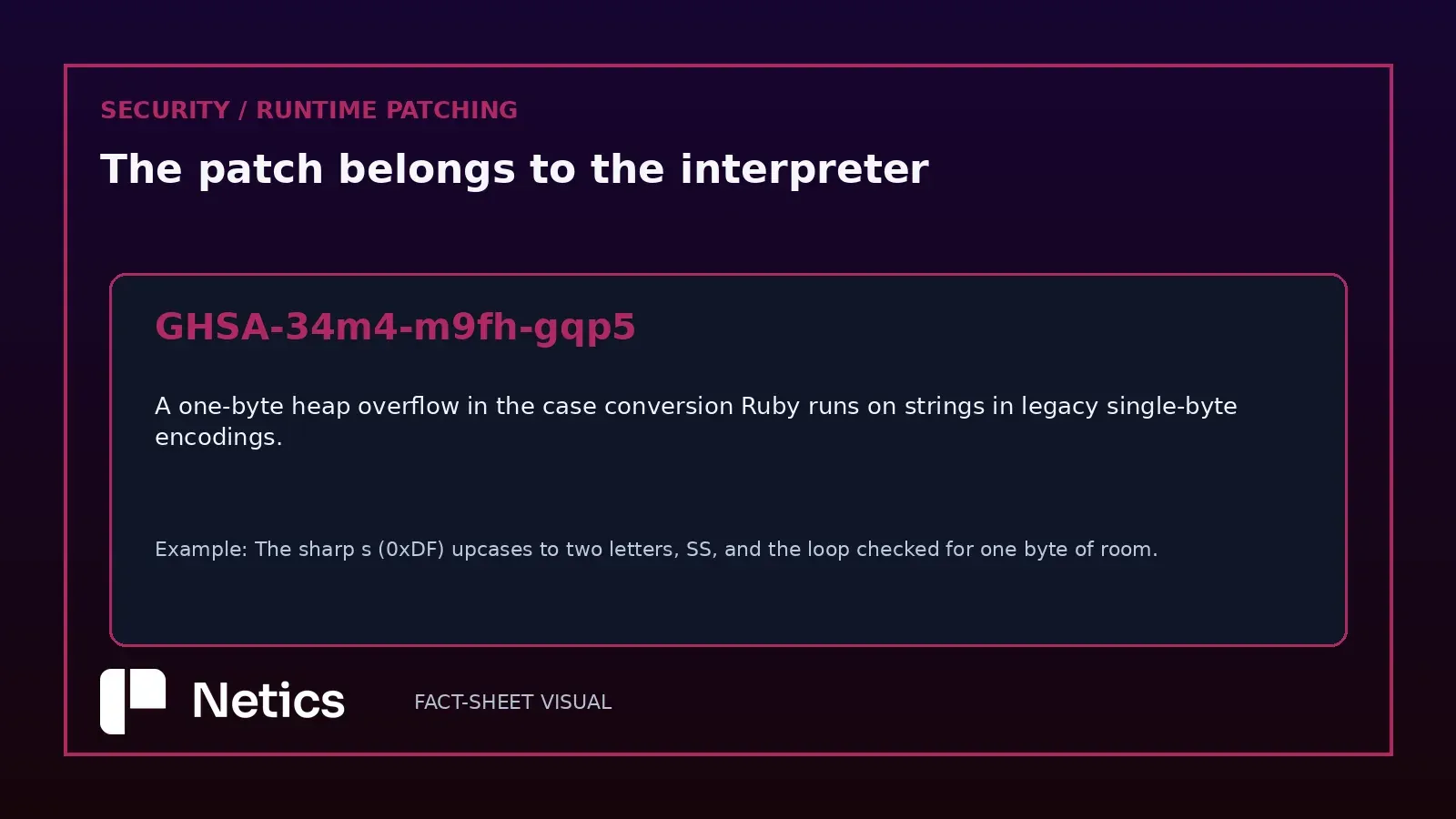
The overflow lives in the loop that changes the case of a string. In fourteen legacy single-byte encodings, among them ISO-8859-1 and Windows-1252, the sharp s shares a code point that upcases into two letters: ß becomes SS. The loop checked that one byte of room remained in the output buffer before each write, then wrote two bytes whenever it met that character. The buffer is sized at the input length plus 20 bytes, so a run of sharp s characters reaches the end and the second letter of the last one lands past the buffer.
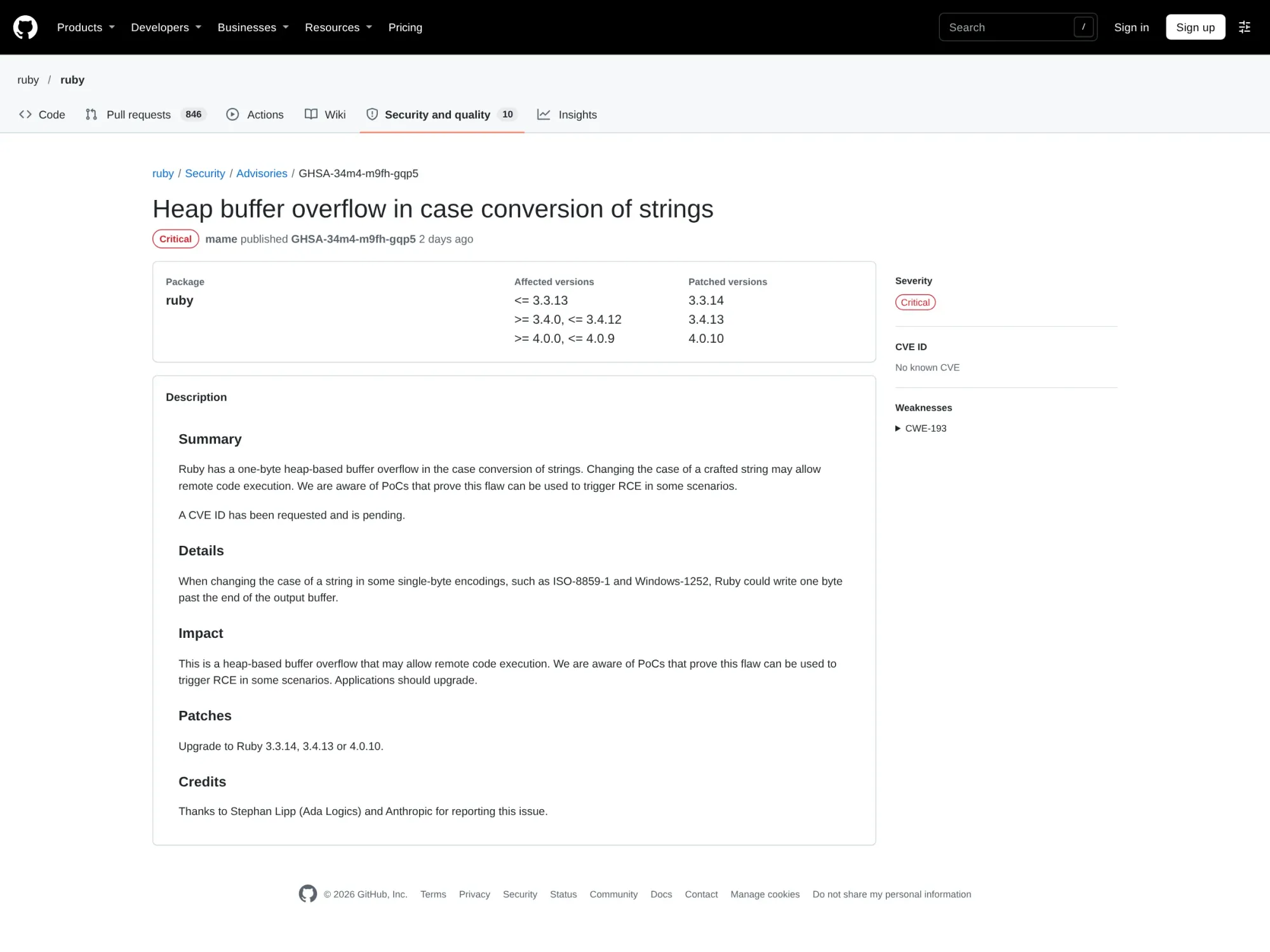
Equixly's analysis of 19 November 2026 records what that byte can be: S when upcasing, s when folding, which gives an attacker control over where it lands and no control over what it is. The reachable methods are upcase, swapcase, downcase(:fold) and casecmp?, and the loop has been present since Ruby 2.4.0.
Legacy encodings carry the reachable path
A Ruby application that works on UTF-8 strings never enters the affected routine, because UTF-8 takes a different code path. The exposure belongs to applications that tag incoming text with a legacy encoding and then change its case, which is what Veria Labs reports for Rails and classic-style Sinatra in their default configuration. Veria Labs limits its default-exposure finding to Rails and classic-style Sinatra.
That condition is the one worth measuring on a real fleet, because it separates a Ruby service that happens to run an affected version from one that can reach the overflow with request data.
The interpreter holds the fix, gems hold nothing
The patch belongs to the interpreter, which changes who can deliver it. Updating Rails, running bundle update, or bumping an application's gemfile leaves the vulnerable loop in place, because the loop lives in the binary that runs the application. Equixly states the consequence for containers directly: rebuild the image on a fixed base and restart the processes, since a running worker keeps the old interpreter until it restarts.
Ruby 3.2 and older sit outside the fix entirely. Those branches are end of life, they will not receive a patch, and the same planning question governs them as any other expired runtime, which is the point the PostgreSQL 14 end-of-life post makes for a database branch.
Who ships Ruby inside the product
The reach of this flaw comes from software that carries its own Ruby. GitLab, GitHub Enterprise Server, Mastodon, Discourse and OpenProject all bundle an interpreter, and each one needs a vendor release built on a fixed Ruby.
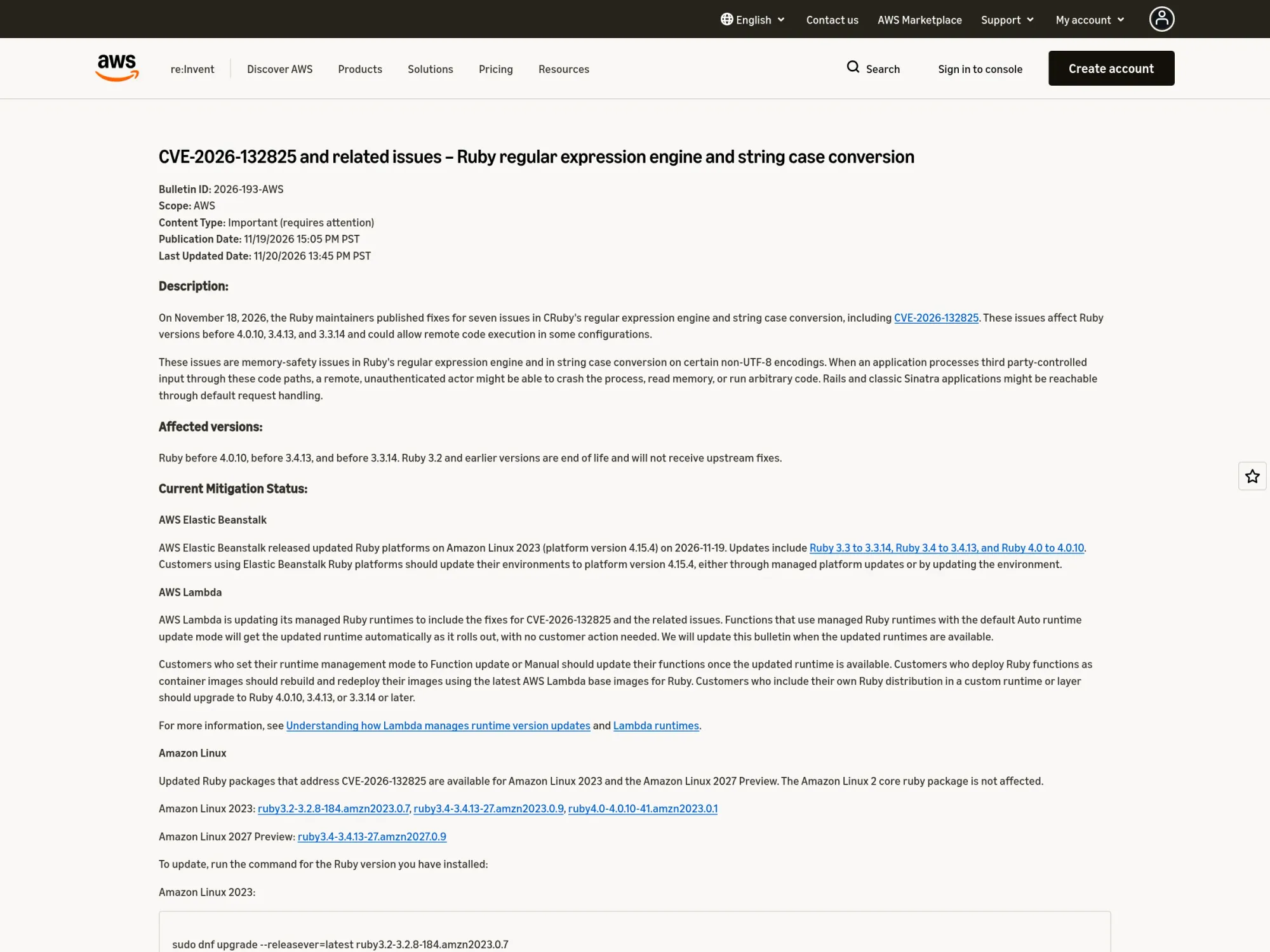
Managed platforms move on their own schedule, and the AWS bulletin for these flaws shows what that schedule looks like. Elastic Beanstalk published platform version 4.15.4 on Amazon Linux 2023 on 19 November 2026 with Ruby 3.3.14, 3.4.13 and 4.0.10, and Amazon Linux packages covering ruby3.2, ruby3.4 and ruby4.0 were targeted for 20 November 2026. The bulletin keeps the core Ruby 2.0.0 package on Amazon Linux 2 out of scope.
Two readings of one severity
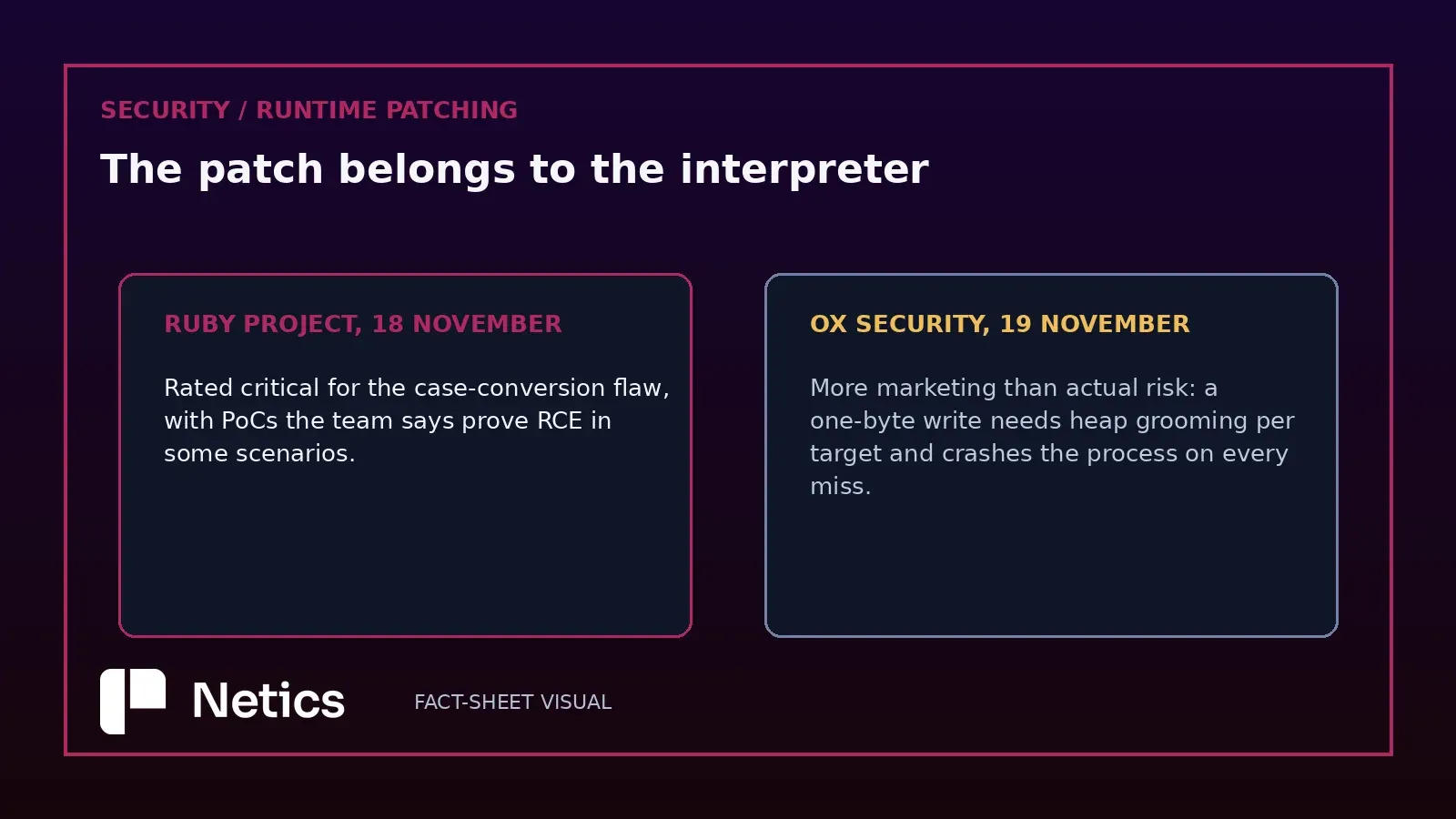
The Ruby advisory rates the case-conversion flaw critical and states the team is aware of PoCs that prove it can trigger remote code execution in some scenarios, and it assigns no score of its own. Censys reports that MITRE's CVE record gives the flaw a CVSS 3.1 score of 7.4.
Ox Security takes the argument further and calls the finding more marketing than actual risk: a one-byte write needs heap grooming tailored to each target, and a miss crashes the process. The Ruby team says it is aware of PoCs that trigger remote code execution in some scenarios, and Veria Labs plans to publish its proof of concept about a week after disclosure.
The inventory that decides the week
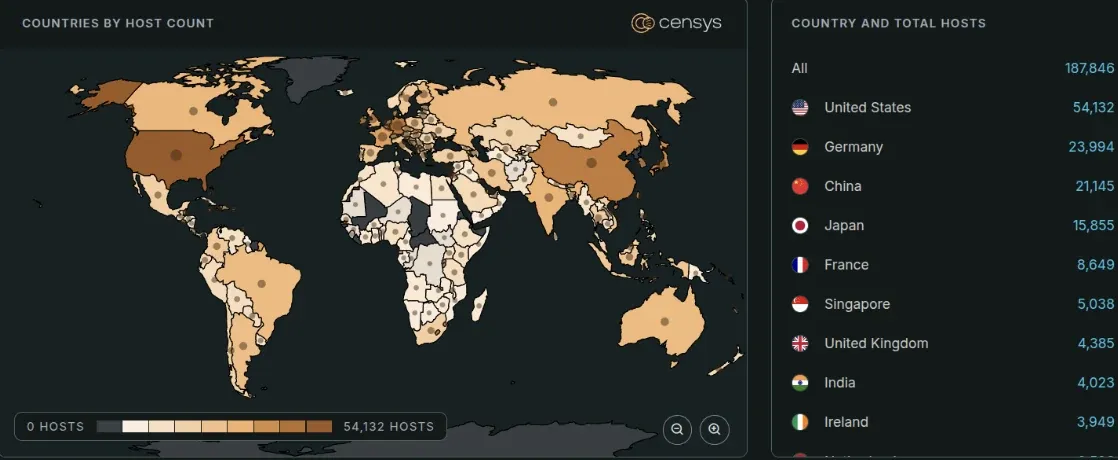
Censys offers the closest thing to a measured exposure figure. Its advisory of 19 November 2026 reads the Ruby version from WEBrick servers and finds that of roughly 4,500 such hosts, 285 report a branch the Ruby team still patches and all of those are affected. About 2,000 report an end-of-life Ruby from 2.4 through 3.2. None of the WEBrick servers it has scanned reported a fixed release at that point.
That distribution shapes the work. The end-of-life population is the larger one and the harder one, because it needs a branch change, and a package bump leaves it in place. A fleet that runs several interpreters needs a list before it needs a patch window. The infrastructure monitoring with plain-language alerts that reports a version per host is the artifact this work starts from, and Censys' own reading of WEBrick hosts demonstrates the value of a version inventory: the interpreter inside a container answers to the image, and the image answers to whoever rebuilt it last.
The order that fits the evidence: enumerate every interpreter, including the ones inside products and images; move to 3.3.14, 3.4.13 or 4.0.10; rebuild images on the fixed base and restart the processes; then decide on the end-of-life hosts. Censys adds the step that follows exposure: treat an instance that was reachable while unpatched as exposed, review it for signs of use, and rotate the secrets it holds if anything shows up.
What the proof-of-concept window changes
No in-the-wild exploitation had been reported as of 19 November 2026, and Veria Labs said it planned to publish its proof of concept about a week after disclosure. That window is the useful part of the timeline for an estate that already knows its interpreters, and it is a short one for an estate that does not.
The seven flaws ship in one release, which helps: a single interpreter upgrade covers the whole list, and the interpreter remains the only place where any of them can be closed.
Sources
- Security advisories: multiple vulnerabilities in Regexp and String case conversion — ruby-lang.org, 18 November 2026
- Ruby2Shell: Pre-auth heap overflow in Ruby 3.3, 3.4, and 4.0 — Equixly, 19 November 2026
- Nov 19 Advisory: Ruby Heap Buffer Overflow in String Case Conversion (CVE-2026-132825) — Censys
- ruby2ßhell (CVE-2026-132825): key facts — Orca Security, 19 November 2026
- CVE-2026-132825 and related issues — AWS Security Bulletin 2026-193
- Ruby2Shell (CVE-2026-132825): Real RCE Risk or Just Hype? — Ox Security, 19 November 2026
- GHSA-34m4-m9fh-gqp5 — GitHub Advisory Database
Source: "Security advisories: multiple vulnerabilities in Regexp and String case conversion" — ruby-lang.org, 2026-11-18, https://www.ruby-lang.org/en/news/2026/11/18/multiple-vulnerabilities-in-regexp-and-string/, with Equixly's technical analysis at https://equixly.com/blog/2026/11/19/ruby2shell-pre-auth-heap-overflow-in-ruby/, Censys' advisory at https://censys.com/advisory/cve-2026-132825, Orca Security's summary, Ox Security's risk reading and the AWS bulletin 2026-193 at https://aws.amazon.com/security/security-bulletins/rss/2026-193-aws; all fetched and saved on 2026-11-20 under sources/2026-11-20/ruby2shell-cve-2026-132825/.