
Arm's AGI CPU and CSS N4 Put the CPU Back in the Agentic AI Architecture
Arm's AGI CPU and Neoverse CSS N4 target agentic workloads where data movement, concurrency and responsive CPU execution matter as much as accelerator throughput.

TL;DR
Arm is presenting two routes into the same agentic-AI infrastructure direction: a production-ready Arm AGI CPU for customers that want deployable compute, and Neoverse CSS N4 for partners that need configurable silicon. Arm reports up to 128 cores per die, LPDDR6, PCIe Gen 7, up to 2x performance, up to 1.25x performance per watt and up to 1.75x memory bandwidth versus CSS N3. The important Netics reading is not that every server now needs a custom CPU. It is that agents turn CPU work, memory movement and concurrent orchestration into visible parts of the design instead of background plumbing.
Arm's announcement is a same-day vendor claim, not an independent benchmark. The figures are useful boundaries for an architecture conversation; they are not a promise about a particular rack, workload or total cost of ownership. Teams should ask where the bottleneck sits before treating a faster CPU as a complete answer.
The announcement is really about two adoption paths
Arm's release combines a product for deployment with a subsystem for customization. Arm AGI CPU is described as production-ready silicon aimed at highly responsive agentic AI. CSS N4 is the configurable route: a common compute foundation that partners can adapt around their own system requirements, including bespoke compute platforms, DPUs, networking and other specialized designs.
The distinction matters. “Agentic AI” is not one workload with one ideal processor. A scale-out data plane can prioritize throughput efficiency. An agent execution environment may care more about response time while it retrieves data, calls a tool, checks a policy and starts another operation. The two paths let Arm sell a common Neoverse platform without insisting that every customer make the same silicon decision.
The release also names a broad ecosystem around AGI CPU, including OpenAI, Meta, Cloudflare, Oracle, SAP, Lenovo, Supermicro and Verda. It cites Google Cloud's Axion-based GKE agent sandboxes, Microsoft's Cobalt 200 work on sandbox tool execution, NVIDIA Vera's agentic positioning and Volcano Engine's plan to bring Arm AGI CPU-powered agentic sandboxes to market. Those names establish momentum in Arm's own account of the ecosystem. They do not, by themselves, establish equivalent performance or production maturity across those deployments.
Why CPU responsiveness becomes part of the agent loop
A conventional accelerator-centric mental model can treat the CPU as the coordinator around the “real” compute. An agentic loop makes that separation less comfortable. An agent reasons, retrieves information, calls tools, interacts with databases and communicates with other agents. Each step can involve control-plane decisions, serialization, authentication, queueing, memory access and hand-offs between components. The accelerator may still perform the expensive model operation, but the system's perceived responsiveness is shaped by everything around it.
Arm has not proved that CPU performance is now the dominant cost or bottleneck. The source does not provide a workload trace, a measured agent latency distribution or an independent comparison of a complete deployment. The narrower conclusion is stronger: when an infrastructure design contains more data movement and more concurrent work, CPU, memory and I/O choices deserve explicit capacity planning.
Take a hypothetical Casablanca logistics platform that runs route exceptions through an agent. A request might retrieve a shipment record, call an optimization service, check a business rule and write an approved change. The model call is only one stage. If the surrounding system waits on memory, queueing or database coordination, buying more accelerator throughput does not automatically improve the user-visible path. The example is illustrative; it is not a report of Netics client work.
CSS N4's figures are a design signal, not a deployment result
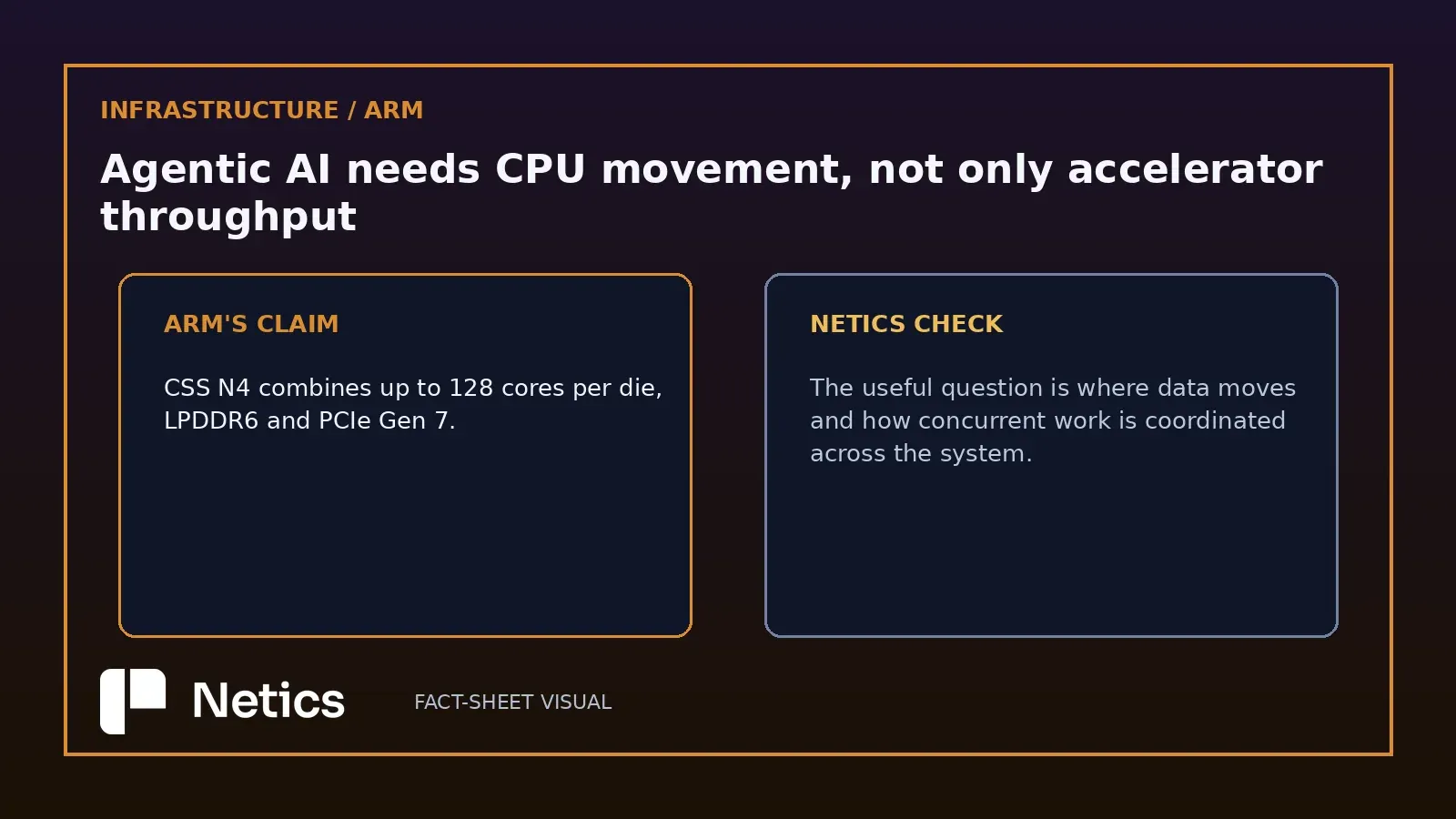
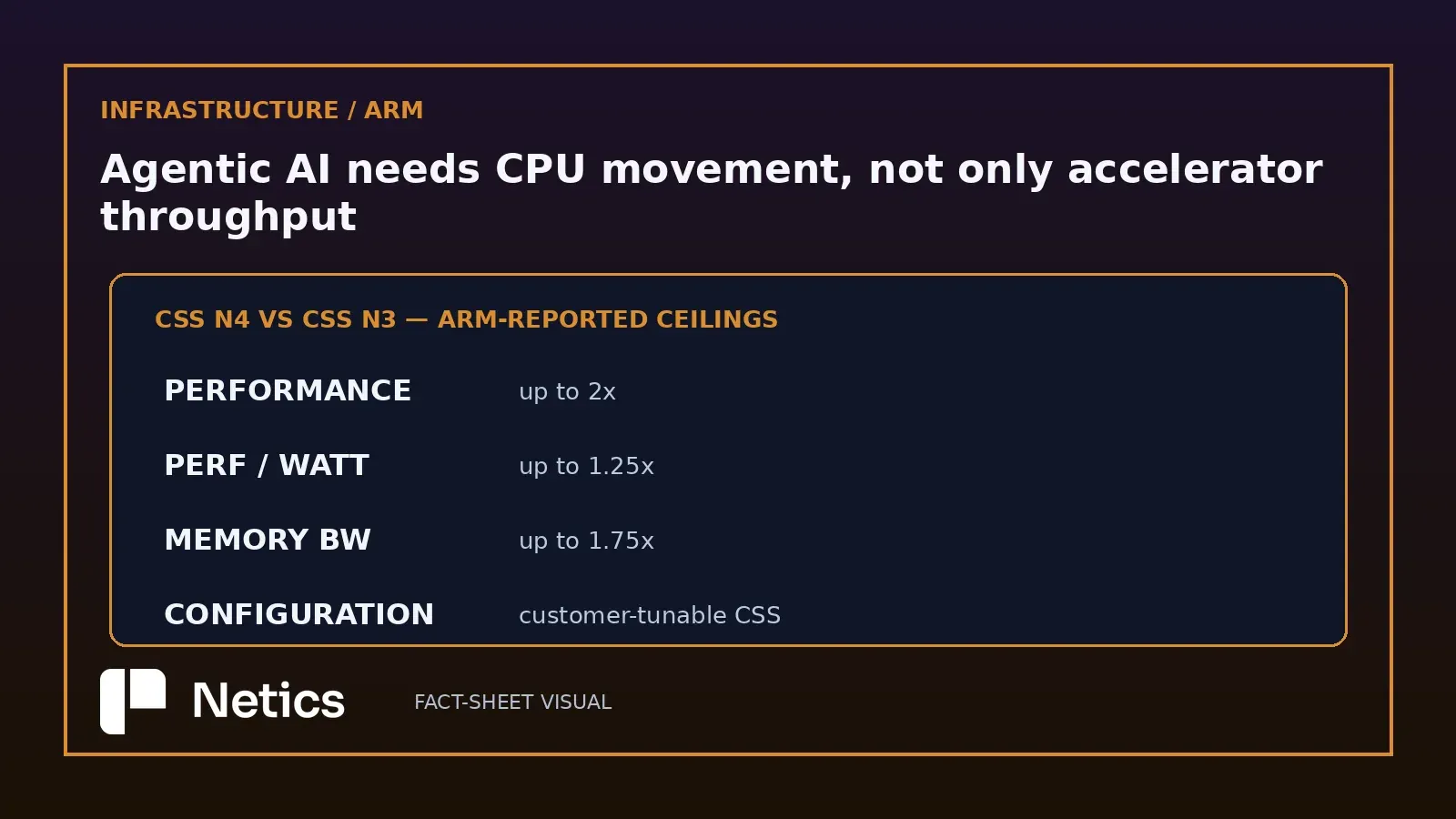
Arm reports CSS N4 at up to 2x the performance, up to 1.25x the performance per watt and up to 1.75x the memory bandwidth of CSS N3. It also highlights up to 128 cores per die, LPDDR6 and PCIe Gen 7. Those are meaningful changes in the menu available to infrastructure designers. They suggest a subsystem intended to keep more compute, memory and I/O in conversation as systems become heterogeneous.
The qualifiers matter. “Up to” describes a ceiling under Arm's stated comparison conditions, not a universal outcome. Performance per watt is not the same as cost per useful agent action. Memory bandwidth is not automatically useful if the software cannot maintain enough parallel work or if another component limits the path. PCIe Gen 7 connectivity can expand the I/O envelope, but it does not remove topology, firmware, driver or scheduling constraints.
The practical response is to turn the announcement into a measurement plan. Map the agent path from request admission to tool result. Measure CPU time, memory stalls, queue wait, accelerator utilization, serialization and database latency separately. Then compare a candidate platform against the bottleneck that your trace actually reveals. A headline number is a reason to test, not a substitute for testing.
Configurability changes the engineering conversation
CSS is valuable here less because “custom silicon” sounds strategic and more because integration work is expensive. Arm says CSS N4 is its most configurable CSS yet and offers a faster path from CSS to silicon. A proven compute subsystem can reduce the amount of CPU integration a partner must recreate while leaving room to adapt the design to a DPU, a networking product or a specialized platform.
The trade-off is that configurability moves decisions earlier. A partner must define the workload boundary, memory behavior, I/O topology, software target and validation plan before hardware is fixed. The Arm Total Design ecosystem is presented as a way to accelerate IP validation and software development, but ecosystem participation does not eliminate the need for a workload-specific acceptance test.
For infrastructure buyers, the question is therefore not “Should we build an Arm CPU?” Most will not. The better question is whether the platform they buy exposes the controls and telemetry needed to separate CPU pressure from accelerator pressure. Production-ready silicon can shorten adoption only if the surrounding runtime, sandboxing, observability and capacity policies are ready as well.
What operators should do before choosing a path
Start with the agent's concurrency model. Count simultaneous tool calls, database sessions, sandbox launches and accelerator hand-offs under realistic load. Next, identify which memory and I/O paths carry the hot data. Finally, define the failure behavior: what happens when a tool is slow, an accelerator is full or an agent retries an operation?
The discipline applies whether the answer is Arm AGI CPU, a CSS-based custom design or another architecture. Netics has made the same case in its coverage of agent permissions before platform selection: architecture should follow the actual boundary you need to control. Here, the relevant boundary is not only model inference. It is the path through which an agent moves data, invokes compute and changes state.
Arm's announcement deserves attention because it treats that path as a CPU and platform problem, not only as an accelerator problem. It does not settle the procurement decision. It gives architects a more specific set of questions to take to their traces, power budgets and software teams.
For infrastructure architecture discussions and practical AI-system reviews, see the Netics homepage.
Sources
- Arm expands AI infrastructure for the agentic era with AGI CPU and Neoverse CSS N4 — Arm Newsroom, September 8, 2026.
- Arm Neoverse Compute Subsystems N4 — Arm.