
Google’s Finland AI Investment Is a Regional Infrastructure Strategy
Google’s €13 billion Finland plan links data centers, power, heat reuse, skills, and local suppliers. Its real test is regional coordination.

TL;DR
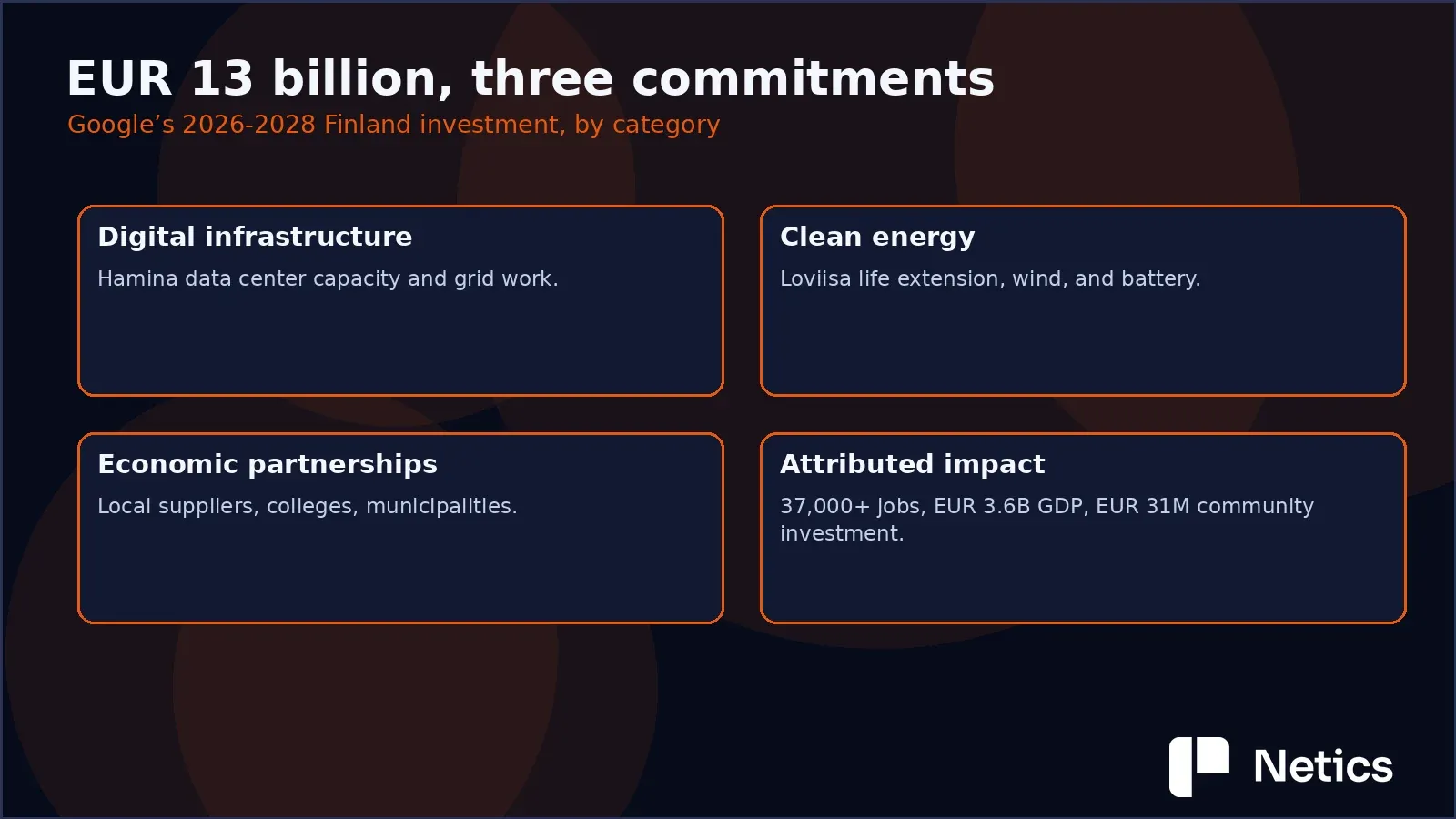
Google says it will invest €13 billion in Finland over the next two years across digital infrastructure, clean energy projects, and economic partnerships. The announcement is larger than a data-center expansion: it connects Hamina capacity with power procurement, a 94-megawatt battery, heat recovery, local suppliers, colleges, and municipal communities.
Google attributes more than 37,000 supported jobs and €3.6 billion in annual GDP contribution to the initial 2027–2028 construction phase. It also attributes €31 million in community investment over four years, including upskilling for more than 4,400 workers and training opportunities for 100 students. The strategic question for Europe is not simply who owns the compute. It is whether energy, skills, heat, procurement, and local accountability are planned as one regional system.
The announcement is about a Finnish operating footprint, not one new building
Google’s announcement starts with a 15-year history in Hamina, where it converted a former paper mill into a data center. The new commitment covers digital infrastructure, clean-energy projects, and economic partnerships across Finland. Google says the spending will help meet demand for services including Search, Maps, and Gemini.
That framing matters. AI infrastructure is often described as a race for larger facilities, faster accelerators, and more transmission capacity. Google is presenting something broader: a portfolio that joins the physical site to the conditions that let it operate. Hamina is the established anchor, while Kajaani, Muhos, and Vaala appear in the community-investment geography. The investment therefore has a regional shape even though the headline is attached to Google’s infrastructure.
The distinction matters for European policymakers and operators. A data center can be a private asset, but its enabling systems are public-facing: grid connections, roads, construction labor, technical education, cooling resources, and municipal services. The announcement does not provide a full project-by-project capacity map, so it would be wrong to treat €13 billion as a disclosed list of individual facilities. It does show how a hyperscaler is packaging infrastructure, energy, and local economic commitments together.
For a related Netics perspective on why infrastructure decisions need durable evidence and ownership, see our published analysis of Linux code provenance and governance. The subject is different, but the operating lesson is similar: a visible system depends on the history and controls around it.
Energy planning is part of the compute design
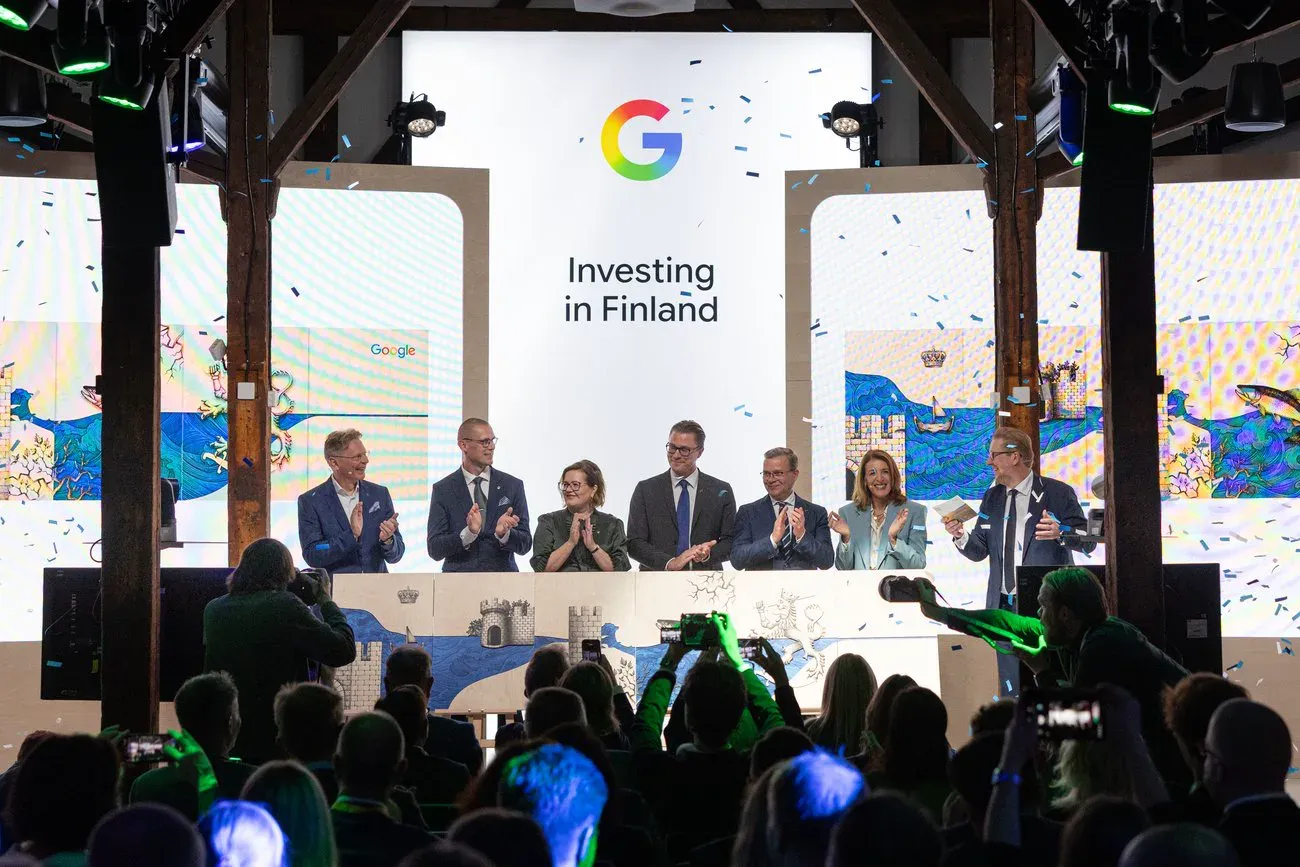
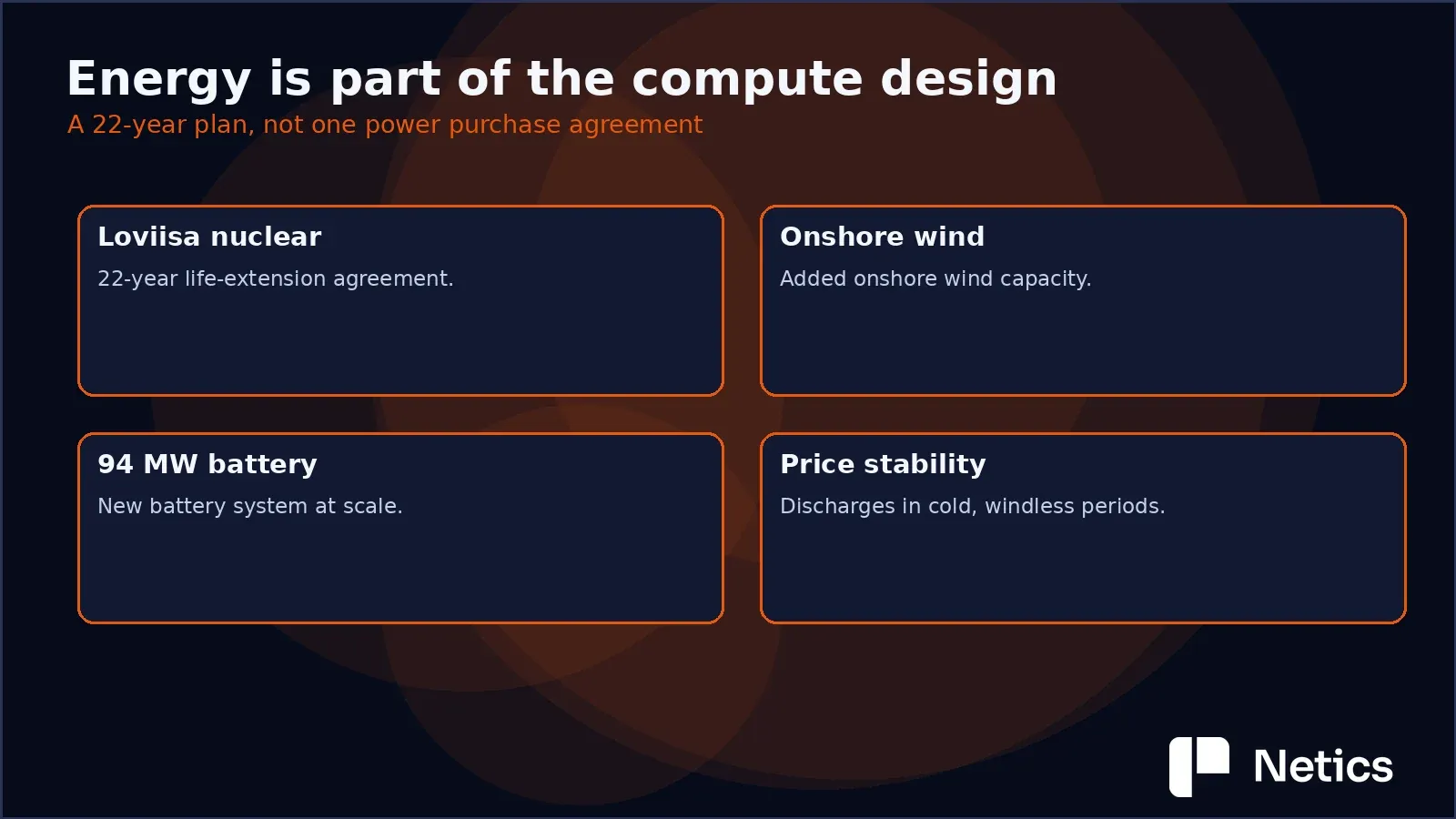
Google says it will support Finland’s grid through a 22-year agreement for the life extension of the Loviisa nuclear power plant, additional onshore wind capacity, and a new 94-megawatt battery system. The company describes the battery as a way to help stabilize prices during cold, windless periods.
The practical implication is that the power strategy is not limited to buying an annual volume of electricity. It includes firm generation, variable generation, and storage. Those resources solve different problems. A long-term nuclear arrangement can support continuity. Wind adds new low-carbon generation but varies with weather. A battery can respond quickly when the system is stressed, although the announcement does not specify its duration, dispatch rules, ownership model, or connection point.
Those missing details are not minor. Grid planners need to know whether a battery is intended for a short balancing service, congestion management, price response, or a combination. They also need transparent assumptions about the data-center load: its ramp profile, redundancy requirements, cooling demand, and ability to shift non-urgent computation. Google’s announcement establishes the components, not the complete operating model.
That is the right level of caution for sovereignty debates. European digital sovereignty is not achieved by replacing one logo with another. It depends on whether critical compute has an energy plan that can be inspected, stress-tested, and reconciled with other users. A hyperscaler’s investment can strengthen a regional system, but only if the surrounding contracts and planning decisions remain legible to public authorities.
The Finnish example also gives European regions a concrete planning question: what must be agreed before a large AI load arrives? The answer includes connection queues, reserve requirements, price exposure, construction timing, water and cooling constraints, and the treatment of curtailed or flexible workloads. These are infrastructure-governance questions, not marketing details.
Heat recovery turns efficiency into a local relationship
Google points to Hamina’s seawater-based cooling system and offsite heat recovery distribution to local homes and businesses as environmental initiatives developed during its Finnish presence. The new announcement places those efforts beside its energy and community commitments.
Heat reuse is strategically important because it changes the local conversation about a data center. Without a useful destination, waste heat is a thermal-management problem. With a connected district-heating network, it can become a resource for homes and businesses. That does not make every data center automatically beneficial: useful heat depends on temperature, distance, seasonal demand, network design, backup systems, and an economic agreement that survives changes in load.
For new European projects, heat reuse should be designed before construction rather than added as a communications layer after commissioning. The feasibility work should identify an anchor customer, the required heat-grade lift, pipeline route, metering, maintenance responsibility, and a fallback for periods when demand is low. It should also disclose what share of recovered heat is expected to be useful under different seasons and operating conditions. Google’s announcement confirms an existing Hamina example but does not quantify its recovered heat or establish performance targets for the new investment. Those figures should not be invented.
The broader point is institutional. A data center can be evaluated as a building, an electricity customer, or a node in a local energy system. Only the third view captures the relationship with surrounding communities. Heat recovery is one practical way to make that relationship measurable.
Jobs and skills are an infrastructure constraint
Google says the initial construction phase in 2027 and 2028 will support more than 37,000 jobs nationwide and contribute €3.6 billion annually to Finland’s GDP. Those figures are Google’s estimates and should remain attributed to Google; they are not an independent economic assessment in the announcement.
The company also says the Hamina data center supports roles including computer technicians, electrical and mechanical engineers, security staff, catering, and facilities management. That list is revealing because it expands the workforce discussion beyond machine-learning specialists. A reliable AI facility needs technicians who can maintain equipment, engineers who can manage power and cooling, security personnel, and the operational services that keep a site functioning.
Google says it will invest €31 million in Hamina, Kajaani, Muhos, and Vaala over the next four years for education and economic growth. The program includes AI upskilling for more than 4,400 workers through local-college partnerships and new training opportunities for 100 Finnish students for future data-center careers.
For policymakers, the operational test is whether training is connected to actual pathways: accredited courses, apprenticeships, supplier demand, and jobs that remain after construction peaks. For employers, the relevant question is how much capability can be built locally rather than imported temporarily. The announcement supplies commitments and participant numbers, but not completion rates, curricula, hiring targets, or retention outcomes. Those are the metrics that will show whether the skills strategy compounds.
SMEs also enter the story here. Google says its Hamina presence supported more than 600 Finnish suppliers between 2023 and 2025 across construction, operations, and network fiber. Smaller firms can gain from this ecosystem, but only if procurement is accessible beyond the largest contractors. Regional benefits are stronger when SMEs can see predictable requirements, qualification support, payment terms, safety expectations, and a route from one project to the next.
The European sovereignty question is coordination, not isolation
The investment strengthens Finland’s position as a host for large-scale digital infrastructure, but it does not by itself answer every European sovereignty concern. Google remains the operator and primary decision-maker for its facilities and services. The announcement does not promise local control of Google’s models, a guarantee of domestic data residency for every workload, or independence from global supply chains. Those claims would go beyond the evidence.
A more useful sovereignty test is operational. Can Finland and the wider European market understand the energy dependencies, workforce pipeline, supplier participation, heat-reuse performance, and public commitments attached to the compute? Can other companies access the skills and infrastructure created around the investment? Can public authorities plan for a future in which workloads grow, prices change, or a facility’s priorities shift?
The framing avoids two easy mistakes. The first is to treat any foreign investment as a sovereignty failure. The second is to treat any clean-energy or jobs commitment as proof of sovereignty. The real outcome depends on governance around the asset: disclosure, enforceable agreements, resilience planning, and benefits that do not stop at the fence line.
What European regions should measure next
Google’s announcement gives regional planners a useful checklist, even where it leaves important detail open. First, publish the load and connection assumptions needed for credible grid planning. Second, separate annual clean-energy claims from hourly reliability and flexibility. Third, specify whether storage can support the wider system and under what dispatch rules. Fourth, measure heat reuse in delivered energy, not only installed equipment. Fifth, report training completion, employment, and retention rather than enrollment alone.
Procurement deserves its own dashboard. Count local SMEs by category, contract value, repeat work, and time to payment. Track whether network-fiber, facilities, security, and maintenance opportunities are available to firms outside the immediate construction tier. Finally, make community spending legible by location and outcome so residents can distinguish a durable program from a one-time announcement.
These measurements do not diminish Google’s commitment. They make it testable. A €13 billion investment is large enough to reshape regional infrastructure; the public interest is served when the surrounding system can show what changed, for whom, and under which assumptions. Teams working through that kind of infrastructure boundary can use the Netics homepage as a starting point for an architecture conversation.
Sources
- Google — Google deepens its commitment to Finland with a €13 billion investment in AI infrastructure — Google, September 9, 2026.