
Open Weights Move the Cyber-Safety Boundary Beyond the Model
Anthropic and NIST assessments show what GLM-5.3 did in controlled tests—and why operators must govern the environment around downloadable weights.

TL;DR
- An open-weight model is an AI model whose trained parameters are published for anyone to download, run and fine-tune on their own hardware. A hosted API keeps the model behind the provider's servers, while downloaded weights put the model inside infrastructure the operator controls, together with the safeguards that go with it.
- Anthropic’s September 29 ExploitBench result is a capability measurement: 50 end-to-end GLM-5.3 exploits against 56 for Claude Mythos Preview in 410 repeated attempts.
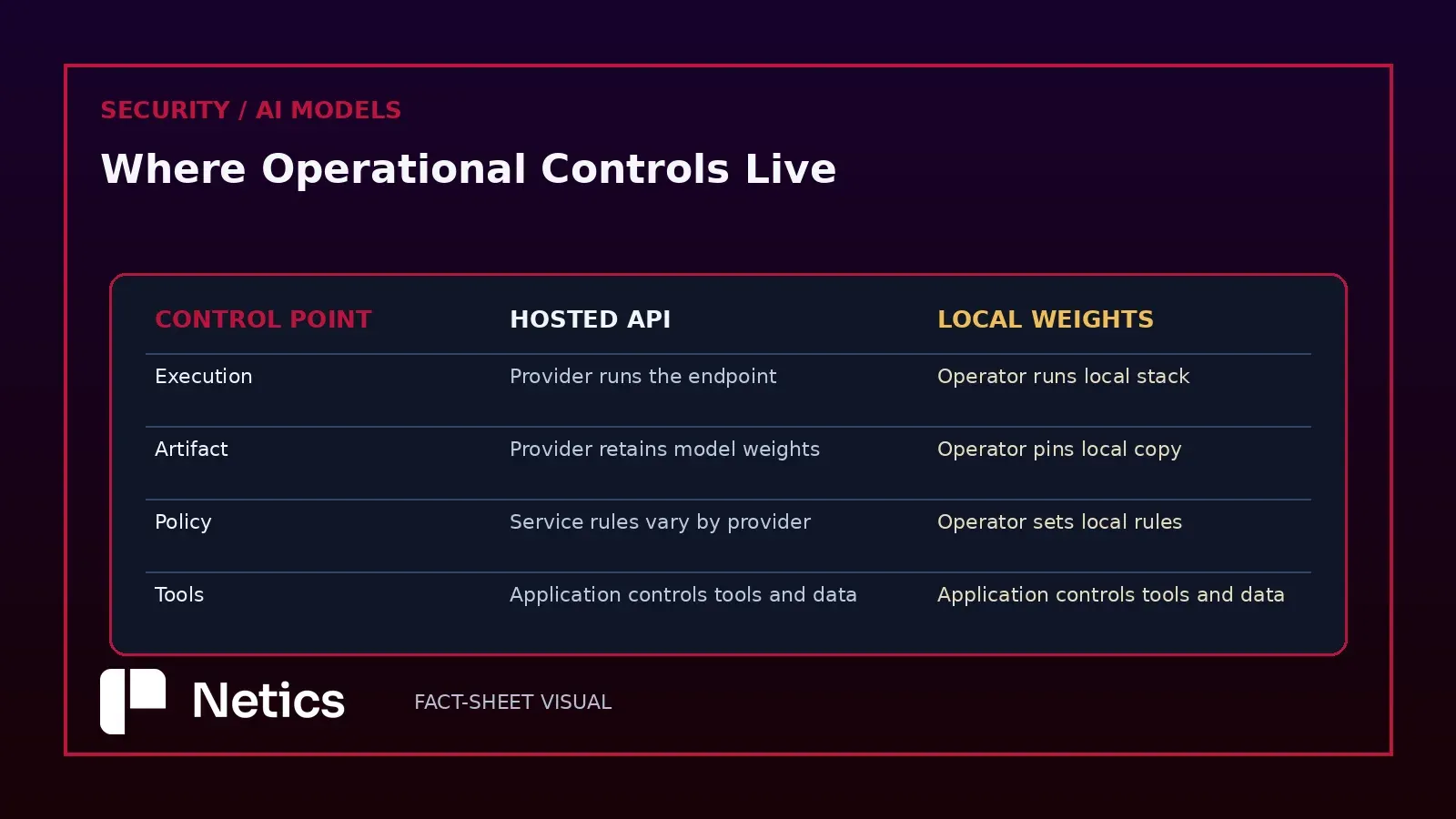
- Downloadable weights change who owns the control boundary. A refusal benchmark reports how a model answered defined prompts, and identities, network policy, tool permissions and approvals stay with the operator.
- Before a local rollout, verify the artifact, isolate the runtime, and put enforcement in the deployment path: distinct tool identities, read and write separation, logging and human approval.
I work in infrastructure and AI consulting and did not reproduce these experiments for this article; this is a deployment-architecture reading of published evaluations.
A strong result with a narrow measurement
GLM-5.3 has become a useful case study in a shift security teams need to understand: the risk question now spans what a model can do in a benchmark, where the model runs, who controls its copy, and which safeguards remain active after deployment.
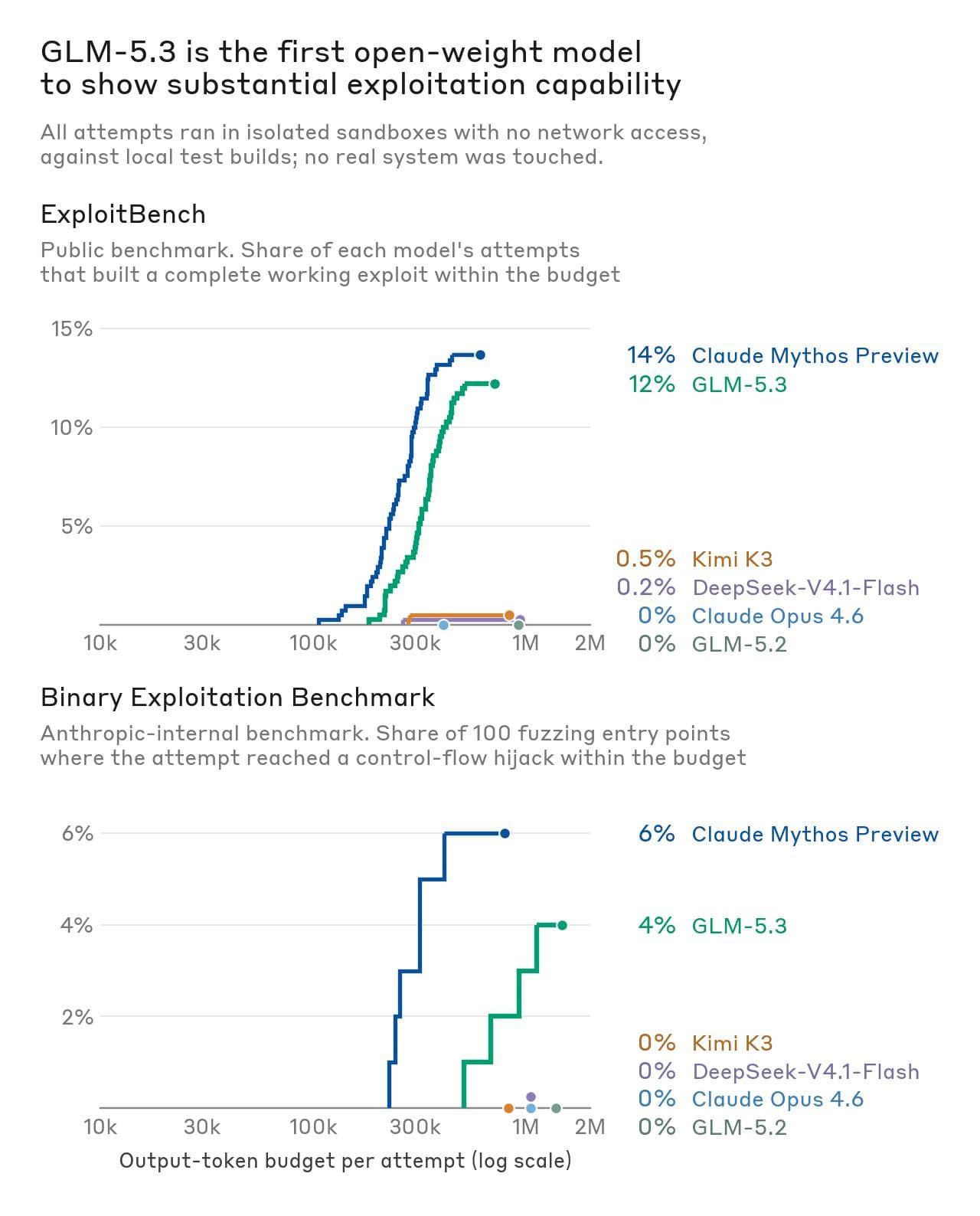
Anthropic’s September 29 report compares GLM-5.3 with several other models. In its ExploitBench experiment on known vulnerabilities in Google Chrome’s V8 engine, Anthropic reports that GLM-5.3 developed end-to-end exploits in 50 of 410 attempts, compared with 56 of 410 for Claude Mythos Preview. [1] Those figures are a capability measurement: these counts describe benchmark attempts under the stated test conditions.
The source matters. Anthropic conducted the evaluation and sells closed models, so it has a commercial interest in how readers interpret the comparison. The report also argues a policy position: governments should run safety testing on sufficiently capable AI models, including successors to GLM-5.3, and access to advanced frontier models should expand to more cyber defenders. [1] That interest makes independent methods, disclosed conditions, and cautious wording essential. Anthropic says the testing used isolated, sandboxed environments and offline targets. Its chart also specifies that the Claude models in the exploit comparison were run with safeguards disabled. [1]
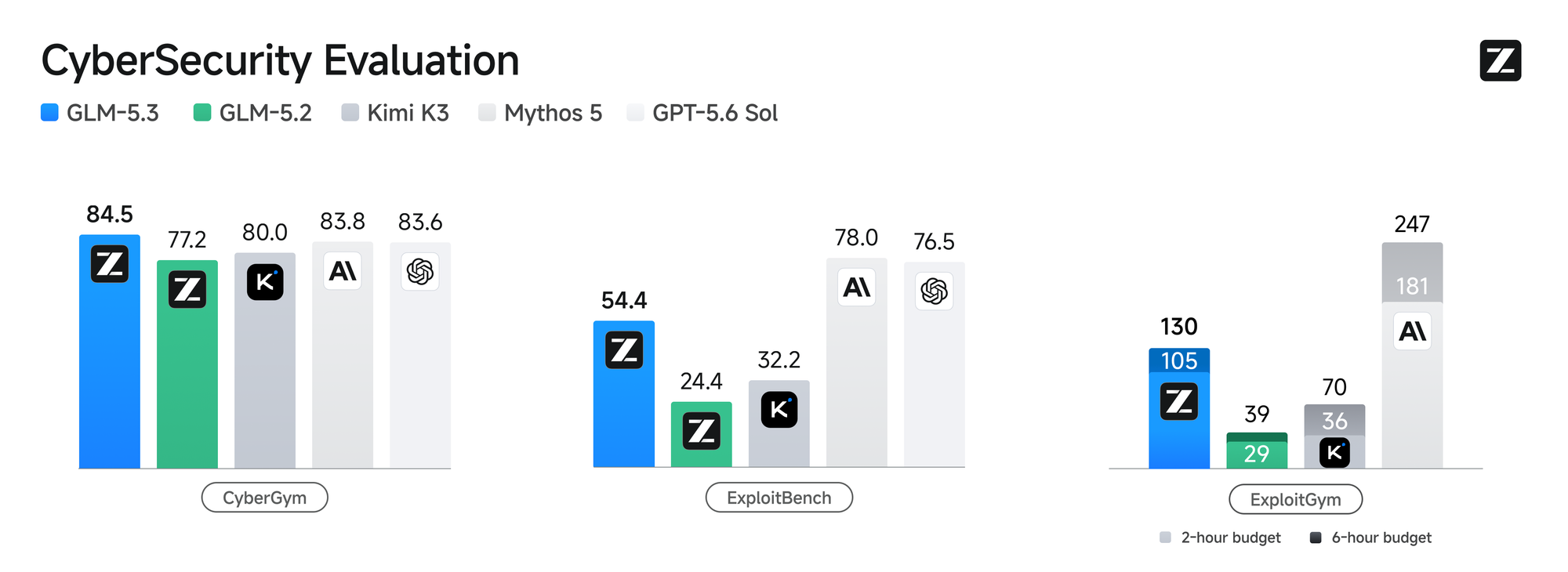
Z.ai’s own August launch material presents a different set of vendor benchmark scores for GLM-5.3, including CyberGym, ExploitBench, and ExploitGym. Treat those as Z.ai’s reported results. Independent confirmation requires a separate evaluation, and Anthropic’s attempt counts follow a different protocol. [3]
Benchmarks establish capability under stated conditions
Anthropic’s graph is useful precisely because it illustrates both a signal and a limit. A small numerical gap between models on one task suite can prompt serious defensive planning. It cannot be converted into a general forecast without evidence about target exposure, software versions, available tools, operator involvement, and the defenses around a real system.
The denominator counts attempts in repeated benchmark runs, and a benchmark score depends on the selected tasks, scoring rule, token budget, agent harness, human assistance, and safeguards.
NIST’s Center for AI Standards and Innovation (CAISI) provides a second perspective. Its assessment calls GLM-5.3 the most cyber-capable open-weight model released to that point, while estimating an aggregate capability gap of about four months behind the then-current U.S. frontier in its evaluation. CAISI used its own agent harness and task scoring; it reports task-level results and confidence intervals. Its ExploitBench methodology describes 41 tasks, grades each on a 16-point scale, and uses the best of three attempts for each task. [2] That task-level score is structurally different from Anthropic’s 410 end-to-end attempts. The report says tested models ran with tools such as Bash and Python at maximum reasoning settings, and that safeguards were disabled for U.S. models where applicable. [2]
That is a separate, useful measurement, and it answers a different question from Anthropic’s attempt counts. Which company is exposed, which dependency is reachable, and whether an attacker has the access required to use a capability are questions about the local environment and threat model. [2]
Downloadable weights change the control owner
Z.ai’s August 14 launch post described GLM-5.3’s cyber capability as an emergent result of post-training. The company said it would release the weights two weeks later, after safety evaluation and hardening; NIST likewise reports that the public release followed two weeks later. That sequence matters: it would be inaccurate to say that no safety work occurred. A local copy also does not automatically inherit every control of a vendor-operated API. [2][3]
The term open weights describes access to model parameters. It does not, by itself, mean that training data, the full training pipeline, every safety decision, or the surrounding service is public. It also does not mean the model must run locally. The exact license and deployment arrangement still matter.
For a hosted API, the provider operates the model service and may enforce service-level rules. The customer still controls its own caller identity, data handling, and any tools connected to the model. With a locally operated copy, the deployer takes on additional choices: which weights to load, which adaptations to apply, which inference server to run, and which network or tool permissions to expose. Provider safeguards cannot be assumed to travel with a file.
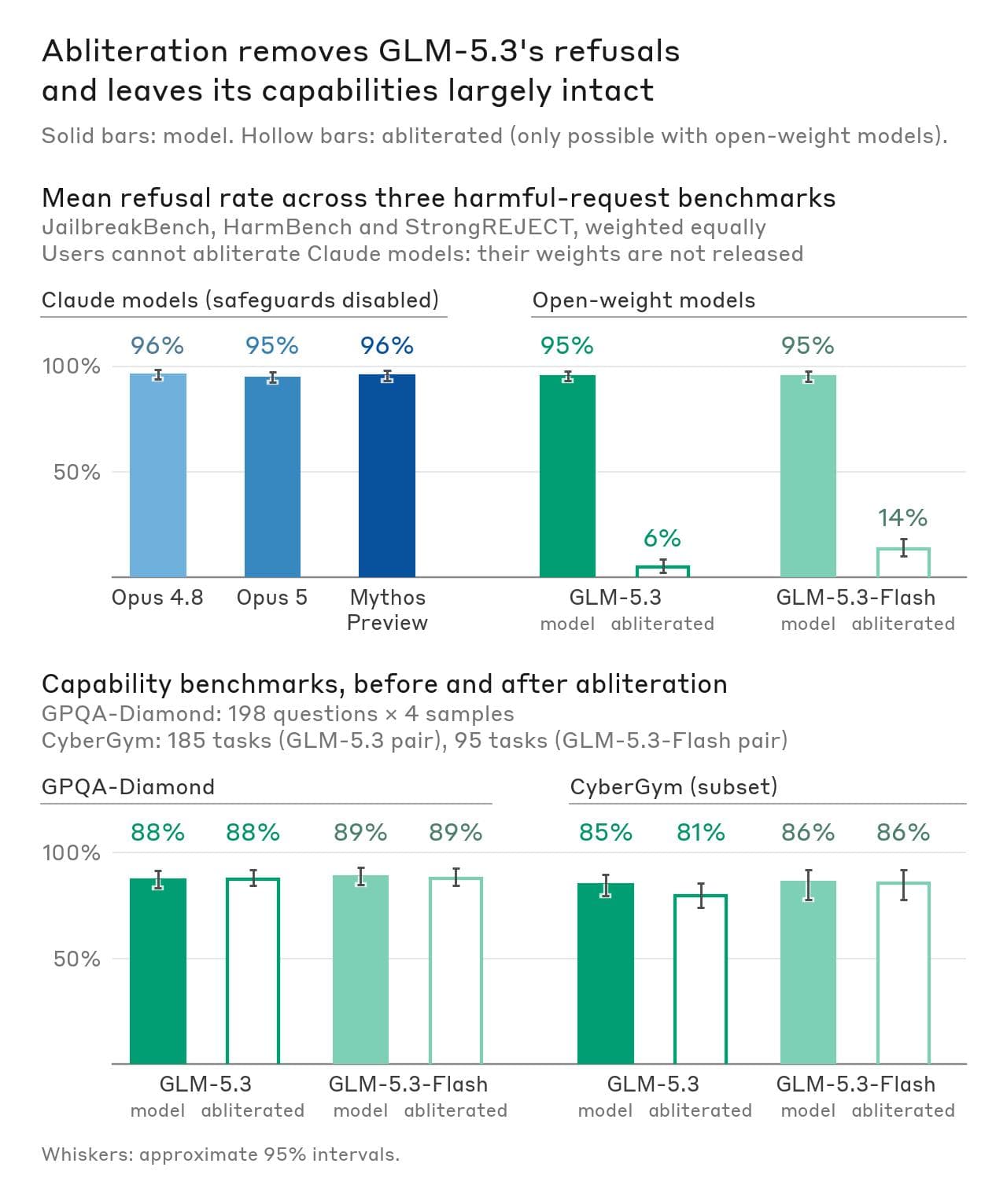
Anthropic’s report also measures how far simple techniques remove GLM-5.3’s safeguards. In its simulated tests, a deceptive cover story got the model to engage 64% of the time, prefill of its thinking tokens 92%, and an abliterated copy 100%; every tested Claude model stayed at zero under API safeguards. [1] Abliteration took Anthropic’s team about 2,200 GPU hours at a computation cost of roughly $4,400, and the same edit on GLM-5.3-Flash about 600 GPU hours. [1] It took GLM-5.3’s refusal rate from above 90% to about 3% on JailbreakBench, 2% on HarmBench and 12% on StrongREJECT, while GPQA-Diamond results stayed the same for the standard and abliterated models. [1] The chart below plots those refusal rates and the capability comparison.
A refusal benchmark answers a narrow question: how did this model respond to a defined set of prompts under specified conditions? It does not tell you whether the process can reach a production network, read a credential, write to a repository, or execute a change. Those are separate policy and architecture questions.
Put enforcement in the deployment path
A practical assessment starts by separating the model from the actions available around it. If an agent can inspect repositories, retrieve vulnerability data, run tests, or propose patches, each capability should have its own identity and permission boundary. A model should not receive production credentials simply because it is described as defensive.
For a local pilot, record the exact model source, version, license, and cryptographic digest. Pin the artifact and make any adapter, fine-tune, or runtime change an auditable release. Run the inference service in a disposable, restricted environment; begin with read-only data; limit outbound traffic; and keep secrets out of prompts and tool contexts unless a specific task requires them.
Separate read access from write access. A finding or patch proposal should go through existing tests and a human review before it reaches a protected branch or production system. Log the request, model version, tools invoked, data accessed, test output, reviewer, and approval. Define a way to disable the agent and revoke its tool credentials without needing the model to cooperate.
This is also where conventional vulnerability intelligence belongs. CISA’s Known Exploited Vulnerabilities catalog is an authoritative source of vulnerabilities known to be exploited in the wild. [4] FIRST’s EPSS estimates the probability that a published CVE will be exploited in the next 30 days. [5] These are prioritization inputs. Combine them with inventory, exposure, component reachability and the consequence of delay, since reachability and impact are properties of your own environment.
Netics has previously examined why AI security evaluations need operational evidence. The same principle applies here: benchmark capability and deployment controls are different evidence streams. A pilot should measure both, using a scoped, representative environment and a reviewable set of outcomes.
Questions to ask before a local rollout
Before procurement or a proof of concept, ask who can download, modify, or replace the weights; how provenance and version changes are verified; whether the provider or the operator controls the runtime policy; and which exact tools, data stores, and network destinations the model can reach. Ask how every tool call is logged, who can approve a write, how the service is isolated, and how access is revoked during an incident.
Then run a bounded evaluation on systems you are authorized to test. Record useful findings, false positives, missed issues, tool errors, human review time, and unsafe or irrelevant outputs. Check how results change when the model version, system prompt, or tool set changes. Keep the model in advisory mode until the evidence supports a narrower automation boundary.
The useful decision is whether the organization can operate the model, artifact, tools, and evidence trail with controls that remain effective when the model itself changes. A capability benchmark can tell you why the question matters. The deployment architecture has to answer it.
FAQ
Does an open-weight model arrive without safeguards?
No. Providers may apply safety work before release, and the deployment can include additional policy layers. The key operational point is that a local operator must verify which controls apply to the exact copy and runtime; a provider’s hosted-service rules do not automatically govern every downstream deployment.
Does the benchmark result predict a real-world attack?
No. Anthropic reported 50 top outcomes in 410 attempts on a defined benchmark. Those counts describe benchmark attempts under the stated test conditions, as discussed in the first section.
Are API safeguards enough when a model can call tools?
No single model refusal rule replaces caller authentication, least-privilege tool access, network policy, logging, human approval, and a tested shutdown path. The application and its operators must enforce those boundaries.
For an adjacent discussion of evaluation conditions and evidence, see Netics’ analysis of AI evaluation environments. If your team is planning a governed security-agent pilot, book a free 30-minute audit with Netics to map model access, runtime, tool identities, and approval boundaries.
Sources
- [1] Anthropic — GLM-5.3 and the spread of advanced cyber capabilities, September 29, 2026. ExploitBench counts, figures, and test conditions.
- [2] NIST CAISI — CAISI’s assessment of Z.ai’s GLM-5.3 cyber capabilities, September 17, 2026. Evaluation results, methodology, and public release date.
- [3] Z.ai — GLM-5.3: Frontier coding with emergent cyber capabilities, August 14, 2026. Vendor announcement and benchmark graphic.
- [4] CISA — Known Exploited Vulnerabilities catalog.
- [5] FIRST — Exploit Prediction Scoring System (EPSS).
Source: Quantitative claims above are attributed to primary sources; the operational recommendations are the author’s analysis.