
containerd or CRI-O: Choose the Kubernetes Runtime Boundary You Can Operate
Netics analysis of the mechanism, its limits, and the operating decision it creates.

TL;DR
This article examines the source mechanism, its limits, and a practical Netics operating decision. Coverage: The comparison starts below Kubernetes; containerd’s operating model; CRI-O’s operating model; The important difference is ownership; Security and failure are not footnotes; Migration is a node lifecycle project; A decision framework; The Netics position; Make the node observable before migrating; The evidence that should decide.
The comparison starts below Kubernetes
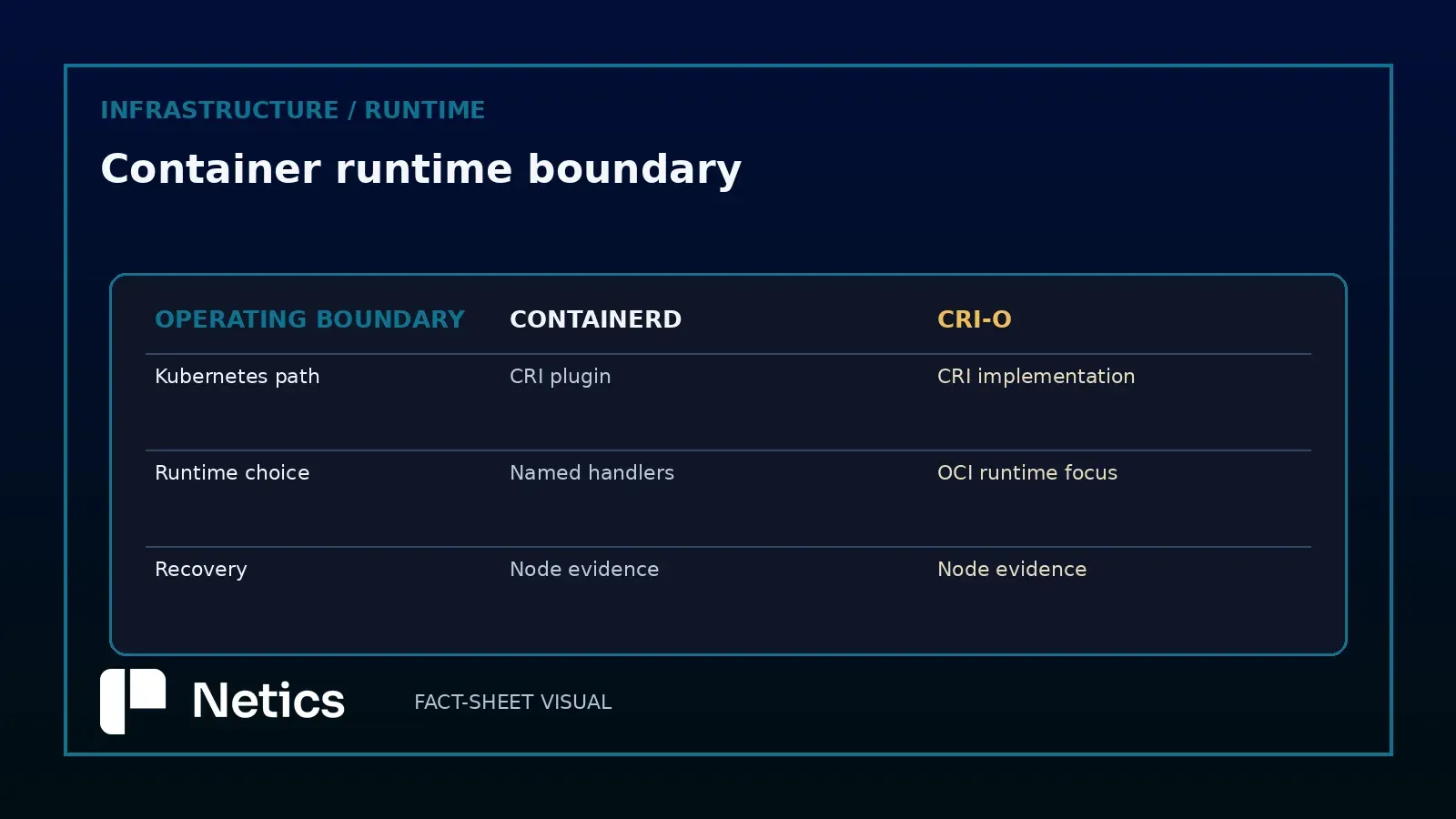
containerd and CRI-O are not two Kubernetes distributions and they are not simply replacements for Docker as a command-line experience. They are runtime boundaries used by Kubernetes through the Container Runtime Interface. containerd documents a CRI plugin that handles requests from the kubelet and manages container lifecycle and images. CRI-O describes itself as a CRI implementation for OCI-compatible runtimes. The buyer is choosing where lifecycle, image, runtime-handler, logging, and debugging responsibility lives on each node.
containerd’s operating model
The containerd documentation describes a daemon and a CRI plugin coordinating images and container lifecycle. Runtime V2 introduces a shim API for runtime authors and allows named runtimes to be selected through CRI runtime handlers. That creates flexibility: a platform can use different runtime implementations for different workload classes. Flexibility also creates more configuration surface. The team must own the config, the handler names, the shim behavior, and the evidence needed to diagnose a node whose runtime choice differs from the default.
CRI-O’s operating model
CRI-O focuses more narrowly on Kubernetes CRI and OCI runtime execution. Its documentation describes a lightweight Kubernetes runtime layer, an OCI runtime such as runc, and conmon monitoring each container. That narrower framing can be attractive to a team that wants fewer general-purpose container-management concepts on the node. It does not remove operational work. Version alignment with Kubernetes, packaging, image storage, logging, and runtime security remain part of the platform contract.
The important difference is ownership
A runtime decision is a choice about the team that will debug the node at 02:00. Ask whether the organization needs containerd’s broader ecosystem and named-runtime flexibility, or CRI-O’s Kubernetes-focused boundary. Then map the ownership of images, snapshots, shims, conmon or equivalent monitoring, runtime classes, and upgrade procedures. A feature comparison without this ownership map answers the wrong question.
Security and failure are not footnotes
Both choices can invoke OCI-compatible runtimes, but the security result depends on configuration and workload policy. Test privileged workloads, seccomp behavior, rootless or unprivileged cases, image-pull failures, disk pressure, runtime restarts, and node recovery. Observe what kubelet reports, what the runtime logs, and what an operator can inspect without attaching a second diagnostic system. A runtime that is theoretically secure but operationally opaque creates a different kind of risk.
Migration is a node lifecycle project
Changing runtimes is not a package swap in a live cluster. Define a node-drain strategy, workload disruption budget, image-cache behavior, observability changes, and rollback. Rehearse one node with the same kernel, CNI, storage, and security profiles as production. Compare startup time, failure behavior, and debugging workflows. This is the same operating-model discipline Netics applies to infrastructure choices such as Proxmox versus VMware: the logo matters less than the boundary the team can own.
A decision framework
Choose containerd when its runtime-handler model, ecosystem integrations, or mixed-runtime requirements solve a real need you can operate. Choose CRI-O when a Kubernetes-focused runtime boundary, distribution alignment, and a smaller conceptual surface are more valuable. Neither choice should be made from a benchmark detached from the cluster’s kernel, storage, network, observability, and incident procedures. The evidence is the rehearsed node lifecycle.
The Netics position
containerd and CRI-O can both be valid Kubernetes runtime foundations. The wrong decision is treating the runtime as invisible plumbing. Make the runtime boundary explicit, test how it fails, document who owns its configuration, and choose the operating model that your team can recover under pressure. For an architecture review, visit Netics Netics or Book a free 30-minute audit.
Make the node observable before migrating
Before changing the runtime, capture the current node’s evidence: kubelet events, runtime logs, image-pull errors, storage consumption, pod startup time, and the commands operators use during an incident. Repeat the same capture after migration. A runtime comparison based only on installation success misses the work that happens when a pod is stuck in ContainerCreating or an image layer cannot be unpacked.
Keep the first migration reversible. Drain one node, move a representative workload set, test a failed pull and a restarted runtime, then return the node to service. Document which behavior belongs to Kubernetes, which belongs to the CRI implementation, and which belongs to the OCI runtime. That separation reduces the chance that an operator changes the wrong layer during an incident.
The evidence that should decide
A useful comparison ends with a runbook, not a winner badge. For each candidate, write the exact node signals an operator will inspect, the command or API used to select a runtime handler, and the recovery action when the handler is unavailable. Record whether the same team owns the CRI configuration and the OCI runtime. If ownership crosses teams, write the escalation contract before the migration.
Also compare the surrounding distribution. Kubernetes version alignment, package repositories, kernel security modules, CNI behavior, storage drivers, and image registry policy can dominate the runtime difference. A runtime choice that looks simple in isolation becomes expensive when it forces a different node image or a new diagnostic path. The right answer is the one that reduces the number of unknowns during a failure, not the one with the shortest installation guide.
Sources
- containerd documentation: Architecture of the CRI plugin — accessed for this draft.