
Deutsche Telekom's €2.5 Billion AI Target Is a Measurement Design
Deutsche Telekom says AI and automation will remove about 2.5 billion euros of indirect cost by 2030 against a 2023 baseline. The euro figure is a forecast; the unit metrics published alongs

TL;DR
- An AI savings target is a company's commitment to cut a defined category of cost by a set future date, and measuring one means naming the cost category, the baseline it is compared against, and the unit tracked each month. The unit moves early and the euro total arrives later.
- Deutsche Telekom expects AI and automation to remove approximately 2.5 billion euros of indirect costs by 2030, measured against a 2023 baseline, with gross savings of about 1.1 billion euros outside the United States in 2027.
- Alongside the euro figures it published unit metrics: 2.6 million customer service calls handled by the Frag Magenta chatbot in the first half of 2026, US call volume down 55%, AI agents handling 40% of US customer contacts, and network event response time down from several hours to about one minute.
- The euro target is a forward-looking statement attached to a baseline. The unit metrics are the auditable half, and they are what a smaller company can copy.
- The operating model in the release is explicit: employees set goals, review results and keep responsibility for decisions.
- Reporting the same unit every month is what turns an AI programme into something a manager can steer.
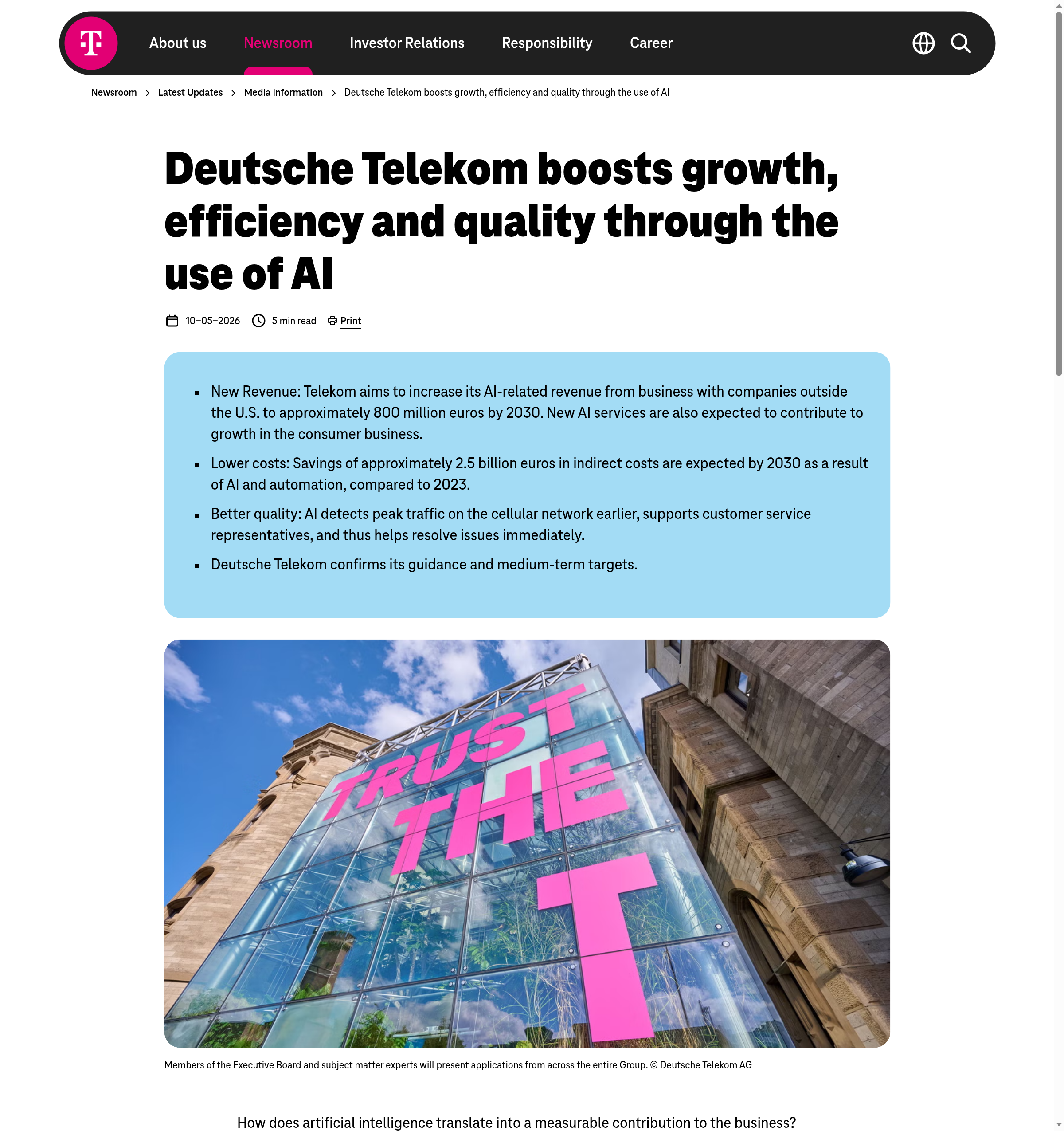
The three claims Telekom took to its investor day
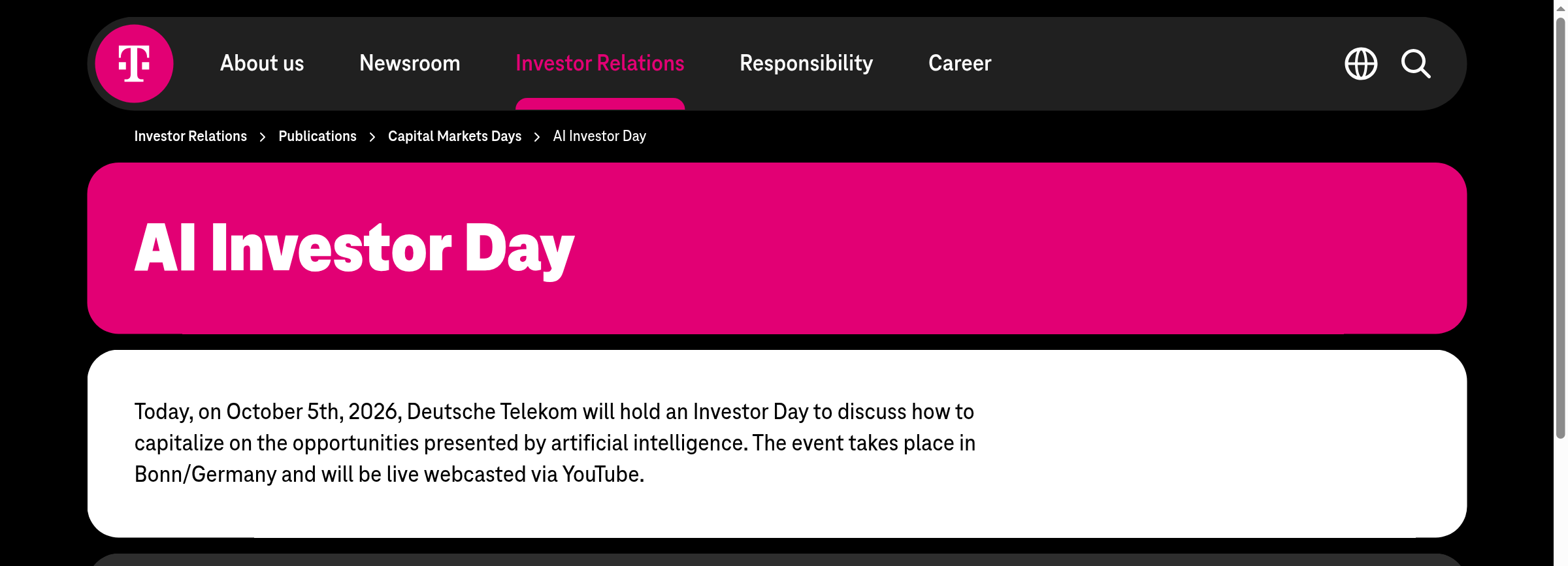
The company held an AI Investor Day in Bonn on 5 October 2026 and published three claims with it. Revenue first: AI-related business outside the United States should reach approximately 250 million euros in 2026 and approximately 800 million euros by 2030. Cost second: savings of approximately 2.5 billion euros in indirect costs by 2030 compared with 2023, with gross savings of about 1.1 billion euros outside the United States expected in 2027. Quality third: AI detecting peak traffic on the mobile network earlier, supporting customer service staff, and resolving issues sooner.
Every number in that paragraph carries a date and a comparator, which is worth noticing because most AI savings claims arrive without either. "2.5 billion by 2030 against 2023" is checkable in principle: pick the cost lines, fix the baseline year, and the arithmetic becomes a matter of accounting policy rather than enthusiasm. Reuters reported the same figure on the day, along with the company's intention to reinvest part of the additional 2027 savings in German digital infrastructure and the fibre build.
What an indirect cost saving actually counts for
Indirect costs are where this kind of claim gets slippery, because the category covers work that never appears in a bill of materials: service desk handling time, network operations effort, development capacity released from maintenance, administrative processing. A saving inside that category can be a headcount that was not hired, a contractor engagement that was not renewed, a shift in where an hour is spent, or a genuine reduction in hours. The distinctions matter at renewal time, when someone asks whether the number came back.
Telekom's own release answers part of that question with unit figures rather than euro ones, and the difference is instructive. The Frag Magenta chatbot handled approximately 2.6 million customer service calls in the first half of 2026. In the United States, customer service call volume fell 55% and AI agents now handle 40% of customer contacts. A RAN Guardian Agent detects impending network strain and helps network management apply countermeasures, with response time for those events down from several hours to about one minute. Initial use cases in customer service show a 30% decrease in complaints.
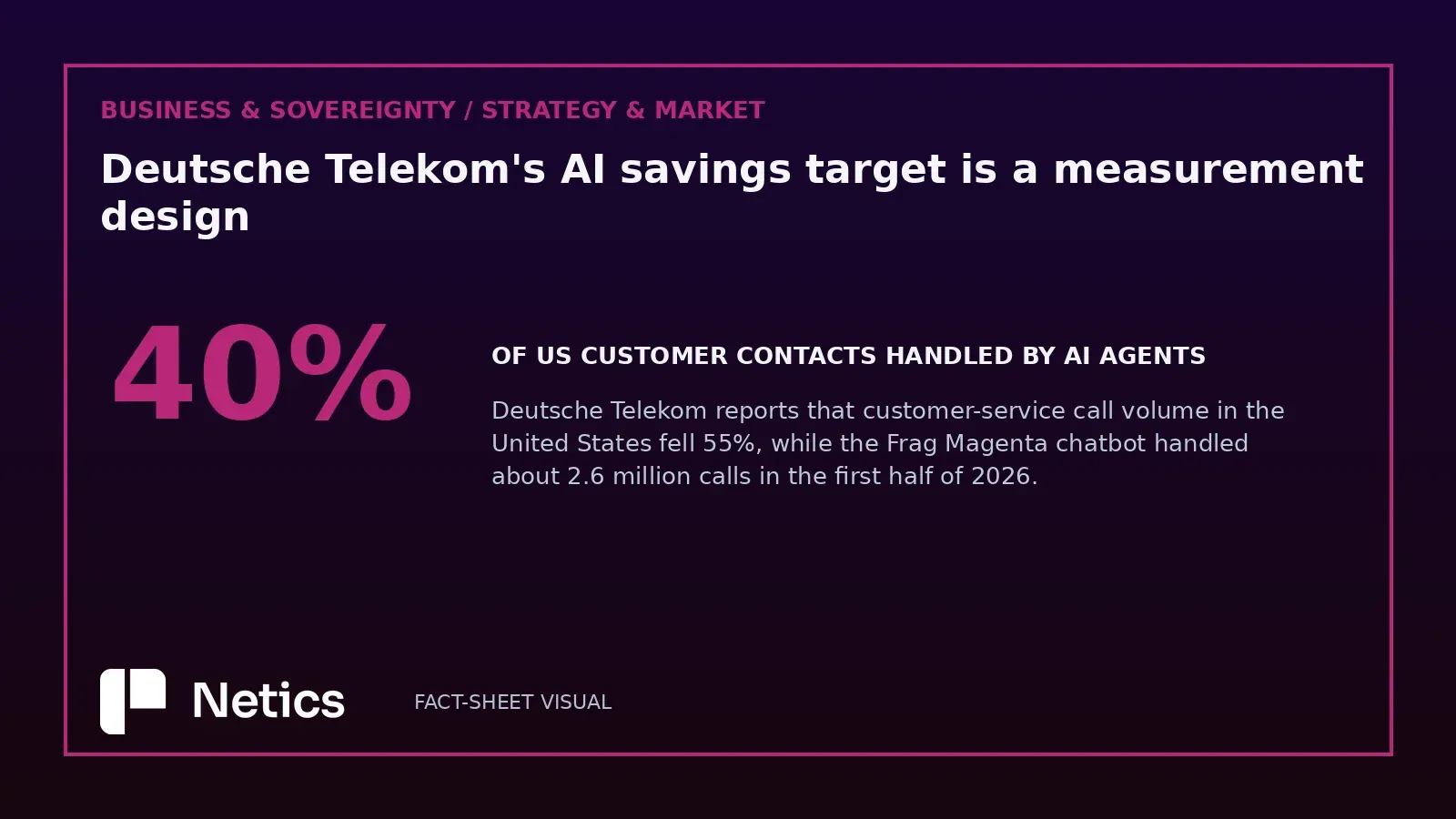
Those units are the ones an operations manager can act on. Call volume, contacts handled by an automated channel, minutes to respond, complaints per thousand lines. Each one can be measured weekly without an accounting exercise, and each one moves before the cost line does. The euro figure is a consequence that arrives later; the unit figure is the leading indicator.
The operating model the company describes
One sentence in the release deserves more attention than the euro figure, because it describes the control that keeps automation from becoming an unaccountable process: employees set goals, review results and retain responsibility for decisions. The same release states that more than 100,000 employees have been trained in AI usage, with AskT, ChatGPT Enterprise and Microsoft Copilot provided under an AI for All initiative.
Chief executive Tim Höttges framed it in similar terms: "AI is fundamentally transforming Deutsche Telekom. It makes our networks even better and smarter, our service more personalized, and opens up new business models: from AI assistants during phone calls to a sovereign infrastructure for European industry." He added, "What matters most is that technology delivers measurable value, for our customers and for our company."
Read together, the release describes a programme where the automation handles volume and the human keeps the decision. That is a defensible division of labour, and it has a measurement consequence: if the human decision stays in the loop, the time saved has to be found somewhere other than a shorter review step.
The unit metrics a smaller company can publish
The part of this release that transfers to a twenty-person business is not the 2.5 billion. It is the habit of attaching a unit to every claim before a supplier or an internal sponsor asks for one.
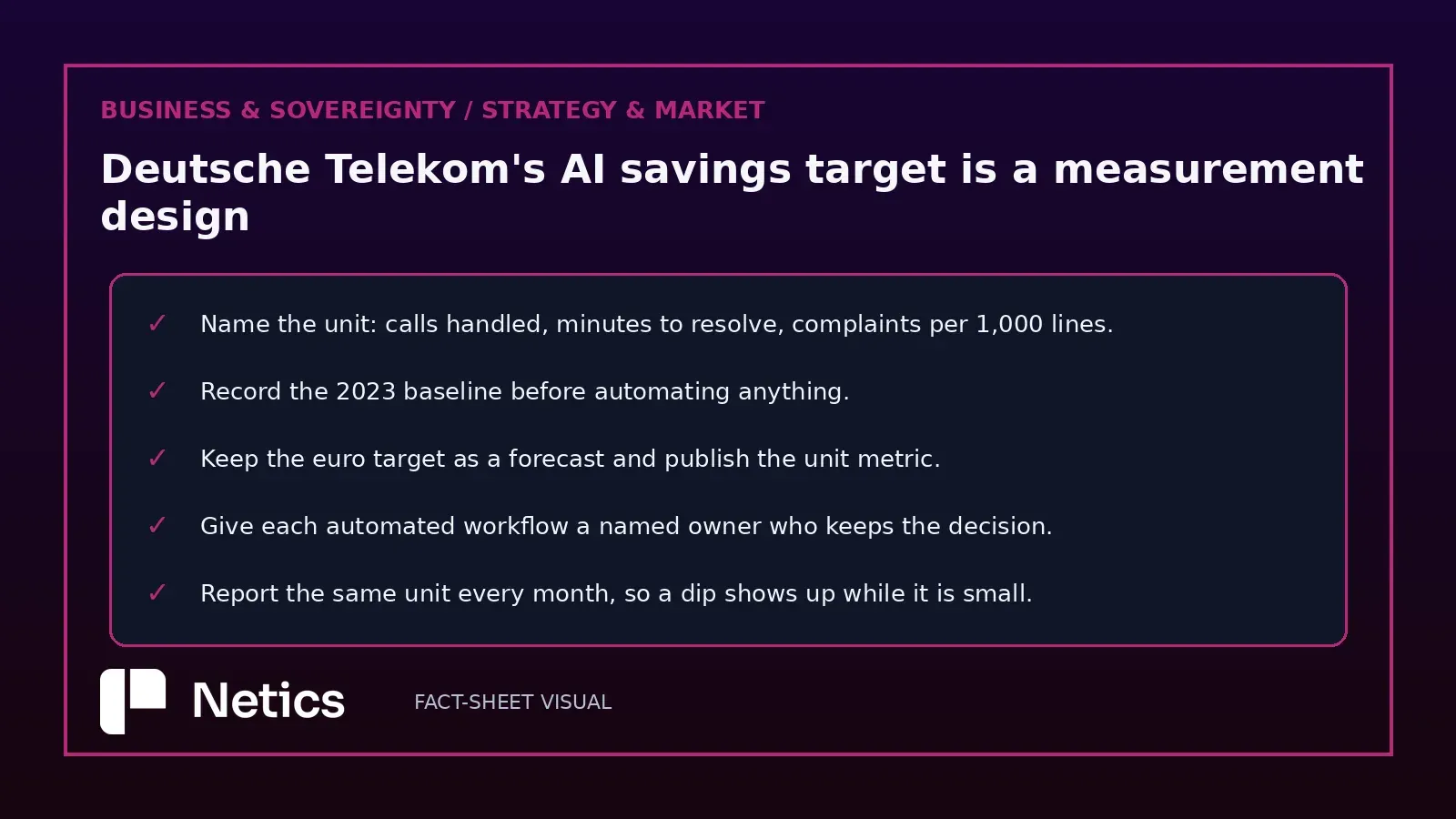
- Name the unit: calls handled, minutes to resolve, complaints per 1,000 lines, invoices processed per hour.
- Record the baseline with a date on it. Telekom's is 2023, and the year is part of the claim.
- Keep the euro figure as a forecast and publish the unit metric as the evidence that supports it.
- Give each automated workflow a named owner who reviews the results and keeps the decision, which is also what automation pipelines with human approval require to be operable.
- Report the same unit every month, so a dip is visible while it is still small.
There is one more consequence worth stating, because it is the failure mode this design avoids. A programme measured only by the aggregated euro target has no early signal: the number is either on track or it is a year late, and by the time the second answer arrives the automation has already been rolled out. A programme measured in units gets a monthly reading on whether the work is actually moving.
Where the euro figure stays a forecast
Two limits belong with any reading of this announcement. The first is that the 2.5 billion figure is management's expectation, presented under the forward-looking statement notice that accompanies the release, and the release says plainly that actual results may differ. The second is that the smaller item in the same release is the one with the least definition attached: savings from AI and automation of 100 to 150 million euros between 2023 and 2027, stated in a paragraph that also covers reinvestment in the fibre build. A figure that small sitting beside a figure that large, in the same announcement, is a reminder that these numbers belong to different measurement systems.
What makes the announcement useful is that it puts the auditable half next to the aspirational half. Our earlier reading of Anthropic's automation percentage made the same point from the inside of a research organisation: a single percentage tells you far less than the unit it was counted in. Telekom's release names its units, and that is the part worth copying.
What a twenty-person company takes from it
Take a concrete case. Imagine a twenty-person professional services firm in Casablanca that has just automated invoice intake: documents are read automatically, matched against purchase orders, and flagged when they do not reconcile. The euro saving is unknown for the first two quarters, and pretending otherwise would be a story rather than a measurement. What the firm can do from week one is publish the unit: invoices processed per hour, exceptions per hundred documents, average days to close an invoice, and the share of exceptions resolved by a named person. Those four numbers rise and fall before any cost line moves, and they answer the only question that matters after the first quarter, which is whether the automation is manufacturing exceptions faster than it removes them.
The same discipline is what makes an external claim credible. A vendor that arrives with a euro target and no unit is asking to be believed; a vendor that arrives with the unit, the baseline date and the owner is asking to be measured. Only one of those two conversations survives an audit.
Sources
Source: Deutsche Telekom boosts growth, efficiency and quality through the use of AI — telekom.com/en/newsroom/latest-updates/media-information/2026/10/deutsche-telekom-boosts-growth-efficiency-and-quality-through-t, published 5 October 2026, retrieved 2026-10-05 (AI-related revenue from business outside the United States of approximately 250 million euros expected in 2026 rising to approximately 800 million euros by 2030; savings of approximately 2.5 billion euros in indirect costs by 2030 compared with 2023; gross savings of approximately 1.1 billion euros outside the United States expected in 2027, with additional savings partly reinvested in digital transformation and the German fibre build; savings from AI and automation of 100 to 150 million euros between 2023 and 2027 stated in the release; the Frag Magenta chatbot handling approximately 2.6 million customer service calls in the first half of 2026; US customer service calls down 55% with AI agents handling 40% of customer contacts; the RAN Guardian Agent and a response time for network events down from several hours to about one minute; a 30% decrease in complaints in initial use cases; more than 100,000 employees trained, with AskT, ChatGPT Enterprise and Microsoft Copilot provided under AI for All; the Industrial AI Cloud in Munich and a platform for small and medium-sized businesses; the Magenta AI Assistant for in-call translation, answers and summaries; the workflow in which employees set goals, review results and retain responsibility for decisions; forward-looking statement notice; Tim Höttges statements that "AI is fundamentally transforming Deutsche Telekom. It makes our networks even better and smarter, our service more personalized, and opens up new business models: from AI assistants during phone calls to a sovereign infrastructure for European industry" and that "What matters most is that technology delivers measurable value, for our customers and for our company"). Source: AI Investor Day — telekom.com/en/investor-relations/publications/capital-markets-days/ai-investor-day, captured 2026-10-05 (event on Monday 5 October 2026 in Bonn, starting at approximately 12:00 pm CEST, with the management board presenting AI strategy and use cases; the financial results release for Q3 2026 scheduled for 11 November 2026). Source: Deutsche Telekom sees €2.5 billion in savings from AI, automation by 2030 — Reuters, syndicated through finance.yahoo.com, published 5 October 2026, retrieved 2026-10-05 (approximately 2.5 billion euros, or 2.8 billion US dollars, in indirect cost savings by 2030 compared with 2023; approximately 1.1 billion euros of gross savings in 2027 outside the United States compared with 2023; intention to partly invest additional 2027 savings in Germany's digital infrastructure and fibre-optic network). Internal linkage: Anthropic's 26% Is a Measurement Story Before It Is a Warning. More on Netics' work at automation pipelines with human approval.
Source: Deutsche Telekom media information and AI Investor Day pages — telekom.com, 5 October 2026, captured 2026-10-05; Reuters report on the savings target, syndicated through finance.yahoo.com, 5 October 2026. Figures: screenshots of Deutsche Telekom's official media information page and its AI Investor Day page, captured 2026-10-05.