
Terraform vs OpenTofu: Who Should Own Your Infrastructure State?
Terraform and OpenTofu share core state concepts, but governance, encryption, compatibility, and platform ownership change the decision.

What state actually does
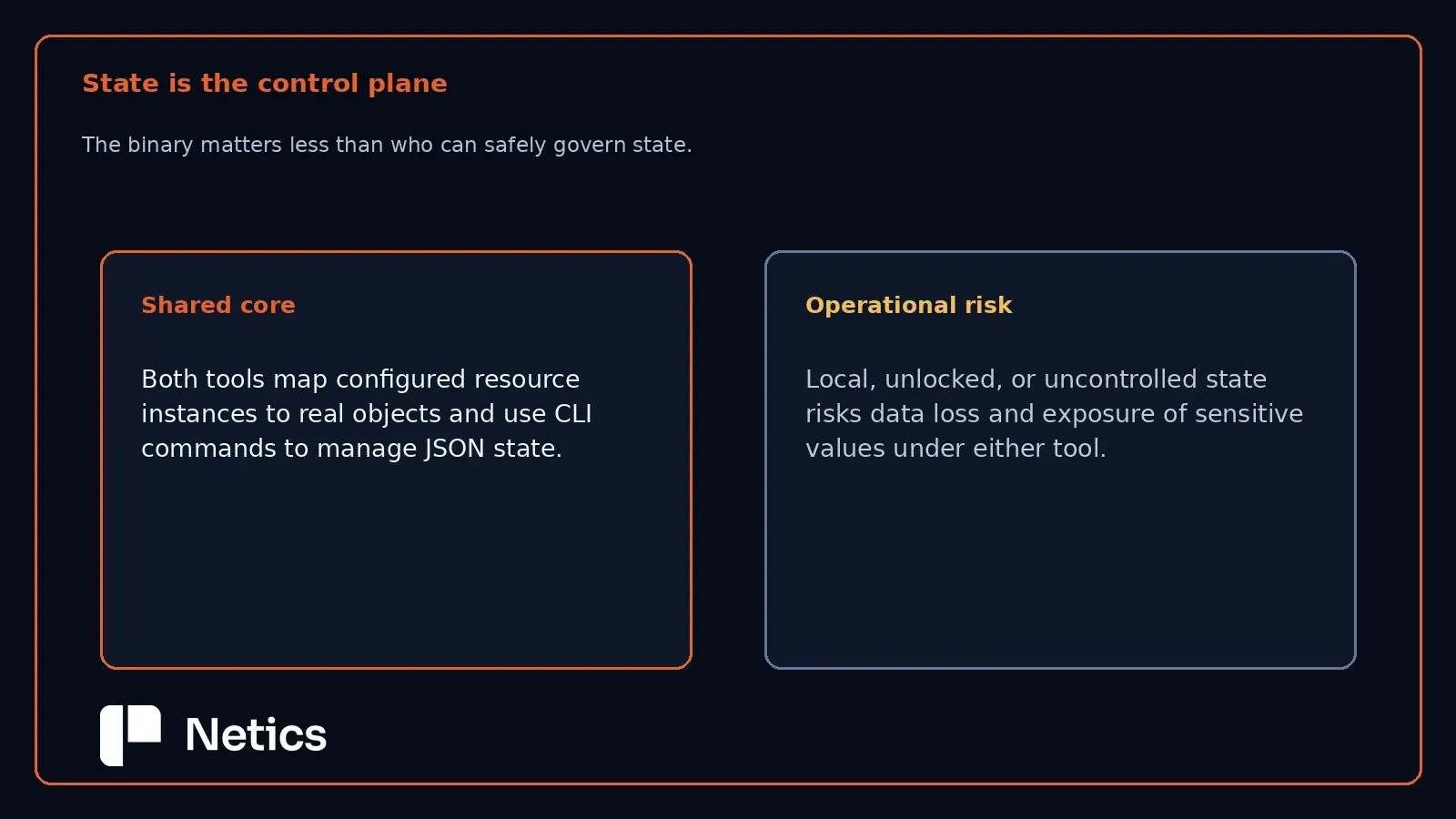
Terraform and OpenTofu both describe state the same way: it stores the bindings between the resources declared in your configuration and the real objects that exist in a remote system — cloud provider, SaaS platform, whatever you're managing. Before any plan or apply, the tool refreshes state against real infrastructure. Both projects expect a one-to-one mapping between a configured resource instance and a live remote object, and both warn that if you break that mapping manually — importing an object outside the tool's bookkeeping, or telling the tool to "forget" one — you're now responsible for keeping the mapping honest yourself.
Both tools store state as JSON. For a related Netics infrastructure decision, see this operational comparison. Both explicitly tell you not to hand-edit that file: use terraform state or tofu state instead, because the CLI is the layer the project commits to keeping stable even as the underlying state format shifts across versions. Both also expose -json output on output and show, specifically so external automation can consume a state or plan snapshot without needing to run the tool itself. On the state file itself — its structure, its purpose, its command-line handling — the two projects are, at this level of documentation, describing the same design.
Remote state, locking, and where the real risk sits
Terraform's own state documentation is blunt about the biggest single mistake teams make: storing state locally, or in a system that doesn't support state locking and access control — a plain git repo, for instance. Terraform's guidance calls this out explicitly as a path to data loss or exposure of secrets, since the state file can contain sensitive values in plain text. Both projects push teams toward a remote backend for the same reason: locking prevents concurrent applies from corrupting state, and centralizing storage means state doesn't live on someone's laptop as the single copy of truth for your production infrastructure.
This is the part governance conversations tend to skip past in favor of the licensing debate, and it's arguably the more consequential one. Whoever owns your infrastructure state also owns your blast radius. A state file with no locking and no encryption is a single point of failure that can leak credentials and get corrupted by a bad merge, independent of which binary you're running.
OpenTofu's compatibility promise, and its limits
OpenTofu's own migration documentation states that it aims to maintain compatibility with Terraform configurations, that most Terraform code is expected to work without modification, and that the process is designed to be safe and reversible. Its stated steps: back up state and code, install OpenTofu, initialize and verify the configuration, and test with a small change before going further. The same documentation flags one specific complication: setups built from multiple Terraform configurations linked by the terraform_remote_state data source need extra care during migration, and OpenTofu maintains a separate guide for that case.
That's a compatibility aim and a documented process — not a guarantee that every configuration migrates cleanly on the first attempt, and OpenTofu's own docs don't claim otherwise. Multi-module setups, and any use of remote-state data sources across configurations, are the places where "safe and reversible" earns its keep: back up first, test on the smallest slice you can isolate, and treat the multi-configuration guide as required reading rather than an edge case.
State and plan encryption: a real OpenTofu differentiator
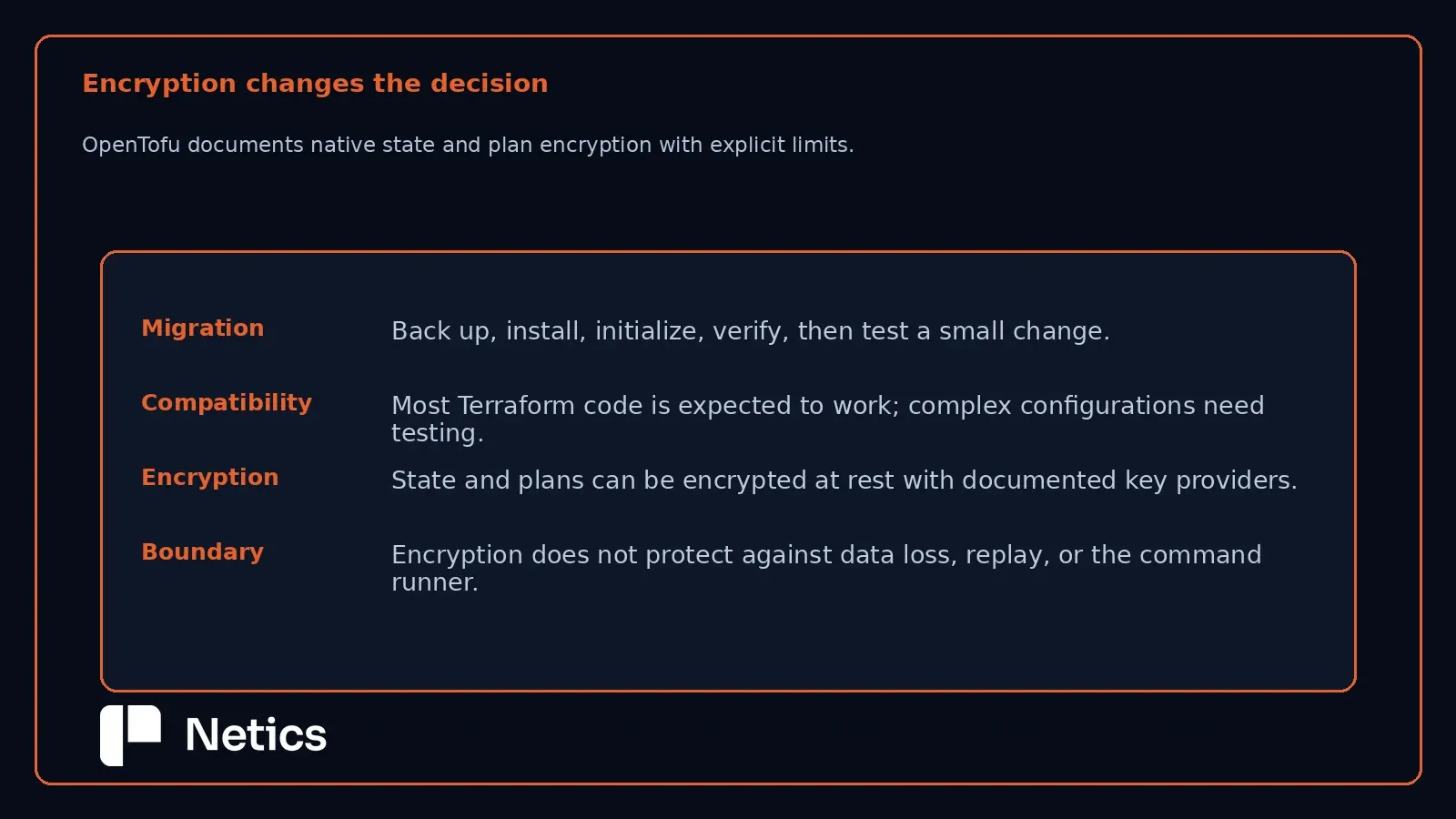
Here the two projects diverge in what's documented, not just in branding. OpenTofu's encryption documentation describes native state and plan encryption at rest — for local storage, for backend-stored state, and for the terraform_remote_state data source — configurable either in code (terraform { encryption { ... } } blocks) or via the TF_ENCRYPTION environment variable, with support for passphrase-based key derivation (PBKDF2), cloud KMS providers (AWS, GCP, Azure), and an external-command provider for custom key management.
OpenTofu's own documentation is careful about what this protects and what it doesn't: encryption protects state at rest against an attacker who gains file access, but it does not protect against data loss from a damaged file, does not protect against replay attacks using an old state or plan, and does not protect sensitive values from whoever is actually running the tofu command. The docs also warn about AES-GCM key saturation and recommend either a key-derivation provider with a long passphrase or a key-management system with automatic rotation — encryption configured carelessly is not much of a security control.
Terraform's own state documentation, in the source reviewed for this piece, addresses this ground differently: it recommends storing state in HCP Terraform or a remote backend for secure storage and collaboration, and it warns against systems without locking or access control, but it does not describe an equivalent native encryption-at-rest configuration in the material reviewed here. That's a documentation gap in what was checked, not a confirmed absence of any encryption capability across Terraform's whole ecosystem — backends and HCP Terraform may offer encryption at other layers not covered by the page reviewed. If encryption-at-rest is a compliance requirement for your infrastructure, verify current Terraform/HCP capability directly against HashiCorp's documentation before deciding it either way.
Pros and cons
Terraform
- Pro: the incumbent — largest provider ecosystem, most third-party tooling, most institutional knowledge on hiring.
- Pro: HCP Terraform gives a managed path for remote state, locking, and collaboration without self-hosting a backend.
- Con: state encryption at rest is not documented at the same native, backend-agnostic level as OpenTofu's, per the material reviewed.
- Con: license and governance model changes are the reason OpenTofu exists — teams sensitive to vendor licensing terms should read HashiCorp's current terms directly rather than relying on secondhand summaries.
OpenTofu
- Pro: native, backend-agnostic state and plan encryption, with documented key-rotation guidance.
- Pro: documented migration path designed to be safe and reversible, with a specific playbook for multi-configuration setups.
- Pro: community/foundation governance model, appealing to teams wary of single-vendor control over a tool this load-bearing.
- Con: younger fork — smaller cumulative provider-compatibility track record than Terraform, even with a strong compatibility aim.
- Con: "most Terraform code works without modification" is a stated goal, not a per-configuration guarantee — complex, multi-module setups need real testing before you trust it.
Decision matrix
| Situation | Lean toward |
|---|---|
| Compliance mandate for state/plan encryption at rest | OpenTofu (native, documented) |
| Heavy reliance on HCP Terraform-specific features today | Terraform |
| Governance/licensing sensitivity is a stated organizational concern | OpenTofu |
Complex multi-module setup with terraform_remote_state chains | Either — but budget real migration testing time, not a weekend |
| Small, single-module infrastructure, low urgency | Either — the documented compatibility aim means low migration cost if you switch later |
| No remote backend or locking configured yet | Fix this first, independent of which tool you pick |
A hypothetical worked example
This is a marked hypothetical, not a Netics client case. Take a Casablanca fintech running twelve Terraform modules across three environments, state stored in an S3 backend with DynamoDB locking, no encryption at rest configured. Its infrastructure lead is evaluating OpenTofu, but the deciding factor isn't licensing — it's that a payments-compliance audit is coming up and state-at-rest encryption for a backend holding provider credentials is now a checklist item. Per OpenTofu's own documentation, native passphrase or KMS-backed encryption is configurable directly against S3-hosted state without changing backends. Per the same documentation, the safe path is: back up the existing state, add the unencrypted fallback method during transition, migrate one environment at a time, and only remove the fallback once every module confirms clean reads. That's a testing project measured in weeks, not a flag flip — and the multi-module note in OpenTofu's migration docs is exactly the caveat that applies here, since the modules share remote-state references across environments.
Netics' position
State governance decisions are infrastructure decisions, not brand decisions, and the tool that owns your state matters less than whether that state is remote, locked, and encrypted at all. Teams treating the Terraform/OpenTofu choice as the whole conversation are skipping the more consequential one: an unlocked, unencrypted state file is a liability under either tool. If your compliance posture specifically requires state-at-rest encryption today, OpenTofu's documented native support is a real, verifiable differentiator worth evaluating on its own merits — not as a proxy for a licensing argument. If it doesn't, the migration decision should be driven by your actual module complexity and how much testing time you can budget for the transition, not by which side of the fork debate feels more comfortable.
TL;DR
- Terraform and OpenTofu describe state — bindings between config and real infrastructure, JSON format, CLI-mediated edits only — in essentially the same terms.
- The bigger governance risk than "which tool" is whether state is remote, locked, and access-controlled at all; Terraform's own docs warn plainly against unlocked or uncontrolled storage.
- OpenTofu documents a migration path designed to be safe and reversible, with a specific guide for multi-configuration setups using
terraform_remote_state— that caveat matters for real infrastructures. - OpenTofu ships native, backend-agnostic state and plan encryption at rest with documented key-rotation guidance; the Terraform state documentation reviewed here does not describe an equivalent native mechanism, though other Terraform/HCP layers may offer encryption not covered by that page.
- Pros, cons, and a decision matrix point toward OpenTofu for compliance-driven encryption needs and governance-sensitive teams, and toward Terraform for teams already deep in HCP Terraform-specific tooling.
- A hypothetical Casablanca fintech example walks through what a real, staged, multi-module encryption migration looks like using OpenTofu's own documented fallback method.
- Netics' position: fix locking and encryption before debating which binary runs
planandapply— the tool choice is secondary to whether state is actually governed.
If you need a state-governance review, talk to Netics before changing the production binary.
*Sources: OpenTofu Migration docs, OpenTofu State/Plan Encryption docs, HashiCorp Terraform State docs — retrieved 2026-08-31.