
A 350M Model Gets Better at Structured Output—The Real Win Is the Training Loop
A small GRPO experiment improves schema compliance, but the durable lesson is how teams should measure and constrain model reliability.


TL;DR
A small GRPO experiment improves schema compliance, but the durable lesson is how teams should measure and constrain model reliability. The article covers: Structured output is a production contract; The reward design explains the result; The gain is targeted, not general intelligence; Evaluation must stay independent; Small models change the economics of validation; The operational loop is more valuable than the checkpoint; The Netics position; A buyer’s test for structured-output fine-tuning.
Structured output is a production contract
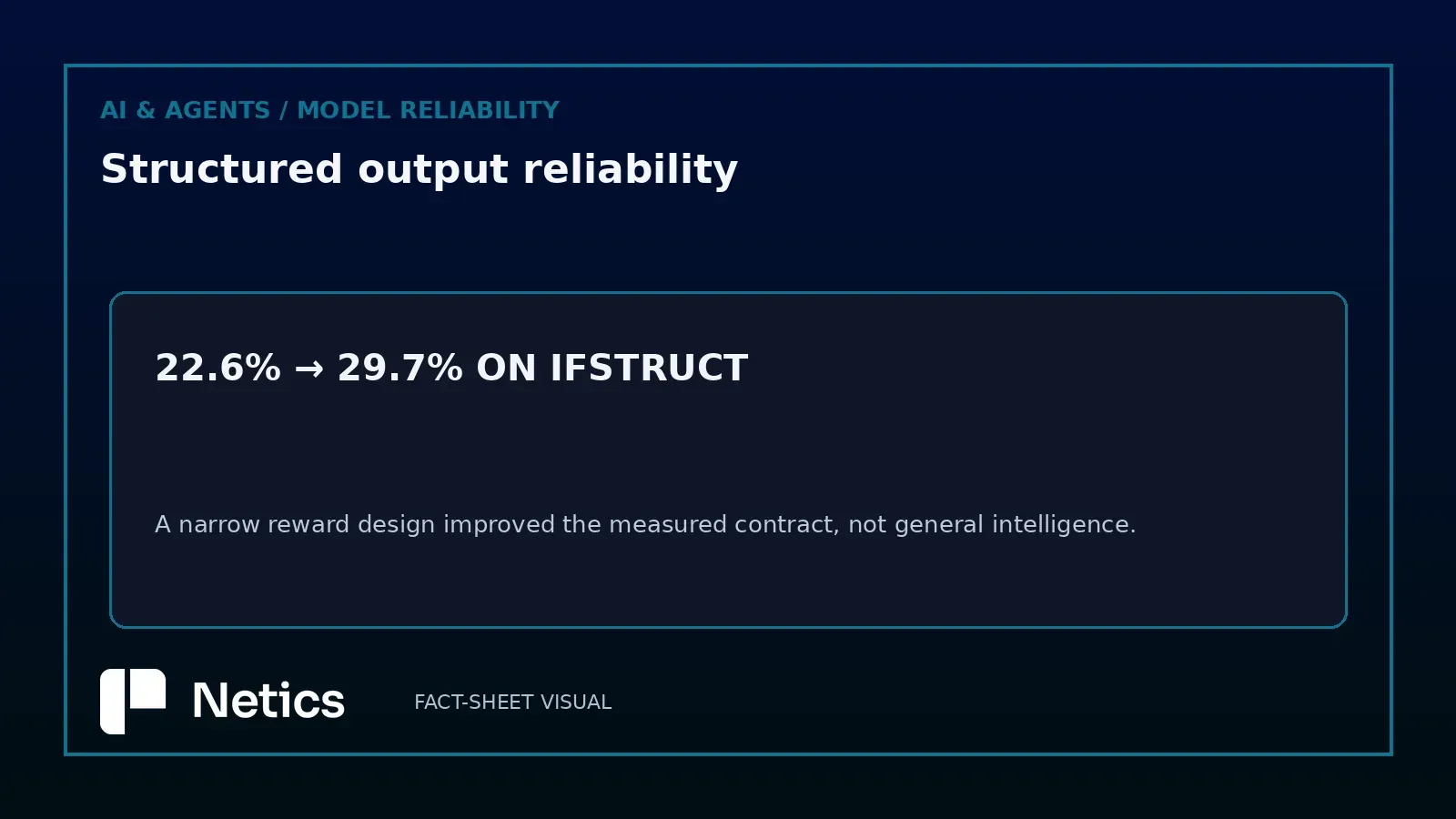
Hugging Face’s public recipe fine-tunes LiquidAI’s LFM2.5-350M with GRPO and evaluates it on IFStruct. The reported experiment moves the model from 22.6% to 29.7% overall pass rate after about 500 training samples and 100 steps. JSON rises from 18.0% to 31.9%, while YAML changes only slightly from 27.2% to 27.5%. Those numbers matter because structured output is not a cosmetic benchmark. A parser, workflow engine, or database either receives a valid shape or it does not.
Figure: Structured output is a production contract.
The reward design explains the result
The experiment uses three reward functions: parseable format, top-level field count, and schema validation. Their weighted combination gives the model a signal closer to the actual integration contract than a generic helpfulness score. The training data also includes fenced-code-block instructions and top-level-array tasks, so the model is being trained on failure modes that downstream systems actually encounter. This is the useful lesson: reliability improves when the reward describes the boundary that production will enforce.
The gain is targeted, not general intelligence
The largest improvement appears in JSON and bare-list compliance, exactly where the training was aimed. YAML barely moves. The result should not be advertised as a general reasoning upgrade or as proof that a 350M model can replace a larger model across tasks. It is evidence that a small model can become more dependable for a narrow output contract when the dataset, reward, and evaluator are aligned. That is a much more practical claim—and one teams can test themselves.
Evaluation must stay independent
The recipe compares a local llama.cpp/BF16 serving setup and uses 2,000 evaluation samples. The baseline is reported at 22.6%, close to the 21.1% figure cited from the IFStruct release context, while the tuned result reaches 29.7%. The comparison is useful, but the training data is not identical to the evaluation distribution. Teams should keep a held-out set that the reward design never sees, include malformed and adversarial requests, and report per-schema failure modes. A single aggregate percentage hides which contract still breaks.
Small models change the economics of validation
A 350M model can run in environments where a larger model is too slow, expensive, or difficult to deploy. That makes it interesting for local extraction, routing, classification, and form generation. But smaller does not mean automatically safe. A model that emits valid JSON can still select the wrong value, omit a business-critical field, or produce a plausible but unsupported decision. Schema validation must therefore sit beside semantic checks, allowed-value validation, confidence thresholds, and human escalation.
Figure: Small models change the economics of validation.
The operational loop is more valuable than the checkpoint
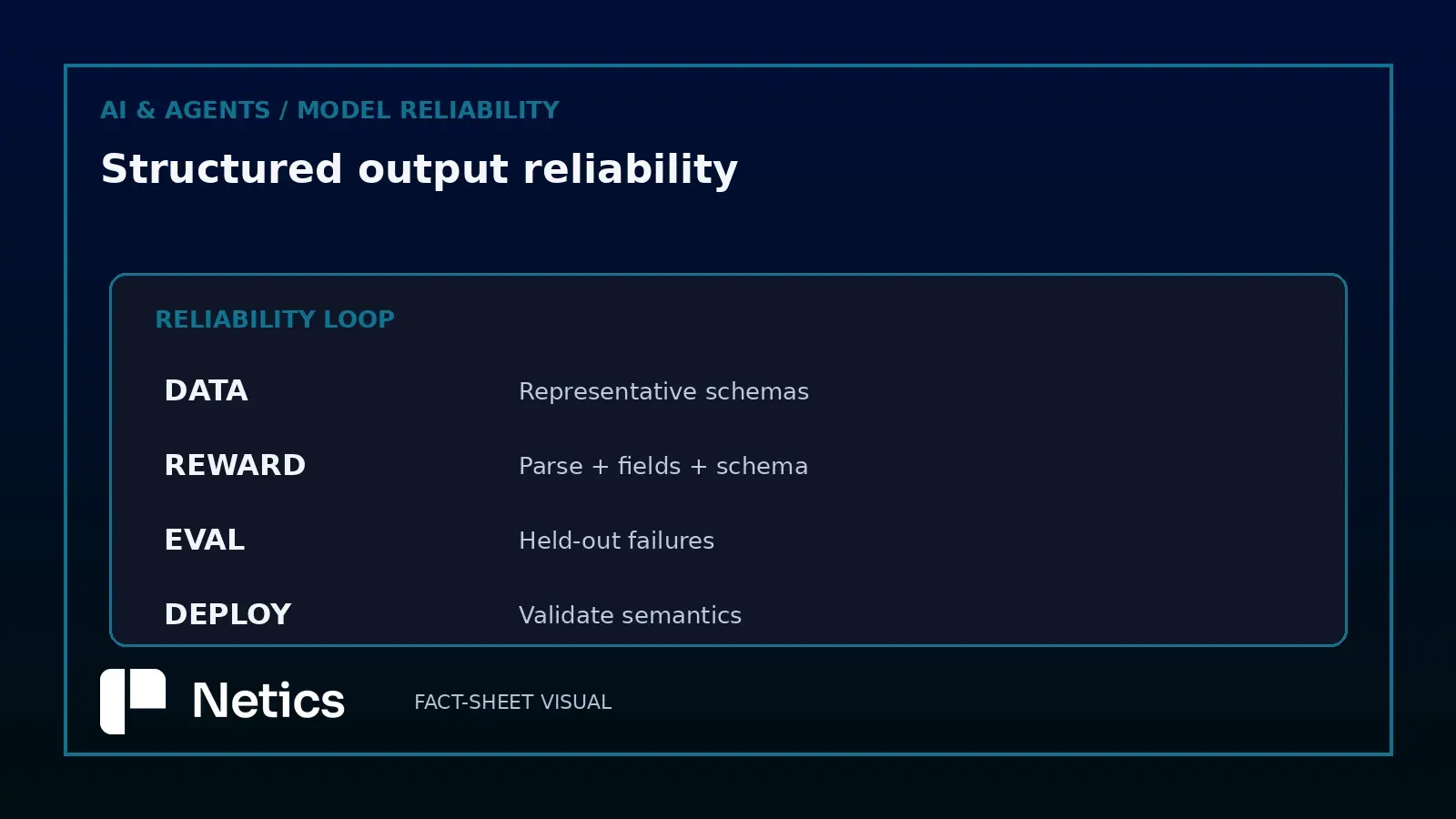
The public notebook exposes a repeatable loop: choose representative samples, define measurable rewards, train a small adapter, serve the model locally, and evaluate against a fixed benchmark. That loop is the asset. Checkpoints age, schemas evolve, and production inputs drift. Keep the dataset version, reward weights, adapter configuration, serving flags, evaluator version, and failure examples together. When the contract changes, rerun the loop instead of assuming yesterday’s score still predicts today’s integration.
What GRPO actually changes about the training loop
Group Relative Policy Optimization, introduced in DeepSeek-AI’s DeepSeekMath paper and later central to DeepSeek-R1, removes the separate critic (value) network that standard PPO requires. Instead of learning a value estimate to judge how good a completion is, GRPO samples a group of completions for the same prompt, scores each with the reward function, and uses the relative ranking within that group as the advantage signal. This matters for a case like the IFStruct experiment: a small reward model built from three concrete checks (parseable format, field count, schema validation) is exactly the kind of cheap, well-defined reward GRPO was designed to exploit, since it needs many sampled completions per step rather than a learned critic that itself has to generalize. That is also why this approach transfers well to a 350M model — the training overhead removed by dropping the critic network matters proportionally more at small model sizes.
Syntactic and semantic failures are different bugs
A schema validator catches syntactic failures: malformed JSON, a missing required field, a wrong type. It does not catch semantic failures: valid JSON with a hallucinated value, an out-of-range number, or a field filled with a plausible-sounding but unsupported answer. These need separate checks — allowed-value lists, range constraints, confidence thresholds — layered on top of schema validation, not folded into it. Reporting one aggregate pass rate conflates both failure classes and hides which one a given fine-tuning pass actually improved.
The Netics position
The experiment is a strong argument for narrow, measurable model improvement—not for declaring small models solved. Teams should start with the output contract they actually need, define the failure taxonomy, and train only where the cost of a larger model is material. Keep independent evaluation and semantic validation outside the reward loop. A 7.1-point improvement is valuable when it reduces retries or manual repair; it is misleading when it becomes a single headline detached from the workflows that consume the output.
A buyer’s test for structured-output fine-tuning
Ask for the held-out schema set, not only the headline score. Request the confusion between parse errors, missing fields, wrong types, and semantically wrong values. Measure latency, memory, retry rate, and escalation rate on the same serving stack used in production. Then compare the tuned small model with a larger baseline on the cases that matter. For an architecture review, visit Netics.
For an architecture review, visit Netics or Book a free 30-minute audit.
Sources
- Primary source: https://huggingface.co/blog/grpo-with-trl-ifstruct — accessed for this draft.