
Microsoft's Safe Participation Framework Treats Youth AI Access as a Design Problem
Microsoft's Safe Participation Framework links youth safety, privacy and opportunity. Netics examines the controls, age signals and accountability behind that promise.

TL;DR
Microsoft has published a Safe Participation Framework for young people’s online experiences. Its three pillars—safety by design, age-differentiated experiences, and education and empowerment—form one operating model: protection, privacy, and the opportunity to participate should not be traded against each other. The announcement points to existing work across PhotoDNA, Bing, SafeSearch, Windows Family Safety, Xbox, Copilot, the Windows Age API, and digital-literacy resources such as Behind the Chat.
Netics’ reading is narrower and more demanding: a framework becomes meaningful only when each promise has an observable control, a privacy boundary, an owner, and a way to learn from failure. Microsoft is right to reject a binary choice between safety and access. The difficult work now is proving that age signals, product safeguards, family tools, education, and external partnerships operate together without turning children into permanent data subjects.

Microsoft frames participation as a design obligation
The announcement’s most important move is conceptual. Microsoft does not present youth safety as a blocklist added after a product is built. It describes a design approach that begins by identifying foreseeable risks, examining product features and user experiences, and applying safeguards proportionate to those risks. It also says that the approach must change as research, science, customers, governments, and other stakeholders reveal new information.
That is a stronger starting point than treating “child safety” as one setting. A young person encounters a system through authentication, content ranking, conversation design, reporting, family controls, crisis responses, data handling, and the surrounding adults who help interpret what happens. A control that works in one layer can fail in another. Microsoft’s language about proportionate safeguards acknowledges that risks are not uniform across technologies and services.
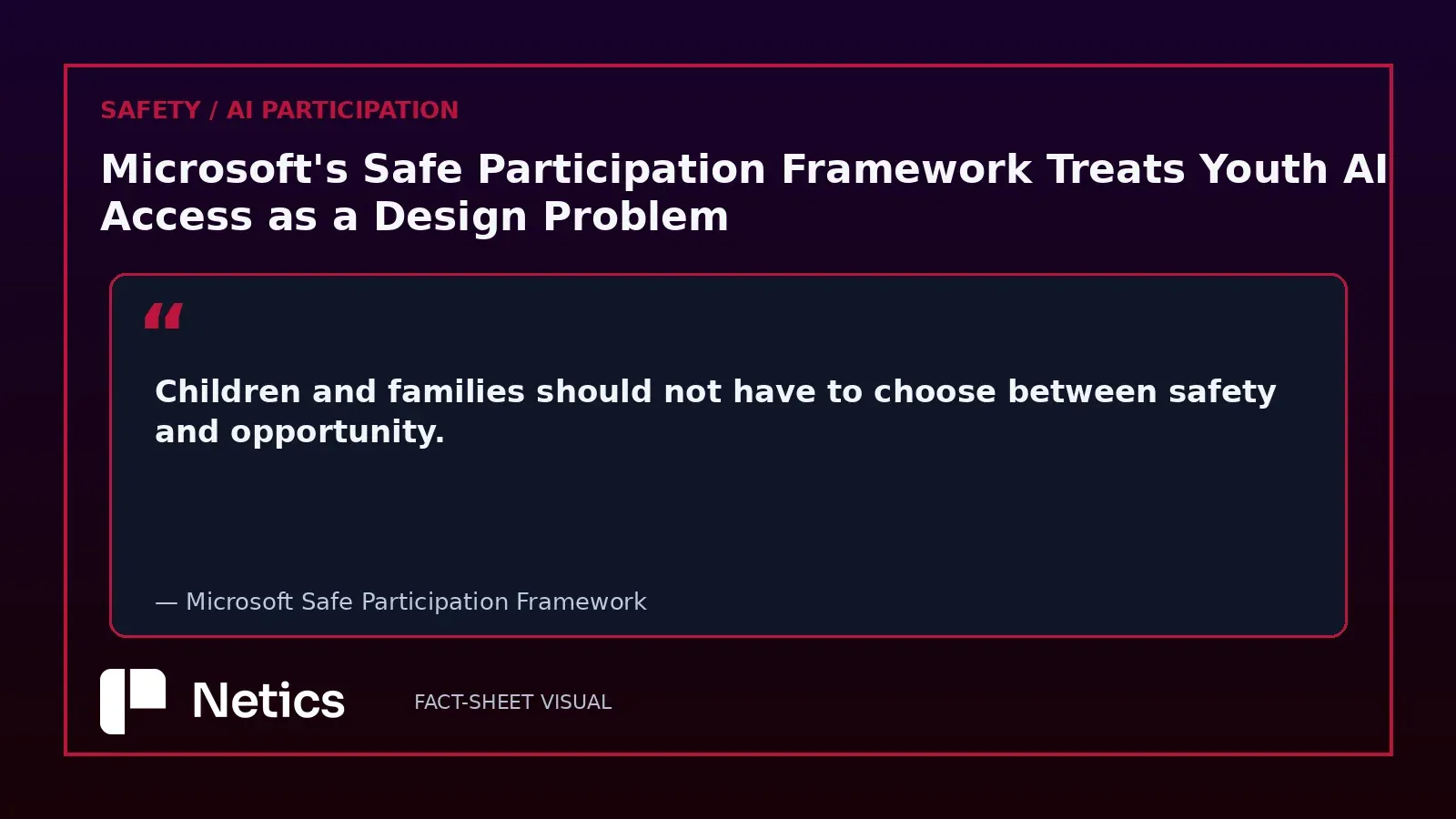
The framework also makes a claim about participation. Microsoft says children and families should not have to choose between protections and the opportunities technology can provide. That opportunity is described in educational, social, and economic terms, not merely as more time inside an app. The distinction matters. If the goal is participation, a product team must ask whether a safeguard blocks a harmful pathway while preserving a legitimate one, and whether the user can understand why an action was restricted.
For Netics, this is where policy language becomes architecture. “Safe by design” should lead to a risk register tied to features, a decision log for safeguards, test cases for foreseeable abuse, and a route for changing controls when evidence changes. The announcement does not claim that Microsoft has solved that measurement problem. It says the framework is a foundation that will continue evolving. That humility is appropriate; the accountability challenge remains.
Three pillars, one operating model
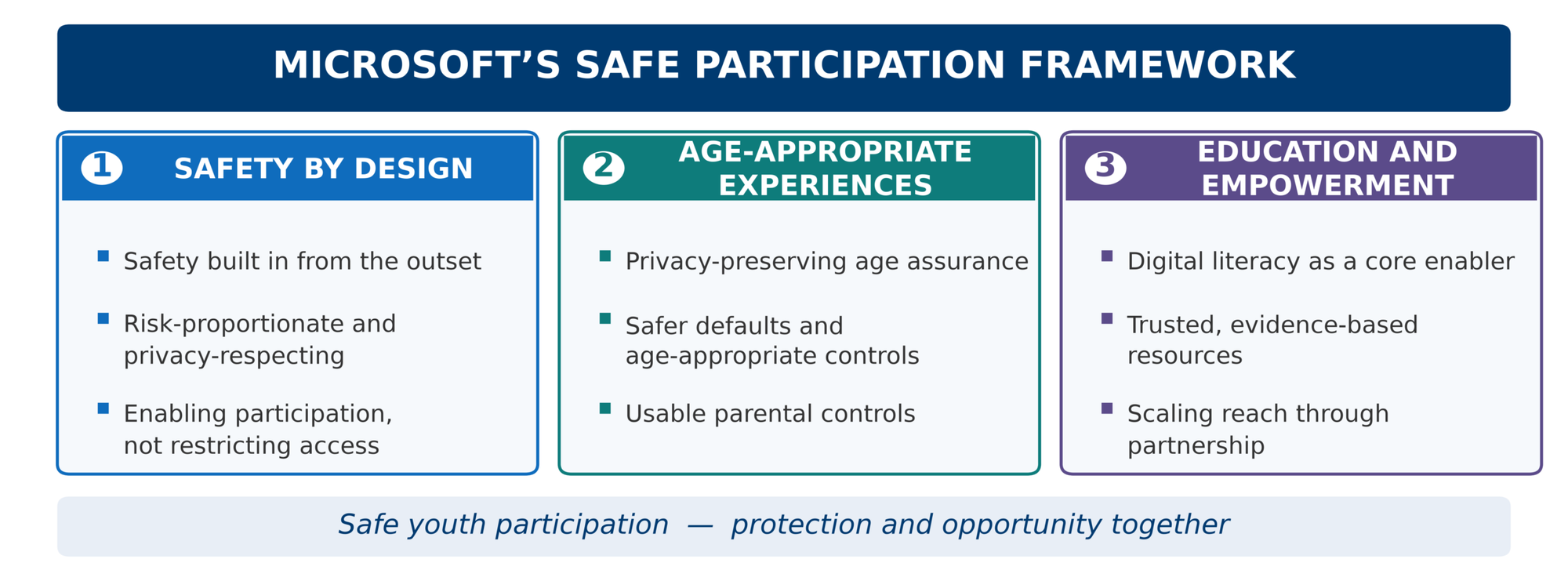
Microsoft divides the framework into three pillars, but they are not three independent programmes. Safety by design supplies the product discipline. Age-differentiated experiences determine how that discipline responds to development, context, and local requirements. Education and empowerment give young people, families, educators, and trusted adults the knowledge and feedback channels needed to use the system safely.
The first pillar is illustrated through Microsoft’s longer investment in online protection, beginning with PhotoDNA in 2009 and continuing into safeguards for AI experiences and emerging harms such as synthetic and non-consensual intimate imagery. Microsoft also points to new protections and defaults in Windows Family Safety, saying that families want tools that are simpler, intuitive, and easier to use. In Bing, the company says it extended its established safety stack to image-upload features in Bing Video Creator and expanded SafeSearch globally to additional categories of harmful content.
The second pillar is not simply an age gate. Microsoft says young people are not one group and that needs, capabilities, and expectations change with age, development, and context. Its Xbox family-safety and privacy tools cover online interactions, content access, spending, screen time, and privacy settings. Microsoft says it is applying many of those learnings to Copilot: users must sign in, access is restricted for children under 13 or older where local law requires, and additional measures address harmful content, self-harm risk, healthy use, reporting, transparency, break reminders, and delusional outputs.
The third pillar recognises that technology cannot deliver safe participation by itself. Microsoft describes digital literacy as a core part of child safety and points to Behind the Chat: A Human Guide to Safe AI Conversations, with classroom resources for educators and materials for parents and trusted adults. The company says these resources will expand throughout Europe, Asia, and the Americas beginning in fall 2026.
The useful reading is not that three pillars sound comprehensive. It is that each pillar depends on the others. A family cannot make an informed choice without understandable education. Education cannot compensate for a product that ignores foreseeable harms. Age differentiation cannot be trusted if the signal is collected opaquely or used beyond its purpose.
Age signals are a control point, not a verdict
The Windows Age API is the announcement’s clearest platform-level mechanism. Microsoft says the API, expanded age-assurance capabilities, and enhanced family-safety tools are intended to give developers trusted age signals that support age-appropriate protections across a broader ecosystem. It also says the approach is privacy-conscious and aims to minimise the collection and sharing of personal data.
That is the right problem to solve, but an age signal should not be treated as a complete understanding of a person. It is a bounded input to a product decision. The important questions are therefore operational: what signal is exposed, to which developer, for what purpose, for how long, with what confidence, and what happens when the signal is wrong? Microsoft’s announcement emphasises privacy-preserving signals and user expectations around understanding how information is collected, used, and protected. It does not provide a full public control matrix in this source capture, so Netics will not infer one.
The practical standard should be data minimisation plus contestability. A developer should receive no more information than the protection requires. A family should be able to understand the result. A product should have a safe path for correction without asking a young person to disclose more sensitive information than the original decision needed. The age signal should also remain separate from unrelated profiling. Otherwise, a tool introduced to reduce data collection can become a new distribution channel for it.
This is not an argument against age assurance. It is an argument for making the boundary explicit. The framework’s strongest future test will be whether the platform can support differentiated safety without quietly centralising more identity data.
Education turns safeguards into capability
The education pillar gives the framework a needed human layer. Microsoft says young people and families should have direct feedback opportunities and easy access to tools and resources that help them evaluate what they encounter and decide when to seek help. That is more realistic than assuming a warning label can carry the whole burden.
Behind the Chat is presented as a guide to the opportunities and risks of AI companionship. Its classroom resources, parent materials, and trusted-adult resources reflect an ecosystem approach. Microsoft also says it will continue working with educators on safety and privacy, and that it plans to deepen partnerships with researchers, AI Safety Institutes, governments, and civil society over the coming year to advance research, evaluations, and benchmarks.
Netics’ qualification is that education must be connected to product telemetry and remediation, not used as a substitute for them. Feedback needs a named destination. Reports need triage. A family resource should explain not only what a system can do, but also what the provider will do when a safeguard fails. Otherwise, empowerment becomes a communication layer floating above an unchanged control plane.
The accountability question the framework leaves open
Microsoft presents the framework as an evolving foundation and explicitly says no single organisation can do this alone. That is credible. Online safety crosses company boundaries, legal systems, schools, homes, and civil society. Collaboration is necessary.
But collaboration does not dissolve responsibility. A provider still needs to say which team owns each control, what evidence is reviewed, how safeguards are evaluated for different ages and contexts, and how users can challenge a decision. The source capture names many mechanisms and commitments, but it does not give a public scorecard for outcomes. Netics therefore treats the framework as a policy direction, not as proof of effectiveness.
The distinction protects both sides. It avoids dismissing real investments in safety, while refusing to confuse a well-structured announcement with independent evidence that every control works. Microsoft says it expects the framework to evolve as technology, research, and societal expectations change. That sentence should become the operating promise: publish what changed, why it changed, what was learned, and which trade-offs remain.
Netics’ reading: participation needs evidence
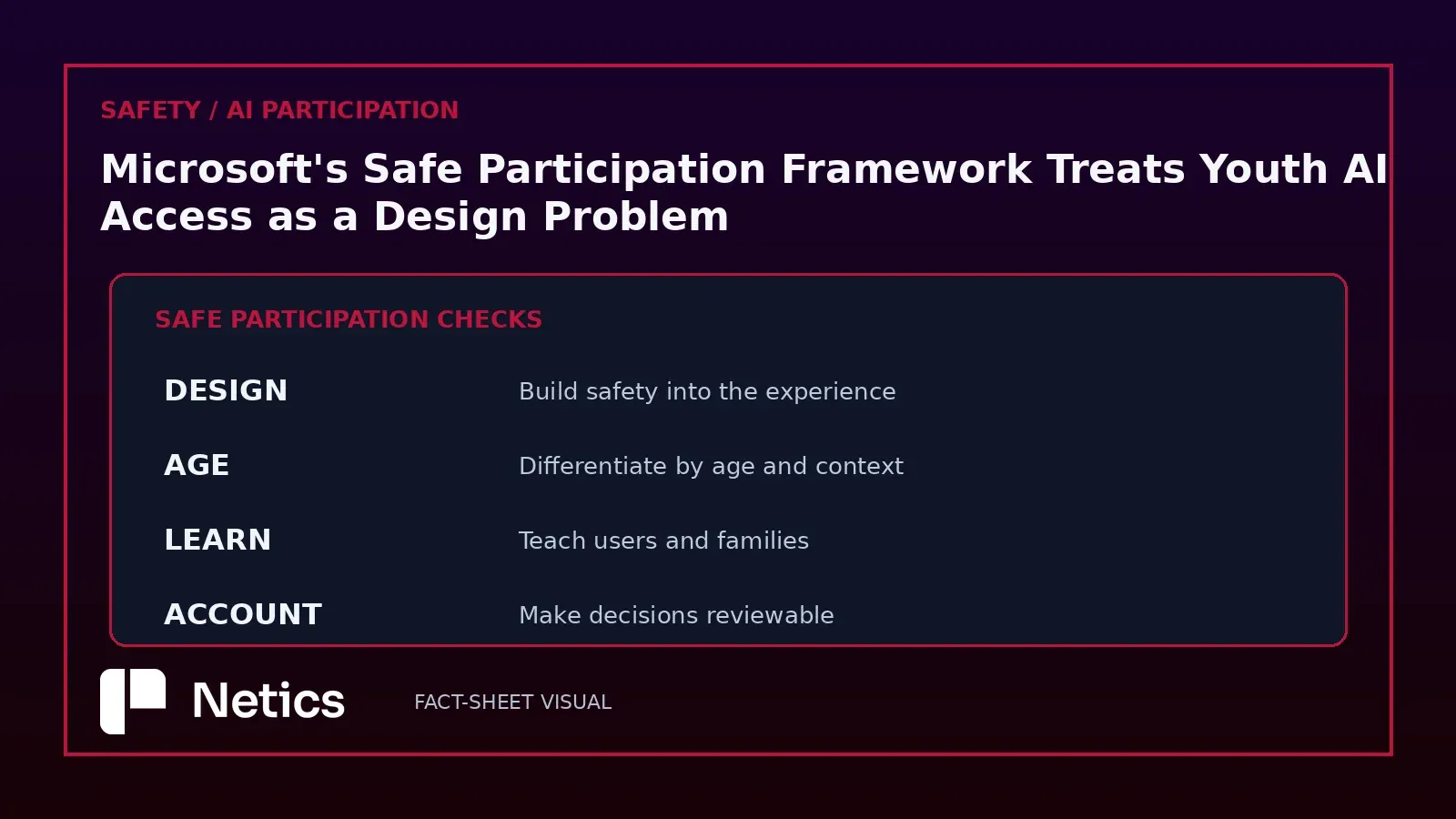
Microsoft is right that protection and opportunity should be designed together. The three-pillar structure is coherent: build safety into products, differentiate experiences by age and context, then give people the knowledge and feedback routes to navigate them. The platform direction around privacy-preserving age signals is especially important because the ecosystem cannot scale age-appropriate controls if every downstream service independently asks families for more personal data.
The framework’s credibility will be earned in the seams. Can an age signal support a safer experience without becoming a new identity database? Can a family understand a restriction and recover from an incorrect one? Can an educator report a harmful pattern and see it reach the team responsible? Can external researchers and civil society test claims without being reduced to advisory decoration?
Those are not reasons to reject the framework. They are the conditions that make it more than a statement of intent. Technology companies should borrow the discipline even when they do not use Microsoft’s products: map foreseeable harms to controls, minimise the data required, separate age signals from broad profiling, teach users what the system is doing, and preserve a documented route for feedback and correction.
For more source-grounded analysis of AI and security decisions, visit the Netics homepage.
Sources
- Microsoft On the Issues — Safe Participation Framework: Opportunity and Safety for the Next Generation in the Age of AI, published September 10, 2026; primary source for the framework, pillars, product examples, age-signal approach, education resources, and partnership commitments.
Source: Microsoft On the Issues, 10 September 2026 — https://blogs.microsoft.com/on-the-issues/2026/09/10/safe-participation-framework-opportunity-and-safety-for-the-next-generation-in-the-age-of-ai/