
Quantum Readiness Gets a Scoreboard: CUDA-Q Logical and the QUOPS Benchmark
NVIDIA's CUDA-Q Logical orchestration layer and Sandia's QUOPS benchmark give fault-tolerant quantum computing something it lacked: a measurable readiness test. Netics explains why that matt

TL;DR
- NVIDIA added CUDA-Q Logical, an open orchestration layer for fault-tolerant quantum applications, and adopted Sandia's QUOPS benchmark into the CUDA-Q platform.
- Fermilab reports a 7x acceleration (five months to three weeks) using CUDA-Q Logical; Iceberg Quantum models 1,000 logical qubits from 150,000 physical qubits.
- Netics' take: QUOPS matters more than any single qubit count, because it turns vendor readiness claims into a common measurable scale — the same move every other engineering market needed.
- The honest reading of the headline results: the 7x figure is a bounded tooling gain and the 1,000-logical-qubit model is an estimate, not a running system.
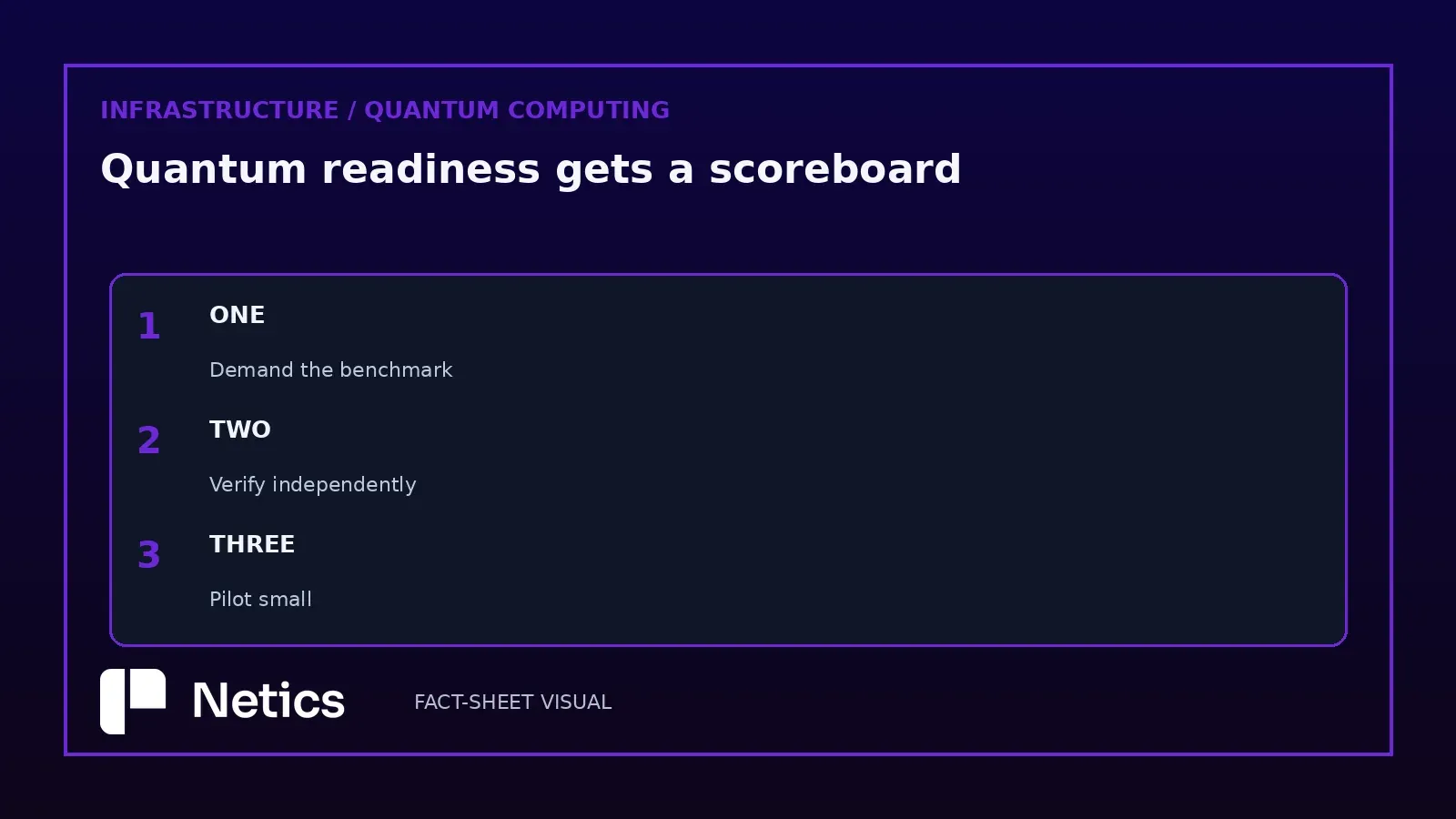
- Buyers should demand a documented benchmark, independent verification, and a small pilot — the pattern Netics applies to every infrastructure purchase.

Why this announcement is a measurement story
Most quantum computing news is a physics story: more physical qubits, higher fidelity, longer coherence. NVIDIA's September 14 announcement is different in kind. It ships CUDA-Q Logical, an open orchestration layer for designing and testing fault-tolerant quantum applications, and it builds Sandia's QUOPS benchmark directly into the CUDA-Q platform. Both moves are about how you measure progress, not about a single record number.
The distinction matters because fault-tolerant quantum computing is not a hardware demo problem anymore. Logical qubits are carved out of many physical qubits through error correction, and the engineering question is not "how many qubits does the chip have" but "how many logical qubits can a full system support for a useful calculation." That is an orchestration and resource-provisioning problem — exactly the kind Netics spends its working life on in classical systems.
CUDA-Q Logical: fault-tolerant design becomes a workflow
The orchestration layer lets researchers design and switch between the components of a fault-tolerant system: architecture, qubit type, error-correction approach, runtime, and resource requirements. The two named results show the structure of the gain. Fermilab used CUDA-Q Logical to transform fault-tolerant system designs into a repeatable, verifiable computational workflow, accelerating development from five months to three weeks — a 7x speedup. Iceberg Quantum modeled its fault-tolerant architecture for Diraq's qubits and showed 1,000 logical qubits can be created with just 150,000 physical qubits, roughly 10x fewer than Diraq's previous estimates.
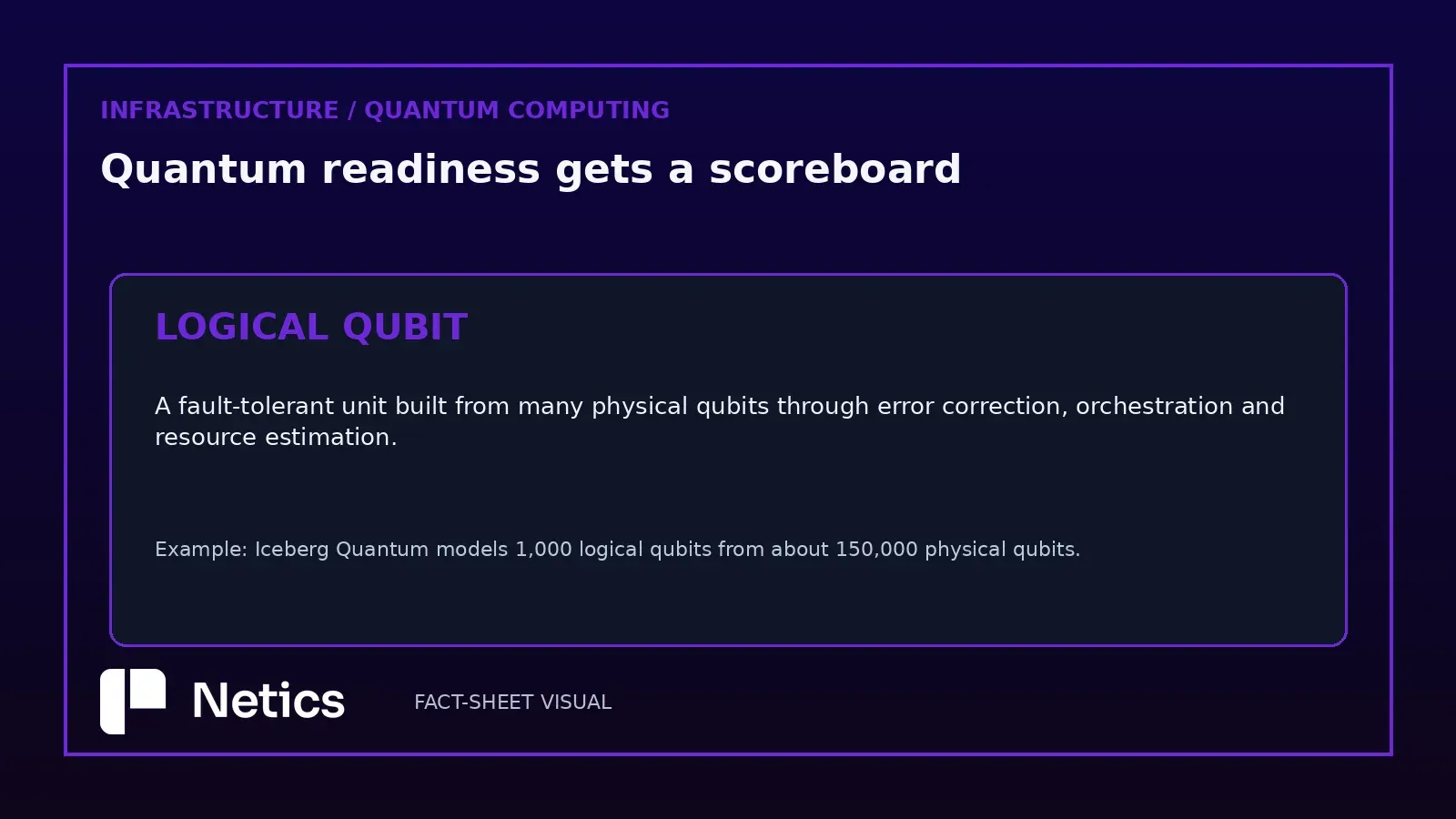
Read those numbers the way an operator would. A 7x reduction in development time is a tooling result, and tooling results compound: the more teams can simulate and verify fault-tolerant designs on GPUs, the faster the whole ecosystem converges on workable architectures. The 10x reduction in physical qubits per logical qubit is the more consequential number, because it attacks the dominant cost driver of the entire field: error-correction overhead.
QUOPS: a benchmark the industry can argue about
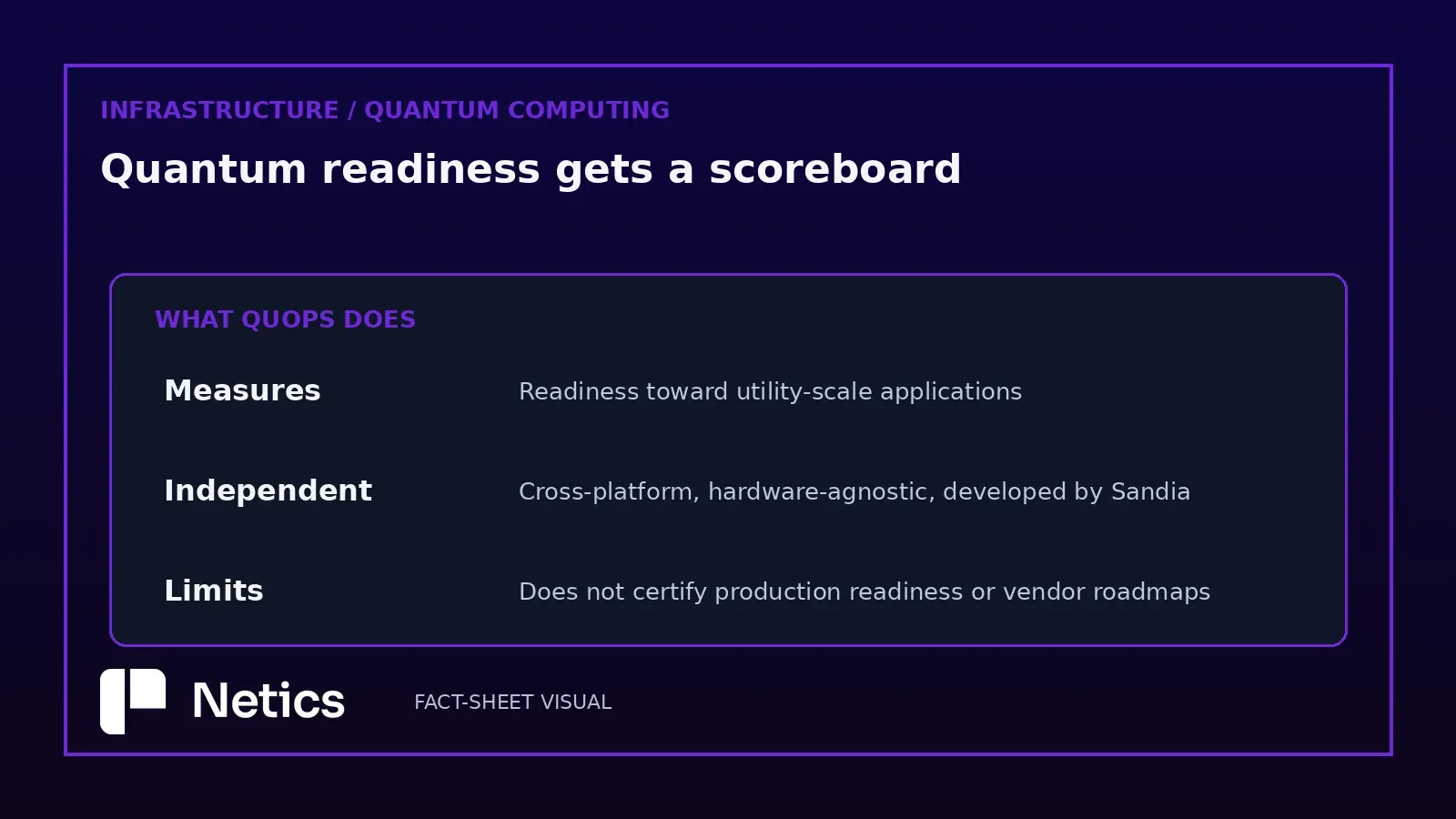
Sandia developed QUOPS to measure how close fault-tolerant quantum hardware is to practical applications. The key design choices are independence and hardware-agnosticism: it is a cross-platform benchmark with a reference implementation in CUDA-Q, and Sandia shared early results in a preprint ahead of IEEE Quantum Week covering QPUs from Google, IBM, and Quantinuum. In other words, three competitors measured on a common scale, published before the event.
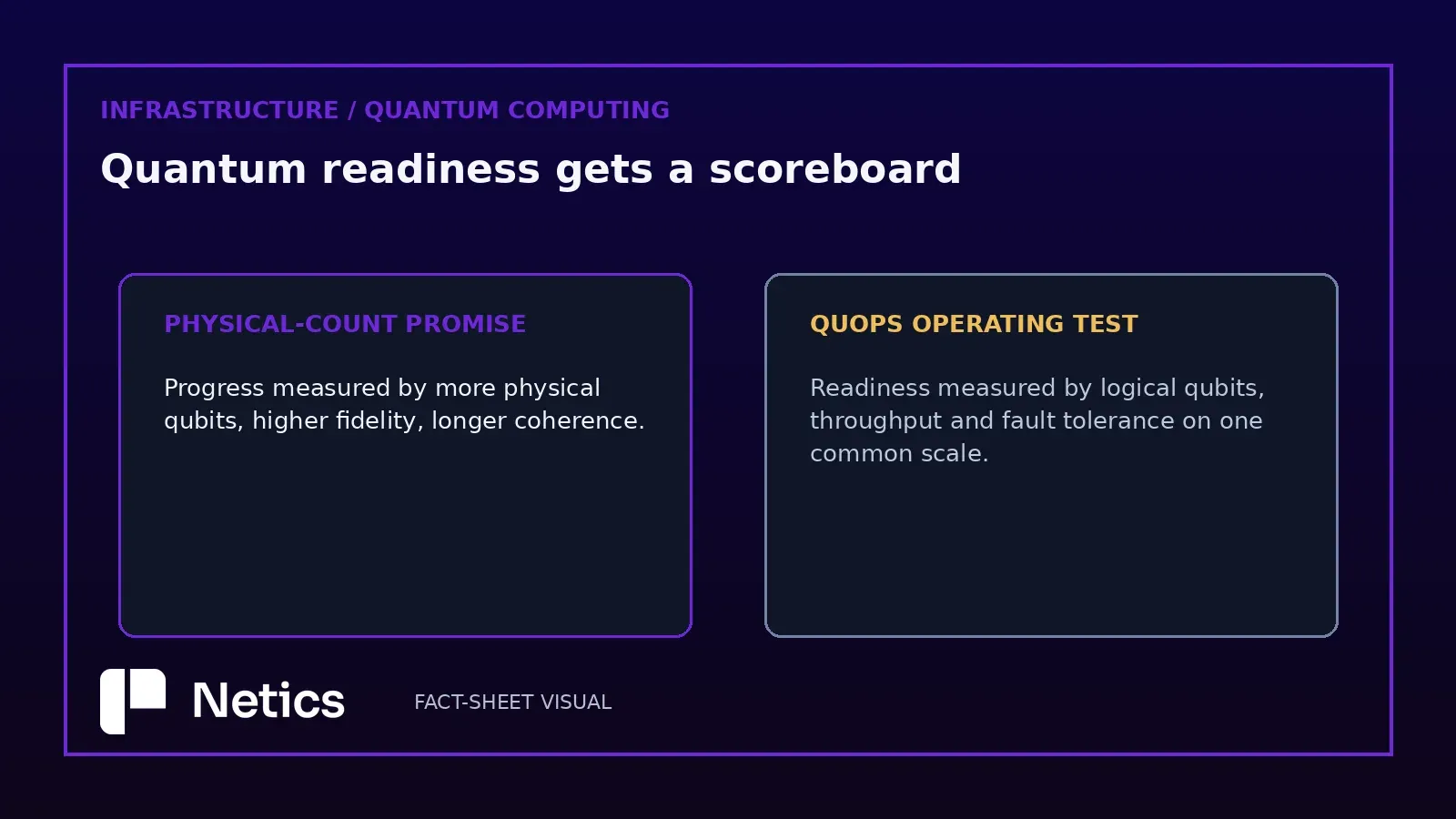
Netics' position is that this is the moment the market starts behaving like every other engineered market. Nobody buys a classical supercomputer on vendor-titled record counts; they buy on standardized benchmarks with documented methodology. Quantum computing has been selling on physics records for years precisely because no credible common scale existed. QUOPS is not the final answer — benchmarks always argue — but it is the first credible common scale with independent methodology, and that changes procurement conversations in finance, energy, and pharma.
What the honest reading of the results looks like
The two headline numbers deserve a careful reading. The Fermilab 7x figure is a workflow speedup on early work: three weeks versus five months of building specialized infrastructure, which is a real but bounded claim about tooling value. It does not say fault-tolerant quantum applications are ready for production. The Iceberg result is a modeling outcome, an architecture estimate using CUDA-Q Logical; it shortens the iteration loop between architecture choices, but a modeled system is not a running one. The announcement itself classifies forward-looking statements accordingly.
For a Netics client, the practical takeaway is simpler than the physics. If your organization is evaluating quantum computing for optimization, materials, or financial modeling, the conversation should now open with QUOPS-style evidence, not with qubit counts. Ask which benchmark was run, how the methodology is documented, and how the vendor's result was verified independently. If a vendor cannot answer those three questions, the honest price of the conversation is the same as with any other immature infrastructure: pilot small, verify independently, and do not let a record number make the architecture decision for you.
A procurement pattern borrowed from classical systems
The pattern here is not new — it is the one Netics applies to every infrastructure purchase. Standardize the measurement before you compare the products. CUDA-Q Logical gives teams a workflow to simulate and verify fault-tolerant designs; QUOPS gives buyers a scale to compare hardware readiness. Together they move quantum computing from a physics pitch to an engineering evaluation. That is progress a technical team can plan on, even while the hardware itself remains years from mass production.
For a practical conversation about evaluating new infrastructure — quantum or otherwise — book a free 30-minute audit with Netics or start from the Netics homepage.
Sources
- NVIDIA Expands Open Source CUDA-Q Platform for Fault-Tolerant Quantum Computing — NVIDIA Newsroom, September 14, 2026. Primary source for CUDA-Q Logical, Fermilab, Iceberg Quantum, and QUOPS details.
Source: "NVIDIA Expands Open Source CUDA-Q Platform for Fault-Tolerant Quantum Computing" — nvidianews.nvidia.com, September 14, 2026.