
Anthropic's 26% Is a Measurement Story Before It Is a Warning
Anthropic revealed Claude "leads" 26% of its AI R&D and published the methodology behind the number. Netics reads the metric design: what 26%, 90%, and 30,000 agents really show, and what st

TL;DR
- Anthropic published three measurements for tracking AI development inside frontier labs: AI-led R&D, oversight of AI agents, and compute allocation (September 17, 2026).
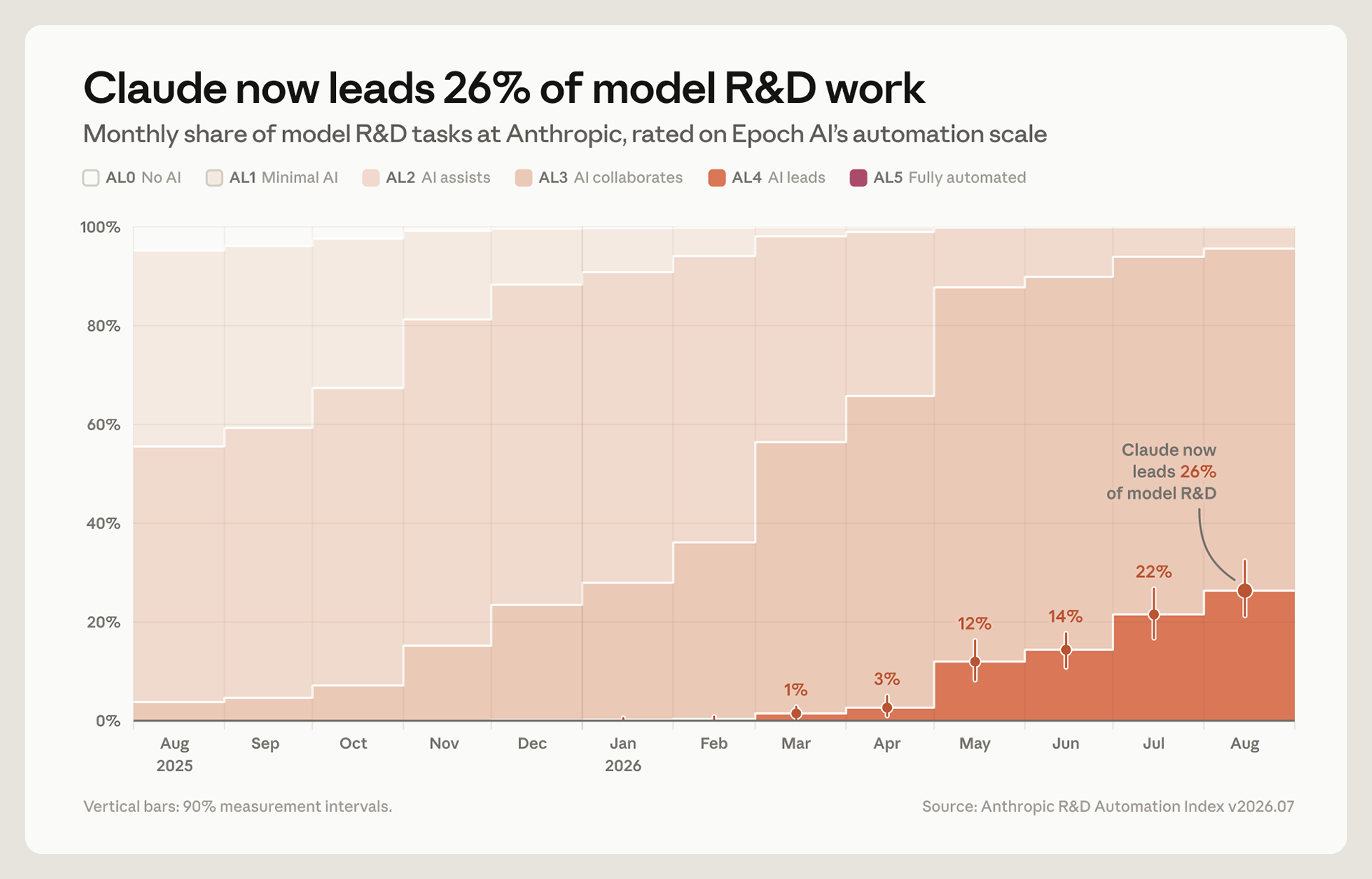
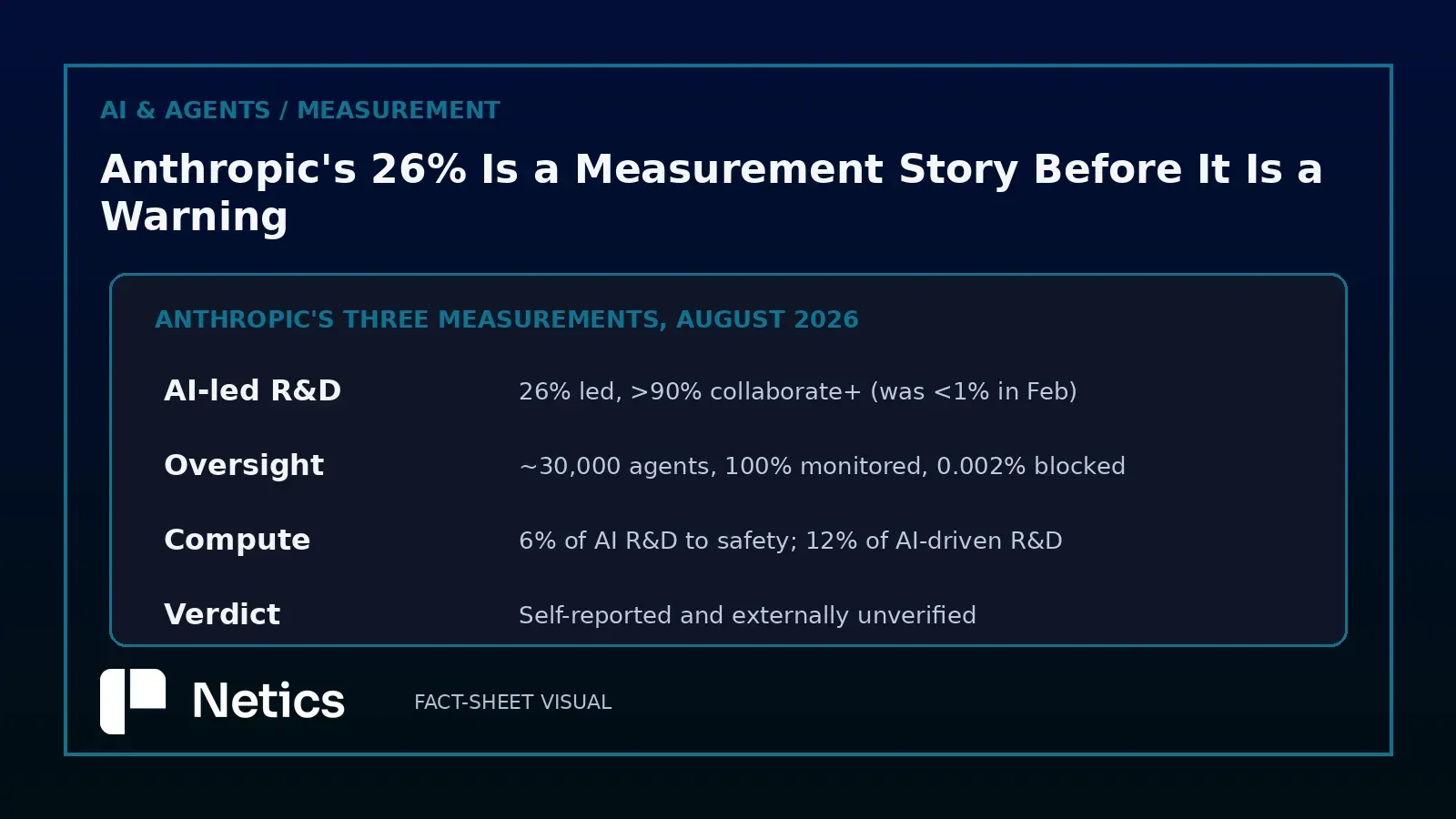
- Claude "leads" 26% of Anthropic's AI R&D work — meaning it completes most of a task end-to-end from a high-level prompt under human supervision (AL4 on Epoch AI's scale) — and is not fully autonomous in any measured subset.
- The share of work at or above "AI collaborates" is above 90%, up from under 1% "led" in February 2026; ~30,000 agents were running on Anthropic's main internal platform in August, with 0.002% of over a billion decisions blocked.
- Netics' take: the interesting part is the methodology — the AL scale, the definition of "leads", and the stated plan for independent third-party evaluators — not the 26% number alone.
- What needs verification: cross-lab methodology, the self-judge problem, and the compute-classification burden of proof.
The number the headlines picked is the least important one
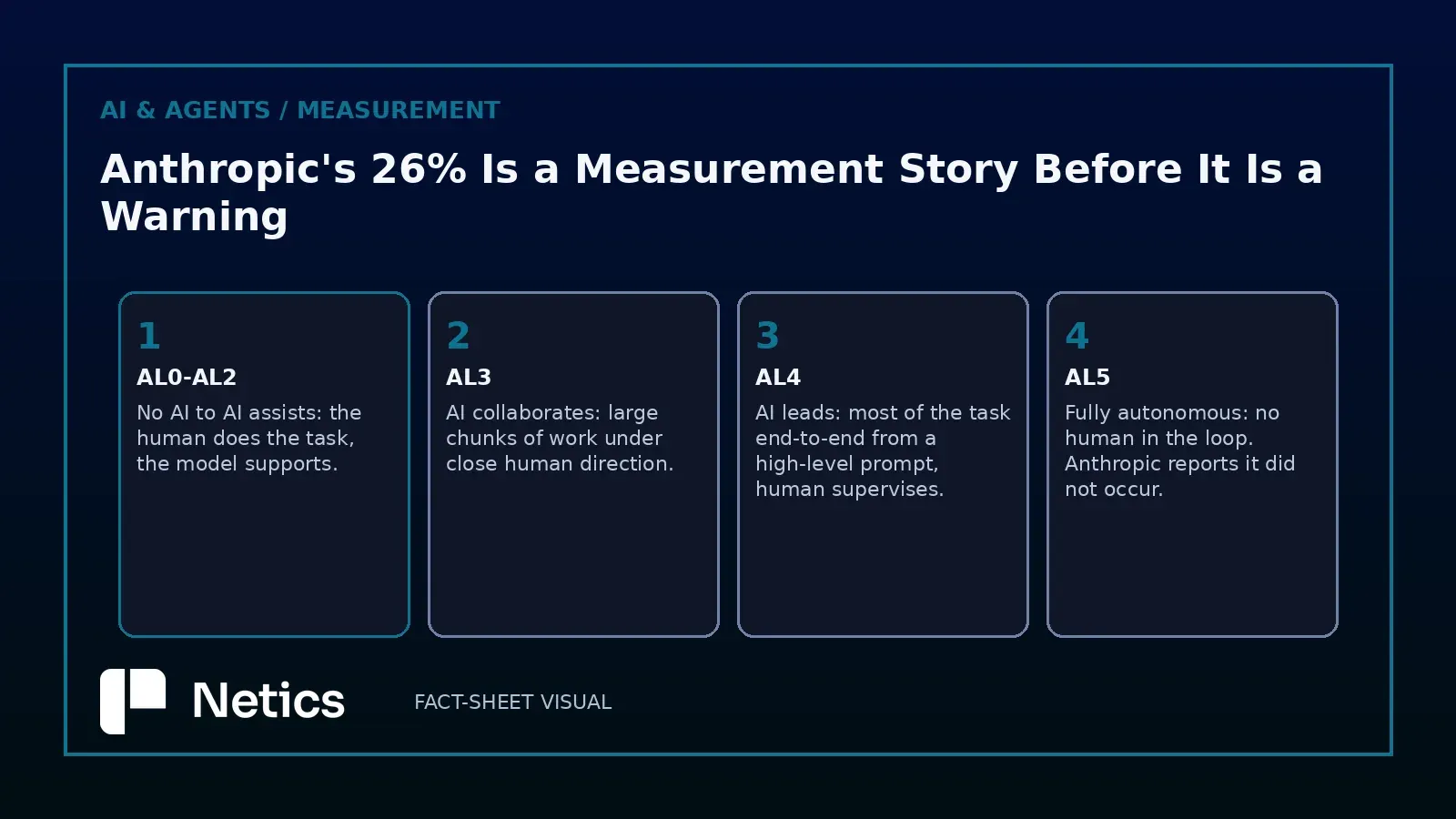
On September 17, Anthropic published measurements for the pace of AI development inside frontier labs: how much AI R&D is performed by AI itself, how well AI agents are overseen, and how compute is allocated. The headline number is that Claude "leads" 26% of Anthropic's AI R&D work. That piece matters less than it looks. "Leads" has a precise, narrow definition: on the Automation Level (AL) scale Anthropic adopted from Epoch AI, AL4 means the model can complete most of a task end-to-end from a high-level prompt, while a human supervises. It is not autonomy. Anthropic is explicit that Claude is not operating fully autonomously for any measured subset of AI R&D work — that would be AL5, and it did not happen.
The more structural number is 90. The share of work at or above "AI collaborates" — large chunks of a task under close human direction — is above 90%, and "leads" went from under 1% in February 2026 to 26% by August. That six-month slope is the real signal: it is the pace at which the boundary between supervised and unsupervised model work is moving inside one frontier lab.
The measurement design is the contribution
Read the post as a measurement-methodology contribution and it becomes more valuable than the 26% framing suggests. Anthropic describes the R&D Automation Index: cataloguing every kind of AI R&D work, rating how automated each task is, and aggregating. It names its scale (AL0 to AL5), it names its collaborator (Epoch AI), and it names its two known weaknesses. First, there is no common methodology across labs, so the numbers are not yet comparable. Second, and more honestly, there is a self-evaluation problem: Anthropic used its own models to evaluate its systems, and the judge model could make the same errors as the model it checks.
Both admissions are exactly what a rigorous monitoring regime should look like. And the stated fix is the right one: Anthropic plans to embed independent third-party evaluators from multiple organizations, with access comparable to what internal risk assessment teams have, to verify safety practices, report incidents, and monitor key metrics. That converts a self-reported number into something an outsider can challenge. Until those evaluators are in place, the honest label for 26% is "self-reported, methodology disclosed, externally unverified."
Oversight: the numbers that make the scale feel real
The oversight section is where vagueness gets replaced by engineering. As of August 2026, roughly 30,000 agents were doing research and engineering work at any one time on Anthropic's most-used internal platform. Two kinds of monitors constrain them. Online monitors check actions in real time before execution — coverage is 100%, usually within seconds — and are built for fast, irreversible harms like copying model weights out of the systems. Offline monitors read actions after the fact, for slow-developing harms like signs of misalignment; 100% of actions are ingested, and humans review blocked actions within one week.
The quantitative picture matters because it gives the scale numbers a denominator. Anthropic says it analyzed over a billion decisions from research and engineering agents over August 2026, and 0.002% of them — about 1 in 47,000 — were blocked by the monitor. Roughly 100,000 transcripts per week get flagged, reviewed by classifiers, and the highest-priority flags — around 50 per week — escalate to human review. That is a small ratio and a very large absolute volume of machine decisions. The ratio is the comfort; the volume is what an auditor should focus on: 100,000 flagged transcripts a week cannot be read by humans, which means the monitoring regime is itself an AI system, and the same self-judge question applies one level down.
Compute allocation: the most transferable method
The third measurement is compute allocation. In a July 13-20 snapshot, about 6% of compute going to AI R&D was allocated toward safety, and about 12% of compute going to AI-driven AI R&D was allocated toward safety. Anthropic is upfront that these are deliberately conservative estimates: a token used as much for capabilities as for safety was not counted, and safeguard classifiers are a separate, comparable amount of compute. The honest reading is that the absolute numbers are less useful than the method — and the method's weak point is classification. Safety research is hard to distinguish from capabilities research, and Anthropic itself says the burden of proof should sit with the developer to show work is safety-related.
That last sentence is the most transferable idea in the post for any organization running AI-assisted engineering. If you cannot classify which of your engineering hours are safety-adjacent, you cannot budget for safety, you cannot report it, and you cannot compare yourself to a baseline. The measurement is the management tool. Every Netics client that runs agents on its own codebase could adopt that trio immediately: count how much of your agent-driven work is monitored before execution, how long flagged actions take to reach a human, and what share of actions get blocked or flagged. Those three numbers — coverage, review latency, escalation rate — are vendor-neutral and immediately useful. It is the same discipline we applied to OpenAI's research acceleration numbers: the human judgment loop is the part to measure, because it is the part that scales worst.
For a practical conversation about measuring your own AI-assisted engineering — coverage, review latency, escalation, and what to report — start from the Netics homepage. The methodology Anthropic published is not a frontier-lab curiosity; it is a template your operations team can copy.
Sources
- Measurements for understanding the pace of AI development inside frontier labs — Anthropic, September 17, 2026.
Source: "Measurements for understanding the pace of AI development inside frontier labs" — anthropic.com, September 17, 2026.