
Android's Security Posture Just Got an API
Google's Security-State libraries give Android fleets a single programmatic view of patch status across OS, modules, and kernel — an Effective Security State that replaces the coarse SPL che

TL;DR
- Google introduced AndroidX Security-State and Security-State-Provider libraries, giving a single programmatic view of an Android device's real patch status.
- The "Effective Security State" evaluates what is installed, what is published, and what is pending across OS, system modules, and kernel — not a single blanket value.
- Google's use case: an app on an unmanaged, employee-owned device can verify patched components before granting access to corporate data, and downgrade functionality only when a genuinely critical fix is pending.
- Early signal: CrowdStrike and Okta are already using the libraries — device patch posture is becoming a conditional-access input, and that signals where access decisions are heading.
- Netics' take: this is patch evidence becoming an access decision — the pattern mature infrastructure teams already use on servers, finally applied to Android fleets.
- Practical move: ask your MDM/EMM vendor and your app teams whether they consume Security-State data today, and what they fall back to when it is absent.

Why a security patch status became a hard problem
On September 17, Google introduced the AndroidX Security-State and Security-State-Provider libraries, whose job is to consolidate a device's security status into "a single, straightforward interface." The reason this needs a new API is modularity. Android no longer ships security fixes only through full system updates: critical fixes now also arrive for system modules and for the kernel, through different channels. That is good for patching speed and bad for knowing what a device actually runs. For an enterprise trying to answer one question — "is this device safe to grant access to corporate data?" — the answer used to be a single blanket value like the SPL (security patch level) check, which is exactly what Google says either over-blocks or under-protects.
The Effective Security State replaces the blanket value
The core idea is simple and it is the right idea. Instead of one coarse number, the libraries let a partner determine a device's true "Effective Security State" by evaluating three things: what updates are currently installed, what updates have been published, and what specific updates are pending installation — across the operating system, the system modules, and the kernel. Three scopes, three states, one verdict you can actually defend.

That verdict is exposed programmatically, which is the part that matters for enterprises. An Android Enterprise partner, an OEM, or a security-sensitive app can now query the real patch posture instead of guessing from a coarse field. This is the same discipline Netics applies when it reviews infrastructure: you do not grant access because a server "looks patched"; you check the actual state of the components your decision depends on.
The BYOD case Google describes is the one to test
The blog's example is precisely the hard case. Consider an enterprise app running on an unmanaged, employee-owned device — no device policy controller, personal phone, corporate data inside. With the Security State Library, the app can verify exactly which components are patched before granting access to sensitive corporate data, and scale down functionality only when a genuinely critical fix is pending. Android's own summary is worth keeping: a "zero trust posture built on real evidence, instead of a coarse SPL check that either over-blocks or under-protects."
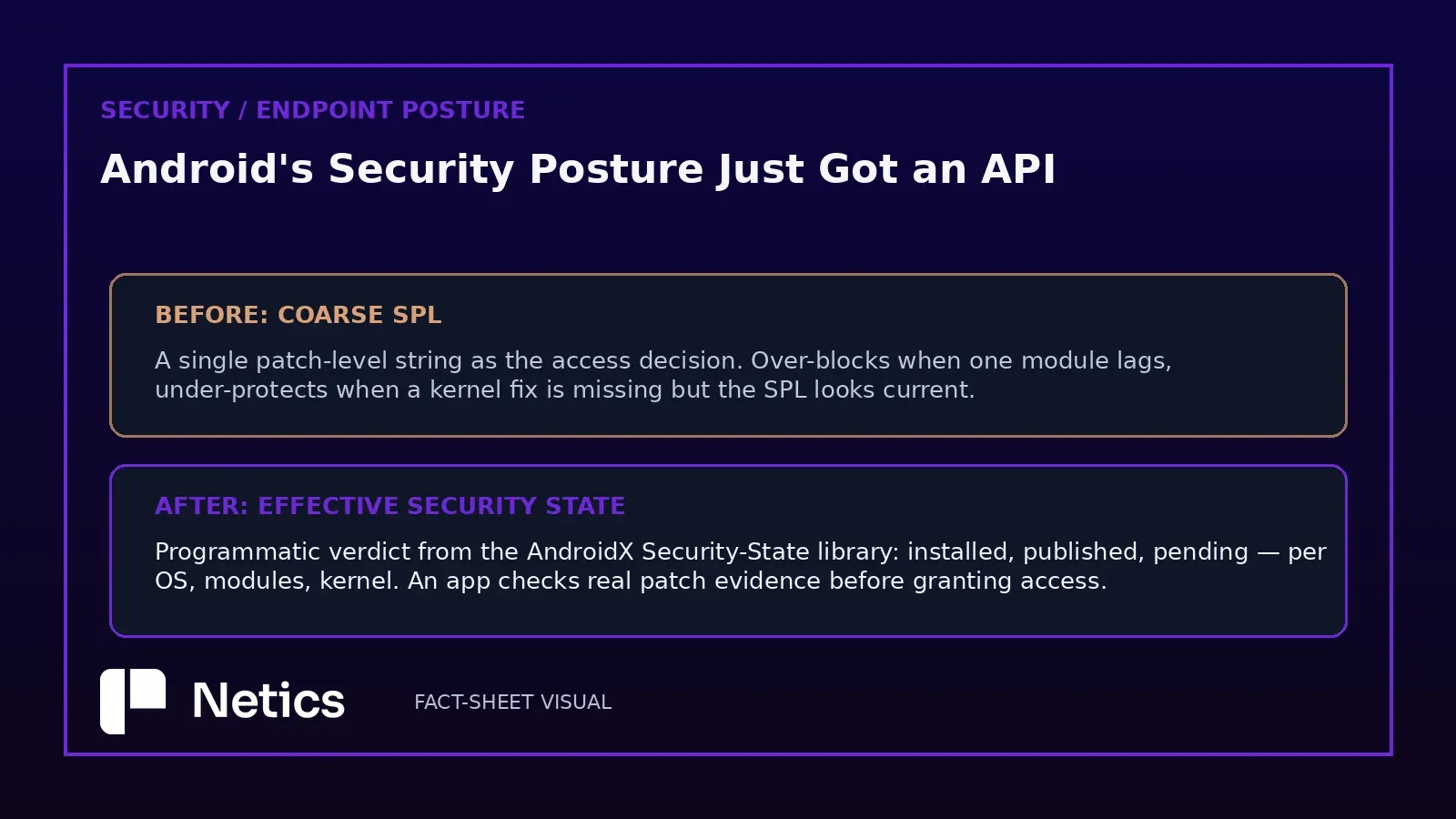
The uncomfortable truth behind that sentence is that most enterprise mobile access today runs on the coarse check. MDM solutions report a patch level; conditional access policies compare it to a threshold; and everyone knows the number is lying in some percentage of cases, because a single security patch level cannot represent a modular update stream. Google is offering a replacement that is harder to fool — and, because it is an AndroidX library, one that independent apps and partners can integrate without waiting for a specific MDM vendor.
Who is already using it, and what that signals
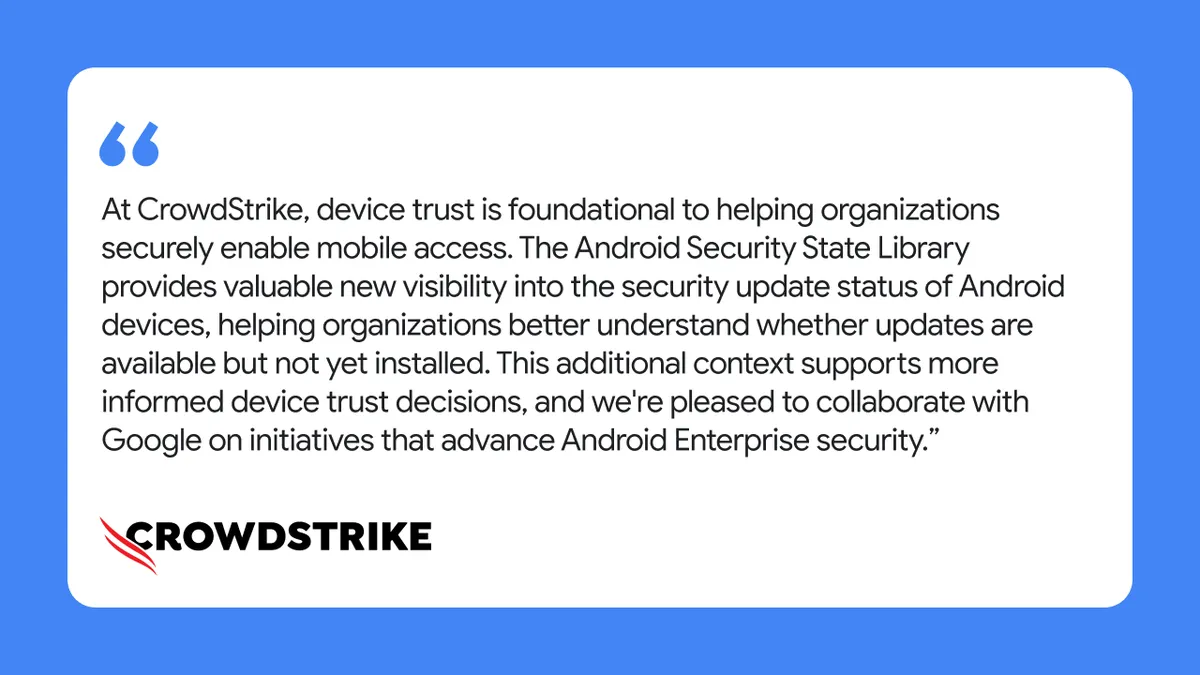
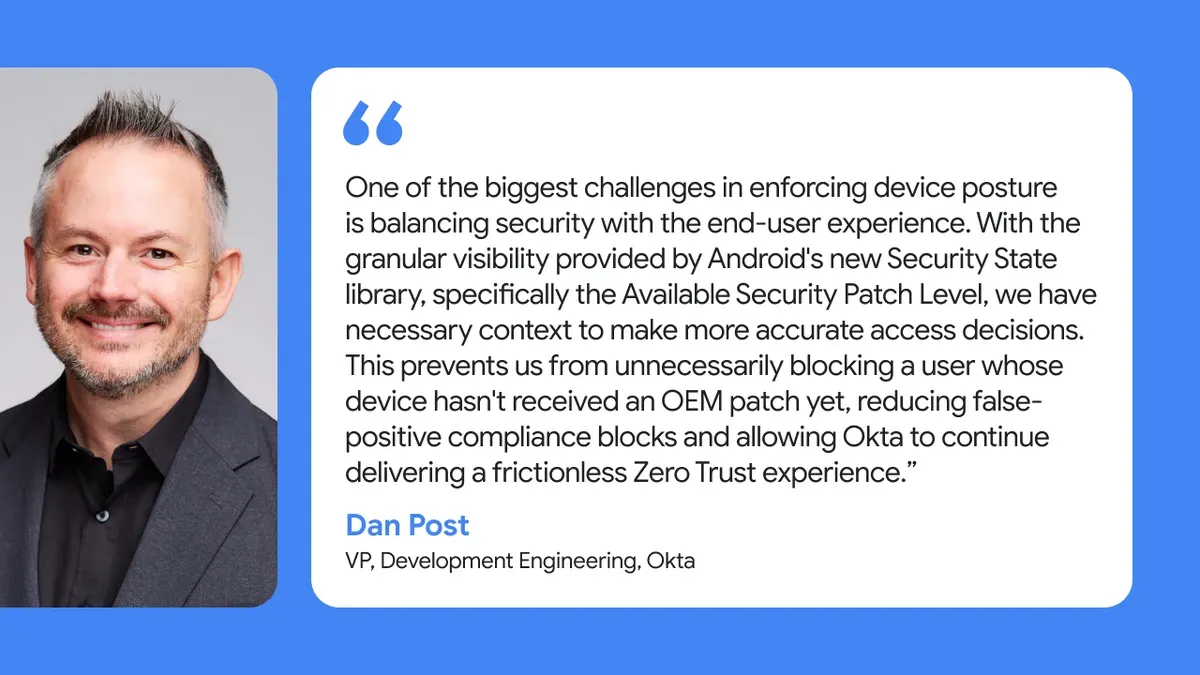
Google names early partners: CrowdStrike and Okta are both shown with the library, and Google says Android Enterprise partners can make "better informed access decisions" by integrating it. Those two names are not accidental. CrowdStrike is an endpoint-detection vendor whose whole model depends on device posture; Okta is an identity provider whose conditional access policies decide whether a device may reach an application. Both are saying, in effect, that a device's patch posture is an identity input — the same way a certificate or a managed-device flag is.
For a Netics client running Google Workspace, Microsoft Entra, or any identity-aware access stack, the question to ask is whether your conditional access rules can consume this signal yet. Most cannot, today. That is fine — this is a September 2026 launch — but the direction is set.
What this changes for EU fleets and BYOD policy
The regional angle is where this gets concrete. European companies run large Android fleets under GDPR obligations and, increasingly, security-by-design expectations. The old SPL-style check is hard to defend in an audit when someone asks "how do you know every device in scope is patched for CVE-2026-xxxxx?" The honest answer used to be a coarse field plus hope. With Security-State, the answer can become a programmatic query: what is installed, what is published, what is pending, per component. That is evidence an auditor can look at.
The obligation it creates is the same one every good infrastructure control creates once it exists: you can no longer claim you had no way to know. If your app or your MDM does not consume Security-State yet, document the gap and the fallback you use in the meantime. Netics applies the same discipline to servers, containers, and endpoints: evidence first, access second — which is exactly the boundary established in our earlier piece on zero-trust boundaries for AI agents.
There are still real limitations worth naming. The libraries give you the device's verdict; they do not fix the device, and they do not tell you whether the patch was correctly applied on every SKU — OEM implementation variance is a live question until the ecosystem proves out. Google's announcement is a platform capability, not a guarantee. Treat it as a new, much better signal to feed into your access decisions, not as a security guarantee you can stop thinking about.
For a 30-minute review of your device-fleet evidence — what your conditional access actually checks, what falls back to a blanket value, and what a Security-State integration would tighten — book a free audit with Netics or start from the Netics homepage.
Sources
- Android Security State Libraries — Google Security Blog, September 17, 2026.
- Introducing the AndroidX Security State Libraries: A Unified View of Device Security — Android Developers Blog, September 2026.
Source: "Android Security State Libraries" — blog.google, September 17, 2026.