
Kubernetes Admission Policy Moves Governance Into the API Server
Netics analysis of the mechanism, its limits, and the operating decision it creates.

TL;DR
This article examines the source mechanism, its limits, and a practical Netics operating decision. This article covers: What changes when policy becomes an API object; The mechanism is deliberately narrower than a webhook; Binding is where governance becomes operational; Failure policy is a business decision; Parameters make one policy reusable; What admission policy does not solve; A rollout sequence for platform teams; The Netics position.
What changes when policy becomes an API object
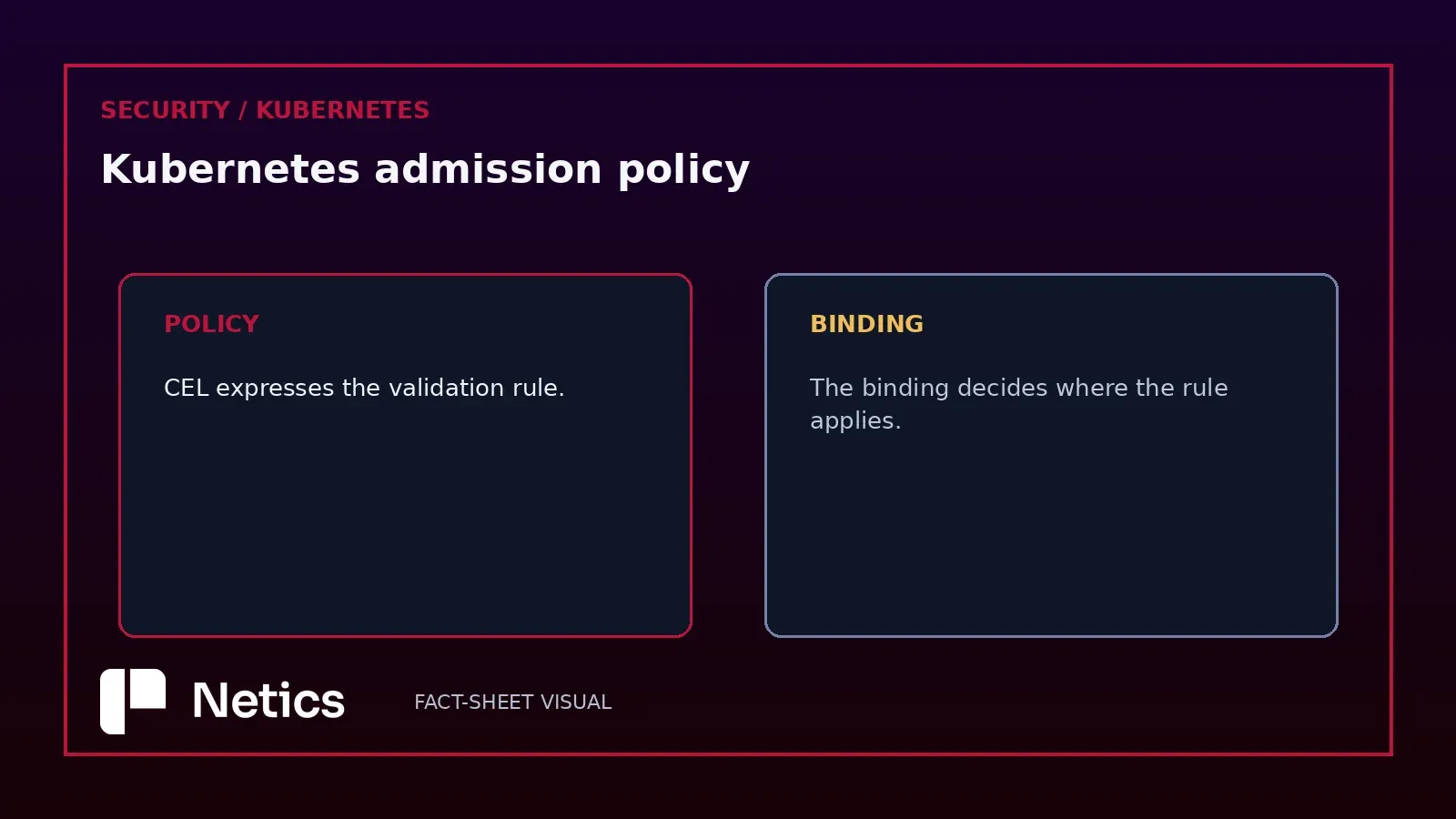
Kubernetes ValidatingAdmissionPolicy gives platform teams a declarative place to express admission checks. The policy contains CEL expressions, and a separate binding determines where the policy applies. That separation matters. It turns an enforcement rule into an API object that can be reviewed, versioned, selected by resource and namespace, and tested against the same control plane that accepts the workload. The important change is not that CEL is shorter than a webhook. It is that policy ownership becomes visible inside the cluster configuration.
The mechanism is deliberately narrower than a webhook
The Kubernetes documentation describes CEL expressions evaluated against admission data such as the incoming object, the old object, the request, and, where configured, parameters. That gives a policy author useful context without requiring every rule to become a separately deployed service. The boundary is also a limitation. A policy is not automatically a complete authorization system, business workflow, or external risk engine. If the rule needs network calls, long-running state, or a vendor-specific decision, the declarative object may not be the right place.
Binding is where governance becomes operational
A policy that exists but is not correctly bound is documentation, not enforcement. The binding selects resources and can scope the policy to namespaces or other match conditions. That means the review must cover two objects together: the expression and the set of requests to which it applies. A permissive expression with a broad binding is a different risk from the same expression applied to a narrow test namespace. Teams should review both as one change.
Failure policy is a business decision
The admission configuration has to define what happens when evaluation cannot produce the desired result. A fail-closed choice protects the boundary but can stop deployments during a policy or control-plane problem. A fail-open choice preserves availability but weakens the guarantee. Neither is universally correct. The decision should be tied to the resource: a production identity object, a privileged workload, and a disposable development deployment do not necessarily deserve the same failure behavior.
Parameters make one policy reusable
The API design supports parameter resources so one policy shape can be applied with different values. That is useful for platform teams that want a common rule with environment-specific limits. It also introduces a new review surface. The parameter object becomes part of the effective policy and needs ownership, validation, lifecycle, and rollback. A policy review that ignores parameters can approve a safe expression paired with an unsafe value.
What admission policy does not solve
Declarative admission does not prove that the image is trustworthy, that the runtime is patched, or that a human will respond to an exception. It checks requests at a boundary. Supply-chain evidence, runtime isolation, observability, and incident response remain separate controls. This is where the broader Netics infrastructure argument applies: a control boundary only helps when its ownership and failure modes are explicit. The API server can enforce a rule, but it cannot create an operating model by itself.
A rollout sequence for platform teams
Start with an audit-only or narrowly scoped rule whose outcome can be compared with current workloads. Record which objects would be denied, which namespaces are affected, and which teams own the exceptions. Then move one high-value control into an enforced binding with a rollback manifest. Test upgrades, deleted bindings, malformed parameters, and a policy evaluation failure. Keep the policy and binding in the same review unit. This makes a change reproducible instead of relying on a platform engineer remembering an invisible dependency.
The Netics position
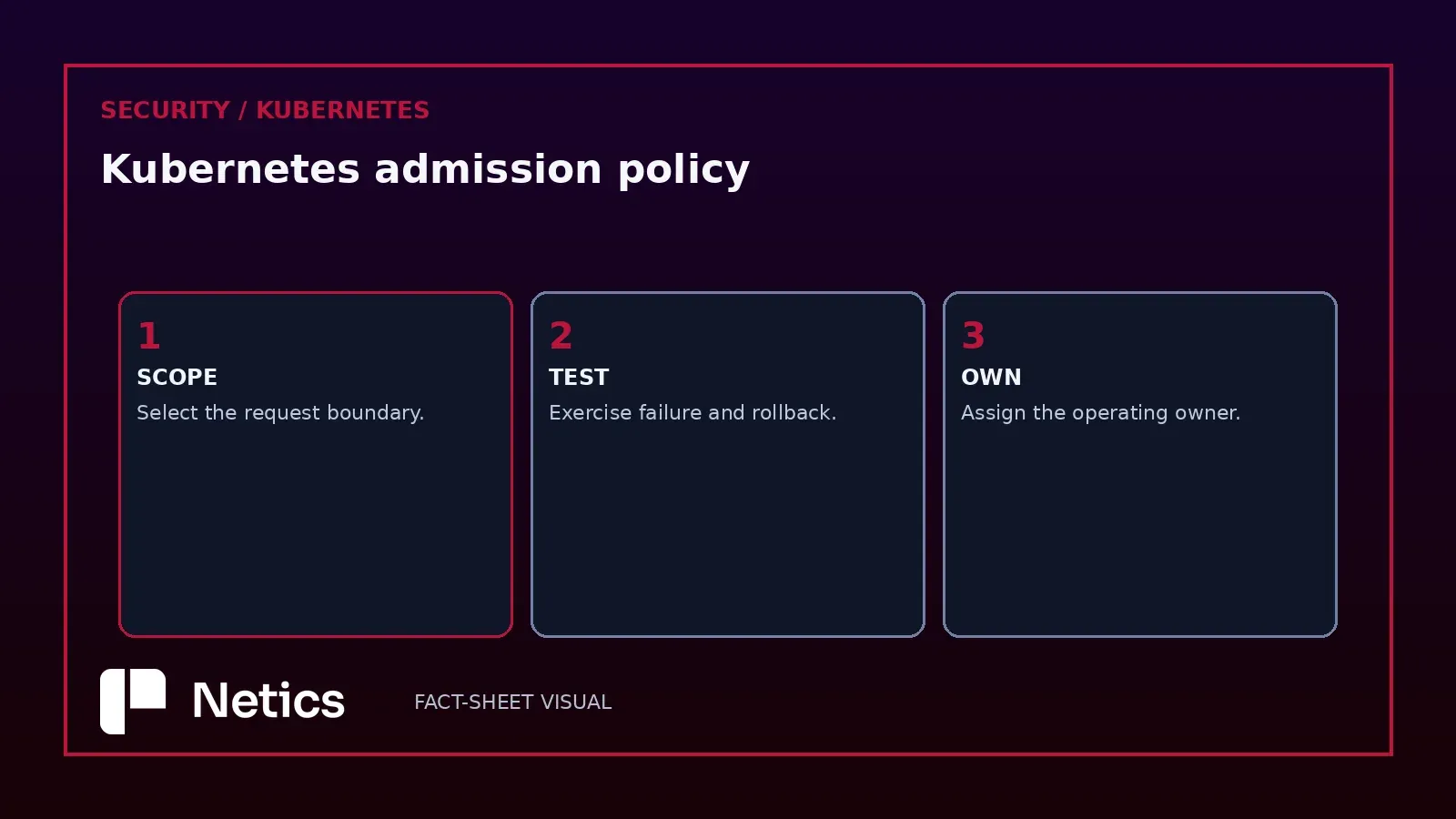
ValidatingAdmissionPolicy is valuable because it reduces the distance between a governance decision and the API request that must obey it. But its value comes from disciplined scope, not from adding another YAML object. Define the request boundary, test the expression, own the binding, and decide failure behavior before calling the control production-ready. Governance becomes stronger when the enforcement point is close to the resource and the people responsible for it can actually inspect the full path. For an architecture review, visit Netics Netics or Book a free 30-minute audit.
Test the policy like code
CEL expressions deserve the same discipline as application code. Keep representative admission objects in a test fixture, exercise CREATE and UPDATE paths separately, and include the absence of an old object where the expression expects one. Test the binding selectors too: a valid expression can be harmless in one namespace and disruptive when a selector expands. Treat the policy, binding, and parameter resource as one versioned unit. A rollback that deletes only the expression but leaves a binding is not a complete rollback.
The operational dashboard should expose denied requests, evaluation errors, and policy changes as distinct events. A denial is not necessarily a policy defect; an evaluation error can indicate a malformed expression or missing parameter; a change event can explain why the result changed. Those signals let the platform team distinguish an intentional control from an accidental outage.
Sources
- Kubernetes documentation: Validating Admission Policy — accessed for this draft.