
GitHub Extends Security Validation to Third-Party Coding Agents
GitHub now applies CodeQL, dependency, and secret checks to third-party coding agents. Netics explains why validation should gate release, not certify generated code.

TL;DR
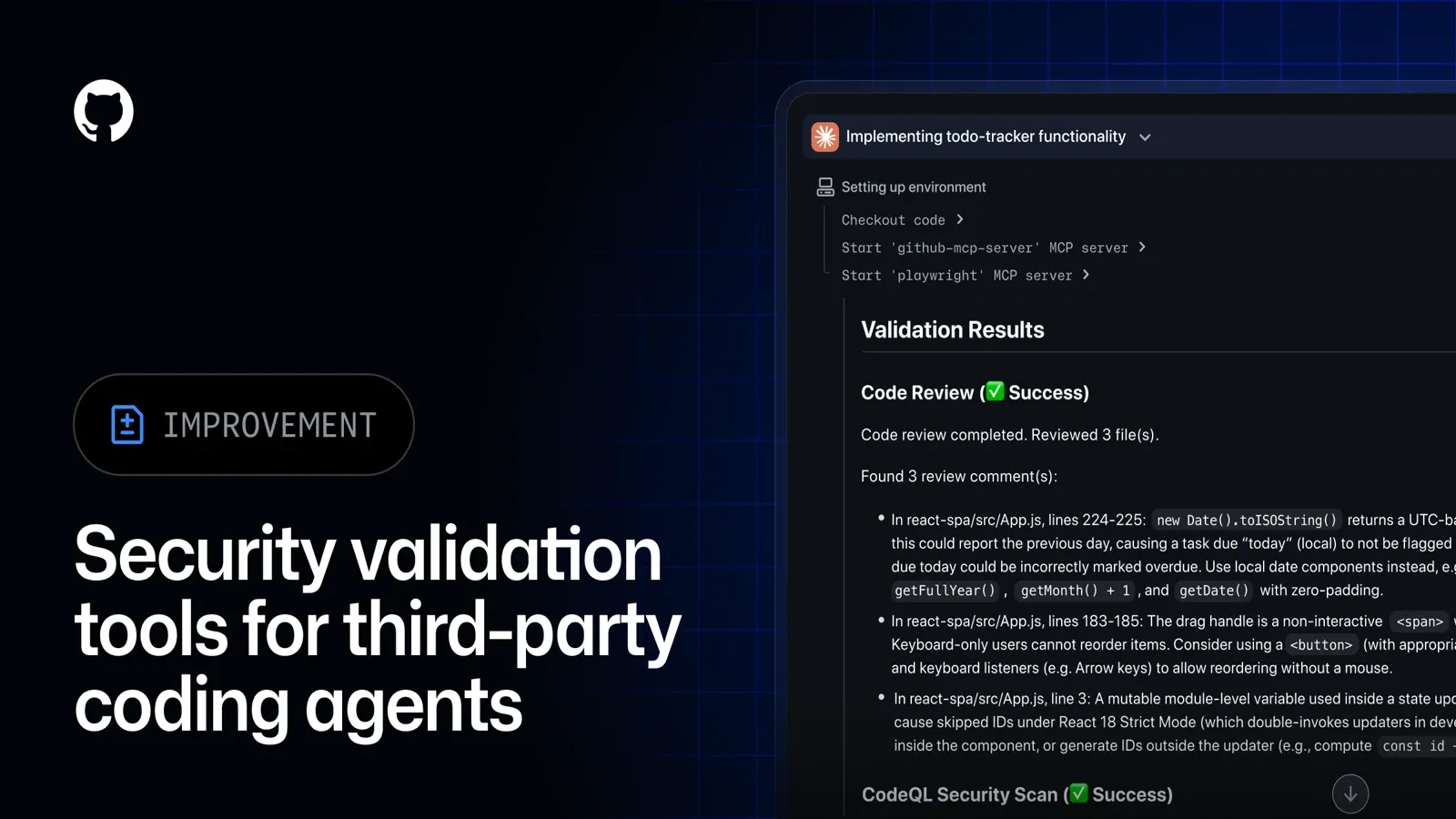
GitHub has made security validation generally available for third-party coding agents, including Claude and OpenAI Codex working inside repositories. The service applies CodeQL analysis, GitHub Advisory Database checks for newly introduced dependencies, and secret scanning for items such as API keys and tokens. When it finds a problem, the agent attempts a fix before the pull request is finalized. These controls are enabled by default, inherit the repository’s Copilot validation settings, and do not require a GitHub Advanced Security license.
The three detectors cover three different failure shapes, and automatic repair is helpful—but it still needs an owner.
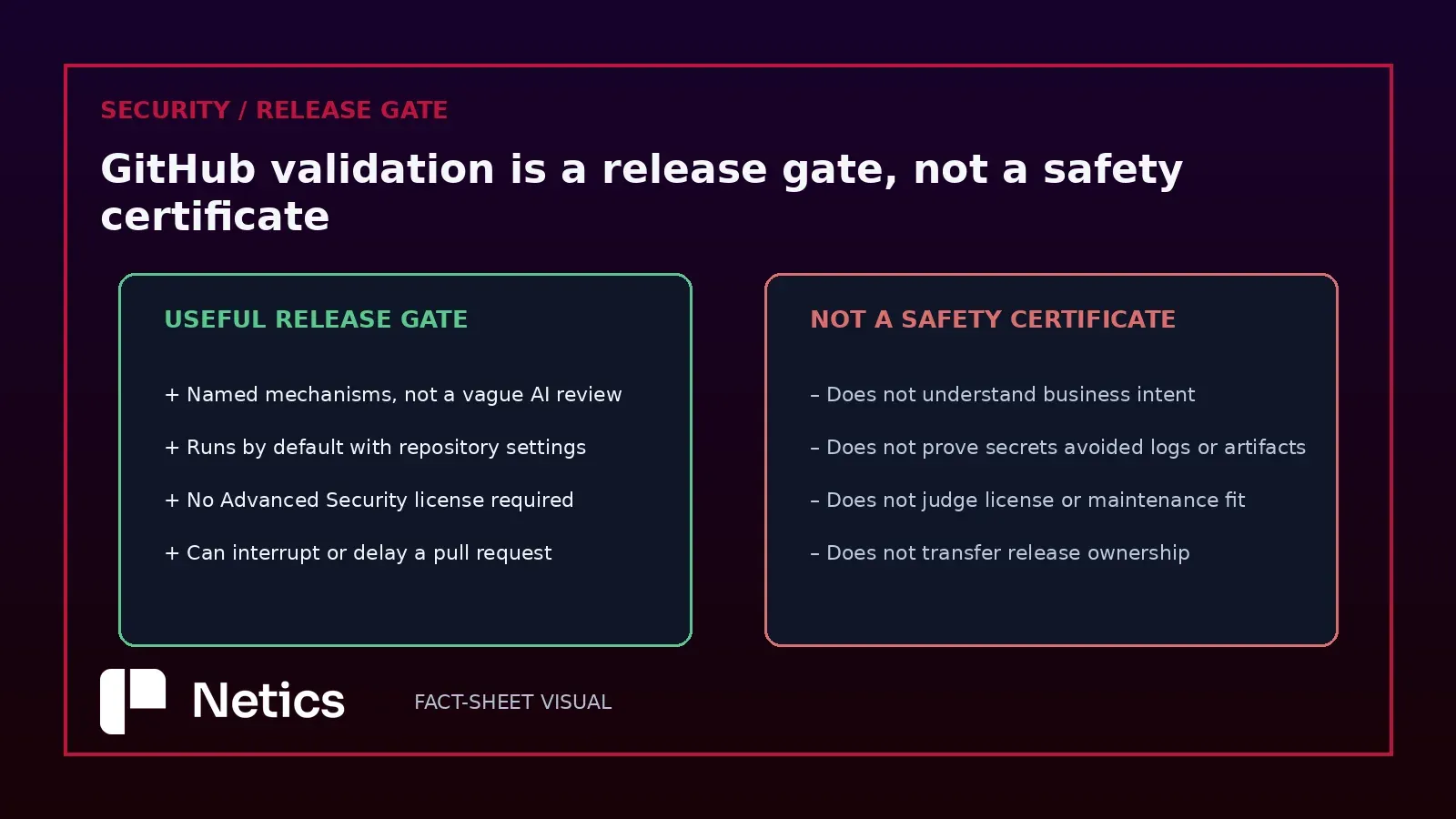
GitHub’s announcement is therefore best read as a concrete release gate, not as evidence that generated code is safe. Netics’ position is simple: automated validation can stop or delay a change, but it cannot replace judgment about what the code is meant to do, what it can access, or whether the surrounding system makes the change acceptable.
The important change is at the pull-request boundary
GitHub’s announcement describes a specific workflow. A third-party coding agent creates code in a repository. GitHub then analyzes that generated change for potential security vulnerabilities with CodeQL, checks newly introduced dependencies against the GitHub Advisory Database, and uses secret scanning to detect sensitive information, including API keys and tokens. If an issue appears, the agent attempts to resolve it before finalizing the pull request.
This is not a vague promise to “make AI code safer.” It is a concrete set of checks placed between generation and finalization. That placement matters because a defect can be caught before it becomes part of a reviewed or merged change. It also gives engineering teams a familiar object—the pull request—around which to require evidence.
Three detectors cover three different failure shapes
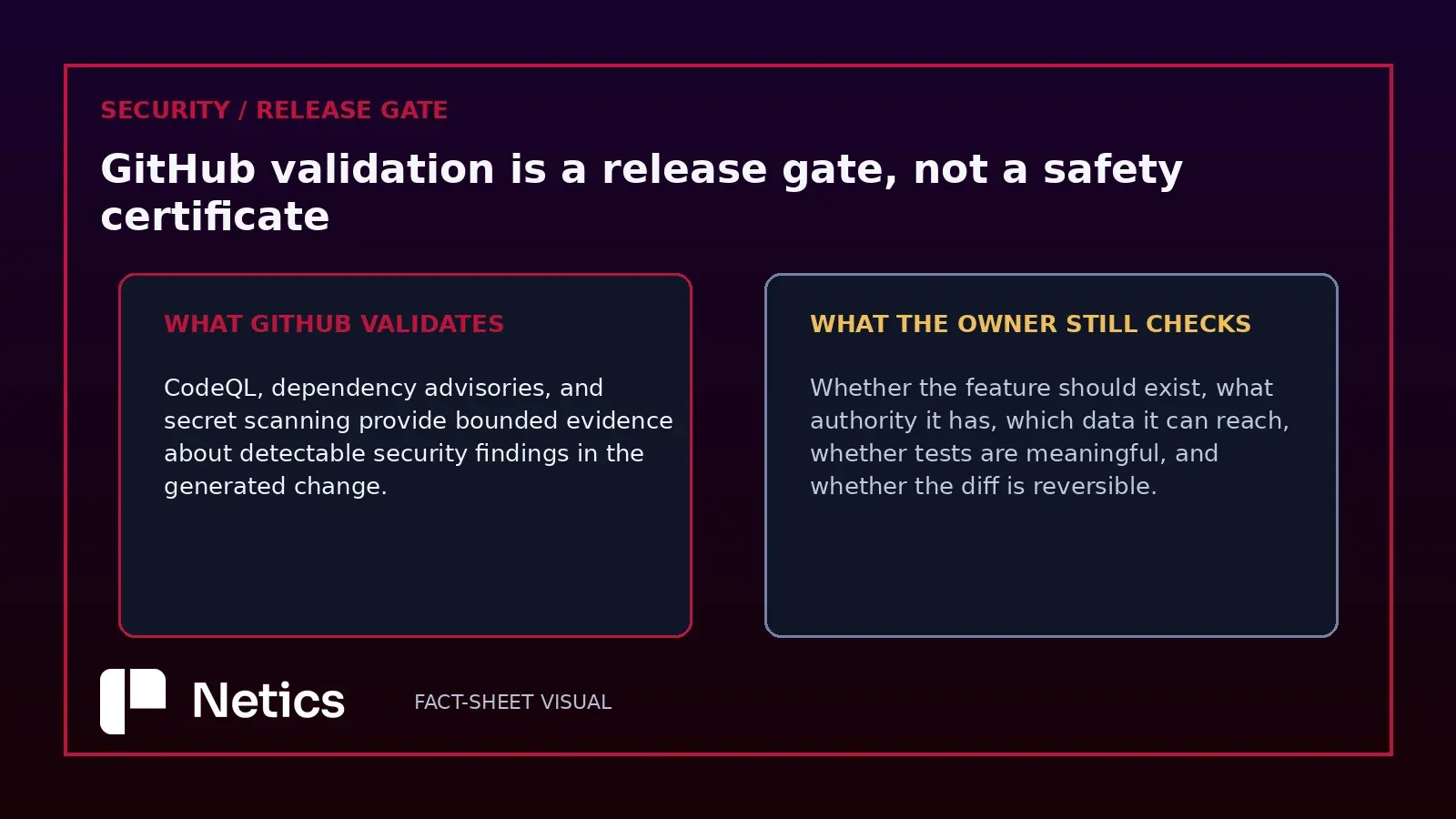
CodeQL is aimed at vulnerability patterns in the code. The Advisory Database check is aimed at newly introduced dependency risk. Secret scanning is aimed at sensitive material such as tokens and API keys. Those are related concerns, but they are not interchangeable signals.
A change can pass one detector and fail another. A dependency may be known to be vulnerable even when the new application code is tidy. A token may be exposed without a CodeQL finding. Conversely, code can have a security-relevant behavior that is wrong for the business but not represented by a vulnerability query or a known advisory.
That distinction is why the announcement is stronger than a generic “AI review” label. It names mechanisms. It also reveals the boundary: the checks are good at classes of detectable evidence, not at deciding whether the requested feature should exist or whether an agent understood the task correctly.
The source adds a useful but broad outcome claim: GitHub says its Copilot cloud-agent validation has proactively prevented hundreds of potential security leaks and vulnerabilities since October 2025. That is evidence that automated checks can interrupt real failure modes. It is not a measured safety rate for third-party agents, and it does not tell a team how many context-specific defects remain after a clean run.
Automatic repair is helpful—and still needs an owner
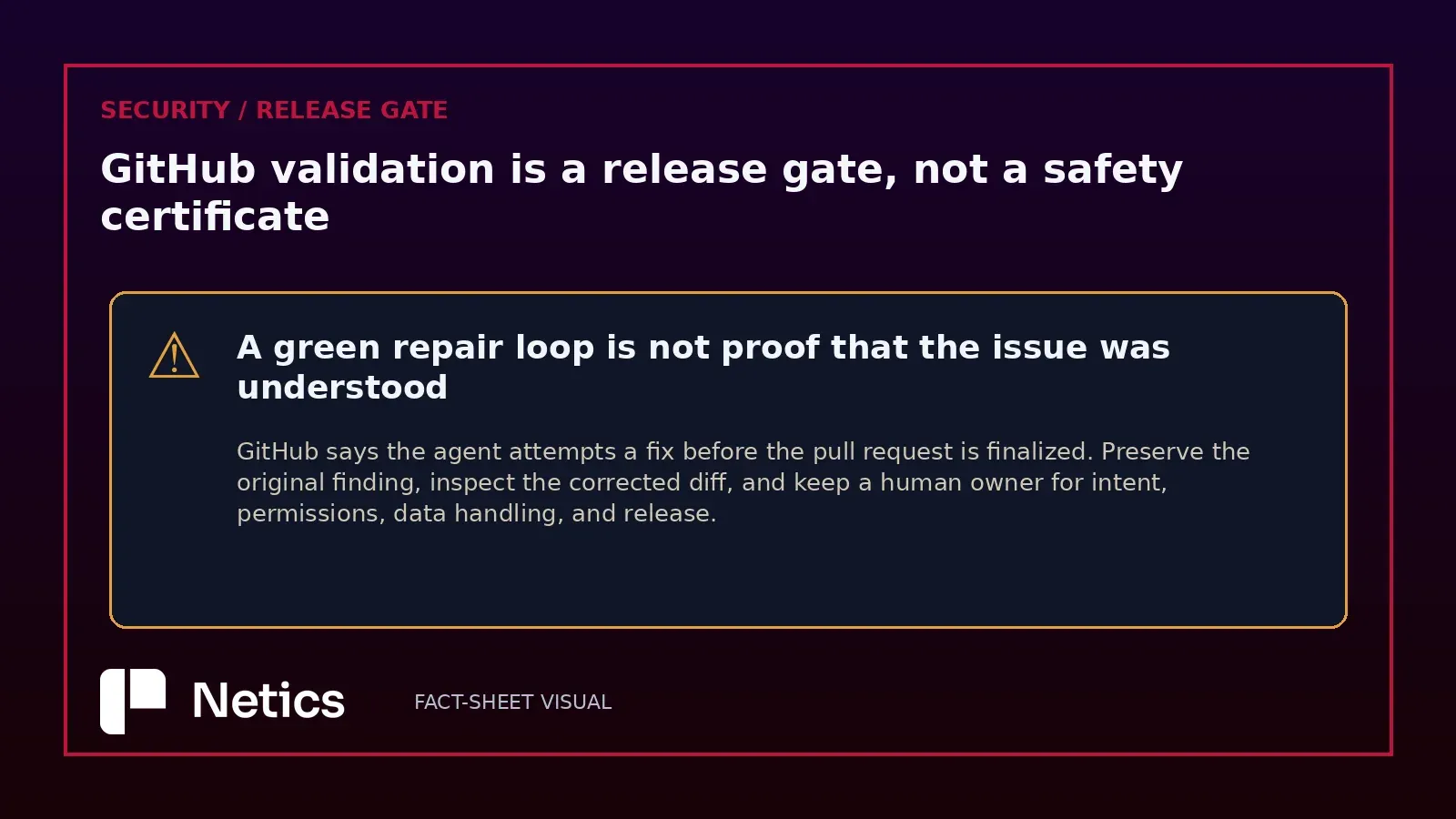
The agent attempts to resolve issues before finalizing the pull request. That can reduce friction: a dependency can be replaced, an unsafe pattern can be rewritten, or a detected secret can be removed. It also creates a second risk if teams confuse “the agent tried again” with “the issue is understood.”
A repair changes the evidence under review. The corrected diff still needs to be inspected, and the reason for the finding should remain visible to the person approving the change. Otherwise the workflow can optimize for a green gate while losing the causal story of what was wrong.
Default settings reduce setup work, not responsibility
GitHub says the validations are on by default and follow the repository’s Copilot settings for which validation tools to use. If a team has already enabled security validation for Copilot cloud agent, third-party agents automatically receive the same protections. The announcement also says that security validation does not require a GitHub Advanced Security license.
Those defaults are operationally important. They lower the chance that a new agent integration arrives with no security checks because nobody found the right switch. The lack of an Advanced Security license requirement lowers a commercial barrier too. Teams can therefore treat the feature as a baseline control rather than a premium add-on.
But inheritance can hide a configuration decision. A repository’s settings are not necessarily a complete release policy. Before relying on the default, security owners should record which tools are enabled, what happens when a check fails, who reviews attempted fixes, and which environments or branches are covered. “On by default” answers the activation question. It does not answer the authorization question.
Validation is a release gate, not a proof of safety
This is where Netics parts company with the easy reading of the announcement. Post-generation validation is valuable precisely because it can stop a pull request or force another repair attempt. It should be treated like a release gate: evidence must meet a threshold before the change moves forward.
A gate is not a certificate. CodeQL does not know the business intent of a feature. Dependency checks do not decide whether a library’s license, data flow, or maintenance posture fits the system. Secret scanning does not prove that credentials were never exposed through logs, prompts, generated artifacts, or a different repository. An attempted fix does not prove that the agent preserved the requested behavior.
The remaining review questions are ordinary engineering questions, even when the code was written by an agent: Does the change have the intended authority? Can it reach production data? Are tests meaningful for the changed behavior? Did the agent widen a permission, alter a workflow, or add a dependency whose risk is not captured by an advisory? Is the diff reversible?
A practical control for teams adopting agents
Use GitHub’s validation as the first stop in a layered path. Let the checks run with the repository’s inherited settings, preserve findings and repair attempts in the pull request, and require a human owner to inspect the final diff. Add tests that exercise the feature’s actual authority and data boundaries rather than only its syntax. For sensitive repositories, make the approval rule explicit: a clean scan is necessary evidence, while intent and runtime impact remain review work.
That approach is deliberately less exciting than saying an agent is now “secure.” It is also more useful. GitHub has extended named security controls to third-party coding agents and removed the Advanced Security license requirement. The right response is to use that baseline everywhere it applies, then keep the release decision with the people who understand the repository.
For teams designing that boundary, Netics’ architecture perspective is the relevant next step: connect automated findings to permissions, ownership, and rollback rather than treating a green check as the end of the process.
Sources
- GitHub Changelog — Security validation for third-party coding agents (published June 9, 2026)
Source: Security validation for third-party coding agents — github.blog, June 9, 2026.