
CUDA Rust's Two Tracks Put Memory Safety Back in the Compiler
NVIDIA ships two compiler tracks for writing GPU kernels in Rust. Netics explains why compile-time memory safety changes kernel engineering more than the language switch does.

TL;DR
- NVIDIA announced CUDA Rust with two compiler tracks: cuda-oxide for SIMT-style kernels and cutile-rs for tile-based kernels.
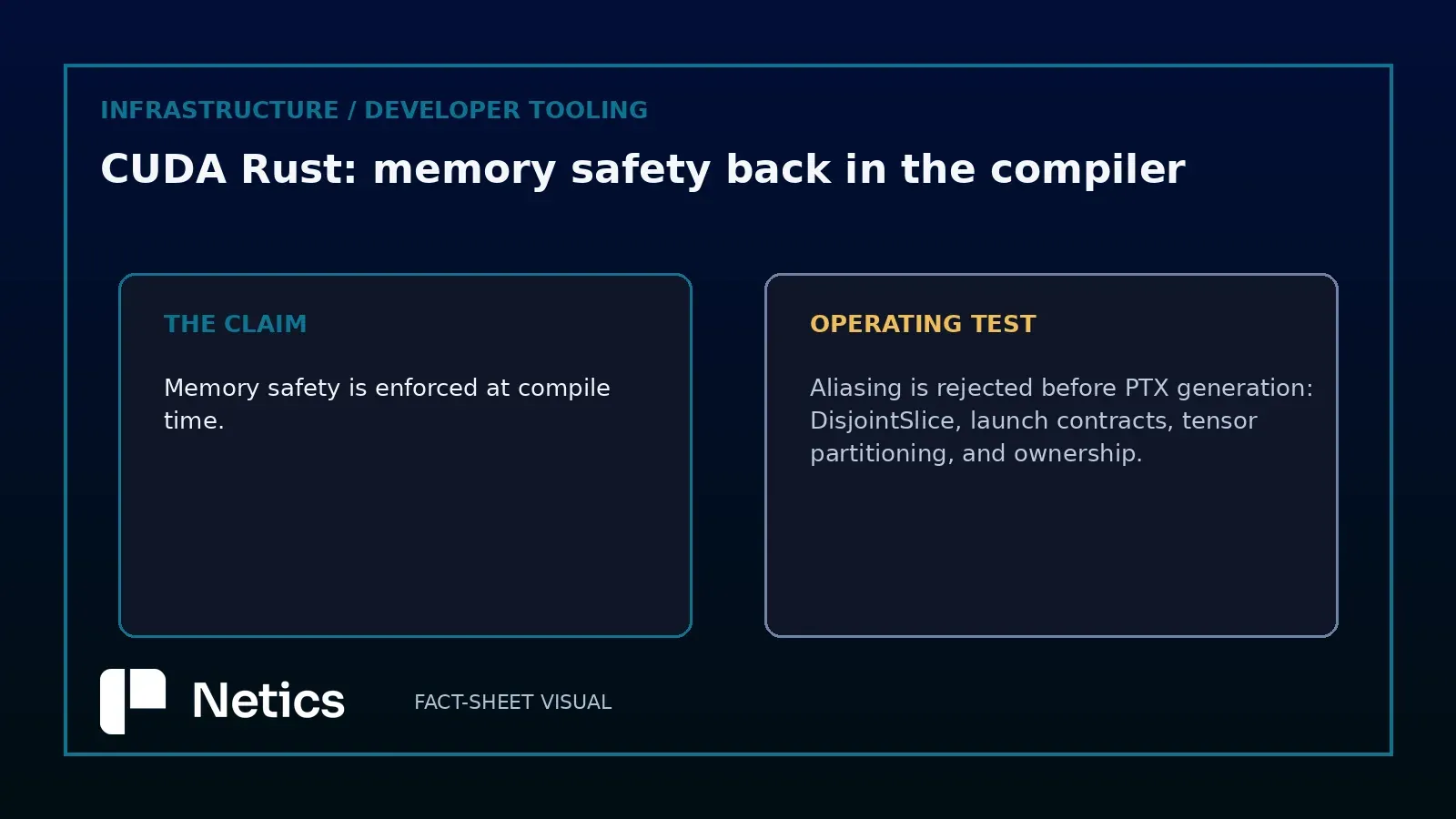
- Both enforce memory safety at compile time — aliasing and ownership are checked before PTX is generated, not after a crash in production.
- The announcement is honest that neither path is production-ready. Netics' advice: pilot on non-critical workloads now, treat the toolchain maturity as the real schedule risk.

A compiler announcement that is really a safety announcement
NVIDIA's September 8 post introduces CUDA Rust: two ways to write GPU kernels in a native Rust toolchain rather than as a wrapper around code written elsewhere. Read it as a language story and it is a long-term bet. Read it as a safety story and it is more interesting — because the two tracks share one design goal: catch aliasing and memory bugs at compile time, before a kernel runs on a fleet of GPUs.
The post is deliberately candid about maturity. cuda-oxide is described as early alpha. cutile-rs is further along — published on crates.io and already used in Hugging Face's Grout inference engine and in mistral.rs — but the post still warns that coverage is incomplete and APIs will move. That honesty is the detail that makes the announcement usable for planning. A vendor that states plainly that its tooling is not production-ready is giving you the information you actually need to schedule adoption.
The SIMT track: cuda-oxide compiles bread-and-butter kernels to PTX
The first track keeps the programming model most CUDA developers already know. cuda-oxide is a custom rustc codegen backend: it intercepts compilation, routes kernel functions through Rust MIR, the community Pliron IR framework, and LLVM IR, and emits PTX. Everything that is not kernel code goes through the standard backend. The requirement list is what you would expect for a compiler experiment: Linux, a GPU with compute capability 8.0 or later, a CUDA toolkit 12.x or newer, clang with libclang headers, and a pinned nightly toolchain.
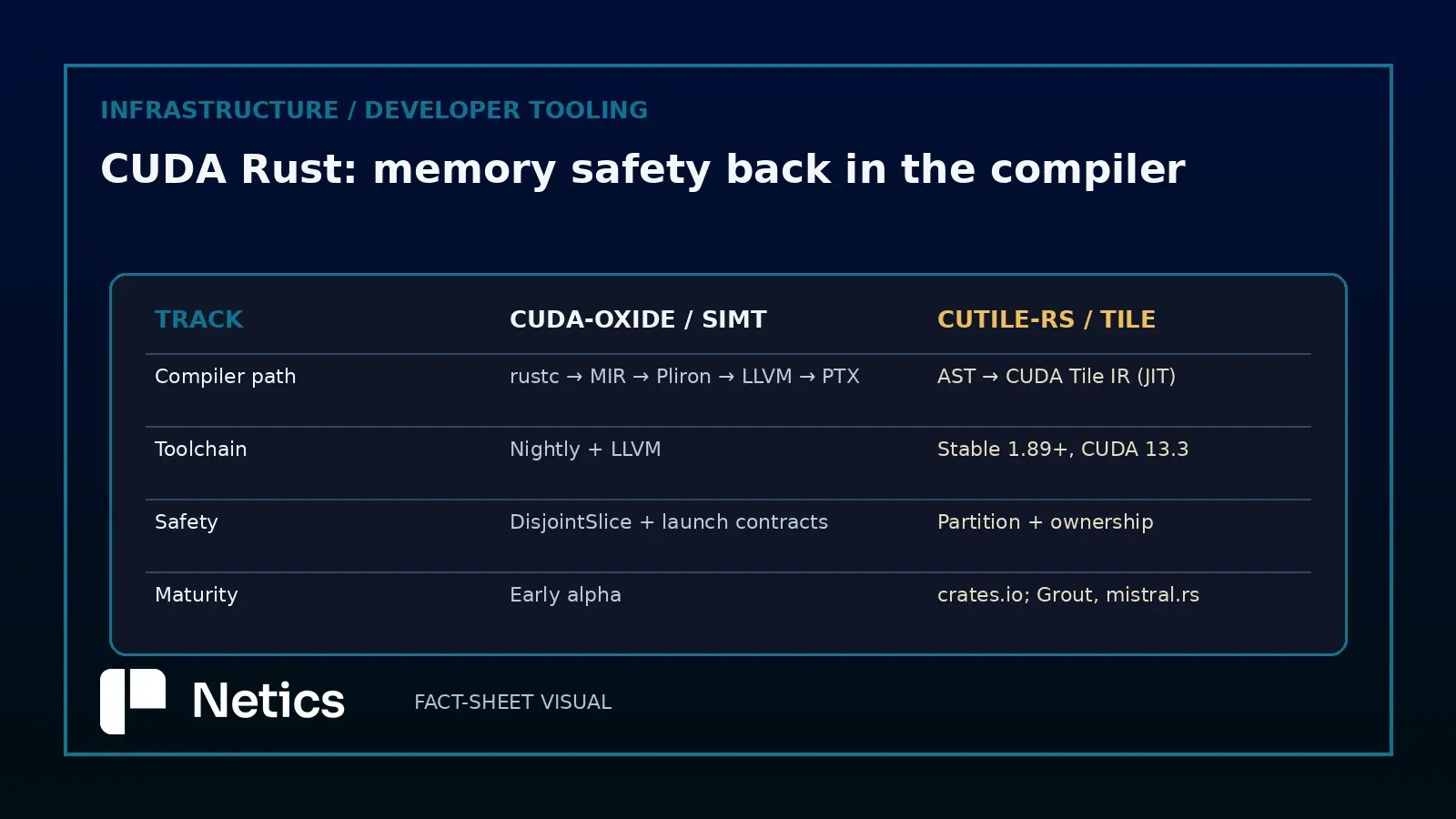
The safety mechanism lives in the kernel signature. A vector-add example reads a and b as ordinary shared slices, readable by every thread, while the output is a DisjointSlice: a type that hands each thread exclusive access to its own element and nothing else. The post explains why this matters: &mut [f32] is the wrong shape for the job, because every thread would need the same mutable reference, which Rust correctly refuses. DisjointSlice splits that one mutable borrow into per-thread pieces. Combined with launch contracts, the compiler can reject kernels that would alias memory before they ever run.
The Tile track: cutile-rs lets the compiler own the mapping
The second track works one level higher. You program against tiles rather than scalars: each tile block runs the kernel body once as a single logical thread over one sub-tensor, and the compiler decides how many real GPU threads back it. A #[cutile::module] macro embeds the kernel's AST in the host binary and JIT-compiles it through CUDA Tile IR when the kernel is first needed.
The toolchain burden is lighter than the SIMT track: stable Rust 1.89 or newer and CUDA 13.3, no nightly and no LLVM of your own. The trade-off is a different kind of safety mechanism. Where cuda-oxide prevents aliasing through DisjointSlice and launch contracts, cutile-rs uses tensor partitioning and ownership to guarantee exclusive access. Same goal, different enforcement point, and the choice between them is an architecture decision, not a style preference.
Why compile-time checks matter more than the language
The honest framing is that both tracks move a class of bugs that currently costs teams production incidents into the compiler. GPU kernels are hard to debug in production: the failure is often a wrong number, a corrupted buffer, or a thermal event, not a clean crash with a stack trace. A kernel that cannot be written with aliasing in the first place removes an entire failure family from the incident playbook.
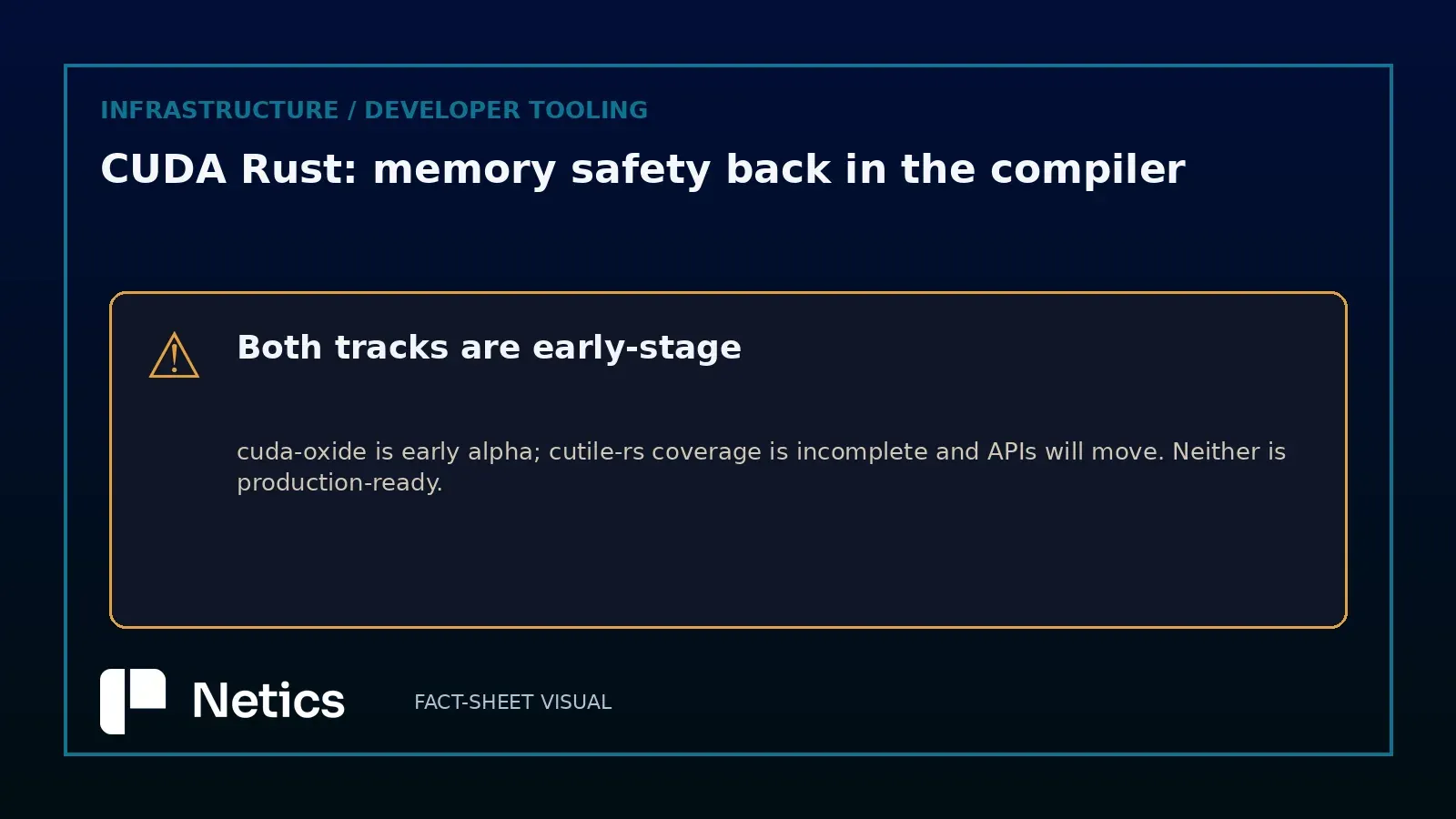
That is also the limit of the announcement. Being able to write DisjointSlice kernels does not make the rest of the stack production-grade. The post says the inter-language story is planned — CUDA Rust, CUDA C++ and CUDA Python frontends should interoperate — but planned is not shipped. A team that converts a critical kernel to a nightly-only toolchain is trading a known runtime risk for an unknown toolchain risk, and the announcement gives you no evidence yet that the exchange is profitable at scale.
What a cautious adoption path looks like
The post's own recommendation is a reasonable starting point: reach for the Tile track first, because the compiler decides how tiles map onto each architecture and your source does not encode architecture-specific choices; drop to SIMT when you need thread-level control or want to manage memory yourself. Netics would add two planning rules on top.
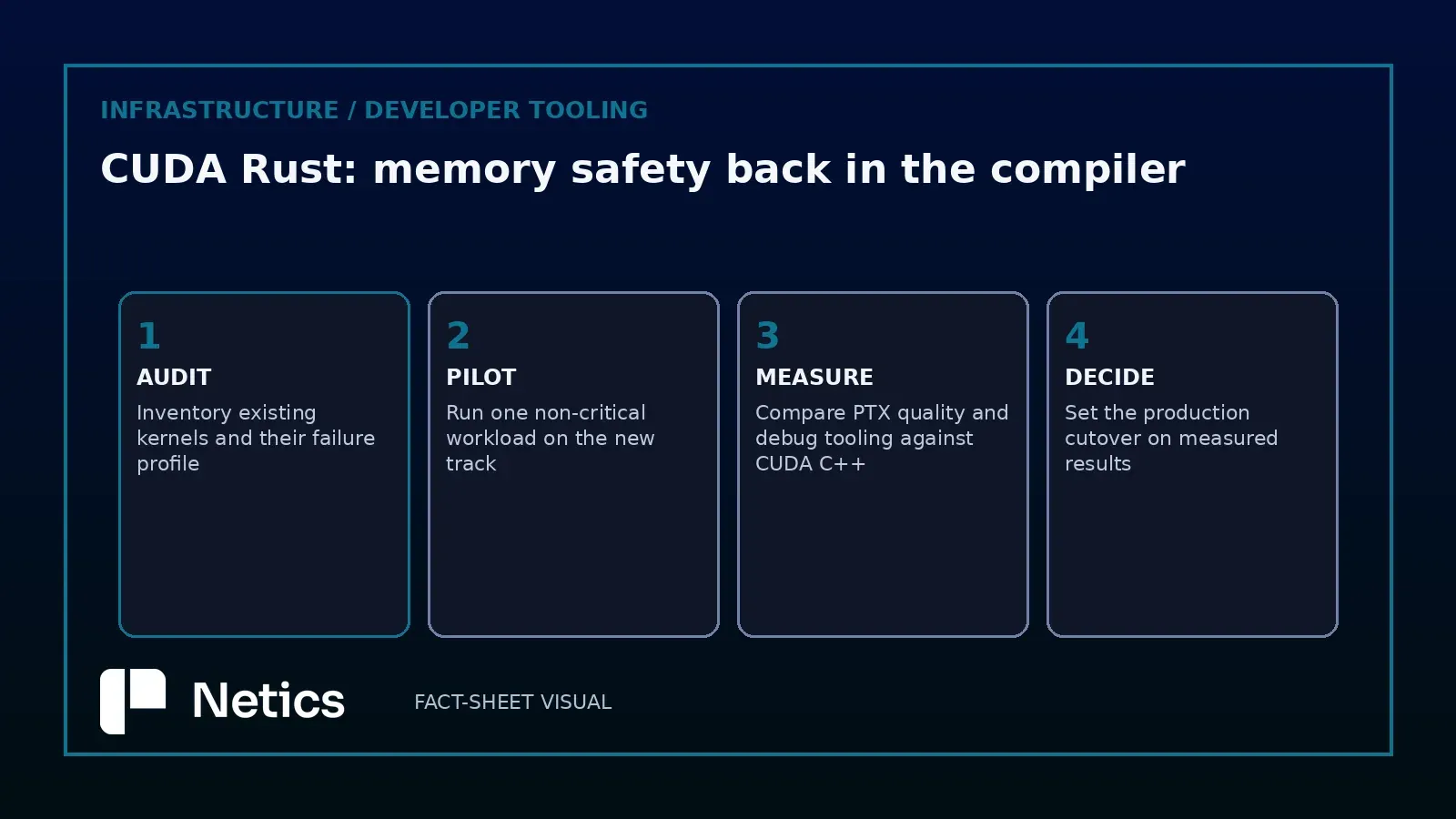
First, treat toolchain maturity as the critical path. The interesting engineering is the compiler work, and compilers take years to harden. Budget for nightly churn, missing coverage, and debugger gaps. Second, keep CUDA C++ and CUDA Python as the baseline until you have measured a real workload end to end. Rust in the kernel is a safety upgrade worth piloting; it is not yet a reason to rewrite a working inference stack.
For a practical conversation about GPU workload engineering, book a free 30-minute audit with Netics or start from the Netics homepage.
Sources
- Introducing CUDA Rust: Two Tracks for Writing GPU Kernels — NVIDIA Technical Blog, September 8, 2026. Primary source for the two tracks, requirements, memory-safety mechanisms, and maturity statements.
Source: "Introducing CUDA Rust: Two Tracks for Writing GPU Kernels" — developer.nvidia.com, September 8, 2026.