
Bee Releases Data Keys Only to Attested Instances and Publishes the Measurements
"Bee, an Amazon company, published the architecture behind Zero Operator Access: EC2 attestation gates key release, PCR14 covers container digests, and a public transparency log publishes th


TL;DR
- Zero Operator Access is a design in which no operator, inside the company or inside the cloud provider, holds a technical path to customer data, and Bee, an Amazon company, built it for a wearable personal AI device that records conversations.
- The AWS Architecture Blog published the architecture on 20 November 2026: a user's device releases the keys that decrypt their data only to EC2 instances whose boot measurements match an approved reference.
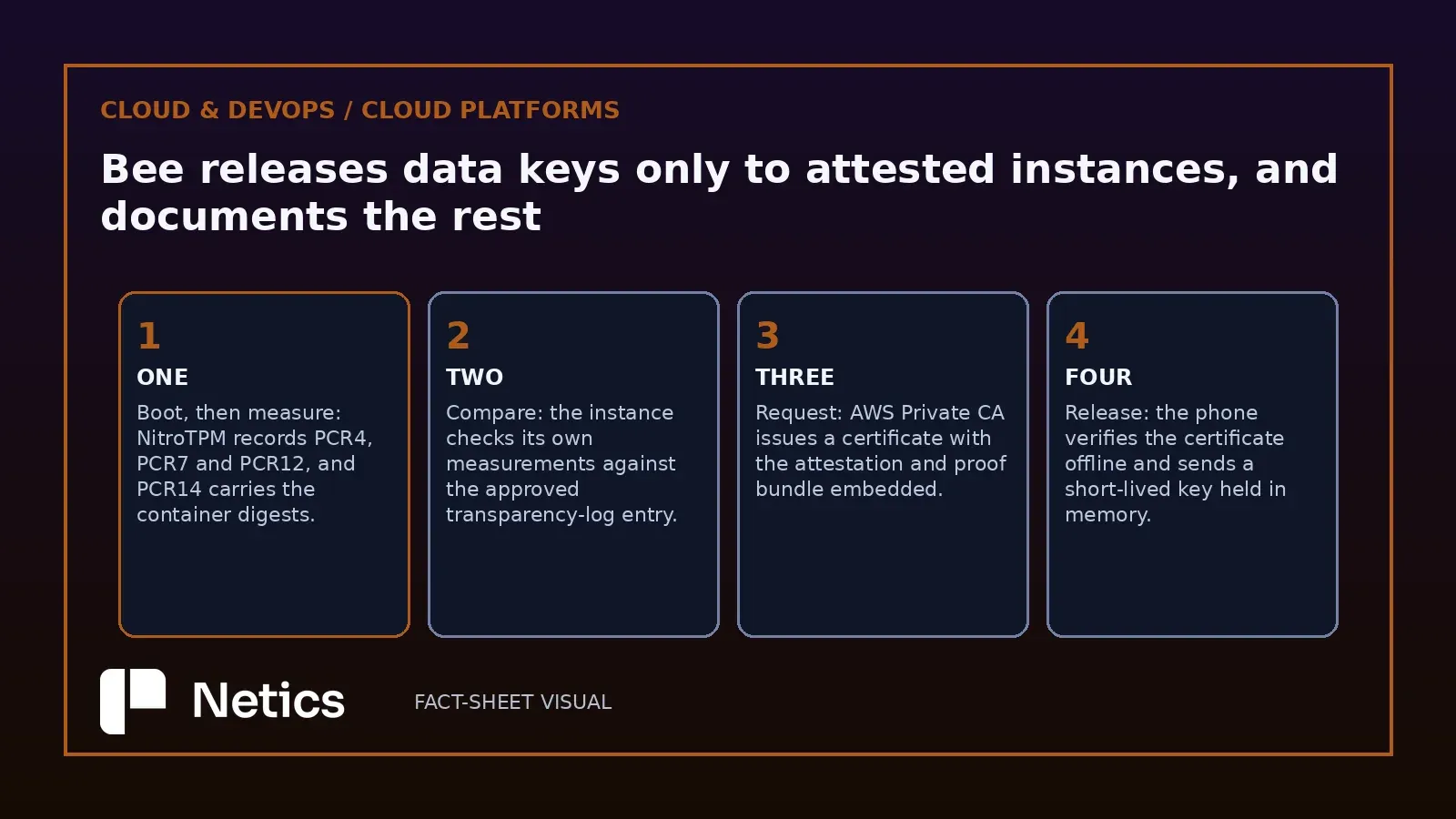
- The boot measurements carry the workload as well as the kernel: PCR4, PCR7 and PCR12 record the kernel image and Secure Boot state, and PCR14 is extended with one deterministic hash computed across the manifest, all container digests and all artifact checksums.
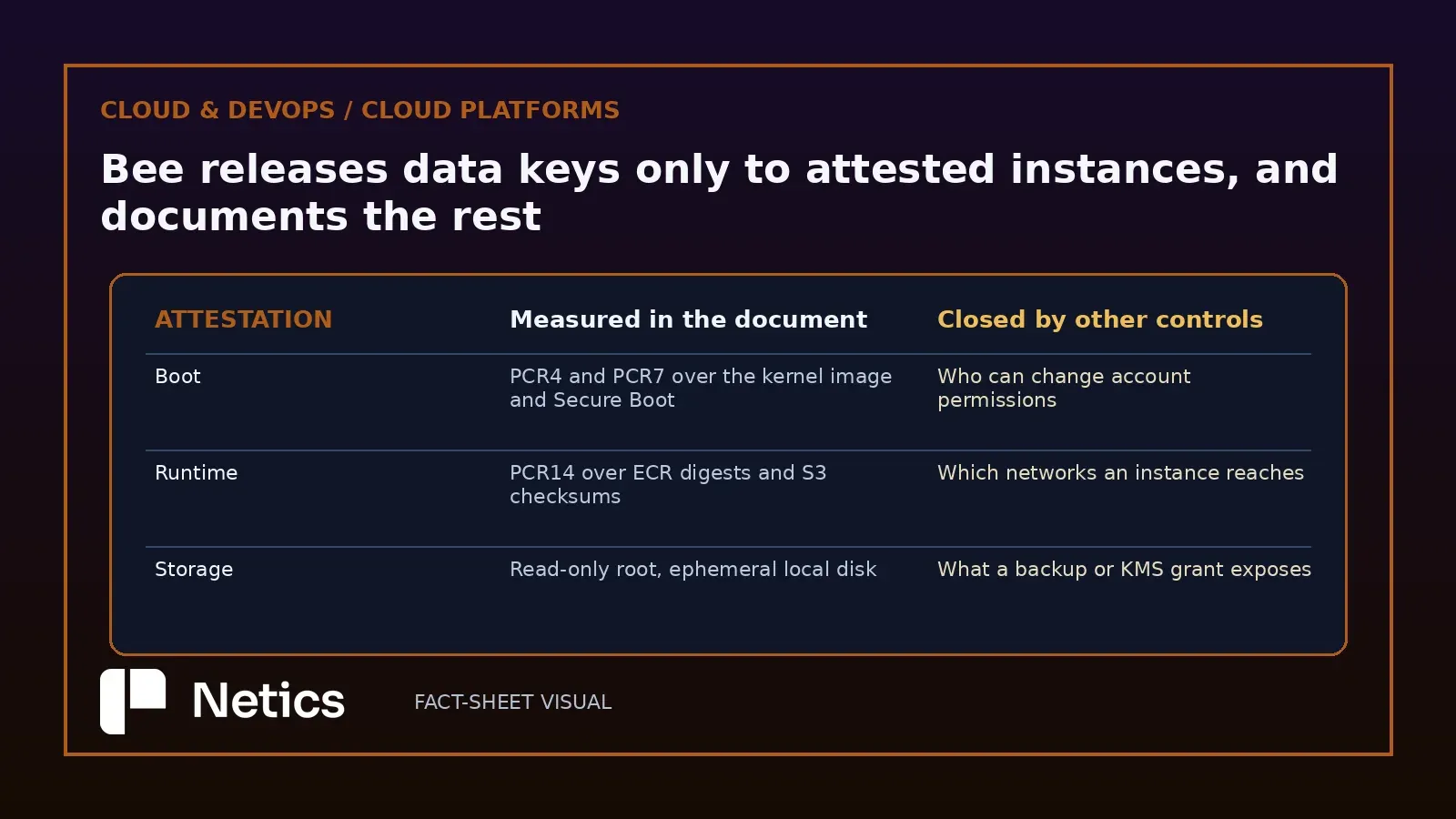
- What attestation measures has a boundary, and the post states it plainly: the document proves what runs inside an instance, so networks the instance can reach and permissions that can change the account need separate controls, which Bee supplies through isolated subnets, VPC endpoints and service control policies.
- The order of operations is the technical heart: PCR14 is extended before the attestation document is drawn, so one signed hardware measurement covers both the OS state and the workload state.
- The transparency log carries the expected values: a separate Amazon team runs the transparency service, commits the PCR map to Sigstore Rekor, and the proof bundle is stored in replicated S3 buckets so a client verifies at boot with no network call.
- A team can apply the design by computing reference measurements before boot, extending workload digests into a PCR, embedding the proof in the certificate the client checks, and keeping the released key short-lived and in memory only.
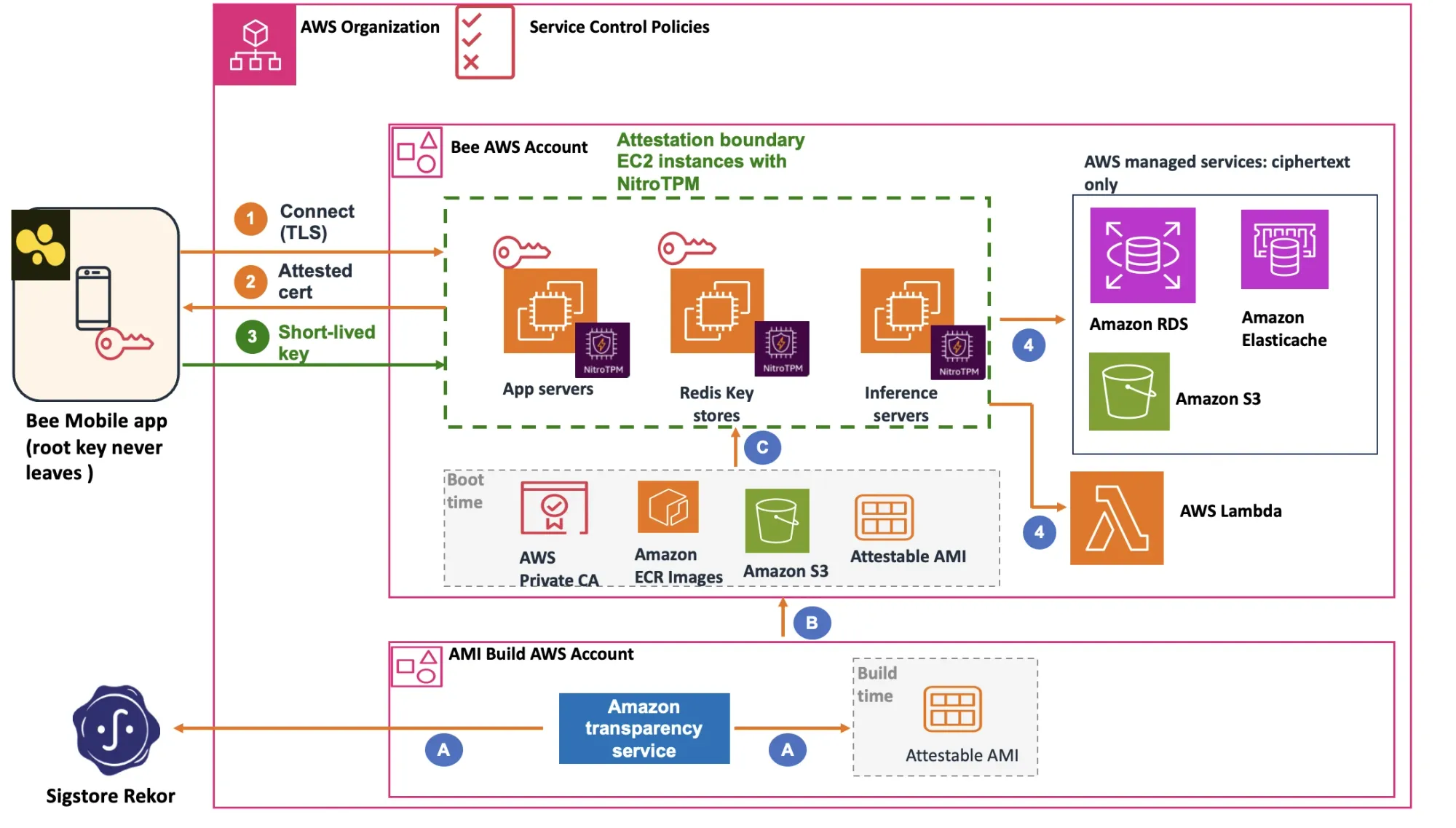
Bee, an Amazon company, published How Bee implemented Zero Operator Access for personal AI on AWS on 20 November 2026, and the post is unusual for what it admits early. Attestation measures the software running inside an instance; network reach and account controls define its operating environment. The architecture that follows is a set of answers to that gap, written around one control that carries the weight: a device that refuses to hand over a decryption key until the server proves which software it is running.
What Zero Operator Access means in this build
Bee is a wearable device that listens, summarises and remembers, which makes its data the kind a company would rather not be able to read. The post defines the target as an architecture with no mechanism for operators to access customer data, and it holds three groups to that promise: Bee engineers, other Amazon employees, and AWS infrastructure operators. The first two groups fall under Bee's own controls; the third is inherited from the AWS Nitro System.
The phrase in the post is zero operator access, and the useful reading is literal. The design enforces that promise through a technical control that keeps the key beyond engineers' reach. It removes the key from the building. Users' encryption keys originate on their devices, AWS never holds them, and the post states that no storage layer, backup, IAM policy or KMS grant can provide access to a key the provider never had.
The boot measurements carry the workload as well as the kernel
Reference measurements are computed offline during the image build, from the Unified Kernel Image and the Secure Boot configuration, before any instance launches. Bee verifies against PCR4, PCR7 and PCR12, the registers that record boot components and configuration as the machine starts, and NitroTPM produces a signed attestation document containing those values.
Container and model integrity requires its own measurement alongside the kernel. Bee closes that gap with a custom measured boot tool that runs before any application container starts: it resolves each container image in the manifest to its immutable ECR digest, retrieves the SHA-256 checksum of each S3 artifact, hashes the manifest with all of those values, and extends the result into PCR14. A swapped image, a modified model weight or an edited manifest produces a different PCR14 and therefore a different attestation document.
Why the PCR14 extension happens before the attestation document
This is the sentence worth re-reading twice: the post says PCR14 is extended before the NitroTPM attestation document is obtained. An attestation document is a snapshot of the registers at the moment it is signed. Extending PCR14 first places the workload hash inside the signed snapshot, so the document a client verifies covers the kernel and its workload, and any later image change produces a different measured state.
Doing the extension first turns two measurements into one signed statement about the OS state and the workload state together. The ordering is easy to lose in a rewrite, which is why it belongs in a review checklist next to the code that opens the TPM. The same reasoning explains why the transparency service recomputes PCR14 independently from the same ECR digests and S3 checksums before committing the full PCR map.
What attestation measures and which paths stay open
The post is candid about the boundary. The post places network reach and unilateral permission changes outside the attestation measurement. Bee limits network reach with isolated subnets and VPC endpoints, constrains permission changes through separation of duties and service control policies, and keeps short-lived keys only in memory with persistence disabled. Attested instances run in isolated VPC subnets with no internet egress, and the only outbound paths are VPC endpoints to RDS, ElastiCache and tightly scoped Lambda functions that receive data already encrypted with user keys.
Permissions get the same treatment, at the level of the organisation. The Bee team manages the private certificate authority and the deployment pipeline, and it does not control the transparency service. The transparency team commits entries to the public log and holds no access to Bee's AWS accounts. Service control policies span every Bee account, limit the actions possible in each one, and need multiple levels of approval to change. Shipping code that never appears in the public log would take coordination across independent teams, which is the point.
Where the transparency log fits
A measurement means nothing to a client that has no reference for it. Sigstore's Rekor documentation describes the service as "an immutable, tamper-resistant ledger of metadata", built on a verifiable data structure, with auditors monitoring for consistency so that the log stays append-only and entries are never mutated or removed; the public instance carries a 99.5% availability objective. That gives Bee a place to publish expected values that a device can check without trusting Bee's own database.
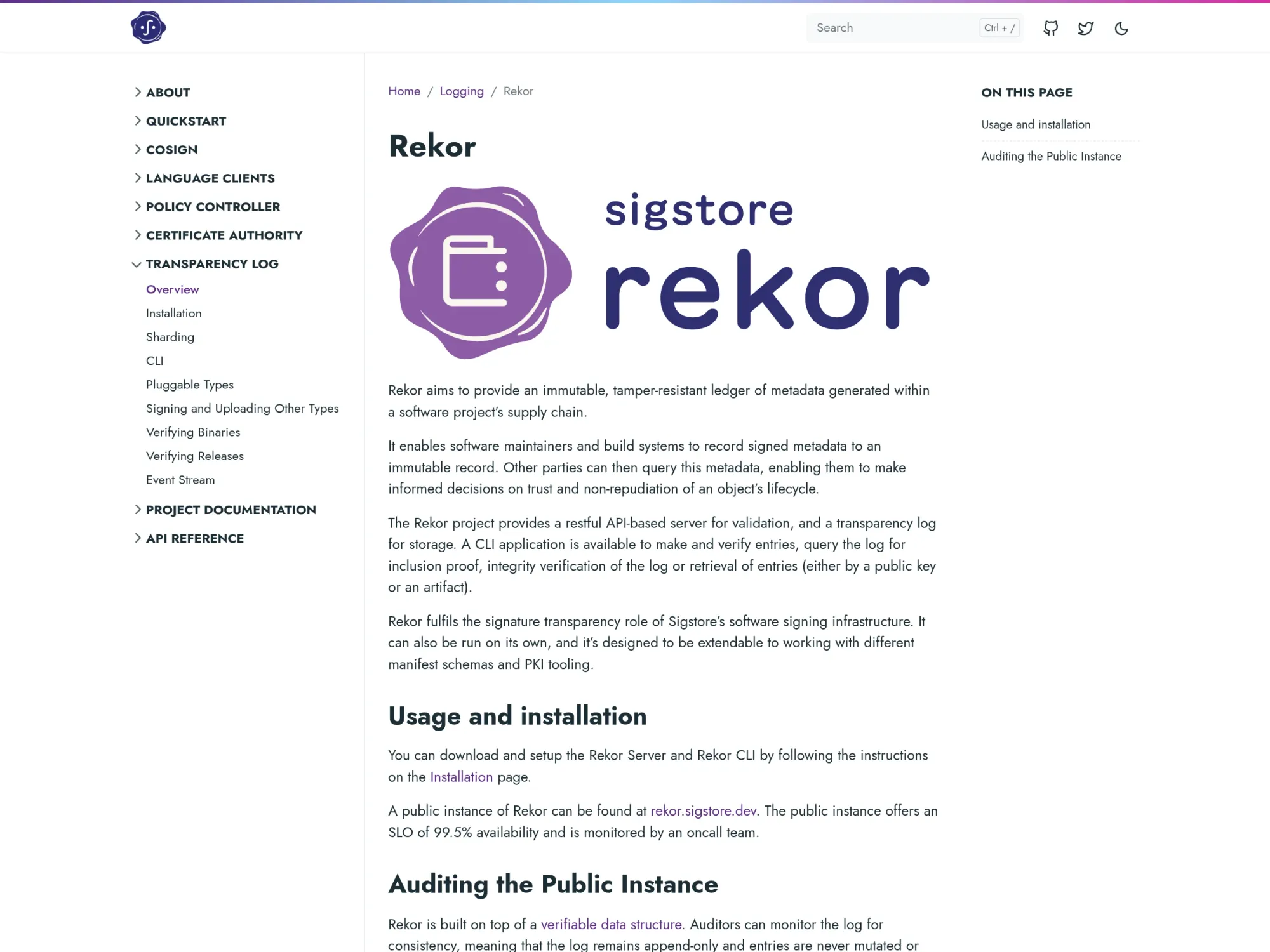
The operational detail determines how verification behaves. Bee stores the resulting proof bundle in regionally replicated S3 buckets, so verification at boot runs offline with no runtime dependency on external infrastructure. The revocation path remains unspecified if an approved workload is later found vulnerable, including the signal that stops clients from releasing keys to that measured state and the way clients receive it alongside the replicated proof bundle. A phone that needed to reach the public log before releasing a key would carry the log's availability into every session, and the SLO becomes a user-visible failure mode. Offline verification keeps the trust anchor in the client, which is where it belongs.
What a team can copy from this design
Most teams do not run a consumer device fleet and can still use the same implementation pattern. Compute reference measurements offline, before a machine boots, so the expected value exists ahead of the thing being checked. Extend a digest of the workload into a register before drawing the attestation document. Put the evidence inside the certificate the client already validates, so verification happens in one step and offline. Keep the released secret short-lived and in memory: Bee's key lives in the application process and in Redis with persistence disabled, and expires after seven days without user activity.
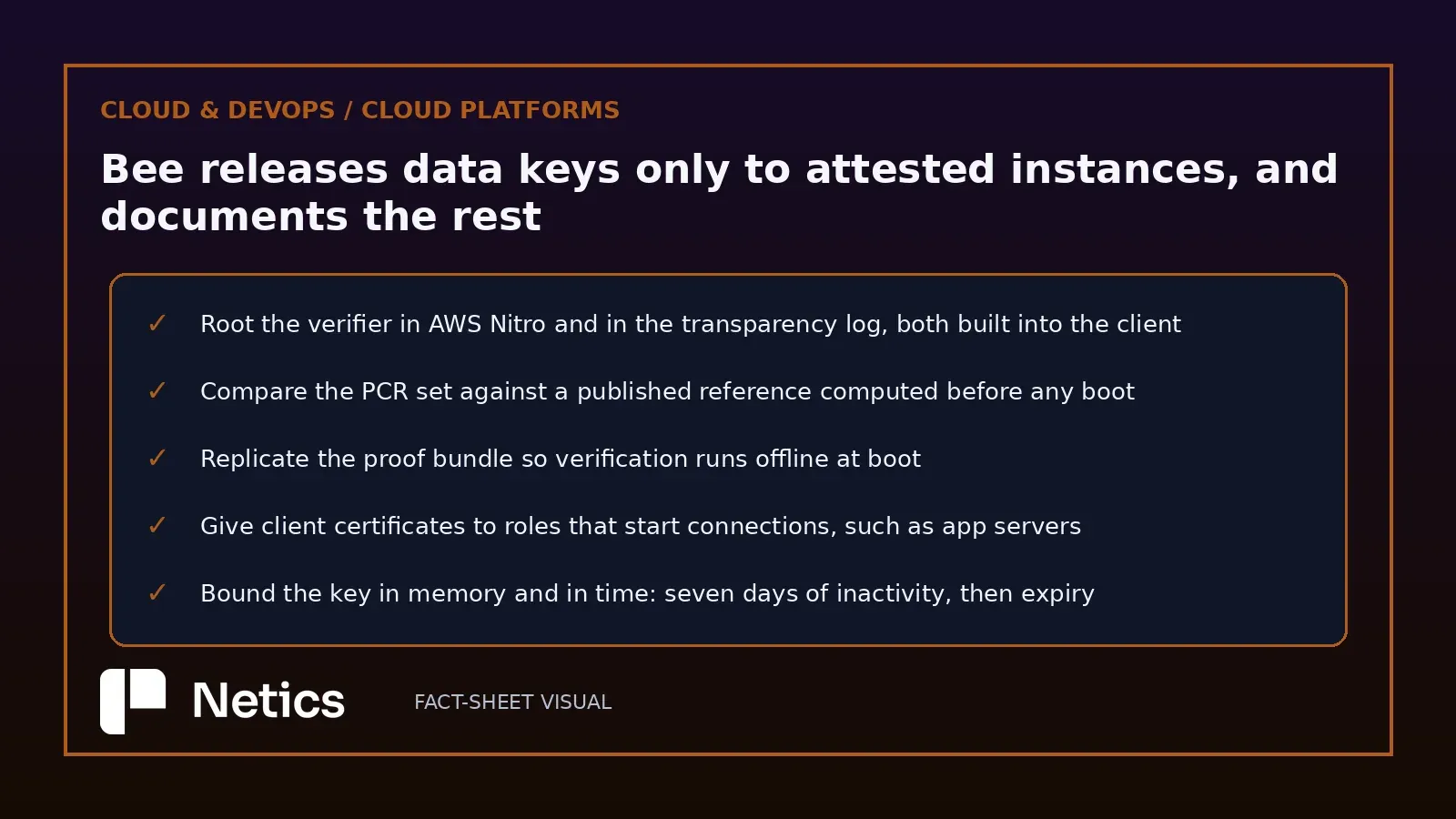
The pattern also names the part that a checklist tends to skip. A certificate proves the measured process; network controls govern the destinations that process can reach. For an attested instance, a default security group and an internet route create network exposure that egress rules and permission boundaries must close. Teams applying the same model on their own hardware should examine these dimensions as part of infrastructure and cloud work: the exposure model combines software measurements with network controls and permission boundaries. AWS offers a related primitive for pods in Nitro Sandboxes on EKS, where each pod gets its own hardware-isolated virtual machine.
Bee intends to move its inference to Amazon Bedrock Mantle, which the post describes as providing zero operator access as a managed capability, while user-held keys and attested application servers stay in place. The same verification path survives that move: the phone checks what its server is running against measurements published in a public log before it releases a key.
Sources
- How Bee implemented Zero Operator Access for personal AI on AWS — aws.amazon.com/blogs/architecture, 20 November 2026
- Rekor overview — docs.sigstore.dev, Sigstore documentation
- AWS Nitro System — aws.amazon.com/ec2/nitro
Source: "How Bee implemented Zero Operator Access for personal AI on AWS" — aws.amazon.com, 2026-11-20, https://aws.amazon.com/blogs/architecture/how-bee-implemented-zero-operator-access-for-personal-ai-on-aws/, read against the Sigstore Rekor documentation at https://docs.sigstore.dev/logging/overview/ and the AWS Nitro System page at https://aws.amazon.com/ec2/nitro/; all fetched and saved on 2026-11-21 under sources/2026-11-21/bee-zero-operator-access/.