
Ambient Networking Reaches GA on GKE With One Envoy per Node
"Google made ambient networking generally available on GKE on 21 November 2026. The data plane lives in per-node DaemonSets, and the documentation scopes the product to single-cluster Layer

TL;DR
- Ambient networking is a way to run a service mesh on Google Kubernetes Engine in which the mesh data plane runs as one shared proxy per node, and application Pods carry no sidecar container.
- On 21 November 2026 Google announced general availability of ambient networking for GKE, after a preview period it says began earlier in the year.
- The node side is a set of DaemonSets in the
gke-managed-ambientnamespace: an NRI plugin that redirects Pod sockets, an xDS agent, and a shared Layer 4 Envoy proxy that enforces mTLS for every enrolled Pod on that node. - The control plane keeps routing policy outside the Pod: Traffic Director distributes xDS rules, Certificate Authority Service issues workload identity certificates on demand, and the GKE Gateway controller translates Gateway API resources into managed Google Cloud resources.
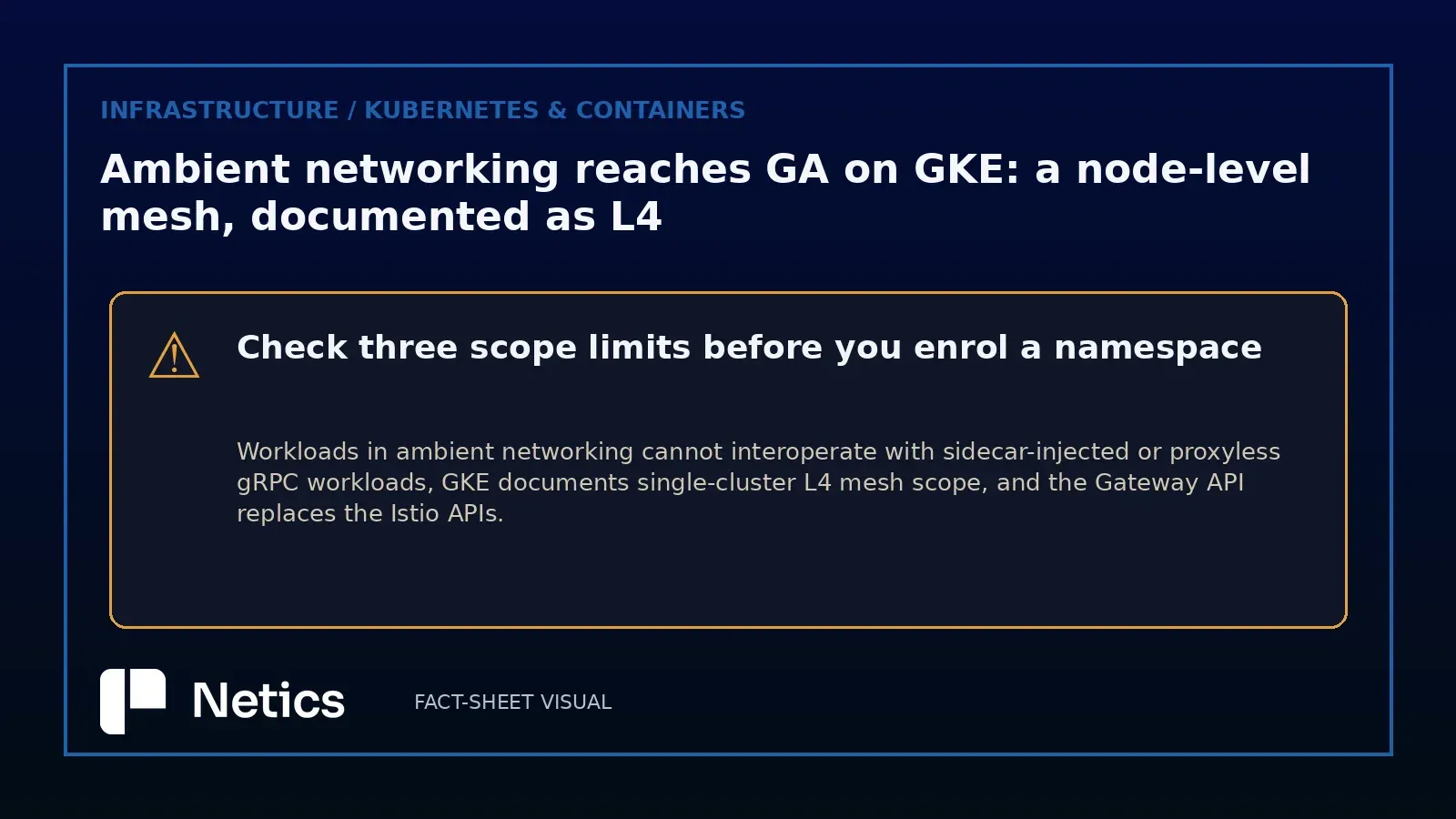
- Google's own documentation draws the boundary at single-cluster Layer 4, requires the Gateway API, states that Istio APIs are unsupported, and records that ambient workloads cannot interoperate with sidecar-injected or proxyless gRPC workloads.
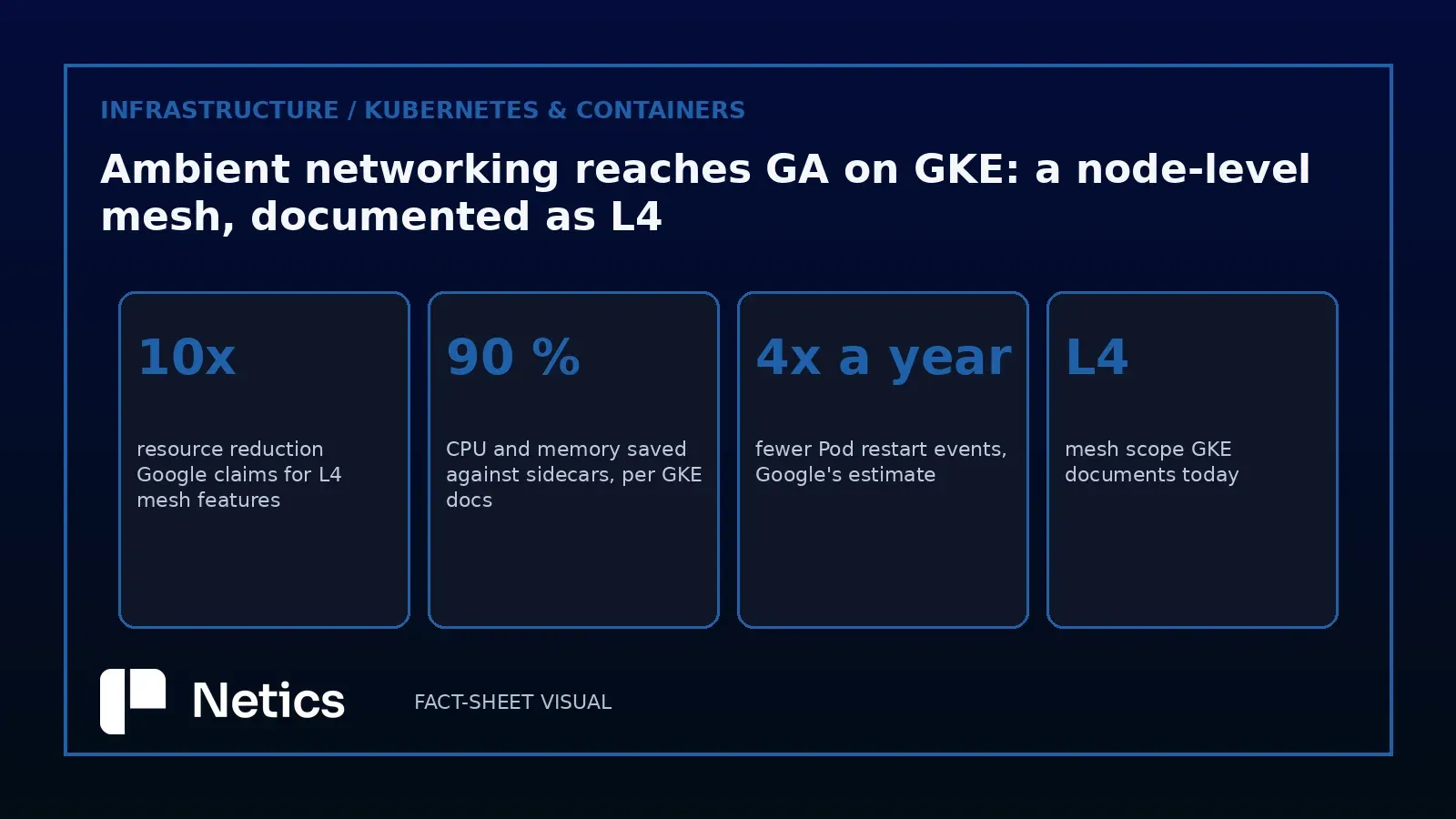
- The resource numbers arrive in two shapes: the blog claims up to a 10x reduction in GKE resource usage for Layer 4 mesh features, and the documentation states up to 90% lower CPU and memory against sidecar models; the blog separately attributes an average fourfold annual reduction in application disruption to eliminating CVE-driven Pod restarts.
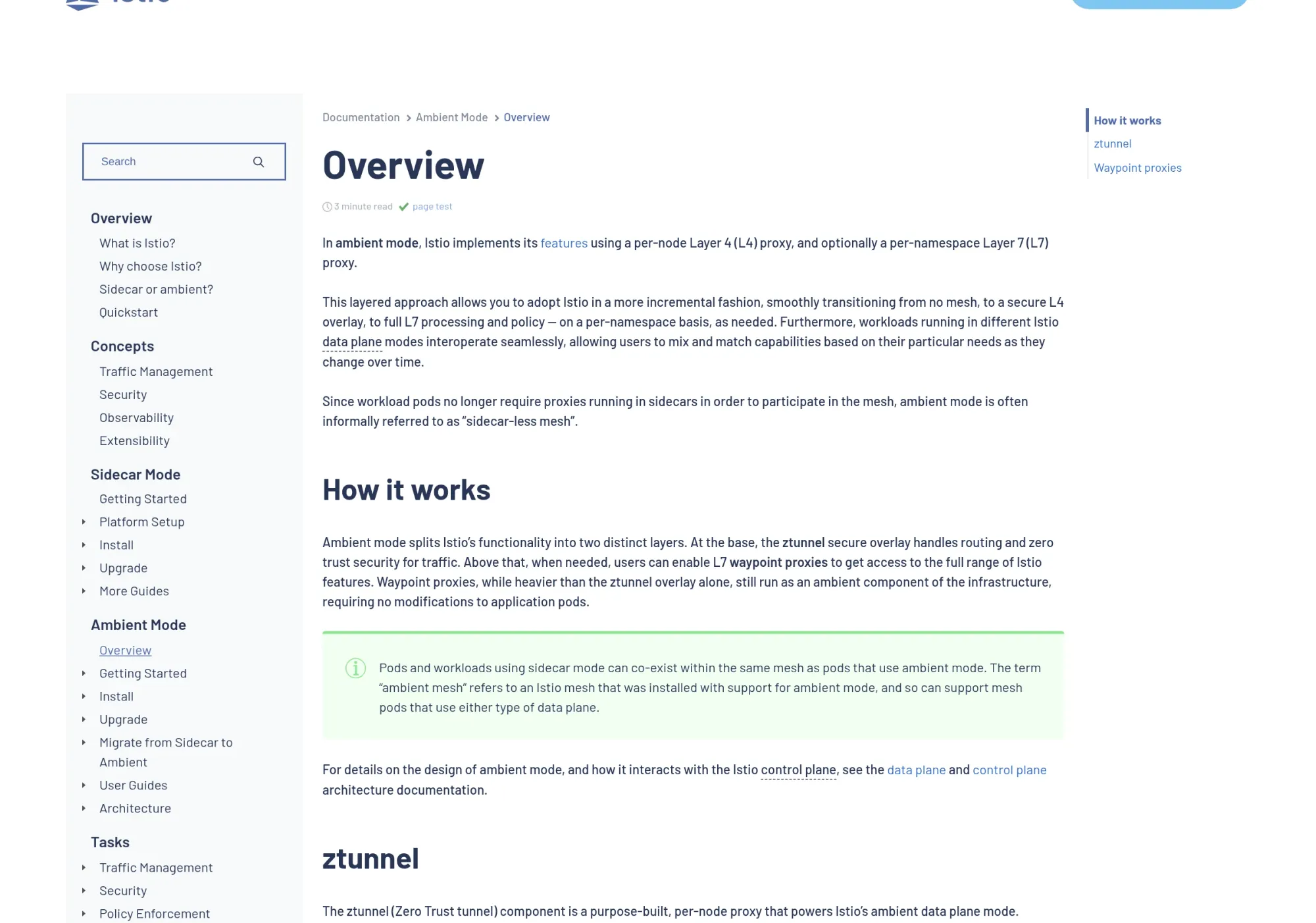
- Upstream Istio splits ambient into two layers, a Rust ztunnel per node for L3 and L4 plus an optional per-namespace waypoint proxy for L7, and that split is the comparison that shows what the managed product covers today.
- The migration checklist for platform teams starts with Gateway API readiness, a deliberate namespace label because billing follows that label, and an inventory of the sidecar-injected workloads a namespace already runs.
Google's networking team published Introducing ambient networking for GKE on 21 November 2026, signed by product manager Chris Crall, and the architecture deserves attention. GKE ambient networking runs its mesh data plane in shared per-node components. Google manages those node components alongside the GKE control plane.
What ambient networking runs on a Node
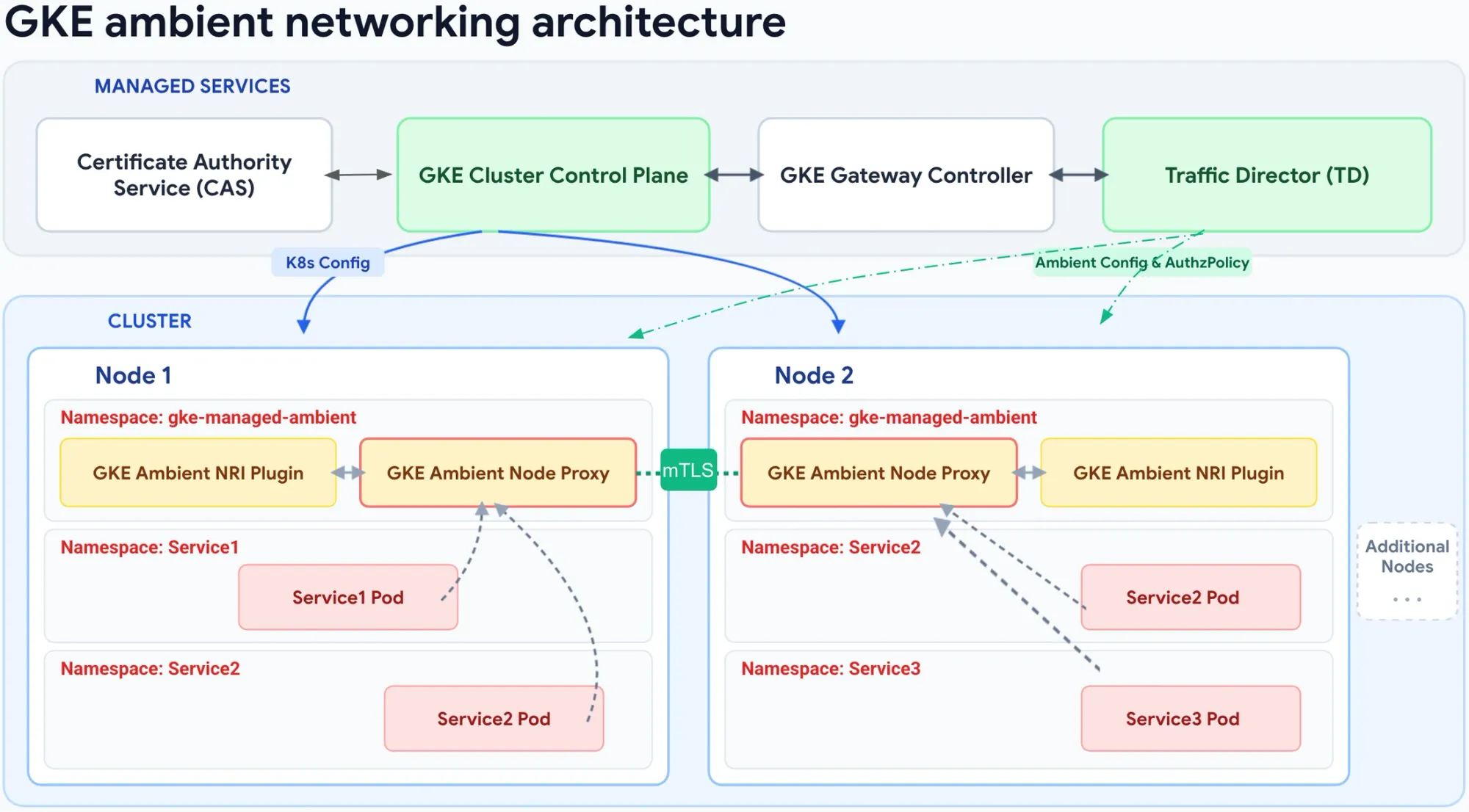
The node side carries the whole design. Google's diagram shows two worker nodes, each holding a gke-managed-ambient namespace with an ambient NRI plugin, a node proxy, and the service Pods that route through it. The plugin hooks the network runtime interface and redirects Pod sockets; the xDS agent inside the node proxy pod pulls configuration from Traffic Director and requests certificates from the GKE control plane on demand.
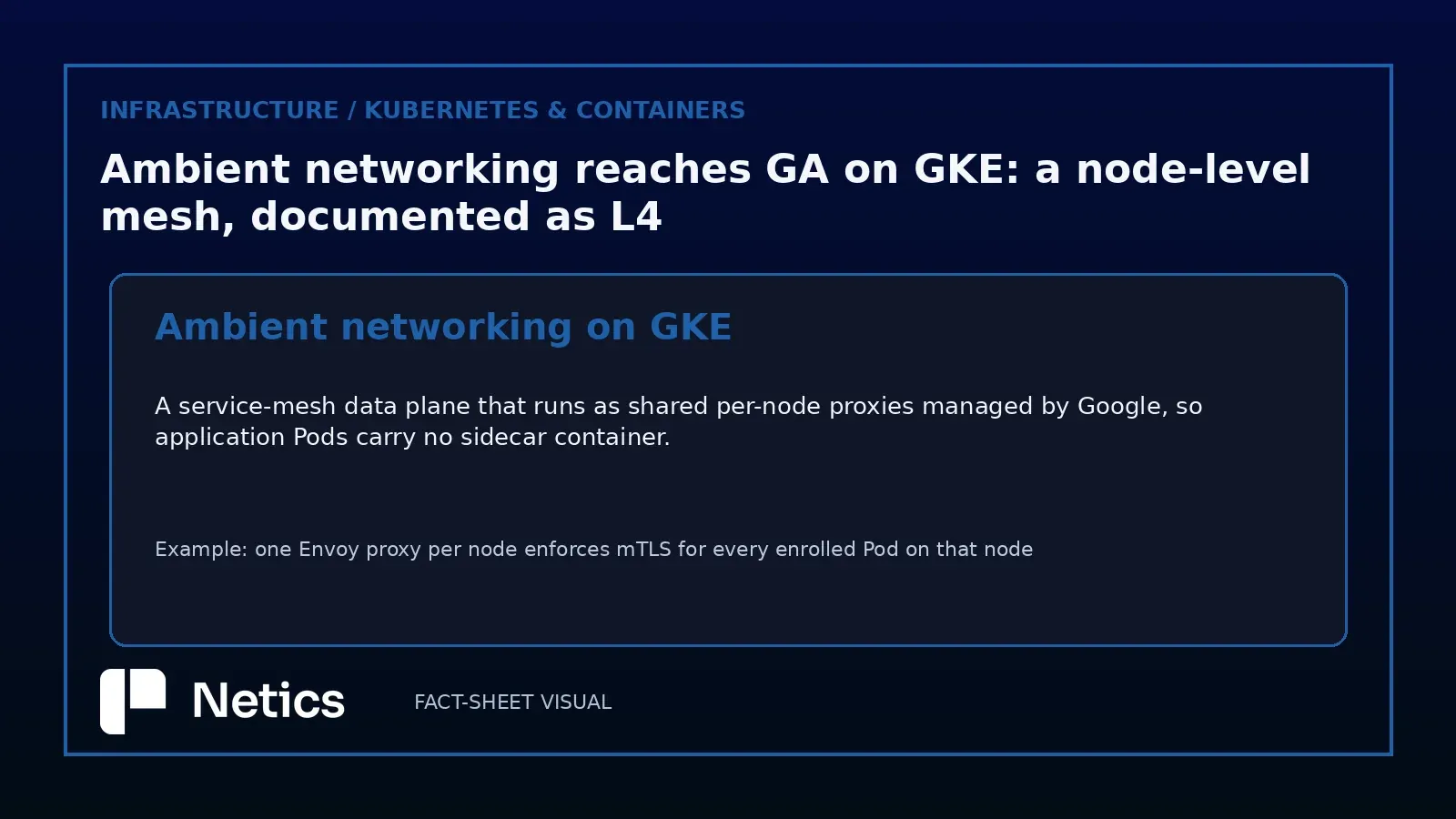
The proxy itself is a shared Layer 4 Envoy instance. It terminates mutual TLS, evaluates authorization policy, balances load and emits telemetry for every enrolled Pod on the node. The documentation puts the components in DaemonSets that are "automatically versioned, patched, and upgraded alongside the GKE control plane", which is the sentence that changes an operator's calendar: a mesh CVE becomes a node image event handled inside normal cluster maintenance.
The control plane keeps routing policy outside the Pod
Four managed pieces do the coordinating. Traffic Director acts as the xDS control plane and streams routing rules, access-control policy and cluster state to the node proxies. Certificate Authority Service issues the workload identity certificates that the proxies present to each other. The GKE control plane manages the cluster, and the Gateway controller reads Gateway custom resources and hands configuration to Traffic Director.
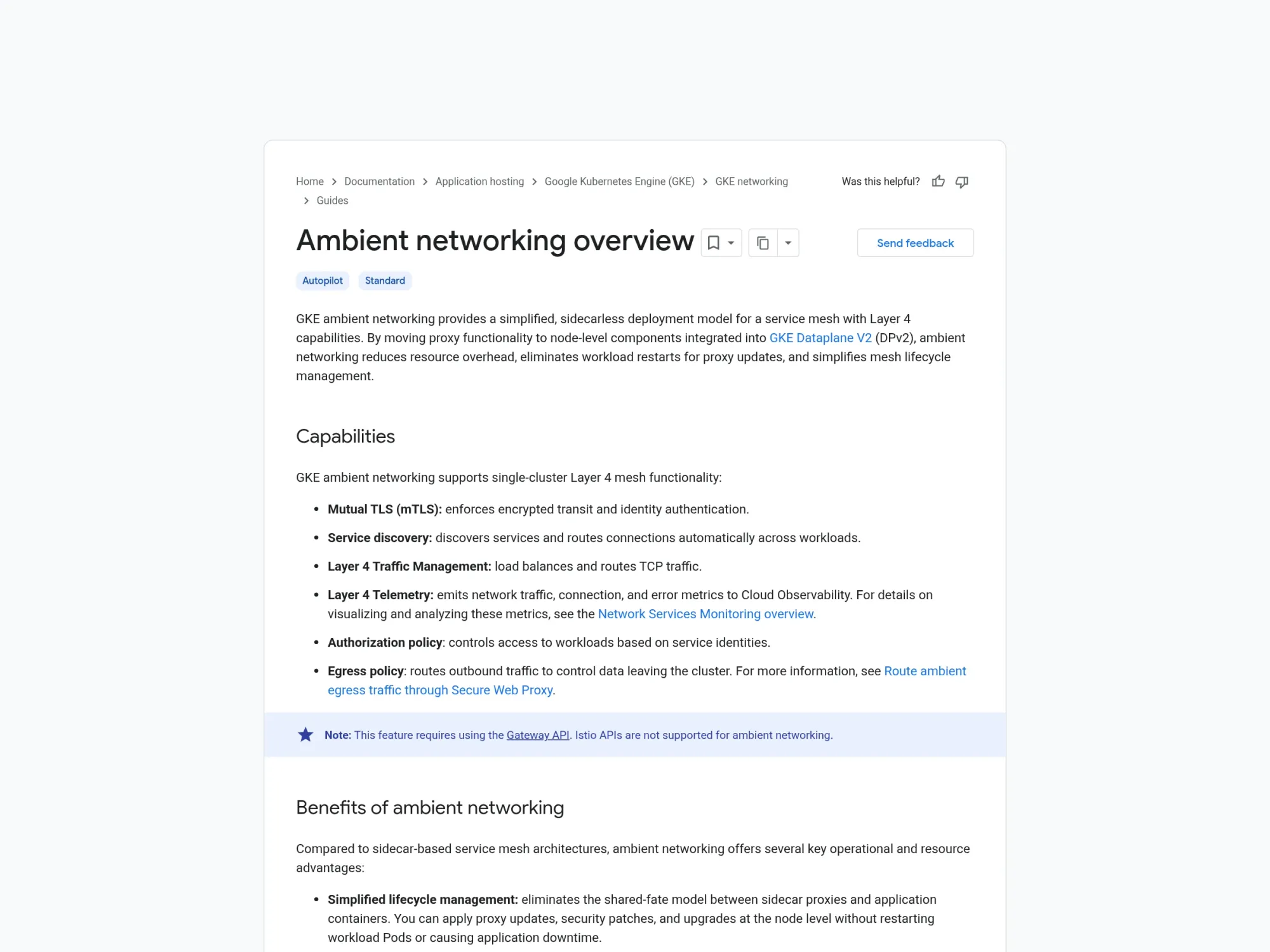
That arrangement is worth reading slowly, because it explains the product's shape. Policy lives in Google Cloud resources, and the Gateway API is the interface to it. The documentation is explicit: "Gateway API requirement: ambient networking requires the Gateway API. Istio APIs are not supported." A team with a pile of Istio AuthorizationPolicy and VirtualService objects has a translation project in front of it, and the Gateway resources you manage are automatically translated into managed Google Cloud API resources.
Telemetry arrives through the same path. The announcement pairs the GA with Network Services Monitoring, a Google Cloud capability that shows service-to-service connections, latency and error rates across clusters. The node proxy emits L4 metrics by construction; the announcement also lists L7 metrics, which is where the scope question starts.
Google's documentation draws the boundary at L4
The announcement describes a sidecar-less architecture in production and lists zero-trust mTLS, authorization policy, L4 and L7 metrics. The overview page states the scope in its own words: "GKE ambient networking supports single-cluster Layer 4 mesh functionality". Two limits follow. The documented product covers one cluster and Layer 4 mesh functionality, so an operator who knows the Istio mesh API has a mapping exercise ahead.
The interoperability line is the one that bites during a migration. The documentation records that "workloads enrolled in ambient networking cannot interoperate with sidecar-injected workloads (on GKE, Compute Engine, or Cloud Run) or proxyless gRPC workloads". In a cluster where one team still runs injected Envoy sidecars, the mesh boundary follows namespace lines, and a service that spans both sides needs a plan before the label goes on. The neighbouring story in Kubernetes networking this year is the same lesson at a lower layer: the kube-proxy IPVS mode removal moved traffic handling from one dataplane to another and left a configuration audit behind it.
The resource numbers arrive in two shapes
Google publishes two separate upper-bound resource claims. The blog says ambient networking "enables up to a 10x reduction in GKE resource usage for layer 4 (L4) mesh features, including mTLS, load balancing, telemetry", and the documentation describes a model that consolidates proxying into shared node-level instances and records CPU and memory overhead at up to 90% below sidecar models. Google presents both figures as upper bounds on resource savings.
The disruption claim is separate and softer: ambient networking "can reduce administrative overhead and application disruption an average of four times annually by eliminating pod restarts required by CVE patches for L4 mesh usage". Google attributes this average fourfold annual reduction in application disruption to eliminating Pod restarts required by CVE patches for L4 mesh usage.
What upstream Istio splits into two layers
Istio's ambient mode documentation offers a functional comparison with Google's documented per-node Layer 4 architecture. Ambient mode divides the mesh into "two distinct layers": a per-node ztunnel proxy, written in Rust, that handles L3 and L4 functions such as mTLS, authentication, L4 authorization and telemetry, and an optional per-namespace waypoint proxy that adds Layer 7 policy and traffic management. The ztunnel "does not terminate workload HTTP traffic or parse workload HTTP headers", and traffic inside the secure overlay is tunnelled with HBONE.
Read the two documents together and the mapping is visible. Functionally, GKE's node proxy parallels ztunnel for shared per-node Layer 4 processing; Traffic Director supplies xDS configuration and cluster state to node-level proxies. The GKE overview documents single-cluster Layer 4 mesh functionality, the Gateway API requirement and the absence of Istio API support for ambient networking. Both documents use the vocabulary of "sidecar-less mesh". GKE exposes its control surface through the Gateway API and managed Google Cloud resources.
A migration checklist for platform teams
Start with the interface. Confirm the Gateway API is installed and that the Gateway resources you need exist in the cluster, because ambient networking requires it and the translation into managed Google Cloud resources happens at apply time. Then inventory what the namespace runs. Any workload with an injected sidecar, any proxyless gRPC service and any Compute Engine or Cloud Run service that talks to these Pods sits on the far side of an interoperability line.
The label is the switch and the meter. The documentation notes that "All Pods in any namespace with the ambient label networking.gke.io/dataplane-mode=ambient will be billed", so label a namespace whose contents you have counted, and check the pricing page before an estate-wide rollout. Keep the first namespace small, watch the L4 metrics in Network Services Monitoring for a week, and compare the node CPU profile against the sidecar baseline you recorded beforehand. Teams planning a wider self-hosted move can start from sovereign infrastructure and cloud exit.
The GA establishes product availability. The documentation provides the criteria a team needs to assess adoption. For teams whose requirements fit the documented single-cluster Layer 4 scope, the package provides one managed Envoy per node and policy in Google Cloud resources.
Sources
- Introducing ambient networking for GKE — cloud.google.com, 21 November 2026
- Ambient networking overview — docs.cloud.google.com, GKE networking
- Ambient mode overview — istio.io, Istio documentation
Source: "Introducing ambient networking for GKE" — cloud.google.com, 2026-11-21, https://cloud.google.com/blog/products/networking/ambient-networking-for-gke-sidecarless-service-mesh, read against the GKE ambient networking overview at https://docs.cloud.google.com/kubernetes-engine/docs/concepts/ambient-overview and the Istio ambient mode overview at https://istio.io/latest/docs/ambient/overview/; all fetched and saved on 2026-11-21 under sources/2026-11-21/ambient-networking-gke-ga/.