
AWS Frontier Agents Earn Autonomy by Keeping an Approval Gate
AWS Security Agent and DevOps Agent are now generally available. The autonomy is real — the approval gate is what makes it shippable. Netics on where the boundary should sit.

TL;DR
- AWS Security Agent and AWS DevOps Agent reached general availability on March 31, 2026, as the first two products in AWS' frontier-agent family.
- AWS Security Agent delivers on-demand penetration testing that chains individual findings into higher-severity attack paths by reading source code, architecture diagrams, and documentation — not just scanning endpoints.
- DevOps Agent investigates incidents across AWS, multicloud, and on-prem stacks, correlating telemetry, code, and deployments; preview customers reported up to 75% lower MTTR.
- Context is both the differentiator and the risk: an agent that understands your architecture and secrets layout is an agent with a complete map of your attack surface — its blast radius is not a scanner's.
- Both run continuously and act autonomously, which is exactly why the missing piece is not capability but an explicit human approval step before fixes are applied.
- Netics' read: the autonomy is the headline, the approval gate is the product. Buy the boundary, not the demo. Three controls — read broadly, write narrowly; segment environments; keep approval evidence — are where the product meets production.
Two agents, one design claim
AWS' machine-learning blog introduced the pair as a new class of capability it calls frontier agents: systems that work independently toward goals, scale to concurrent tasks, and run persistently for hours or days without constant human oversight. The concrete products are AWS Security Agent, for on-demand penetration testing, and AWS DevOps Agent, for incident operations. Both became generally available on March 31, in six regions for the Security Agent: US East (N. Virginia), US West (Oregon), Europe (Ireland), Europe (Frankfurt), Asia Pacific (Sydney), and Asia Pacific (Tokyo).
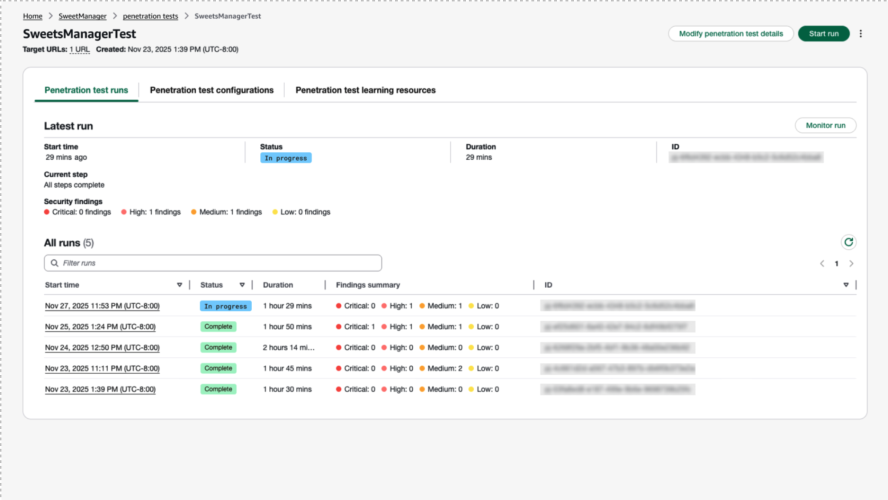
The design claim is worth separating from the feature list. A traditional scanner generates findings; an agent attempts exploitation with targeted payloads and attack chains, then validates that what it found is a legitimate risk. The difference is confirmation. AWS Security Agent does not report a weakness it cannot exploit, which is precisely why security teams can hand it a production application without drowning in false positives. On the AWS security blog, the company put a number on that discipline: a 92.5% success rate on CVE Bench v2.0 for discovering and validating real-world vulnerabilities.
Context is the differentiator, and the risk
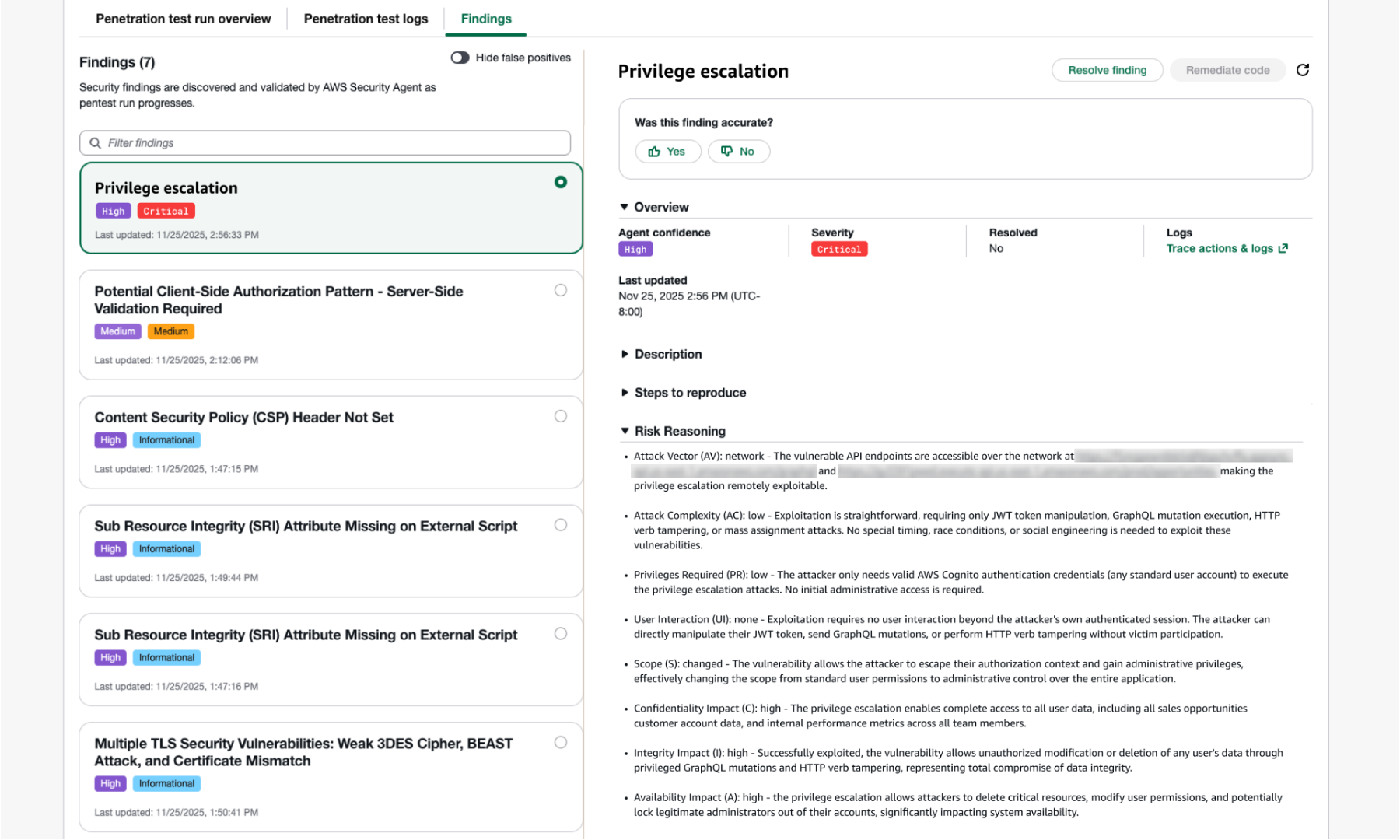
What makes the Security Agent more than an automated pentester is that it ingests design documents, architecture diagrams, infrastructure-as-code, source code, user stories, and threat models. That context lets it connect findings into attack chains. The security blog's worked example is instructive: a stored XSS (CVSS 6.1) that chains to an exposed admin configuration endpoint returning production database credentials — a CVSS 9.8 that SAST, DAST, or SCA tools had not surfaced, because the vulnerability only existed as a sequence, not as a single check. The agent read the PRD, understood the endpoint was for troubleshooting behind an assumed auth gateway, and proved the full path.
That is a genuinely new test capability, and it changes the economics: AWS quotes roughly 24 task-hours and about $1,200 for a typical comprehensive test with remediation, against a manual engagement that traditionally runs weeks and is rationed to the most critical applications. Continuous testing of the whole portfolio becomes affordable instead of aspirational. But the same context ingestion is the risk boundary. An agent that understands your architecture and your secrets layout is an agent with an unusually complete map of your attack surface. The blast radius of a compromised agent is not a scanner with a fuzzer; it is a tester that already knows where the sensitive endpoints live.
The operations agent is where the approval question gets real
AWS DevOps Agent resolves incidents, correlates telemetry, code, and deployment data across AWS, Azure, hybrid, and on-prem stacks, and works with CloudWatch, Datadog, Dynatrace, New Relic, Splunk, and Grafana plus GitHub, GitLab, and Azure DevOps. Preview data claims up to 75% lower MTTR, 80% faster investigations, and 94% root-cause accuracy. WGU's SRE team used it in production to cut an estimated two-hour resolution to 28 minutes, finding a Lambda configuration as the root cause.
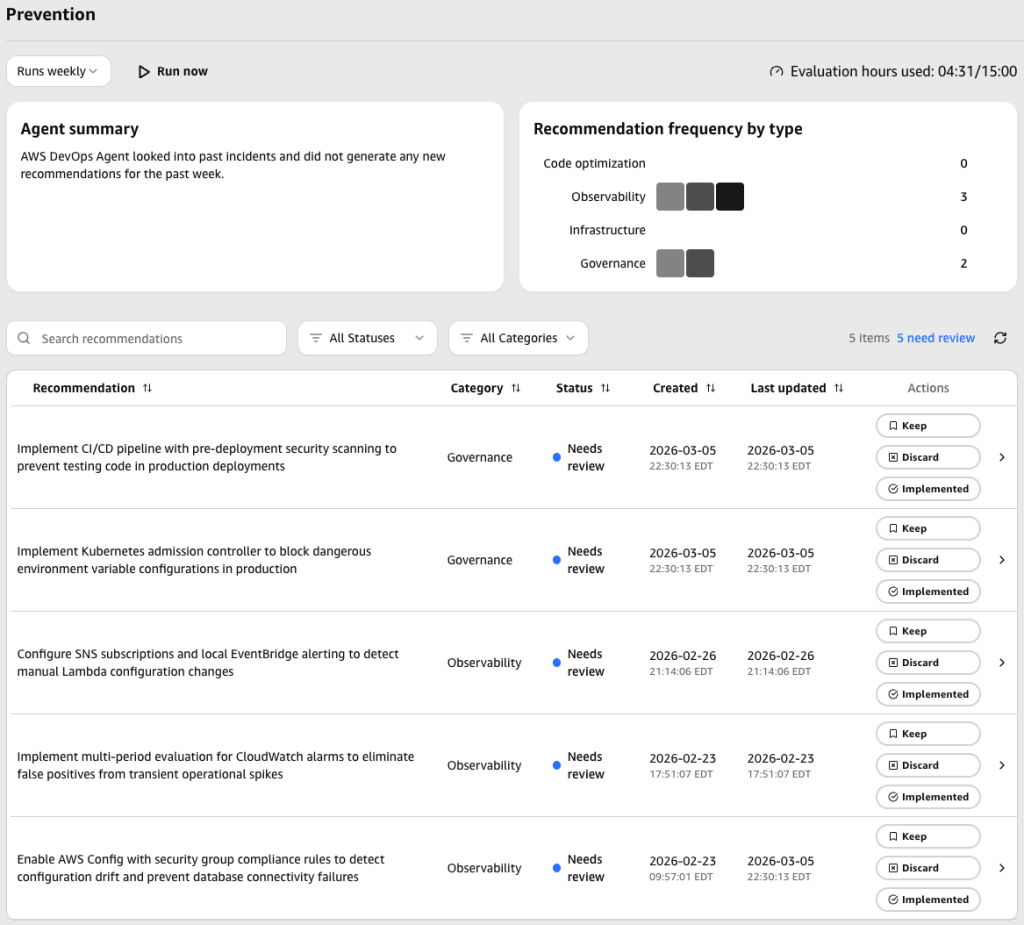
The deciding detail is in the last paragraph of the announcement: DevOps Agent, working with tools such as Kiro and Claude Code, can generate validated fixes that can be applied back into the system. That sentence contains the entire governance debate. An agent that investigates, proposes, and patches removes the human from the loop that matters most — the moment a change is written to production. Nothing in the materials suggests AWS is positioning the agent to self-apply fixes without review; the opposite is implied by the emphasis on validated fixes. But every AI operations product will be judged on whether the approval step is a real gate or a checkbox an operator rubber-stamps at 2 a.m. during an incident.
Where the Netics boundary sits
We have argued before that controlled access comes before another platform, and that zero-trust agents need hard boundaries outside the model. These frontier agents are the same argument wearing a product. The boundary that matters is not the model's judgment; it is the interface between the agent and your production systems.
Three controls, not three settings
Three controls belong in every deployment.
- Read broadly, write narrowly. Give the agents wide read access for analysis — telemetry, runbooks, source — and route every write through a human-approved queue. The security blog's own six-step lifecycle keeps a developer review between "trigger remediation" and "merge."
- Segment by environment. Let pentest and ops agents run against staging and non-production replicas first. The agent's context ingestion is powerful enough that testing against production data should be the exception, not the default.
- Keep the approval evidence. When a human approves an agent-generated fix, attach the agent's trace — which finding, which chain, which attempted exploitation — so the approval is a decision, not a signature. This is the same evidence discipline we apply to agent access control: if the boundary is human, the human needs the material to judge.
The honest tension is cost and speed. The whole pitch is weeks-to-hours and 3-5x faster resolution; every approval step adds latency back. Operators will feel the friction of a review gate precisely when the agent has already done the work correctly ten times in a row. That is not a bug to optimize away. It is the fee for keeping the part of the loop that fails in ways metrics cannot see — judgment about whether the fix is right for this system, this customer, this moment. An agent that never asks for approval is not autonomous; it is unsupervised.
For teams planning their own agent deployment, the practical takeaway is to design the approval gate before the demo: decide which actions require human sign-off, who approves, and what evidence the approver sees. AWS has shipped two serious products that make continuous security testing and accelerated operations possible. The boundary work is yours. For the operational patterns behind agent deployment, the Netics homepage is where we start.
Sources
- AWS launches frontier agents for security testing and cloud operations — AWS Machine Learning Blog, March 31, 2026.
- AWS Security Agent on-demand penetration testing now generally available — AWS Security Blog, March 31, 2026.
- Announcing general availability of AWS DevOps Agent — AWS DevOps Blog, March 2026.
- AWS Security Agent on-demand penetration testing is now generally available — AWS What's New, March 31, 2026.
Source: "AWS launches frontier agents for security testing and cloud operations" — aws.amazon.com, March 31, 2026.