
Controlled Access Comes Before Another Cloud for AI Agents
Cloudflare's Agent Cloud framing is useful, but companies need controlled access, auditability and workflow design before agent infrastructure.

TL;DR • Cloudflare launched Agents Week by asking what a purpose-built foundation for agents should look like, concluding that the current cloud and web were shaped for humans while agents need different primitives — then inviting readers to put the question to their own agents. • The question is the right one, but the category is premature: an agent wired into a CRM, a billing tool and a deployment webhook is operational power, and most companies cannot yet answer who gave it permission or what it changed. • Before buying agent infrastructure, map the work: which decisions are autonomous, which need human approval, which systems are read-only, and what an audit must capture. Agents do not replace process design; they expose it.
What happened
Cloudflare opened Agents Week with a question worth taking seriously: what does cloud infrastructure look like when the user is not a human clicking through dashboards, but an agent executing work? The company's own framing is blunt about the mismatch. "The cloud we have today, and the web it sits on, were built for people," the post says, and agents "have their own needs around speed, structure, and access."
The answer Cloudflare sketches is deliberately double. "An Agent Cloud has to do two things at once": build primitives for an agent-native future, and "acting as a translation layer between the human-shaped web that exists now and the agent-shaped one we're moving toward." The week then runs through the primitives and execution layer, an agentic development lifecycle, secure access to systems of record, and the agentic web.
One detail in the launch post is more honest than most vendor announcements. Cloudflare admits its first framing was wrong, "because of who we were asking — ourselves, instead of our agents." It then publishes a sample prompt to ask your own agent what it needs, listing "secure access to systems of record" and a dev lifecycle it describes as "adlc - like sdlc but with humans taken out of the loop."
Netics' take
The question is right. The purchase order is premature.
Everything on the web was built around human attention: pages, forms, admin panels, approval screens, payment flows. Agents do not pause the way people do, and they do not have common sense unless boundaries are built around them. That is the uncomfortable part of the "agent cloud" pitch — vendors talk about primitives and execution layers, and skip the part where the agent is allowed to touch money, customers, or production.
The first problem is not where agents run. The first problem is what they are allowed to touch. An agent that reads a knowledge base and drafts a support reply is useful. An agent that updates the CRM, changes a DNS record, triggers a deployment and messages a customer is operational power. At that point the model question stops mattering, and the basic ones start:
- Who gave this agent permission?
- Which system did it access?
- What did it change?
- Can the decision path be replayed?
- Can a human stop it before the expensive part happens?
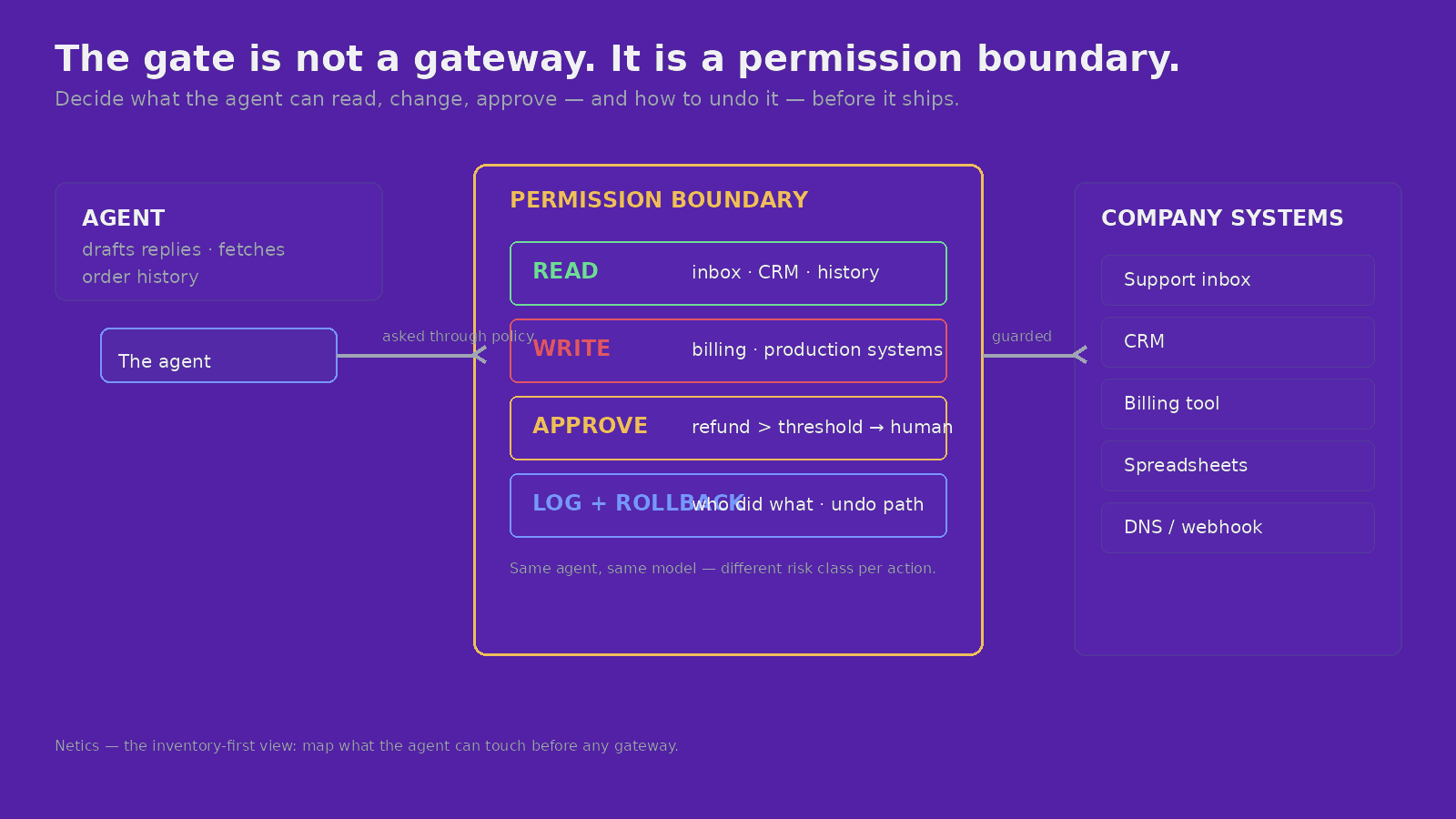
Most companies cannot answer that list today, and no new cloud category fixes that. The ADLC framing deserves special attention: "adlc - like sdlc but with humans taken out of the loop." Removing humans from every loop sounds efficient in a launch-week sentence. In real operations it depends entirely on which loop. Letting an agent draft a reply is low risk. Letting it issue a refund, update accounting and close the ticket without review is a different class of action. A serious agentic development lifecycle needs boring controls — scopes, environments, approval thresholds, logs, rollback paths — not a slogan about removing humans.
There is a trap in rushing to "agent-native" infrastructure before governance exists: faster chaos. Anyone who has automated a business process through five SaaS dashboards knows the web was never shaped for software acting on a company's behalf. But the fix is not a new category of platform. It is a map of what the agent may touch, who approves the risky actions, and what gets logged. We make the same argument when the pitch is an AI gateway: inventory first, tool second.
What this means for SMBs
- Start with boring questions before any platform decision: which decisions should the agent make alone, which require human approval, which systems are read-only, which allow writes, and which actions need rollback.
- Define what an audit must capture before the agent ships. If nobody can replay what the agent did, the agent should not have write access yet.
- Keep data location on the table. In Europe, Morocco and regulated sectors, an agent touching customer records, HR data or infrastructure credentials raises questions of data location and responsibility — blaming the AI will not count as an incident report.
- Do not buy a new agent platform every month. Most of the value in year one is deciding where the agent is allowed to put its hands, and that work is free.
Bottom line
Cloudflare is early to frame the agent-shaped cloud, and the framing is useful. But businesses that adopt agents first will not be saved by a new platform category; they will be saved by narrow permissions, clear context, a strong audit trail and human approval gates where risk is high. Agents do not replace process design. They expose whether the process was clear in the first place. The companies that win will not be the ones deploying the most agents — they will be the ones that knew exactly what each agent could touch before it shipped. Book a free 30-minute audit and we will help you draw that boundary before the agents arrive.
Source: Welcome to Agents Week — blog.cloudflare.com, 2026-08-02. Commentary by Netics.
Explore Netics for practical infrastructure and AI operations guidance.