
The WebAssembly Component Model Turns Portability Into a Contract
Netics analysis of the mechanism, its limits, and the operating decision it creates.

TL;DR
The article examines the source mechanism, its limits, and a practical Netics operating decision. Coverage: Portability starts at the interface; WIT is the boundary worth reviewing; Worlds expose assumptions; Composition is useful only when ownership is clear; WASI is a host contract, not a magic sandbox; The connection to agent infrastructure; A practical adoption path; The Netics position.
Portability starts at the interface
The WebAssembly Component Model is often described as a way to run code in more places. The more useful reading is stricter: it defines how a component describes what it offers and what it needs from its host. The Bytecode Alliance documentation names components, interfaces, worlds, packages, and platforms as the concepts that make this possible. That vocabulary moves portability away from a promise about a binary and toward a contract between a guest and the environment that runs it.
WIT is the boundary worth reviewing
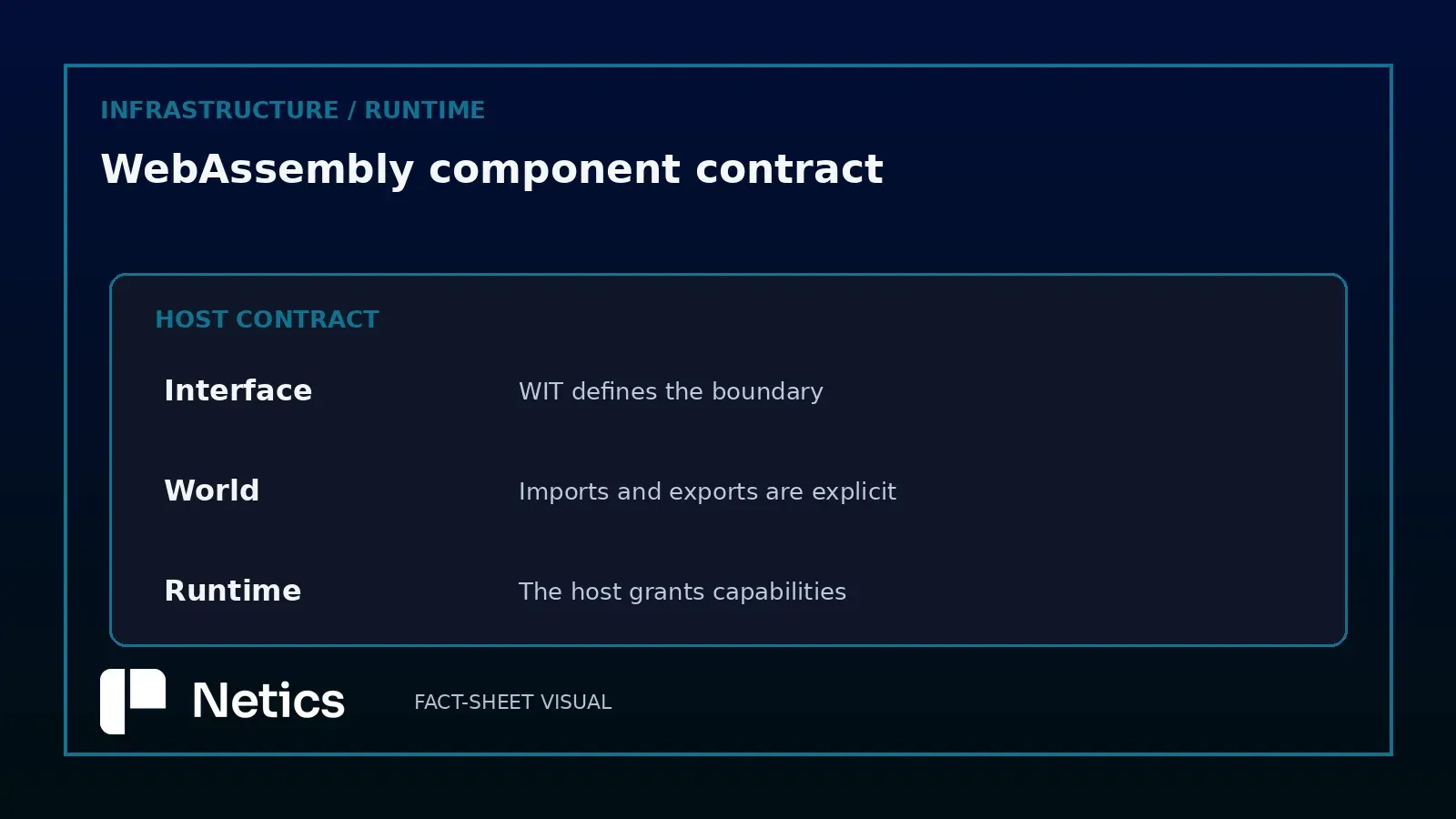
WebAssembly Interface Types, or WIT, describes language-agnostic type signatures and interfaces. It is not a general-purpose implementation language. That distinction is healthy. The interface can be reviewed separately from the Rust, Go, Python, JavaScript, or C# implementation behind it. A team can ask whether the component needs filesystem access, network access, clocks, or other host functions before it decides whether the implementation deserves those capabilities.
Worlds expose assumptions
A world collects the interfaces and types a component provides and depends on. In operational terms, it is a declaration of the component’s expected environment. That is valuable for composition, but the declaration is not the same as enforcement. The runtime must still map those imports to real capabilities, identities, files, sockets, and policies. A component can be portable at the type level while remaining tightly coupled to a host’s authority model.
Composition is useful only when ownership is clear
The Component Model allows components to be composed into larger components. This makes reuse and language interoperability practical, but composition also creates a dependency graph. Someone must own version compatibility, interface changes, resource lifetimes, and the behavior of a component that imports a host function. A platform team that only tracks application repositories will miss the operational contract encoded in the component graph.
WASI is a host contract, not a magic sandbox
WASI provides standard interfaces for platform functions and the user documentation describes WASI 0.2.0 as a stable set of WIT definitions that components can target. That is meaningful progress. It does not mean every host exposes every interface, or that an exposed interface is automatically safe for every tenant. The host decides what is available. The security question therefore moves from “can this binary run?” to “which host capabilities did we deliberately grant?”
The connection to agent infrastructure
The capability boundary resembles the access-graph problem Netics has described for AI agents: authority has to be represented as explicit edges rather than inferred from a prompt. A component import is not identical to an agent permission, but the operational lesson is similar. The interface is the visible request. The host binding is where authority becomes real. Portability and least privilege improve together when those bindings are reviewable.
A practical adoption path
Start with one component whose imports can be enumerated and whose failure is cheap to recover from. Pin the WIT package, record the world it implements, and document every host capability granted at runtime. Test a missing import, an incompatible interface, a denied filesystem operation, and a component upgrade. Keep the component artifact, interface definition, runtime version, and host policy together. That package is the evidence needed when “portable” stops meaning “works on my laptop.”
The Netics position
The Component Model is promising because it makes the boundary between implementation and host more explicit. But a portable component is not automatically a portable operating model. Teams should adopt the interface contract, then build the capability policy and observability around the host bindings. Portability is earned when a component can move without silently acquiring a different authority model. For an architecture review, visit Netics Netics or Book a free 30-minute audit.
Pin the host contract
A component manifest should be accompanied by the host contract that makes it useful. Record the WIT package and world, the WASI interfaces exposed, the runtime version, and the policy applied to filesystem, network, clock, and environment access. Do not treat a component registry as a sufficient inventory. The same component can have a very different risk profile when a host grants different imports.
Compatibility testing should include interface evolution rather than only startup. Compose the component with the consumer version, remove one expected import, send malformed values through the interface, and test cancellation or resource cleanup where the runtime supports it. These tests answer the operational question that portability claims leave open: what happens when the surrounding platform changes?
Separate portability from authority
A useful architecture review should produce two diagrams. The first is the component composition graph: which worlds, interfaces, and packages connect. The second is the host authority graph: which runtime identity receives filesystem, network, clock, or environment access. Conflating them hides risk. A component can compose correctly and still receive more authority than the workload needs. Conversely, a narrow capability policy can make an otherwise portable component fail in a way the team cannot diagnose if the contract was never recorded.
This is also why version pinning matters. A WIT definition is a contract, but contracts evolve. Pin the package and record compatibility decisions when an interface changes. Treat a world change like an API change: identify consumers, test the new composition, and publish a rollback path. The binary is only one artifact in the delivery unit; the interface and host policy are equally important.
Sources
- Bytecode Alliance: Component Model Concepts — accessed for this draft.