
Ubuntu 26.10 Feature Freeze Is a Change-Control Test
Ubuntu 26.10 has entered feature freeze. The important story is how a Linux release turns ambition into controlled risk.


Source: OMG! Ubuntu: Ubuntu 26.10 ‘Stonking Stingray’ hits feature freeze
TL;DR
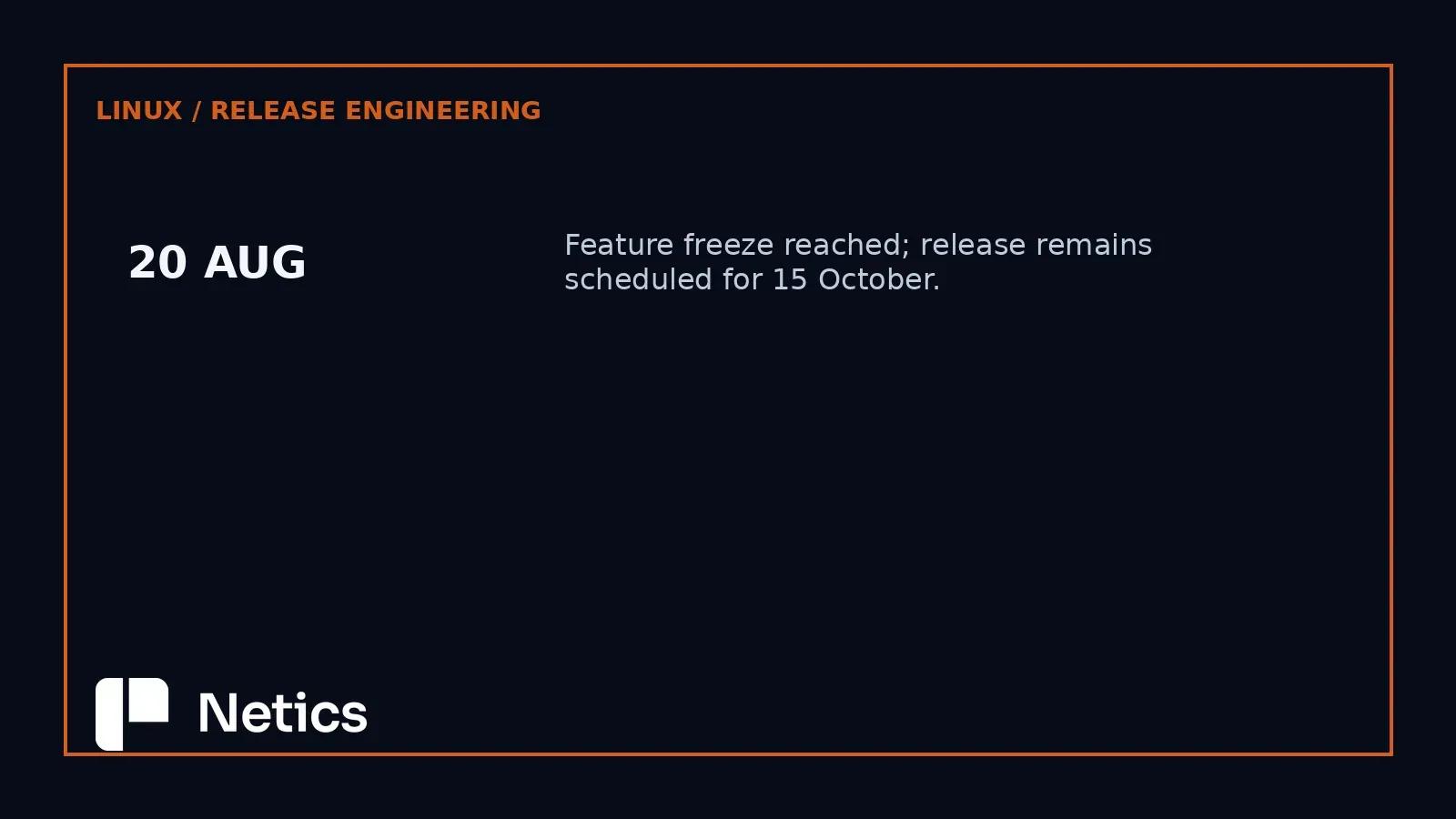
Ubuntu 26.10 entered feature freeze on 20 August 2026. The planned release is 15 October, with a beta on 24 September. GNOME 51, additional Rust tooling, GPU driver management in App Center and a possible Linux 7.3 kernel are among the changes still discussed. For operators, the important event is the freeze: the question moves from what can be added to what can be stabilized safely.
A freeze is a change-control boundary
Feature freeze does not mean Ubuntu 26.10 is finished. It means major changes now need a Feature Freeze Exception, while ordinary bug fixes follow a lower-risk path. That is a useful distinction. A professional freeze does not pretend that defects disappear; it narrows the entry gate and makes late risk visible.
Infrastructure teams often say “freeze” when they mean “nobody touches anything.” That is not a useful operating model. The stronger model is visible change with an owner, evidence and a rollback path. A late feature may still be justified, but urgency alone is not justification.
Linux operators should separate three clocks
Ubuntu’s release clock points to 15 October, with a beta planned for 24 September. Your validation clock is different: drivers, monitoring, agents, kernel modules and recovery procedures must be tested against the exact build you plan to run. Your change clock may be quarterly or tied to a customer maintenance window. Those three calendars rarely align automatically.
The kernel illustrates the risk. The source mentions possible Linux 7.3 integration, but that is a possibility, not a production guarantee. Pin the candidate build, test the workload and decide whether the first stable point release is safer than launch day. This is the same discipline behind documenting Linux code provenance before integration: record the source, version, test and approver.
What a late exception must contain
A credible exception request identifies the defect or missing capability, affected package and version, reproducible impact, architectures involved, rollback path and tests. “This would be useful” is not enough. The same rule applies to internal images: do not let a new repository, agent or kernel module enter silently because a deadline is close. Create a bounded exception and make the next rebuild visible.
Netics recommendation
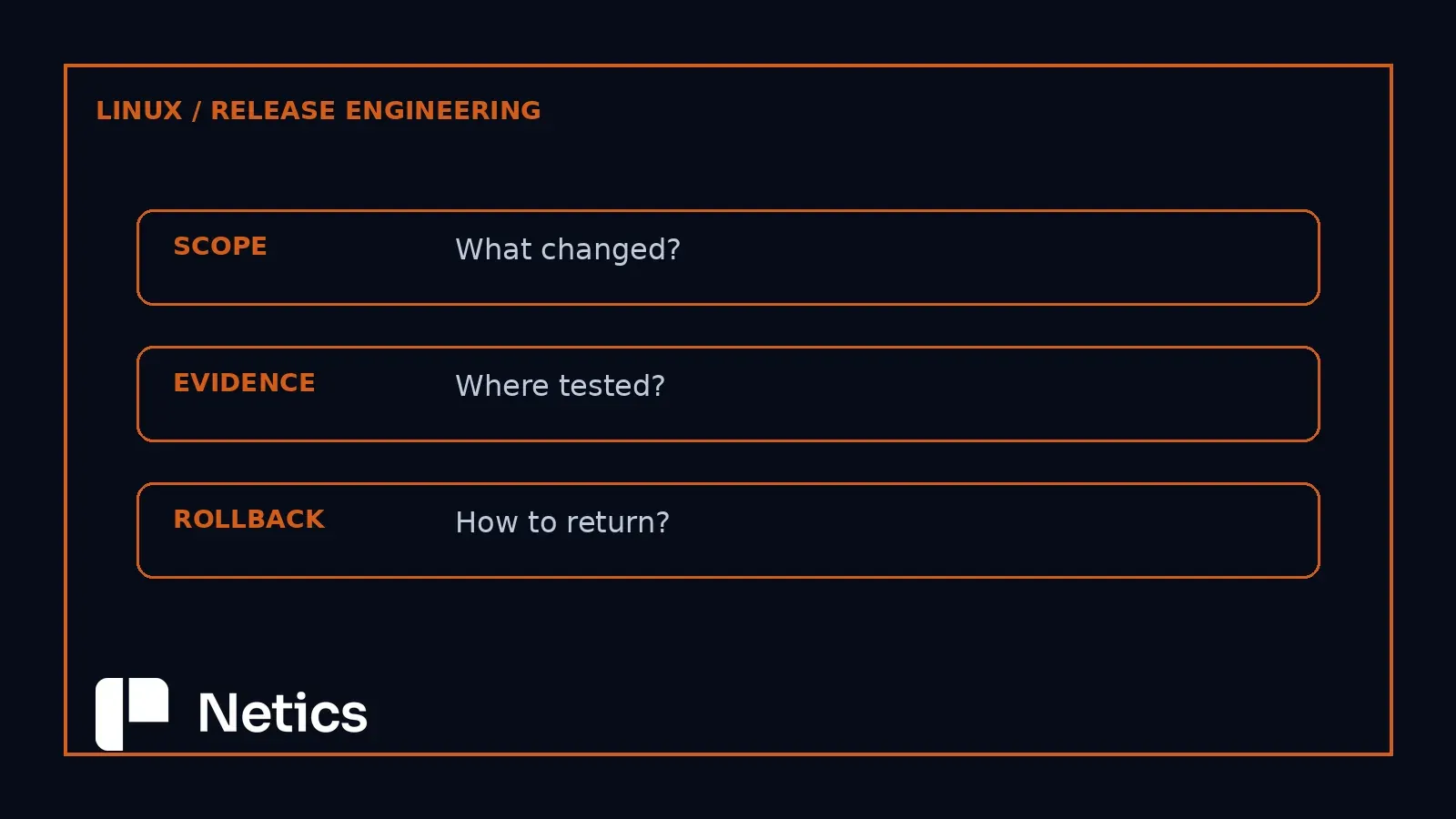
For Ubuntu 26.10, ask four questions: what changed, where was it tested, who approved it and how do we return to the previous image? Keep the beta disposable. Treat the release candidate and final release as separate validation events. Keep production on a known-good image until compatibility and recovery gates pass.
Linux maturity is not the number of features entering an archive. It is the quality of the boundary around late change.
A freeze is also a communication contract. Application owners need to know which packages can still move, which exceptions are possible and when the next image will be cut. If that information lives only in a release-team thread, the operational boundary is already weak. Put the decision into the change record and link the tested artifact.
The practical lesson is broader than Ubuntu. A platform team should make stability visible as a sequence of decisions: intake, validation, approval, release and rollback. That sequence lets a business adopt a new Linux release without confusing upstream momentum with production readiness. A useful release note should therefore answer operational questions, not only list features. Which kernel and drivers are in scope? Which third-party repositories are disabled? Which images receive security fixes first? Which metrics decide whether the release moves from a lab ring to a wider ring? Making those answers explicit turns the freeze into an executable control rather than a calendar event. Source: OMG! Ubuntu, “Ubuntu 26.10 ‘Stonking Stingray’ hits feature freeze” — omgubuntu.co.uk, 24 August 2026.
Netics applies this source-led analysis to practical infrastructure decisions. Explore Netics infrastructure work.