
Linux Governance Begins Before Code Reaches the Repository
The long-running Linux ownership dispute shows why open-source governance depends on contribution records, licensing boundaries, and decisions made before code becomes publicly available.

TL;DR
The latest stage of the long-running Linux ownership litigation offers a governance lesson for every open-source project. The dispute traces back to Project Monterey, which began in 1998 with IBM, SCO, Intel, and Sequent involved. IBM later contributed Project Monterey code to Linux. Xinuos argued that IBM breached a non-exclusive license, while the Second Circuit concluded that the matter arrived too late for relitigation and agreed that Xinuos had framed the dispute as an ownership case rather than a licensing case.
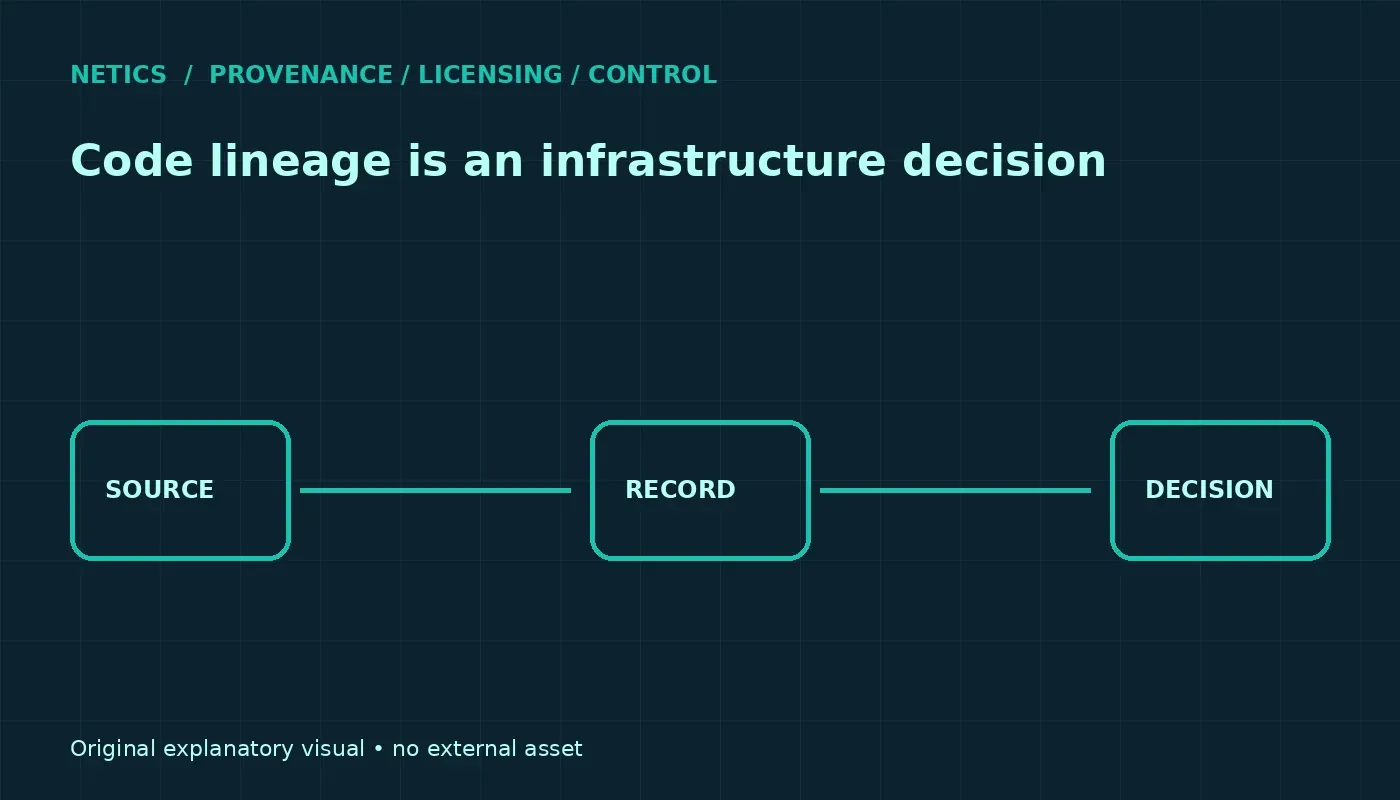
The practical lesson reaches beyond the courtroom. Public availability does not explain where code came from, which rights accompanied it, or which decisions authorized its reuse. Those questions must be answered through contribution records, license reviews, repository controls, and durable documentation. Governance begins before a commit appears in a public tree. The summary also covers: What the litigation says about framing; Provenance requires more than an author line.
The source also records a $14.25 million IBM settlement from 2021 and a later Xinuos rehearing request. Those details do not change the legal posture described by The Register, but they strengthen the engineering lesson: old disputes leave evidence trails that must be preserved before the next transfer.
The repository is the end of a chain
Open-source projects often make their most visible governance decisions inside the repository. Maintainers review pull requests, automated systems run checks, and a project records authorship through commits. Those controls matter, but they operate near the end of a much longer chain.
Code may originate in a commercial collaboration, a research project, a failed product, a contractor engagement, or a prior codebase governed by a separate agreement. By the time a fragment reaches a public repository, its history may already contain multiple contributors, licenses, permissions, restrictions, and unresolved assumptions.
The Linux dispute described by The Register illustrates the distance between visible code and underlying provenance. Project Monterey began in 1998, involved several companies, and eventually became connected to code contributed to Linux. Xinuos later argued that IBM’s contribution breached a non-exclusive license. The disagreement therefore concerned the legal and contractual path by which code moved between projects, rather than the mere fact that the code could be found in an open-source environment.
A repository can preserve a commit date. It cannot automatically establish that every earlier permission was valid.
What the litigation says about framing
The Second Circuit rejected Xinuos’s appeal. According to the source, the court found the matter too late to relitigate and agreed that Xinuos had framed the issue as ownership rather than licensing. That distinction matters because governance depends heavily on precise issue definition.
Ownership, licensing, authorship, authorization, and distribution are related questions, but they produce different evidence requirements. An ownership claim may focus on who possessed rights in a work. A licensing dispute may focus on what a party was permitted to do under an agreement. A contribution review may ask whether a developer or organization had authority to submit the material under the project’s stated terms.
When a project treats those categories as interchangeable, its records become difficult to interpret. A maintainer may know that code arrived from a trusted organization, while a later reviewer may need to establish the exact permission that governed the transfer. Without a documented bridge between those facts, institutional confidence can become difficult to defend.
The court’s treatment of the dispute also highlights time as a governance variable. A claim that surfaces decades after the relevant project decisions may face procedural barriers, evidentiary gaps, and competing interpretations of old documents. A project cannot control future litigation, but it can reduce uncertainty by preserving the reasoning and authorization behind important contributions while the participants and records remain available.
Provenance requires more than an author line
A contribution record should answer several distinct questions.
First, where did the code originate? The answer may identify a project, internal branch, employee, contractor, or external partner. Second, who made the contribution? An author line is useful, but it may not identify the organization that sponsored the work or the person with authority to submit it. Third, under which license or permission was the code distributed? Fourth, was the contribution altered before submission? Finally, which reviewer accepted the stated provenance and on what evidence?
These questions do not require every project to build an elaborate legal department. They do require a consistent minimum record. A contribution process can request a source description, license identifier, authorship statement, and confirmation that the submitter has the necessary rights. For higher-risk material, the process can require a link to the originating repository, a written permission record, or a review by someone responsible for licensing.
The value lies in making hidden assumptions visible. “This came from our old project” is a starting point. It does not identify the agreement, the contributors, the modifications, or the authority for reuse.
Contribution records should preserve decisions
Governance records are most useful when they preserve decisions rather than merely storing artifacts. A project may retain a pull request, but future maintainers also need to understand why the contribution was accepted.
A durable record can include:
- the contribution’s stated origin;
- the applicable license or permission;
- the people and organizations involved;
- whether the material was copied, rewritten, or adapted;
- the reviewer responsible for the provenance decision;
- unresolved questions and their owners;
- the reason the project accepted the contribution.
The structure helps separate evidence from confidence. A reviewer can record that a license file was available, that an organizational confirmation was received, or that the source could not be independently verified. Later maintainers then inherit a documented assessment instead of a vague reputation-based assumption.
The record should also survive repository changes. A link to an internal system may become inaccessible. A branch may be deleted. A company may change names or ownership. Governance therefore benefits from storing concise explanations alongside stable references and retaining the underlying approval material according to the project’s document-retention practices.
Provenance documentation is not bureaucracy added after development. It is part of the project’s supply chain.
Open availability does not settle permission
Once code is public, teams may treat it as available for reuse. That shortcut creates a dangerous ambiguity. Visibility answers where someone can inspect the code. It does not answer what another party may copy, modify, redistribute, or combine with other software.
The Project Monterey history makes this distinction concrete. The source describes IBM as contributing Project Monterey code to Linux and reports Xinuos’s argument that IBM breached a non-exclusive license. The disagreement demonstrates how a transfer can become contested even when the resulting code is visible in a public project.
A governance program should therefore treat “publicly accessible” as an observation, not a permission category. The relevant review asks what license applies, whether the contributor had authority, whether the destination project’s policies were satisfied, and whether any agreement created boundaries around reuse.
That approach is particularly important when code crosses organizational or project boundaries. Internal teams may assume that a company-wide repository grants unlimited authority. External contributors may assume that a permissive project policy covers code supplied by an employer. Both assumptions can fail when the contribution’s origin is more complicated than its repository location suggests.
Hypothetical control example
Hypothetical control example: A project receives a networking component from a company that says the component was developed during an earlier joint initiative. Before merging it, the project requires the submitter to attach four items: the component’s original source location, the license or agreement governing that source, a statement identifying substantial authors and sponsors, and a reviewer’s written decision.
If the source location is unavailable, the reviewer records that limitation and pauses acceptance until the company provides an alternative record. If the agreement permits use but imposes conditions, those conditions become merge requirements and release-checklist items. If the code was rewritten from the earlier component, the record distinguishes the new implementation from copied material. The repository then stores a short provenance note linked to the approval record.
The control does not determine who would win a future dispute. It creates a contemporaneous trail showing what the project knew, what it checked, and why it proceeded. That trail can support future maintenance decisions even when the original participants are no longer involved.
The governance test is decision quality
A mature project should evaluate provenance controls by the decisions they improve. Useful criteria include:
- Can a maintainer identify the contribution’s origin without relying on personal memory?
- Can a reviewer distinguish ownership questions from licensing questions?
- Can the project show who authorized acceptance and which evidence they reviewed?
- Can release managers identify conditions attached to a contribution?
- Can a later audit reconstruct the reasoning without reopening every historical discussion?
- Can the process stop a contribution when evidence is incomplete?
These criteria connect governance with engineering operations. They make provenance part of intake, review, release, and maintenance rather than a document assembled only after a complaint arrives.
The Second Circuit’s ruling does not erase the history of Project Monterey or resolve every question that open-source projects may face. It does show why framing and timing matter. A project that records only the final code leaves future reviewers to reconstruct both. A project that records origins, permissions, and decisions gives itself a stronger basis for understanding what entered the repository and under which conditions.
Governance starts before the commit
The most important control point often appears before a developer opens a pull request. It is the moment when a team decides to reuse an existing component, import a historical branch, accept an organizational contribution, or move code between projects.
At that stage, the project can still ask simple questions while the answers are accessible. Who created this material? What agreement governed it? What changed during transfer? Who can authorize its submission? What obligations follow the code into a release?
Once those questions are documented, repository automation can reinforce them. Templates can require provenance fields. Review labels can identify licensing or origin checks. Release processes can confirm that contribution conditions were carried forward. Maintainer handbooks can explain when a routine review must become a specialist review.
The resulting system is practical because it recognizes how disputes emerge: through accumulated assumptions, incomplete records, and category errors that remain invisible until years later. Open-source governance becomes more resilient when code provenance is treated as an intake requirement and an ongoing maintenance responsibility.
Linux’s history shows that public collaboration can carry private history with it. Good governance preserves that history before it becomes a contested reconstruction.
Source
The Register, “Ancient ownership litigation over Linux; Second Circuit rejected Xinuos appeal,” 2026-08-24: https://www.theregister.com/software/2026/08/24/ancient-who-owns-linux-case-now-has-one-foot-very-deep-in-the-grave/5291513
Source: The Register — 2026-08-24
Explore Netics for practical infrastructure and AI operations guidance.