
SparseEngine Puts Fifteen Sparse Attention Methods Behind One Lifecycle Contract
A research team published SparseEngine, an inference engine designed around sparse attention from the start. It runs 15 sparse methods across four families on a shared

TL;DR
- SparseEngine is an inference engine for large language models that keeps only part of the attention state in GPU memory, published on arXiv as 2609.39068v1 by a team including Harbin Institute of Technology authors and released as Apache-2.0 code in the repository CURRENTF/SparseEngine.
- A sparse attention method is the technique that decides which part of the KV cache survives, which lowers the memory and attention cost of long-context decoding at the price of an approximation.
- Existing inference engines bind that decision to their own cache layout, so a page-based engine fits some methods and blocks others.
- The engine is built with a KV cache abstraction at its centre, so a method defines its own cache representation while scheduling, batching and prefix caching stay shared.
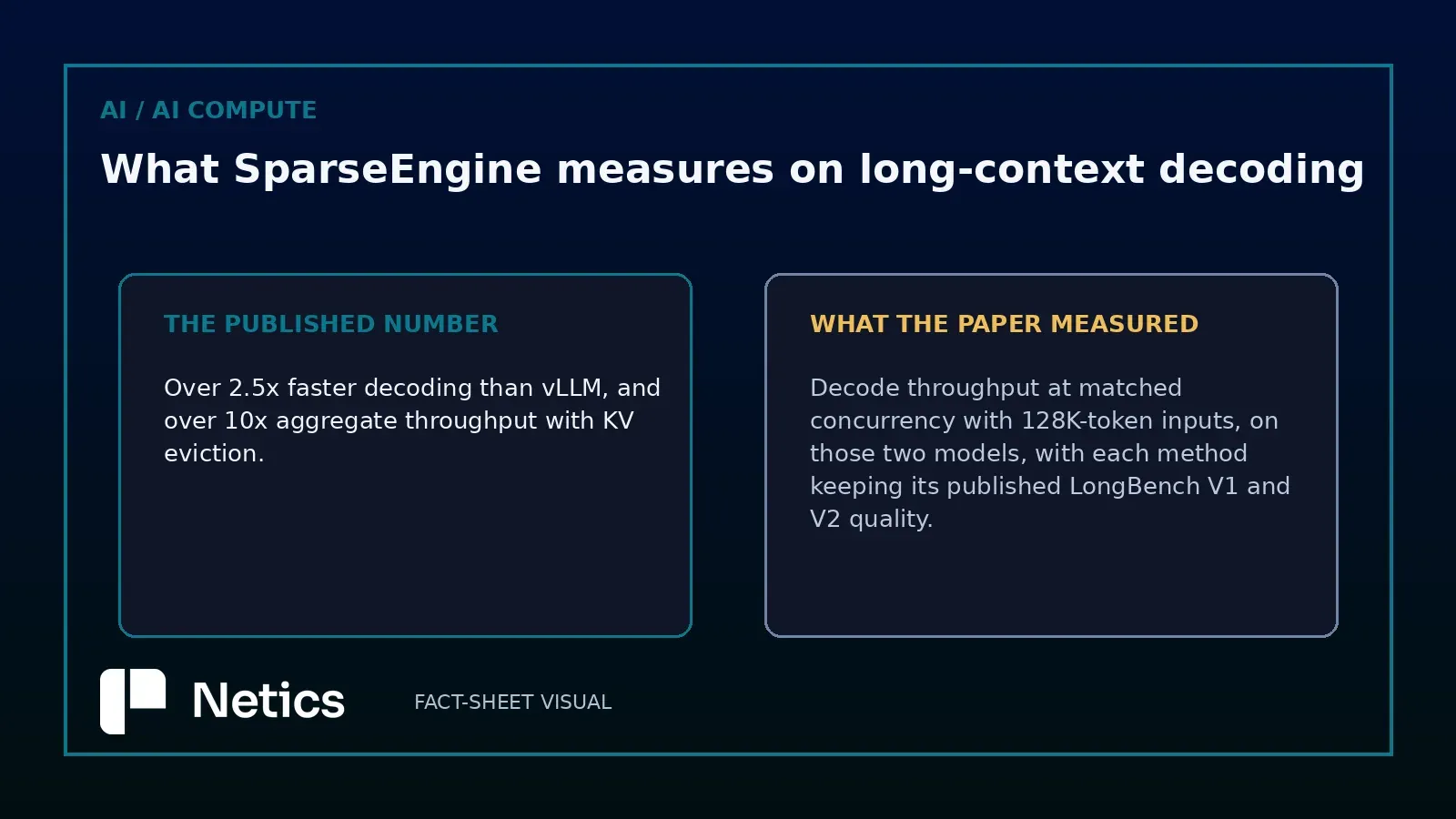
- The reported throughput advantage arrives in two shapes: roughly 10x the aggregate decode throughput of vanilla vLLM with SnapKV and physical KV eviction at each pair's largest tested batch size, a comparison across unequal batch sizes, and around 1.5x to 2.6x at matched batch sizes with Quest and OmniKV.
- The paper adds Chain Cache for multi-turn work, so an eviction method resumes from its compacted history, alongside prefix pruning that removes selected history regions while prefix matching keeps working; on the agent traces SnapKV, Quest and OmniKV stay close to a full-attention reference, H2O drops to 13.0% of SWE-bench Lite tasks resolved against 25.0%, and prefix pruning needs a four-round delay to recover the unpruned baseline.
- Speedups get smaller as contexts shorten, and the evaluation records that methods with the largest speedups carry the largest accuracy drops, which leaves the method's own accuracy budget as the governing number for a team.
- Hosting long-context agents on your own GPUs is the case this engine addresses, and the paper's caveats describe which batches and which attention variants the figures cover.
What SparseEngine builds around the KV cache
Inference for a long conversation spends its budget in two places: the KV cache that holds attention state for every token already processed, and the attention computation that reads it. Sparse attention methods attack both by keeping a fraction of that state. A method such as SnapKV or H2O decides which entries survive, a page-selection method such as Quest picks KV pages per query, and the choice of representation differs between them.
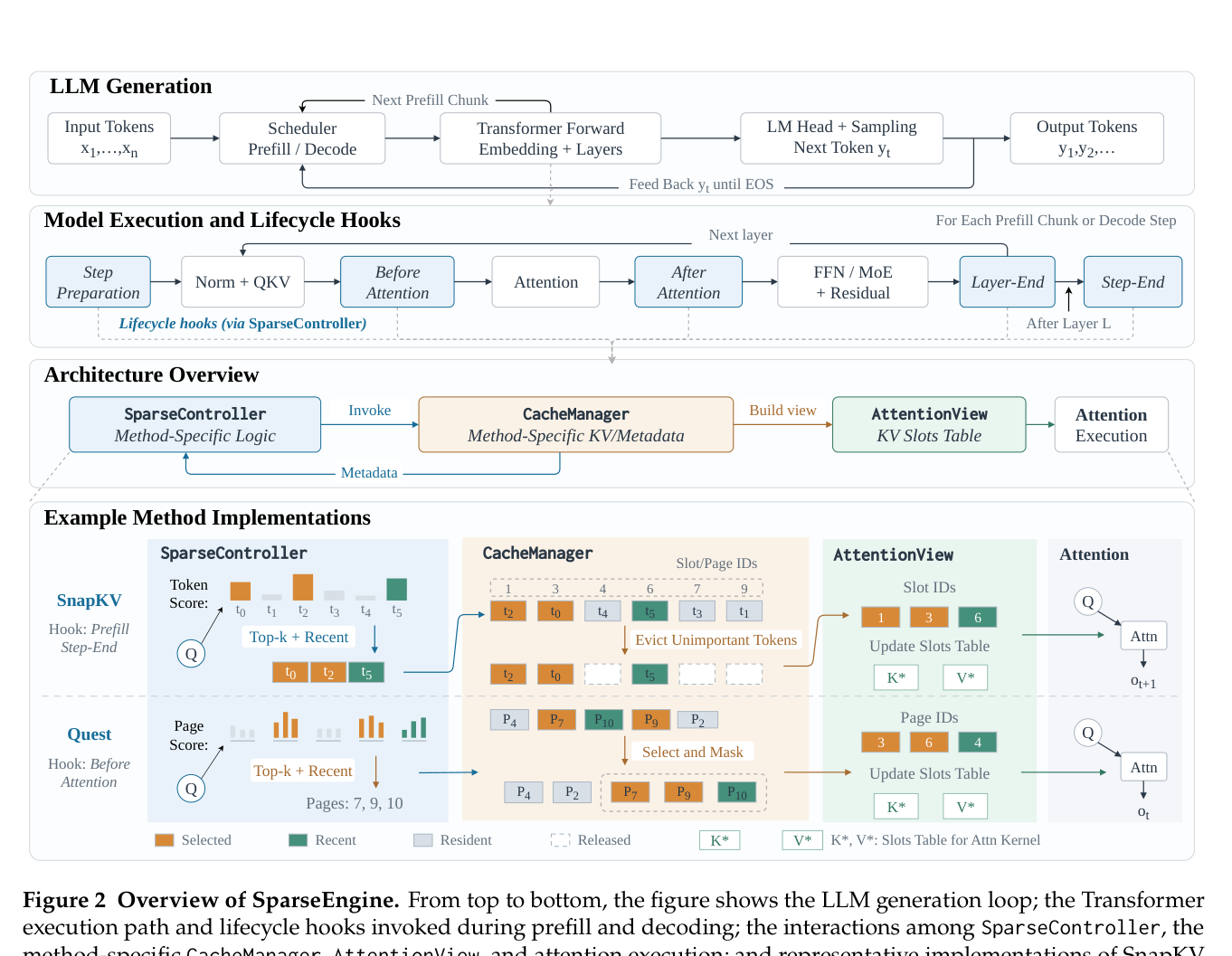
The paper's argument is that engines built around one cache layout constrain which methods they can host. It names Vortex and its page-centric operations, SPIN and its GPU-CPU pipeline partitions, and Tangram with its head-wise retention as engines that fit a family of methods well. The design it proposes moves the boundary: a shared lifecycle contract with fine-grained hooks across prefill, decoding and step transitions lets each method define its own KV representation and workflow while the scheduler, continuous batching and prefix caching stay common.
The fifteen methods and the four families behind them
Coverage is the claim that follows from that boundary. SparseEngine hosts 15 methods across four categories, spread over dynamic sparse attention, KV eviction, KV quantization and KV compression, and Figure 1 of the paper places them side by side with the engines that support them.
One design detail makes the coverage concrete for a serving team. SparseEngine's ChainCacheIndex associates a session with its retained per-layer KV, method-specific metadata and logical token prefix, which is the state an eviction method needs to resume from its retained history in the next turn.
What the reported throughput advantage covers
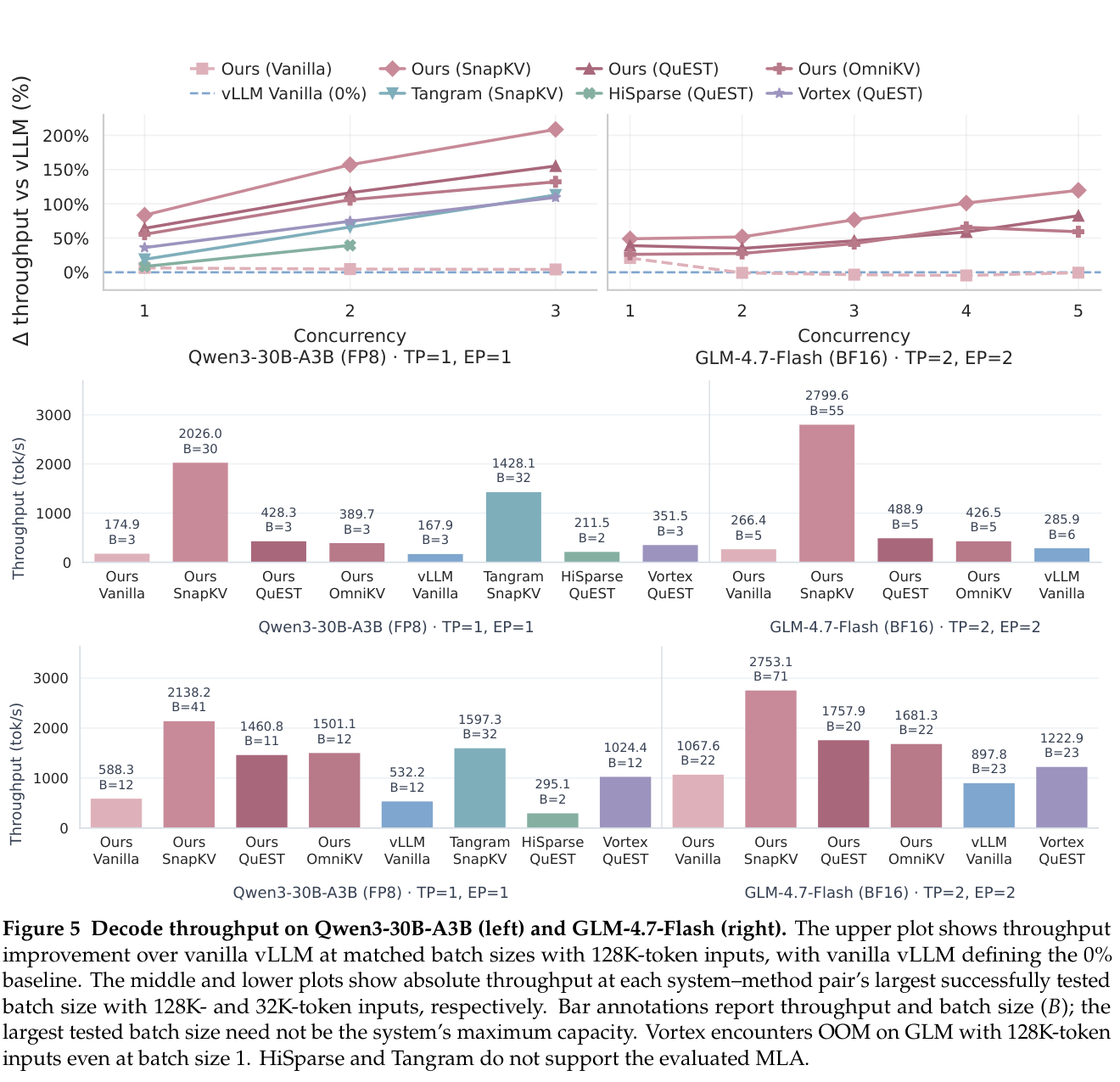
The measured operating points matter more than the headline ratio, and the paper states them precisely enough to check. The two evaluated models are Qwen3-30B-A3B in FP8 and GLM-4.7-Flash in BF16, on hardware drawn from NVIDIA H100, H20, RTX PRO 6000, 4090 and 5090 GPUs. At each system-and-method pair's largest successfully tested batch size, SparseEngine with SnapKV delivers approximately 10x the aggregate decode throughput of vanilla vLLM on both models. With Quest and OmniKV, SparseEngine reaches roughly 1.5x to 2.6x at several matched batch sizes.
The same caption carries the caveat a reader needs. The largest tested batch size need not be the system's maximum capacity, so the aggregate figure describes a measured operating point. Two further notes narrow the comparison: Vortex runs out of memory on GLM with 128K-token inputs even at batch size 1, and HiSparse and Tangram do not support the multiple-head latent attention variant used by that model. Reading the top of that chart as a like-for-like engine comparison overstates it; the engine with the most aggressive eviction holds the largest batches inside a fixed memory budget, which is where its aggregate advantage comes from.
Agent traces, Chain Cache and prefix pruning
Multi-turn work is where the paper spends its second half. Chain Cache lets an eviction method resume from retained, compacted state at the start of a new turn, which answers a practical problem: a coding agent that runs over many turns rebuilds context each time when the cache is discarded between turns.
The evidence for that claim combines task success with speed. With mini-SWE-agent on SWE-bench Lite, SnapKV under Chain Cache resolves 24.7% of tasks on GLM-4.7-Flash against 25.0% for full attention and 25.3% for Quest, and on Qwen3-30B-A3B SnapKV resolves 8.3% against 5.3% for full attention, a base too small to rank the methods. A separate Claw-Eval run puts OmniKV at 68.0 average score and 51.1% pass@1 against 67.4 and 50.5 for the full-attention reference. The speed side comes from replaying recorded agent outputs, with prefill, decoding, scheduling and simulated tool waits included: on Gasai, a dedicated agent trace the paper uses to measure system efficiency only, SnapKV with an 8K cache budget and Chain Cache reaches a 2.24x end-to-end speedup over vanilla on Qwen3-30B-A3B in FP8, with concurrency selected for each method's KV memory requirements on the same GPU configuration.
Prefix pruning adds a control knob for history that carries little value. Retaining 20% of aligned KV tokens in targeted tool results with global scoring costs a slight drop in task success. Delaying that pruning by four tool-result rounds with OmniKV restores performance and reaches 25.0% task success against 23.7% for vanilla on the same 300 tasks. Our reading of that result is that agent dialogues carry many low-value tool results.
Where the speedups get smaller
A second evaluation keeps the article honest about scope. On AIME 2024 with a smaller thinking model, methods that trade sparsity for speed show a clear spread: StreamingLLM holds 18.3% accuracy at 3.36x, PyramidKV 53.3% at 1.66x, and SnapKV at a high budget 85.0% at 1.05x. The paper states the pattern plainly, writing that methods offering larger speedups generally suffer greater accuracy drops, and it attributes the smaller speedups to shorter evaluated contexts, where attention is a smaller share of execution time.
Quality is tracked in the same document on LongBench V1 and V2, where the reported figure is a delta between SparseEngine and each method's reference implementation in percentage points. That framing carries a specific meaning: the engine reproduces the quality of the method it hosts, and the accuracy budget of that method still applies. Choosing SparseEngine settles how many methods a team can run and how efficiently; choosing SnapKV at a low budget settles how much accuracy the service keeps.
What a team hosting long-context agents can take from it
Two costs show up in the same document, and both are worth carrying into a capacity plan. Physical eviction allows larger batches inside a fixed memory budget, which raises aggregate throughput and changes the shape of a deployment: fewer replicas each holding more concurrent requests. Sparsity costs accuracy, and the coding results show how much it can cost: on SWE-bench Lite with GLM-4.7-Flash, H2O resolves 13.0% of tasks against 25.0% for full attention.
For an estate running agents on its own GPUs, the practical use of this paper is a method-selection framework for a team that wants to test the claims on its own traffic. Pick the sparse method by its accuracy budget on your workload, then pick an engine by how many methods and workflows it can host with prefix caching and continuous batching intact. Netics builds and operates self-hosted AI platforms, and the same question decides the model layer there: what stays swappable when the workload changes shape. Our note on KV cache offload in inference factories takes the next step, covering where that state goes once it leaves the GPU.
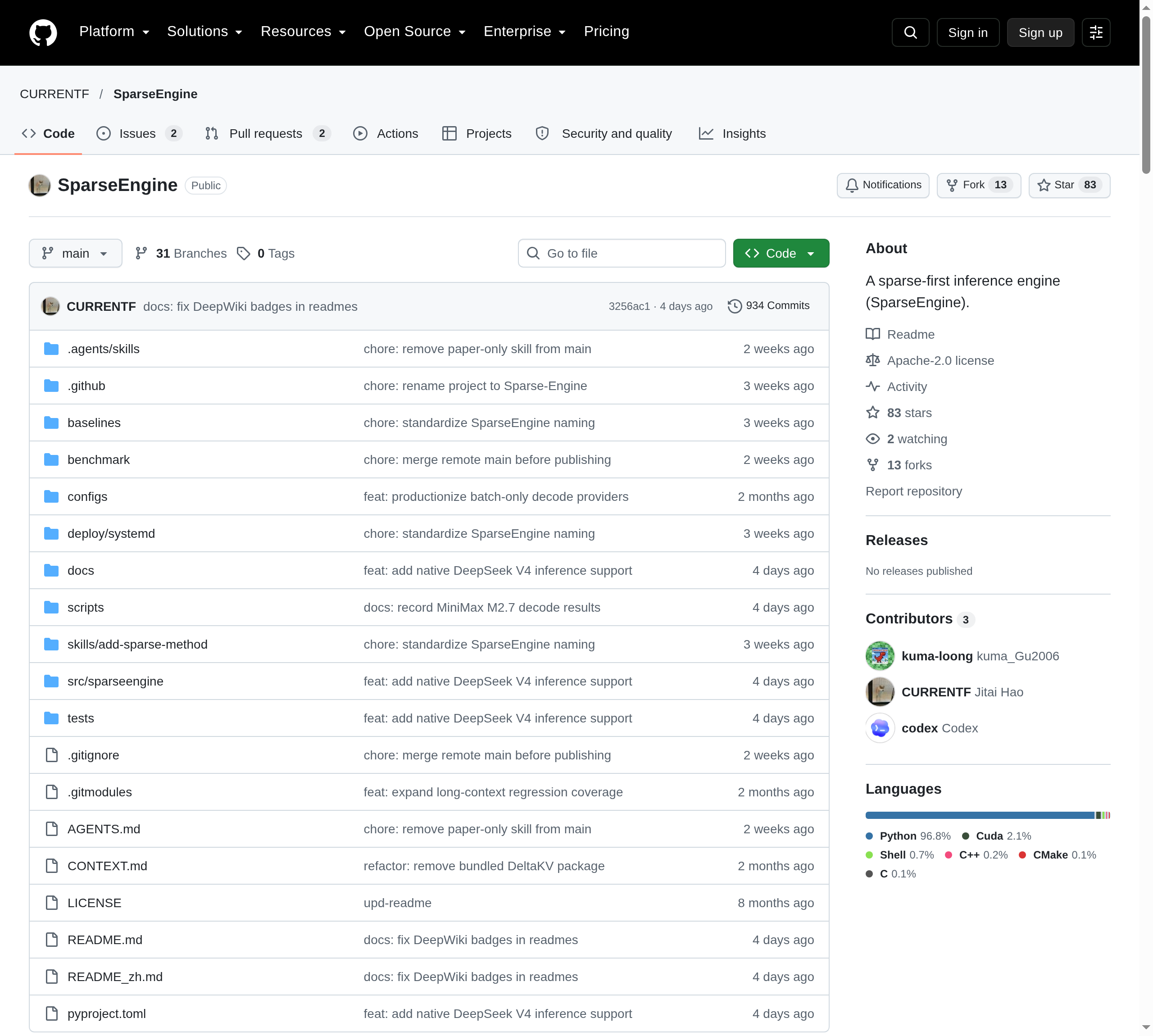
The repository gives the released code, Apache-2.0 and mostly Python, created in January 2026 and last pushed on 8 October 2026, with 83 stars and 13 forks at the time of reading. A serving team that wants to test the claim on its own traffic can run the comparison and read the two charts with their conditions attached, which is a fairer test than the headline ratio on its own. Netics reports the paper's figures in this note with those conditions attached for the same reason.
Sources
Source: SparseEngine: Sparse-First Inference Engine — arXiv:2609.39068v1 [cs.LG], submitted 2026-09-30 — https://arxiv.org/abs/2609.39068, retrieved 2026-10-11 (a ground-up sparse-first inference engine with a shared lifecycle contract giving each method control of its KV representation and computation while coordinating state transitions with shared serving infrastructure; 15 methods across four categories; Chain Cache resuming KV-eviction methods from retained history and controllable Prefix-Cache Pruning removing KV from selected history regions while preserving logical-prefix matching; over 10x higher throughput with KV eviction, over 2.5x faster decoding at matched concurrency than vLLM, over 2x end-to-end speedup on agent benchmarks, with the original task quality of evaluated sparse methods preserved; an author block listing hit.edu.cn (Harbin Institute of Technology) addresses for Qiang Huang and Jun Yu; Figure 1 on method coverage across sparse inference engines; a ChainCacheIndex associating a session with its retained per-layer KV, method-specific metadata and logical token prefix; system comparisons against Vortex, SPIN and Tangram; evaluation on Qwen3-30B-A3B in FP8 and GLM-4.7-Flash in BF16 across NVIDIA H100, H20, RTX PRO 6000, 4090 and 5090 GPUs; approximately 10x aggregate decode throughput with SnapKV at each pair's largest tested batch size; roughly 1.5x to 2.6x with Quest and OmniKV at matched batch sizes; the note that the largest tested batch size need not be the maximum capacity; out-of-memory for Vortex on GLM with 128K-token inputs at batch size 1; no MLA support in HiSparse and Tangram; quality deltas against reference implementations on LongBench V1 and V2; the AIME 2024 spread with StreamingLLM at 18.3% and 3.36x, PyramidKV at 53.3% and 1.66x and SnapKV at a high budget at 85.0% and 1.05x, with the statement that larger speedups generally come with larger accuracy drops and that shorter contexts reduce the speedup; SWE-bench Lite results with mini-SWE-agent at 24.7% for SnapKV under Chain Cache on GLM against 25.0% for full attention and 25.3% for Quest, and 8.3% against 5.3% on Qwen3-30B-A3B; Claw-Eval at 68.0 average and 51.1% pass@1 for OmniKV against 67.4 and 50.5 for the reference; prefix pruning at 20% retention costing a slight drop and a four-round delay restoring performance at 25.0% against 23.7% for vanilla on the same 300 tasks).
Source: CURRENTF/SparseEngine — repository metadata and README, github.com/CURRENTF/SparseEngine, retrieved 2026-10-11 (Apache-2.0 licence, Python as the primary language, created 2026-01-29, last pushed 2026-10-08, 83 stars and 13 forks at the time of reading, described as a sparse-first inference engine and pointing to the paper).
Source: SparseEngine — paper arXiv:2609.39068v1 and the project repository, published 30 September 2026, retrieved 2026-10-11. Figures from the paper's own evaluation sections; images are two figures from the paper and a capture of the project repository, plus one Netics editorial diagram.