
Task-Based OAuth Consent Is an Authorization Architecture
Task-based OAuth consent can reduce unnecessary privilege when scopes, tokens, runtime enforcement, and audit evidence are connected.

Source: Cloudflare: From all-or-nothing to task-based OAuth consent
TL;DR
Task-based OAuth consent means a user can approve only the optional permissions needed for a particular authorization flow instead of accepting every configured capability. Cloudflare’s implementation lets client owners mark scopes as required or optional, and the resulting token contains only the scopes the user granted.[1] That is a useful least-privilege control. The short answer is that smaller consent is useful only with a smaller model of the task boundary: request, grant, enforce, observe, followed by a practical control loop for task-to-tool mapping, token checks, approval rules, storage controls, audit logs, and defenses against confused-deputy behavior. Netics’ conclusion is that a narrower dialog helps only when the rest of the authorization chain is equally narrow.
The short answer: smaller consent is useful only with a smaller model
A consent screen is the visible part of an authorization decision. If the screen becomes more granular while the application still treats every grant as equivalent, the product has improved its interface without improving its control model.
Cloudflare’s announcement addresses a real problem. OAuth clients can be configured with several scopes, but users previously had to approve the full request or deny it. The new scope-customization feature allows client owners to mark specific configured scopes as optional and allows users to deselect those optional scopes during authorization.[1]
For an agent or tool-connected application, that matters because the theoretical capability set is often larger than the task at hand. But the important phrase is “task at hand.” The application has to know what it is asking for now, not merely what it might do eventually.
What changes in Cloudflare’s flow
Cloudflare describes three relevant behaviors:
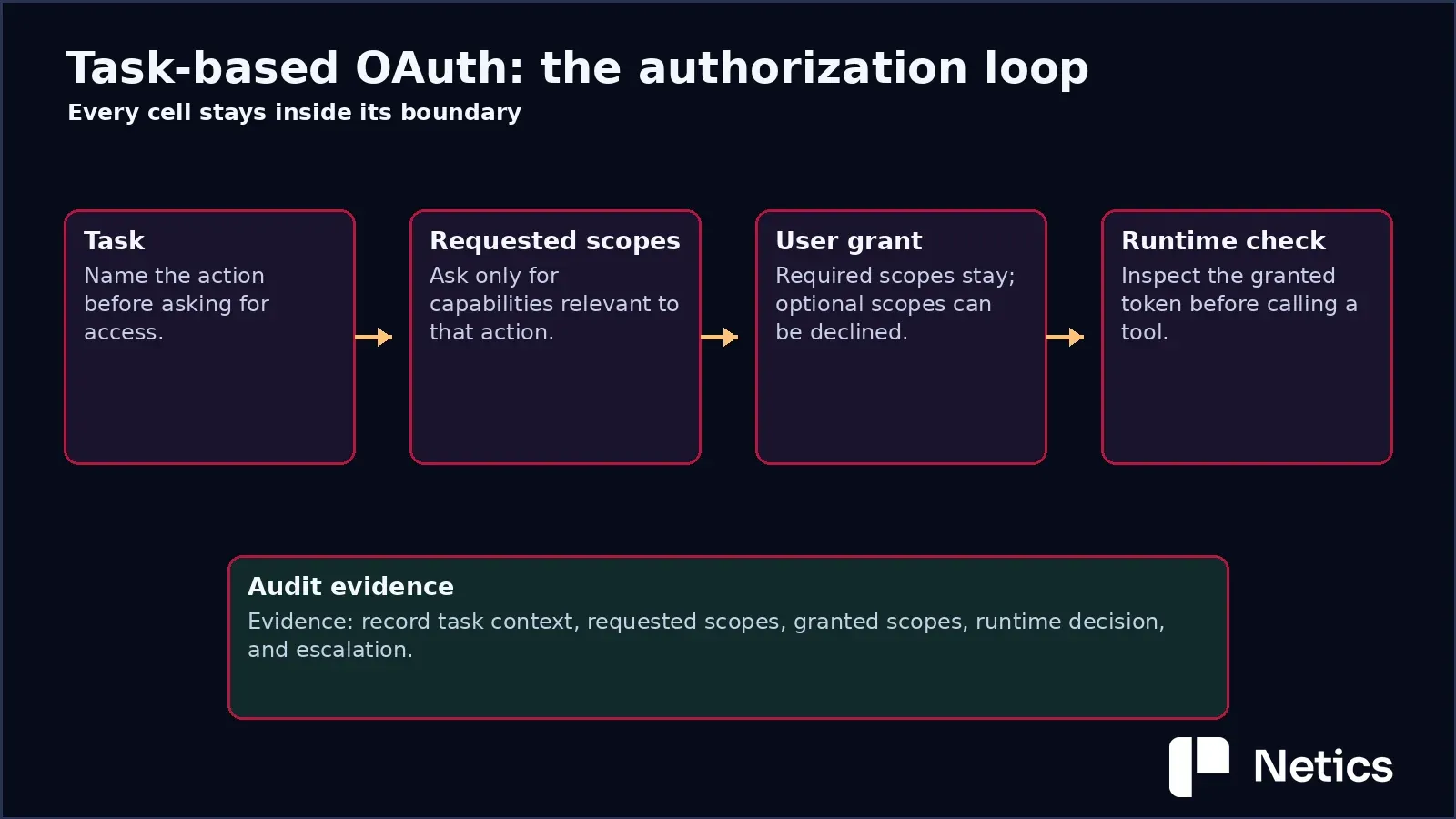
- Developers mark configured scopes as required or optional.
- Users can deselect optional scopes in the authorization flow.
- The token contains the scopes the user actually consented to.[1]
The scopes are evaluated against the specific authorization request, not every scope configured on the client. Cloudflare’s example includes user-details.read, workers-scripts.write, workers-kv-storage.write, and zone.read. When all four are requested, the optional scopes can be deselected. If a later flow requests only two scopes, only those two are evaluated and displayed.[1]
That is a meaningful distinction. “The client can do X” is not the same as “this authorization request needs X.” The second statement is closer to least privilege.
The mechanism: request, grant, enforce, observe
A defensible implementation has four stages:
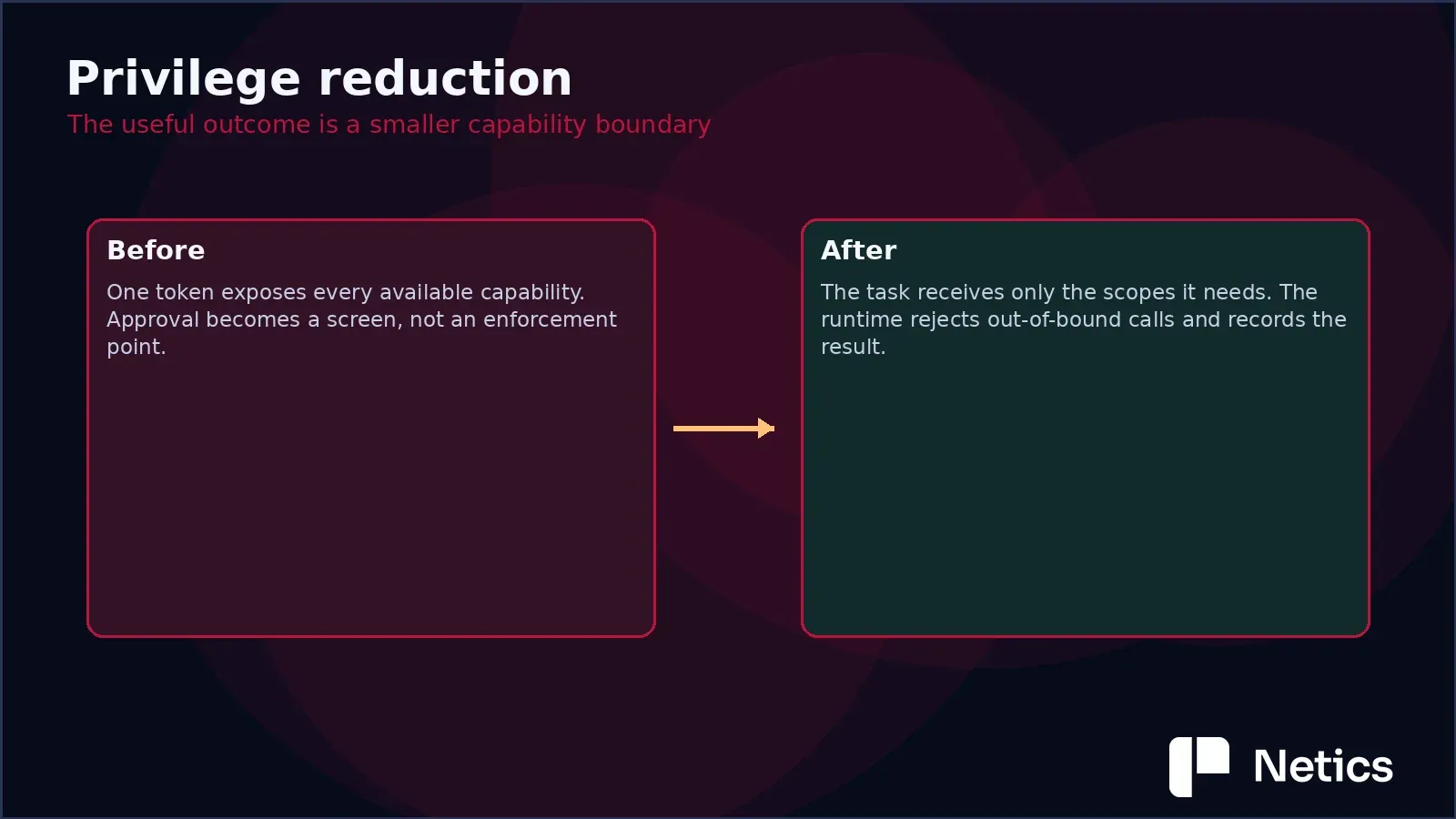
- Request: identify the task and request only the scopes relevant to it.
- Grant: let the user accept required scopes and decline optional ones.
- Enforce: after exchanging the authorization code, inspect the granted scope set and adapt the application behavior.
- Observe: record the authorization decision, token scope, task context, and any escalation path.
Cloudflare explicitly warns developers to check the granted scope set after exchanging the authorization code rather than assuming that the full requested set was approved.[1] This is where many implementations will fail: the consent screen becomes narrower, but the application still assumes the broad path.
For an agent, the practical equivalent is capability-aware degradation. If the user grants read access but not a write scope, the agent should complete the read-only task or explain the missing capability. It should not repeatedly ask for the broad grant or silently substitute a different tool.
What task-based consent does not solve
| It helps with | It does not solve by itself |
|---|---|
| Reducing unnecessary scopes in a request | A compromised tool or malicious instruction |
| Making optional access visible to users | Token theft or unsafe token storage |
| Aligning consent with a specific flow | Confused-deputy behavior |
| Producing narrower granted tokens | Unreviewed privilege escalation |
| Preserving the existing default for clients that do not opt in | Missing audit ownership or incident response |
This limitation is the point, not a footnote. A smaller dialog can make a dangerous architecture look safer if teams do not connect the grant to runtime behavior.
A practical control loop for agent teams
Before connecting an OAuth tool to an agent, write down five things:
- the user task;
- the tool calls required for that task;
- the minimum scopes for those calls;
- the person or policy that may approve escalation;
- the evidence recorded after the decision.
Then test partial grants deliberately. Remove one optional scope and verify that the application fails safely, reports the missing capability, and does not retain an assumption that the user approved it.
This connects to the broader Netics position that permissions should be mapped before teams choose another platform. Inventory what AI agents can touch before buying another control layer is the right companion principle here: authorization begins with the workflow, not the product menu.
FAQ
Is task-based OAuth consent a new OAuth standard?
Cloudflare says the OAuth specification already allows an authorization server to grant a narrower set of scopes than requested. The task-based framing here is an implementation and product design pattern, not automatically a new universal standard.[1]
Does optional scope selection make an agent safe?
No. It can reduce unnecessary privilege. Safety still depends on token handling, tool trust, approval policy, runtime enforcement, logging, and escalation controls.
What should happen when the user declines an optional scope?
The application should inspect the granted scope set and either complete a reduced task or explain what capability is unavailable. It should not assume the full request succeeded.
Netics’ conclusion
Task-based consent is valuable because it moves authorization closer to the work a user is actually asking an application to do. But consent is only one link in the control chain. If the task boundary does not exist in the tool map, token checks, logs, and escalation policy, the smaller dialog is theatre.
Least privilege is an operating model, not a button on a consent screen.
Sources
[1] Cloudflare: From all-or-nothing to task-based OAuth consent
Source: Cloudflare: From all-or-nothing to task-based OAuth consent — blog.cloudflare.com, 2026-08-20
Explore Netics for practical infrastructure and AI operations guidance.