
Scaleway Adds GPU Zones in Two Countries on Two Accelerator Families
Scaleway announced on 13 October 2026 that it is adding two new clusters, an AMD Instinct MI355X in Stockholm and an NVIDIA B300 in Copenhagen, alongside its GPU Zone in Paris, plu

TL;DR
- A GPU Zone is a part of a cloud region built around graphics accelerators and sized for model training and inference, which makes it a different purchase from a general-purpose compute region.
- Scaleway announced on 13 October 2026, at its ai-PULSE 2026 event, a new AMD Instinct MI355X cluster in Stockholm and a new NVIDIA B300 cluster in Copenhagen, which join its GPU Zone in Paris.
- The same announcement brings two additional availability zones in Milan for a total of three, and plans six more availability zones for 2027 in Stockholm and Frankfurt.
- Two accelerator families in two countries give buyers a choice of silicon inside one provider, and they also put a second software stack into the operational plan.
- The partnership list includes a European inference chip, with VSORA and ZML and the Jotunn8 processor, for which the release gives no specifications or dates.
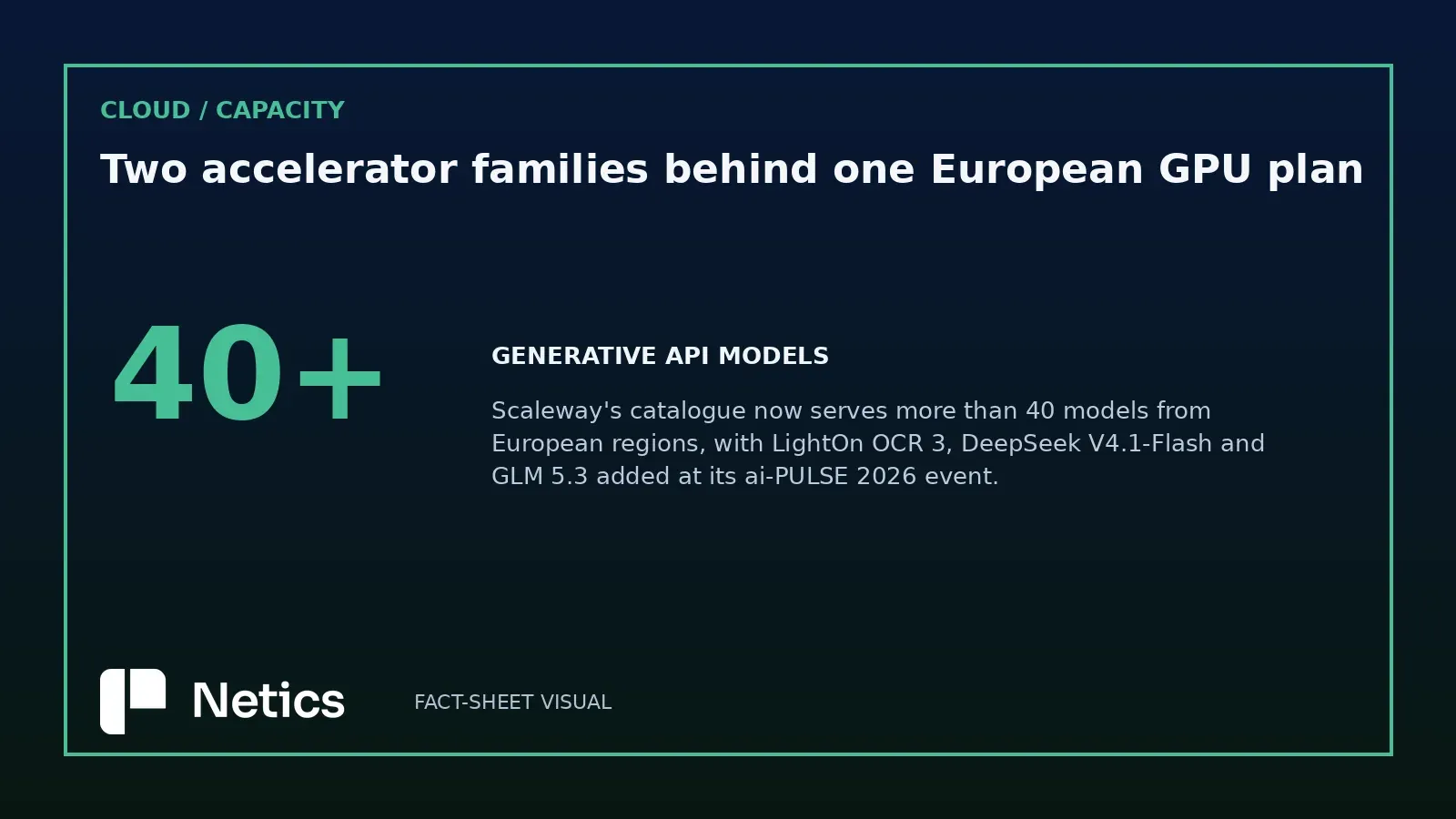
- The model catalogue passes 40 models through Generative APIs, with LightOn OCR 3, DeepSeek V4.1-Flash and GLM 5.3 added in the announcement.
- The questions a buyer can price today are the ones that matter before delivery: which availability zone, which accelerator, which switching path and what the price per hour or per token looks like.
What Scaleway announced on 13 October
Scaleway published the announcement from Paris on 13 October 2026, during its ai-PULSE 2026 event, and it covers three things at once: cloud regions, computing capacity and a model catalogue. The vendor frames all of them as a single argument about running AI applications from Europe, and it lists the references it counts as momentum, including selection under the European Commission's Cloud III framework, selection by the Health Data Hub, an announced agreement with Airbus and organisations such as LVMH and MAIF on its books.
A reader who buys infrastructure can separate the parts. Regions and availability zones describe resilience and latency. Accelerators describe price and portability. The model catalogue describes how much of the stack a provider wants to host.
The Italian region that reaches three availability zones
Milan is the concrete part of the announcement. Two additional availability zones bring the first Italian region to three, which is the point at which a region can carry production: an application spread across three separate zones survives the loss of one, and the vendor describes the resulting service as enterprise-grade resilience.
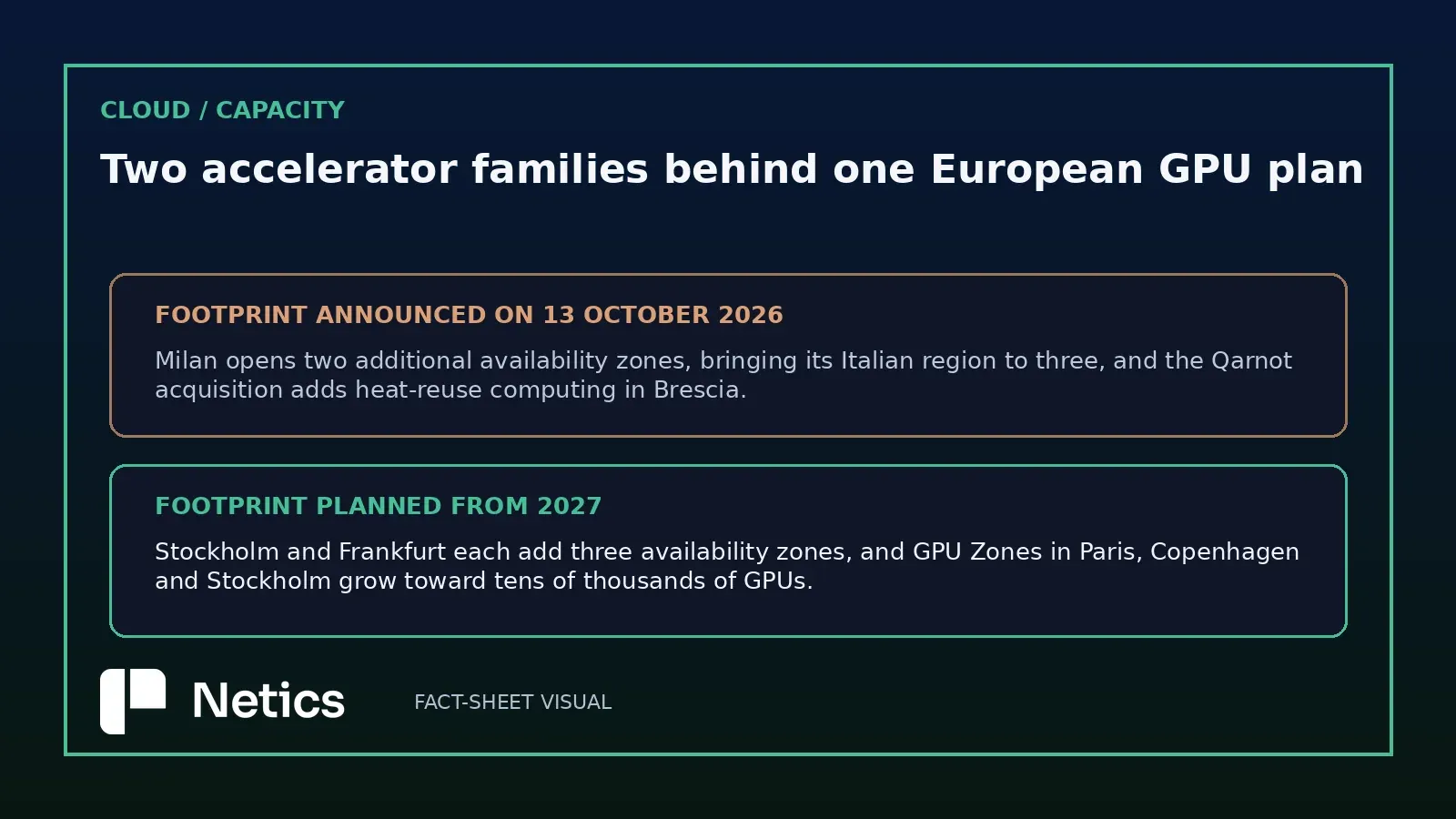
The Italian story continues through Qarnot Computing, a company Scaleway acquired earlier in 2026 and describes as specialising in high-performance computing and waste heat recovery. In Brescia, Qarnot has partnered with A2A to connect its HPC infrastructure to the city's district heating network. Heat reuse is a real engineering choice with a physical constraint attached, since it needs a customer for the heat within pipe distance, and the release presents the Brescia arrangement as the example.
Two accelerator families in two countries
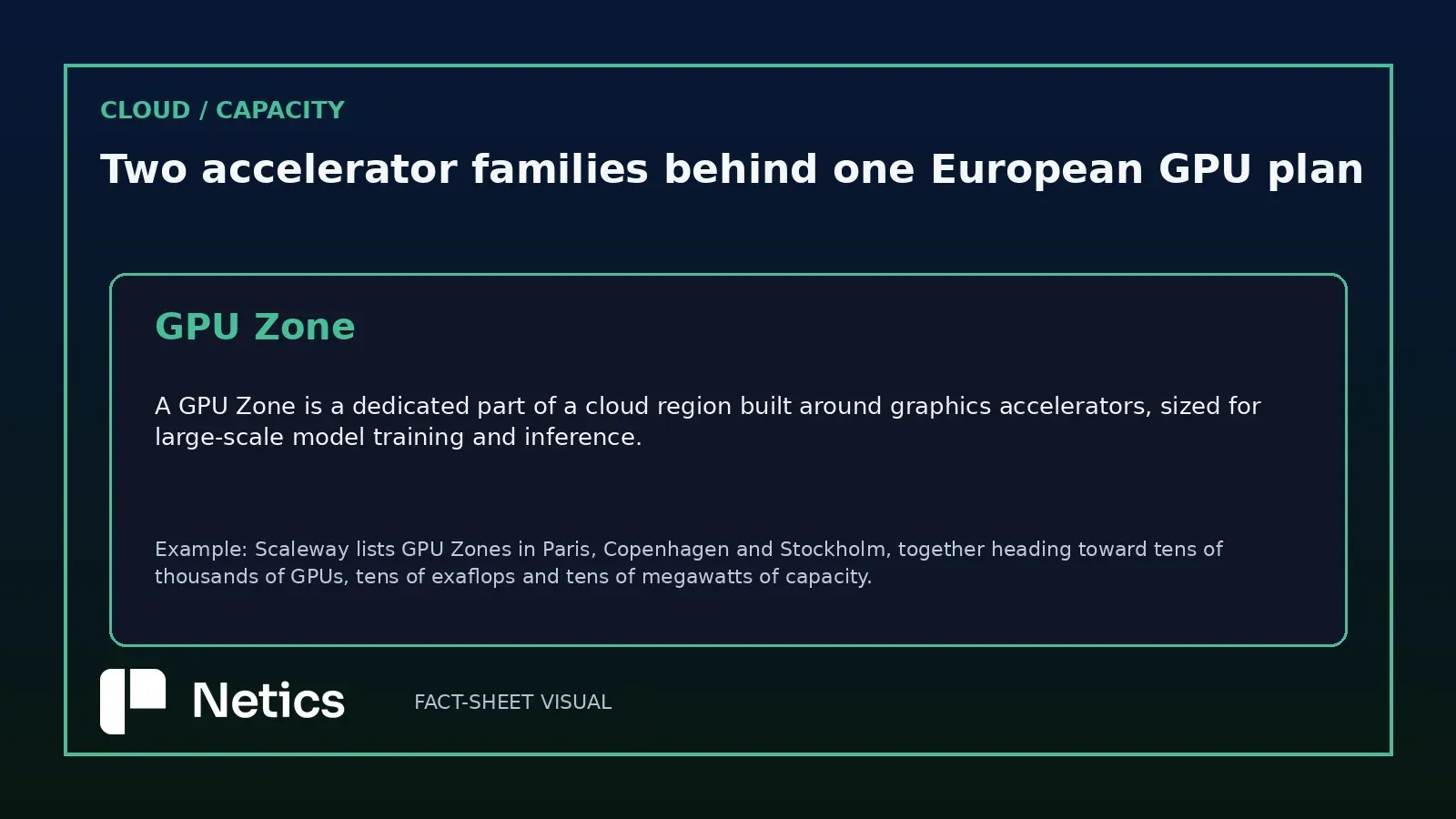
The capacity plan puts different silicon in different countries. Stockholm gets a new AMD Instinct MI355X GPU cluster, which the release presents as aiming to be one of the first computing infrastructures of its kind from a European cloud provider. Copenhagen gets a new NVIDIA B300 cluster with several thousand GPUs. GPU Zones in Paris, Copenhagen and Stockholm are described as eventually representing tens of thousands of GPUs, tens of exaflops and tens of megawatts of capacity. The release gives no delivery date and no price for either new cluster.
Read commercially, two silicon families inside one provider help a buyer. Workloads differ: some inference jobs favour whatever accelerator runs cheapest per hour for that shape of model, and a provider with two families can price them against each other. The vendor states the goal itself, describing a broader range of processor architectures as a way to preserve customer freedom to choose.
Read operationally, the second family also imports a second software stack, and that cost lands on whoever maintains the image, the drivers and the build pipeline. A migration plan written for one accelerator often needs a second pass for the other, which is the sort of detail that decides whether a team actually uses the cheaper option.
The European inference chip in the partnership list
Scaleway also lists a silicon partnership that goes beyond buying accelerators. With VSORA and ZML, the company says it is contributing to a new European AI inference offering based on the Jotunn8 processor, with the stated aim of supporting new European chip architectures and widening the technology options available to businesses.
That item deserves the same treatment as the GPU counts. A development partnership is an early step on a long path that runs through silicon, compilers and production workloads. The release gives no specifications, no dates and no performance figures for the Jotunn8 effort, so the honest reading is a direction of travel. The European AI Gigafactory project, which Scaleway and iliad Group have joined, sits in the same category.
What the model catalogue adds to the offer
The catalogue section is the part a small team can use this month. More than 40 models are available through Scaleway's Generative APIs, and the announcement adds three: LightOn OCR 3, from the French company LightOn, for text recognition and information extraction from complex documents; DeepSeek V4.1-Flash, with native visual understanding; and GLM 5.3 from Z.ai, an open model described as suited to software development and complex multi-step tasks performed by agents. The vendor's own list of families spans Qwen, Gemma, DeepSeek, GLM, Mistral and Devstral.
Running a model on European-hosted infrastructure answers one question about the data path and leaves another open: how portable the work is. Prompts, evaluations and fine-tunes are the assets a team accumulates, and their portability depends on interfaces more than on the location of the servers. The release also mentions support for cached tokens and customizable rate limits on the inference platform, which are the controls that decide an application's cost per request, and a Dataiku partnership that puts an orchestration platform on the same cloud.
The questions a buyer can price today
Announced capacity and available capacity are two different things, and the gap between them is where procurement lives. Three questions settle most of it. Which availability zone will the workload land in, and what does the service level say about losing one. Which accelerator, at what price per hour, with what commitment. And what the exit looks like, in terms of data format, interfaces and the cost of moving a workload out.
Then price one workload. A single inference service or fine-tuning job, costed per month on a qualifying European region, gives a number to compare with the current bill. Netics works this question through sovereign infrastructure and cloud exit, and the density arithmetic behind a capacity plan is the one we set out when we wrote about how the rack became a power contract.
Sources
Source: Scaleway scales up to power Europe's AI ambitions — scaleway.com/en/news, Scaleway press release, 13 October 2026, retrieved 2026-10-14 (new infrastructure deployments across Europe announced at ai-PULSE 2026; two additional availability zones in Milan bringing the first Italian cloud region to three with enterprise-grade resilience; the Qarnot Computing acquisition covering high-performance computing and waste heat recovery, with a partnership with A2A in Brescia connecting HPC infrastructure to the city's district heating network; three availability zones in Stockholm and three additional zones in Frankfurt planned for 2027; GPU Zones as dedicated infrastructure for large-scale model training and inference; a new AMD Instinct MI355X GPU cluster in Stockholm aiming to be one of the first computing infrastructures of its kind from a European cloud provider; a new NVIDIA B300 cluster in Copenhagen with several thousand GPUs; GPU Zones in Paris, Copenhagen and Stockholm eventually representing tens of thousands of GPUs, tens of exaflops and tens of megawatts; a broader range of processor architectures offered as a way to preserve customer freedom to choose; Scaleway and iliad Group participation in the European AI Gigafactory project; a partnership with VSORA and ZML on a European AI inference offering based on the Jotunn8 processor; more than 40 models available through Generative APIs including LightOn OCR 3, DeepSeek V4.1-Flash and GLM 5.3, with catalogue families spanning Qwen, Gemma, DeepSeek, GLM, Mistral and Devstral; around ten additional products and features on the Data and AI Platform and a new Dataiku partnership; cached tokens support and customizable rate limits on the inference platform; selection under the European Commission's Cloud III framework and by the Health Data Hub, an announced agreement with Airbus and organisations including LVMH and MAIF).
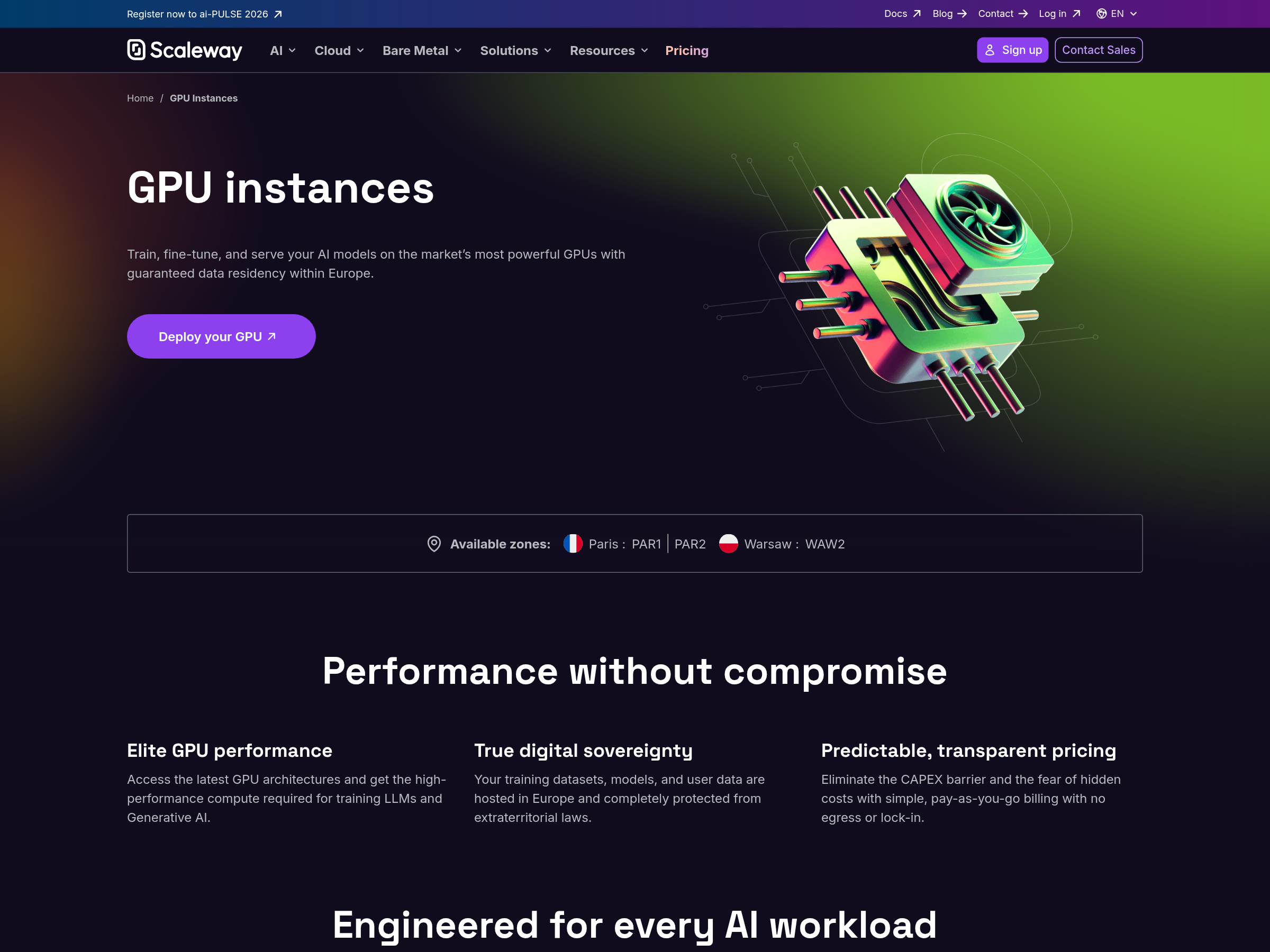
Source: GPU instances — scaleway.com/en/gpu-instances, Scaleway product page, retrieved 2026-10-14 (the accelerator line-up the announcement's clusters belong to, listing the B300-SXM, H100-SXM, H100 PCIe, L4 and L40S instance families, with available zones in Paris (PAR1, PAR2) and Warsaw (WAW2), rechecked 2026-10-16).
Source: Scaleway's announcement of 13 October 2026 and its GPU Instances product page — the capacity, zone and catalogue figures used above, retrieved 2026-10-14. Images are official Scaleway page captures, plus three Netics editorial diagrams.