
"Qdrant vs Pinecone: Who Should Own Your Retrieval Layer?"
"Qdrant hands you the retrieval layer to run and secure yourself. Pinecone hands you a managed index and a bill. Neither choice is free of operational weight — compare what each actually rem

Vector search has quietly become load-bearing infrastructure: it sits under RAG pipelines, agent memory, and semantic search features that product teams now treat as default, not optional. Whoever runs that layer inherits its outages, its scaling curve, and its data-residency questions. Qdrant and Pinecone answer the same technical problem — nearest-neighbor retrieval over embeddings — with opposite defaults on who does that inheriting.
TL;DR
The comparison explains What each product actually does; Deployment ownership: the actual fork in the road; Data model and retrieval mechanics compared; Ingestion and scale mechanics; Operating cost and who carries the ops burden; Lock-in and migration effort; Security, multitenancy, and support model; Who should choose which. The practical choice depends on workload, governance, operational ownership, the Netics position, and the constraints documented by the primary sources.
What each product actually does
Both systems solve the same mechanical problem. A user's data is converted into a dense vector embedding; a query is converted the same way; the engine returns the nearest neighbors in vector space. Qdrant's documentation describes this as Top-K retrieval: the engine computes similarity between a query vector and stored vectors and returns a user-defined number of closest matches. Pinecone's documentation frames its product more broadly, describing itself as "the vector database for AI agents and applications, built for semantic search, knowledge retrieval, and long-term memory at scale."
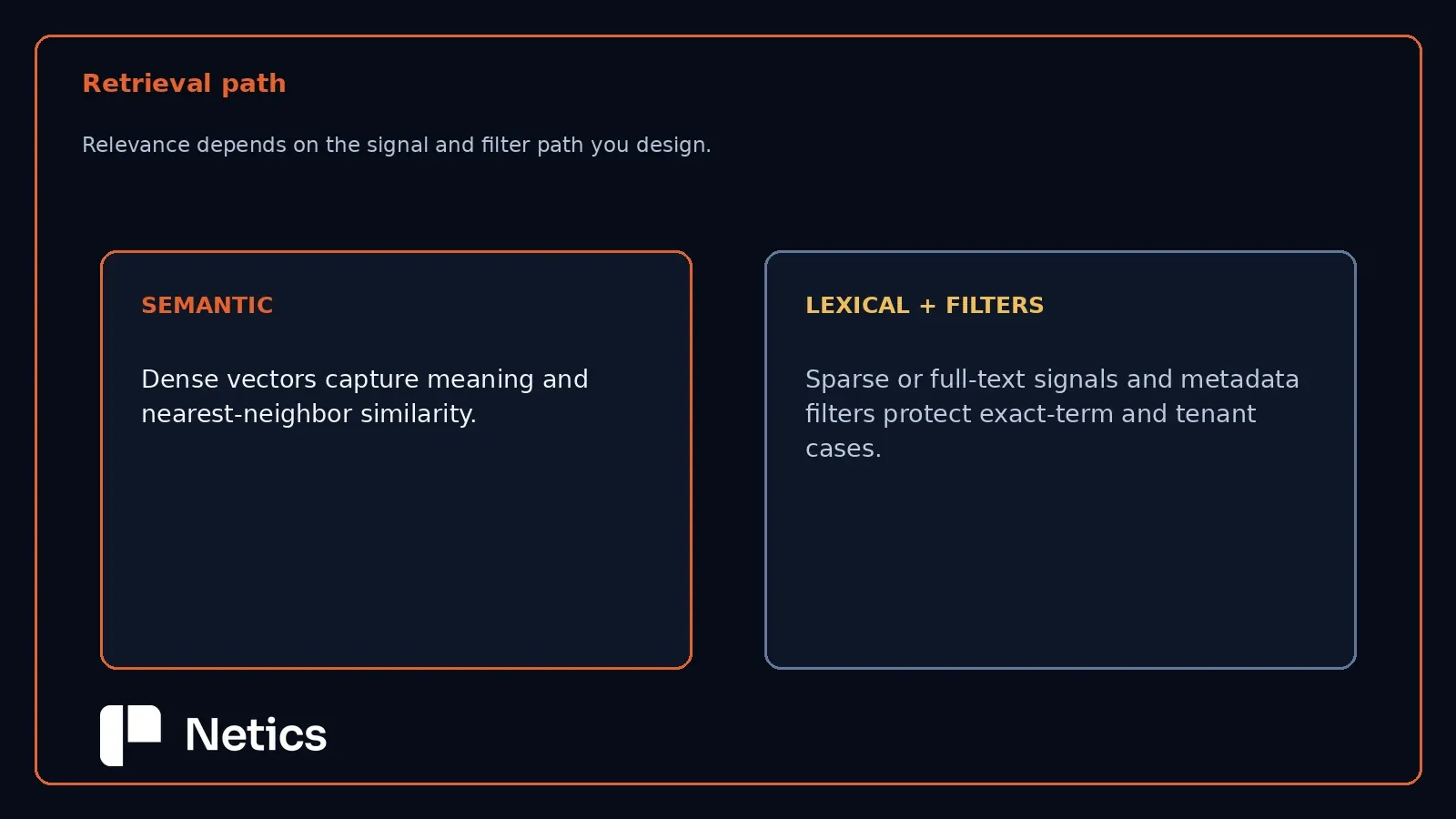
Both also support hybrid retrieval — combining dense vector similarity with lexical or keyword-style matching rather than relying on embeddings alone. Qdrant does this with sparse vectors alongside dense vectors in the same point. Pinecone does it by letting a single index mix a dense_vector field, a sparse_vector field, and full_text_search-enabled string fields, scored per query with score_by. Netics analysis: this convergence matters more than either vendor's individual feature list — it means the mechanism question ("can this do hybrid search") is mostly settled, and the real comparison has moved to operations.
Deployment ownership: the actual fork in the road
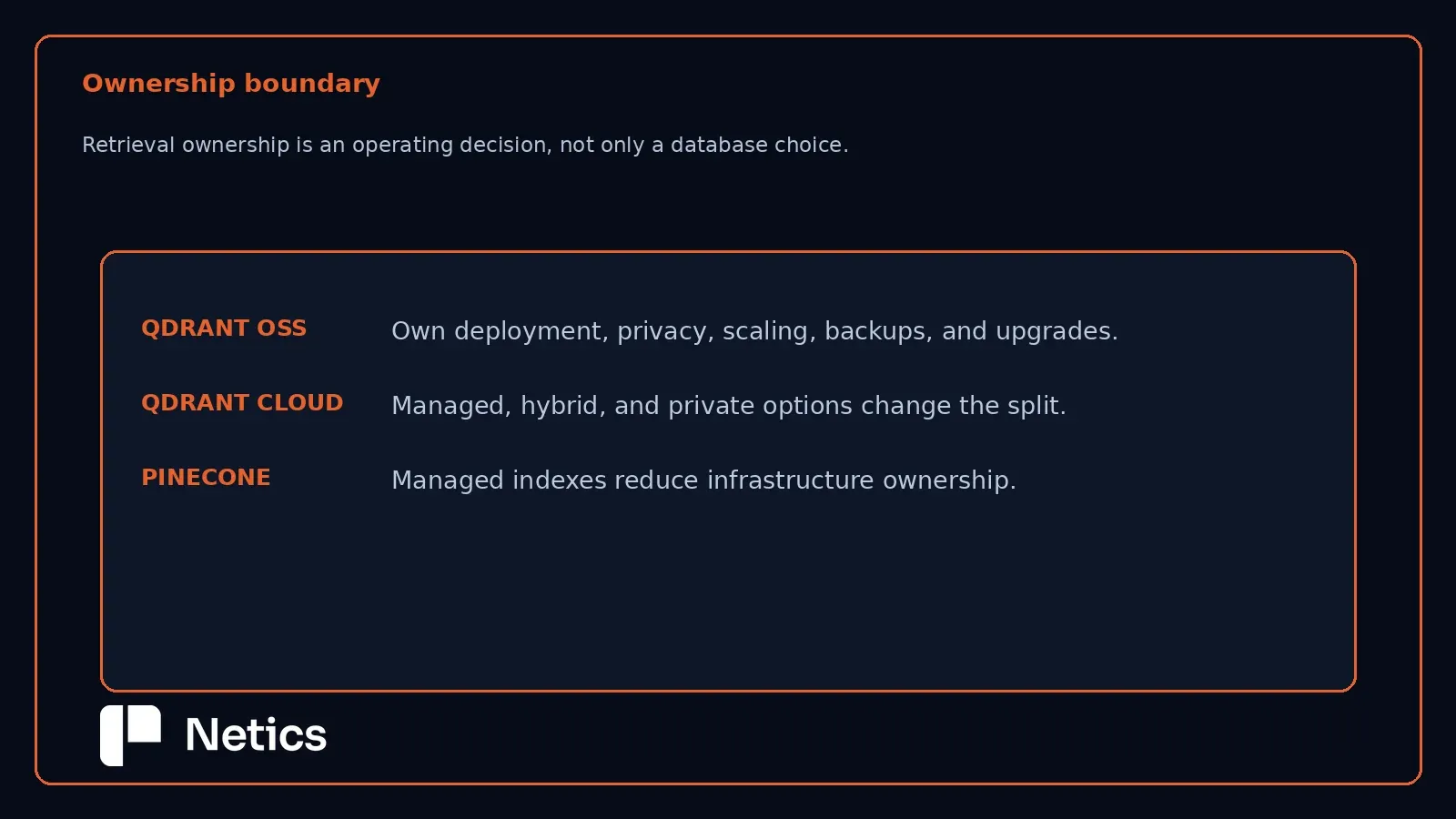
The two products stop being similar. Qdrant's documentation lists four deployment models on the same engine: Managed Cloud (Qdrant-managed infrastructure), Hybrid Cloud (shared responsibility on your own clusters), Private Cloud, and Open Source — the last two described as "full ownership and independence." You can run Qdrant on a laptop, in your own datacenter, or in a customer's VPC, using the identical open-source engine that backs the managed offering.
Pinecone's documentation does not describe an equivalent self-hosted or open-source path. Its indexes are described as serverless, and the ingestion, storage, and query pipeline are Pinecone-operated infrastructure. There is no published option to run the Pinecone engine on your own hardware.
That single fact reframes the entire comparison. This is not "compare two databases and pick the faster one." It is: do you want the option to walk the engine into your own infrastructure later, or are you comfortable outsourcing that infrastructure permanently. Reversibility, not raw performance, is the first decision criterion.
Data model and retrieval mechanics compared
Qdrant organizes data into collections — named sets of points, each point holding a vector (or several named vectors, dense or sparse) plus optional payload metadata, identified by a 64-bit integer or UUID. Its HNSW index builds a graph structure for fast similarity search, and payload indexes extend that graph so metadata filtering and vector similarity run in a single pass. Data is split into segments, optimized automatically in the background, and sharded for distributed deployments.
Pinecone organizes data into indexes containing records or documents, partitioned into namespaces. A namespace isolates one customer's data for multitenancy and speeds queries by scanning only relevant records; namespaces are created implicitly on first upsert. On Standard and Enterprise plans, Pinecone's documentation says it "can accommodate million-scale namespaces and beyond for specific use cases," with a note to contact support above 100,000 namespaces. Metadata in Pinecone is capped at 40KB per record, must be a flat JSON object (no nesting), and supports a defined filter-operator set ($eq, $in, $and, $or, and similar).
Netics analysis: Qdrant's payload-index-plus-HNSW design and Pinecone's namespace-plus-metadata-filter design solve the same multitenancy problem — isolate one customer's vectors from another's, filter without a full scan — with different primitives. Neither is objectively better from the documentation alone; the practical difference is that Qdrant's primitives are configuration you own, and Pinecone's are a managed default you inherit.
Ingestion and scale mechanics
Pinecone's documentation draws an explicit ingestion line: use import (Parquet files from object storage, an asynchronous long-running operation) for 10,000,000+ records, and upsert for ongoing writes, with batch upserts recommended up to 1,000 records per batch for throughput. Sparse-vector indexes carry harder documented limits: a maximum of 1,000 non-zero values per vector, 10 upserts per second per index, 100 queries per second per index, a top_k ceiling of 1,000, and a 4MB maximum query result size.
Qdrant's documentation does not publish equivalent numeric throughput ceilings in the reviewed pages; instead it exposes strict mode, a configurable set of guardrails — blocking filtering or updates on non-indexed payload fields, limiting query result sizes and timeouts, capping payload index counts, constraining batch sizes, enforcing storage limits, and rate-limiting reads and writes. Critically, the documentation states the open-source version "does not enforce anything" by default — you must enable and configure strict mode yourself — while Qdrant Cloud disables filtering and updating by a non-indexed payload attribute by default and restricts payload indexes to 100.
That is a real trade-off, stated plainly by the vendor itself: Pinecone's limits are fixed and known in advance; Qdrant's open-source limits are whatever you configure, which means an unconfigured self-hosted cluster can be abused in ways a managed service structurally prevents. A team choosing self-hosted Qdrant for the control it offers has to actually exercise that control, not just have it available.
Operating cost and who carries the ops burden
Neither documentation set reviewed here publishes comparable list pricing, so this section stays qualitative — author-asserted from general infrastructure economics, not from either vendor's pricing page. Self-hosted Qdrant's direct licence cost is zero; the real cost moves to your own compute, storage, backup, monitoring, and the engineering time to run a stateful service reliably — including configuring the strict-mode guardrails the documentation says are off by default. Managed Pinecone converts that same operational load into a usage-based bill for storage, queries, and (per its current promotional terms) bulk imports; Pinecone's documentation notes a one-time $250 bulk-import credit for Standard and Enterprise organizations valid through August 30, 2026 — a time-limited promotion, not a stable pricing signal, and worth verifying directly before it factors into any procurement decision.
Take a concrete illustrative case: a Casablanca-based SaaS company running a support-ticket semantic search feature over roughly two million documents. If the team already runs Postgres and Redis in production and has an on-call rotation, adding a self-hosted Qdrant cluster to that estate is incremental work, not a new operating model — and it keeps embeddings and payload metadata inside infrastructure the company already controls for data-residency reasons. If the same team has no stateful-service on-call experience, the honest cost of self-hosting is not the server bill; it is the hours spent learning to operate HNSW indexing, segment optimization, and strict-mode configuration correctly, under the same pressure as any other production database. This is an illustrative scenario, not a client account.
Lock-in and migration effort
Qdrant's open-source availability is the direct lock-in mitigation: the same engine that runs in Qdrant's Managed Cloud runs on your own hardware, so a move from managed to self-hosted (or the reverse) does not require re-architecting around a different retrieval engine — documented tooling exists for snapshots, data migration, and even migrating to a new embedding model. Moving away from Pinecone, by contrast, means moving to a structurally different engine, because there is no published self-hosted Pinecone target to migrate toward — the exit path runs through data export and re-ingestion into whatever system you pick next, dense-vector-by-dense-vector.
The same reversibility question Netics raised when comparing Proxmox and VMware after Broadcom's licensing changes: the platform that lets you change your mind cheaply is not always the platform with the best feature page today. A retrieval layer chosen for convenience now can become the hardest thing to move later, precisely because it worked well enough that nobody budgeted time to keep an exit route live.
Security, multitenancy, and support model
Qdrant's payload-index and strict-mode controls, plus the option to keep the entire retrieval layer inside a private network with no third-party data plane, matter most to teams under data-residency or sector-specific compliance pressure — at the cost of being the party responsible for patching, access control, and incident response on that infrastructure. Support in the open-source and community tiers runs through a Discord community the documentation describes as having "6,000+ active members"; a formal Support Portal is reserved for paying Cloud customers.
Pinecone's namespace model gives per-customer isolation without the operator having to design that isolation themselves, and its documented ecosystem — an MCP server, IDE/CLI integrations with tools like Claude Code, Gemini CLI, and Cursor — suggests a product optimized for teams that want to plug retrieval into an existing agent stack quickly rather than own the index's internals. The trade-off is that your data, embeddings, and query patterns sit inside infrastructure you cannot inspect, audit, or move off without a full migration.
Who should choose which
Choose self-hosted Qdrant when: your team already operates stateful production services, data residency or a private-network requirement rules out a third-party data plane, you expect the retrieval layer to outlive multiple product pivots and want to keep switching costs low, or you need Qdrant Edge's embedded, offline-capable mode for robots, kiosks, or mobile deployments — a use case with no managed-service equivalent in either product's documentation.
Choose managed Pinecone when: the team has no appetite to run another stateful service, time-to-first-feature matters more than long-run switching cost, ingestion volume and shape fit its documented import/upsert model without hitting sparse-vector throughput ceilings, or the agent/IDE ecosystem integrations are themselves the reason to pick a vector store.
Neither is the right answer when the actual requirement is smaller than either vendor's default assumption — a few thousand vectors for an internal tool rarely justifies a managed usage-based bill or a self-hosted cluster with its own on-call burden. In that case, the retrieval layer belongs inside whatever database the team already runs, not as a new system either vendor is trying to sell.
The Netics position
The retrieval layer is infrastructure, not a library import, and infrastructure decisions should be made the way Netics argues infrastructure decisions generally should be made: by what your team can operate, audit, and reverse — not by which vendor's documentation reads more impressively this quarter. Qdrant's open-source-to-managed continuum is the more defensible long-term choice for teams building a durable technical estate; Pinecone's managed-only model is the more defensible choice for teams whose competitive advantage has nothing to do with running databases. Both are honest engineering trade-offs. The dishonest move is picking either one without naming, in writing, who owns the 2 a.m. page when the index falls behind.
If your team is weighing where the retrieval layer should sit inside a broader infrastructure audit, Netics can help scope that conversation — see how we approach infrastructure decisions.
*Sources: Qdrant Documentation — Overview and Concepts, qdrant.tech, accessed 30 August 2026; Pinecone Documentation — Get Started Overview, docs.pinecone.io, accessed 30 August 2026.
For a context-specific architecture review, book a 30-minute audit with Netics.