
Cloudflare Publishes Open Weights for Clairic and Clairic-flash, Its Extraction Models
"Cloudflare released an updated 27-billion-parameter Clairic and a new 9-billion-parameter Clairic-flash on 18 November 2026, with open weights on Hugging Face and hosted endpoints on Worker


TL;DR
- Clairic is Cloudflare's extraction model: it reads unstructured text, images and PDF pages and returns typed values, estimates and forecasts against a schema the caller supplies, and Clairic-flash is the new 9-billion-parameter version built for lower latency.
- On 18 November 2026 Cloudflare published open weights for both models on Hugging Face under the Apache-2.0 licence and kept hosted endpoints on Workers AI at
@cf/cloudflare/clairicand@cf/cloudflare/clairic-flash. - The updated 27-billion-parameter Clairic replaced the preview's single forward pass with parallel slot autoregressive generation, where each field writes its own tokens, stops at its own end marker, and all fields still advance together in the serving batch.
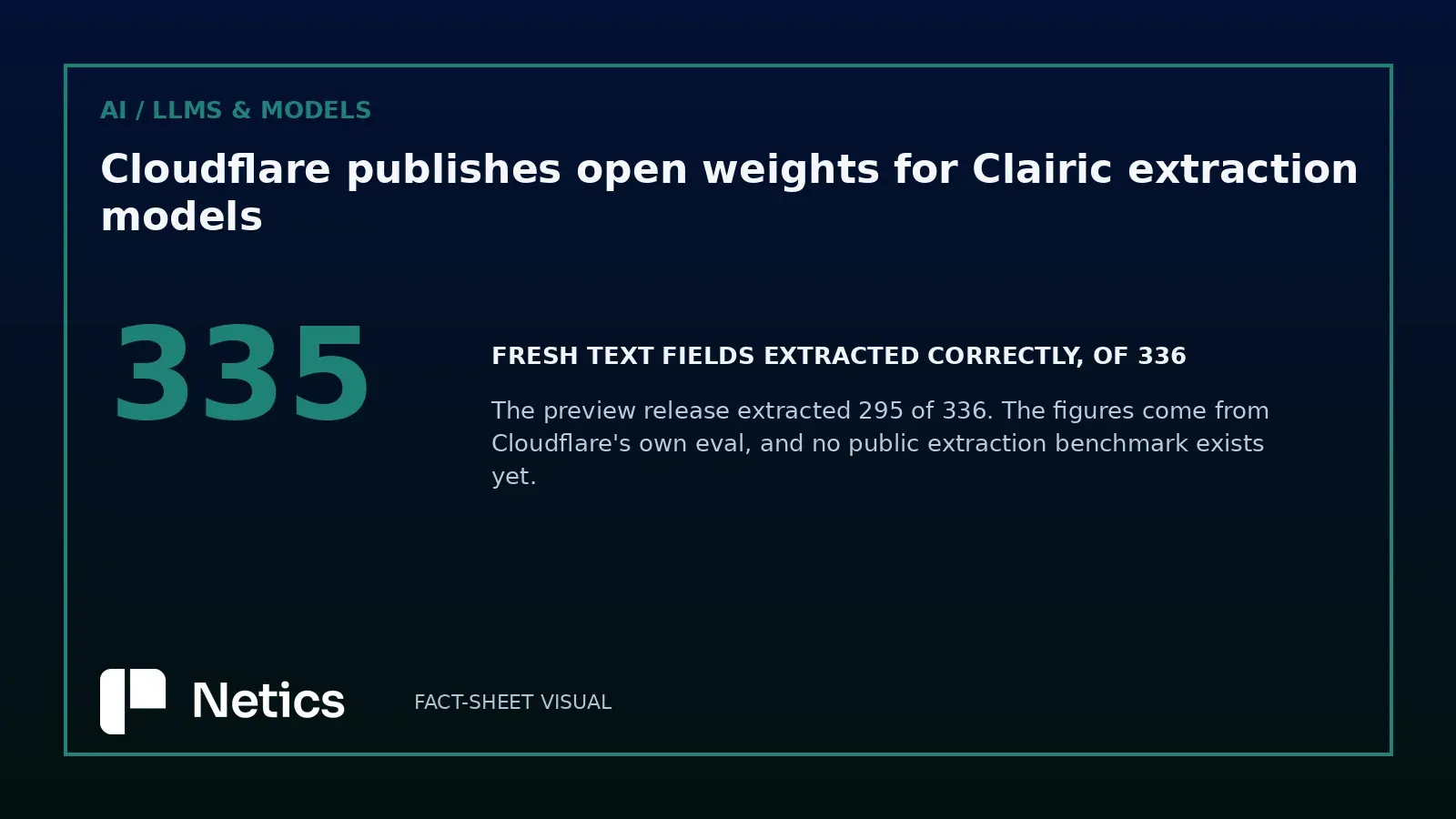
- Cloudflare's own evals report 335 of 336 fresh text fields extracted correctly against 295 for the preview, 1,263 of 1,263 tracked customer assertions, and 576 of 576 synthetic receipt fields, with the comparisons run against its own profiles.
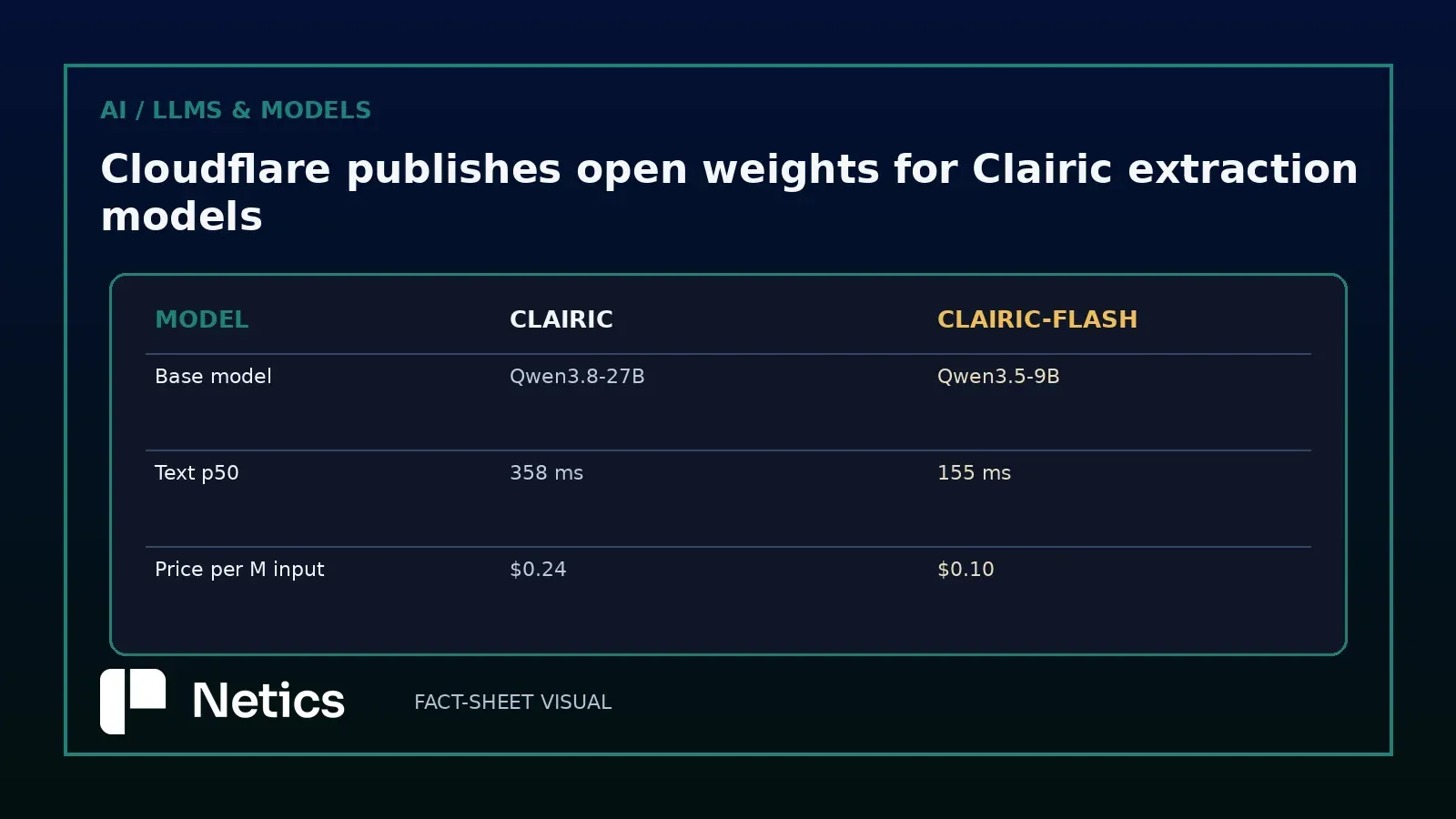
- Measured latency stays under a second: p50 of 358 milliseconds on fresh text fields for Clairic and 155 milliseconds for Clairic-flash, with the slowest published set at 691 milliseconds p50 on commercial leases.
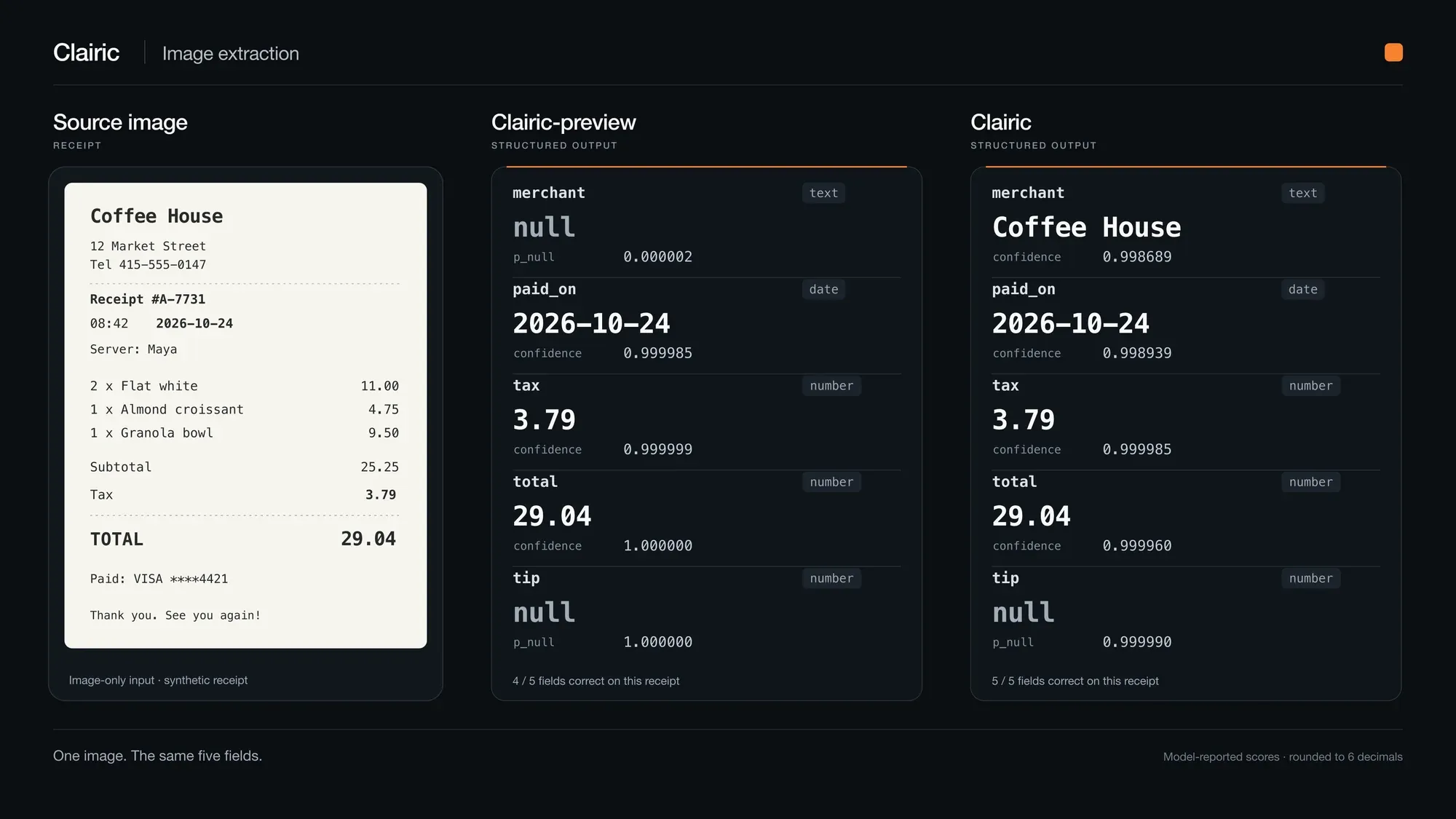
- The typed response keeps confidence scores, character spans and probabilities, and one request can carry up to four images or PDF pages, with line items returned as rows.
- Clairic is priced at $0.24 per million input tokens and Clairic-flash at $0.10, both at $0.10 until 1 December 2026, and output tokens are not billed.
Cloudflare's framing is that a company can be a neolab: build its own frontier models and serve them to its own customers. The two Clairic releases are a narrow version of that ambition. They handle one job, turning a document into fields a program can read, and they compete on cost and latency against general models that are asked to do the same work with a long prompt and a parser.
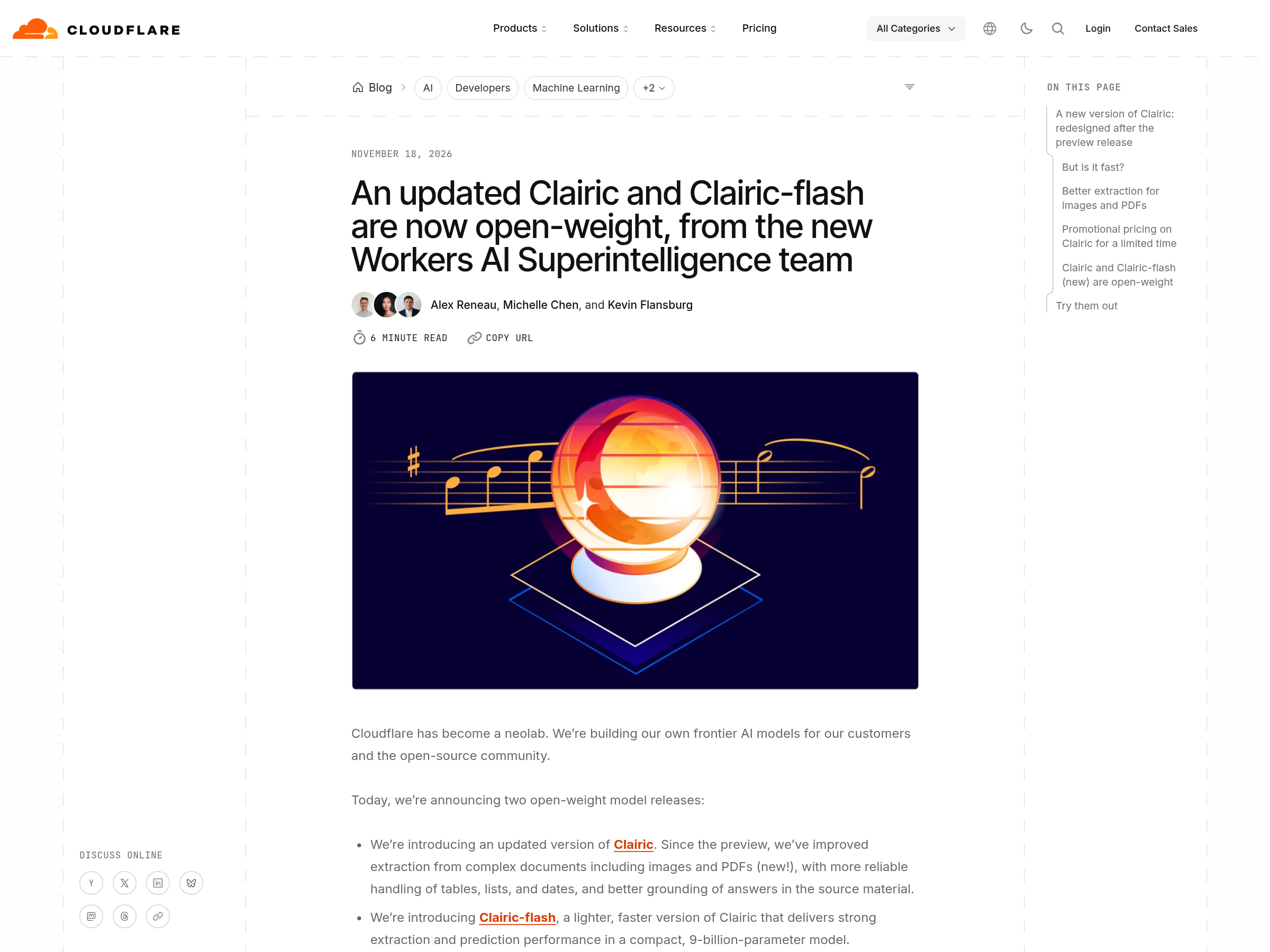
What the two models take in and return
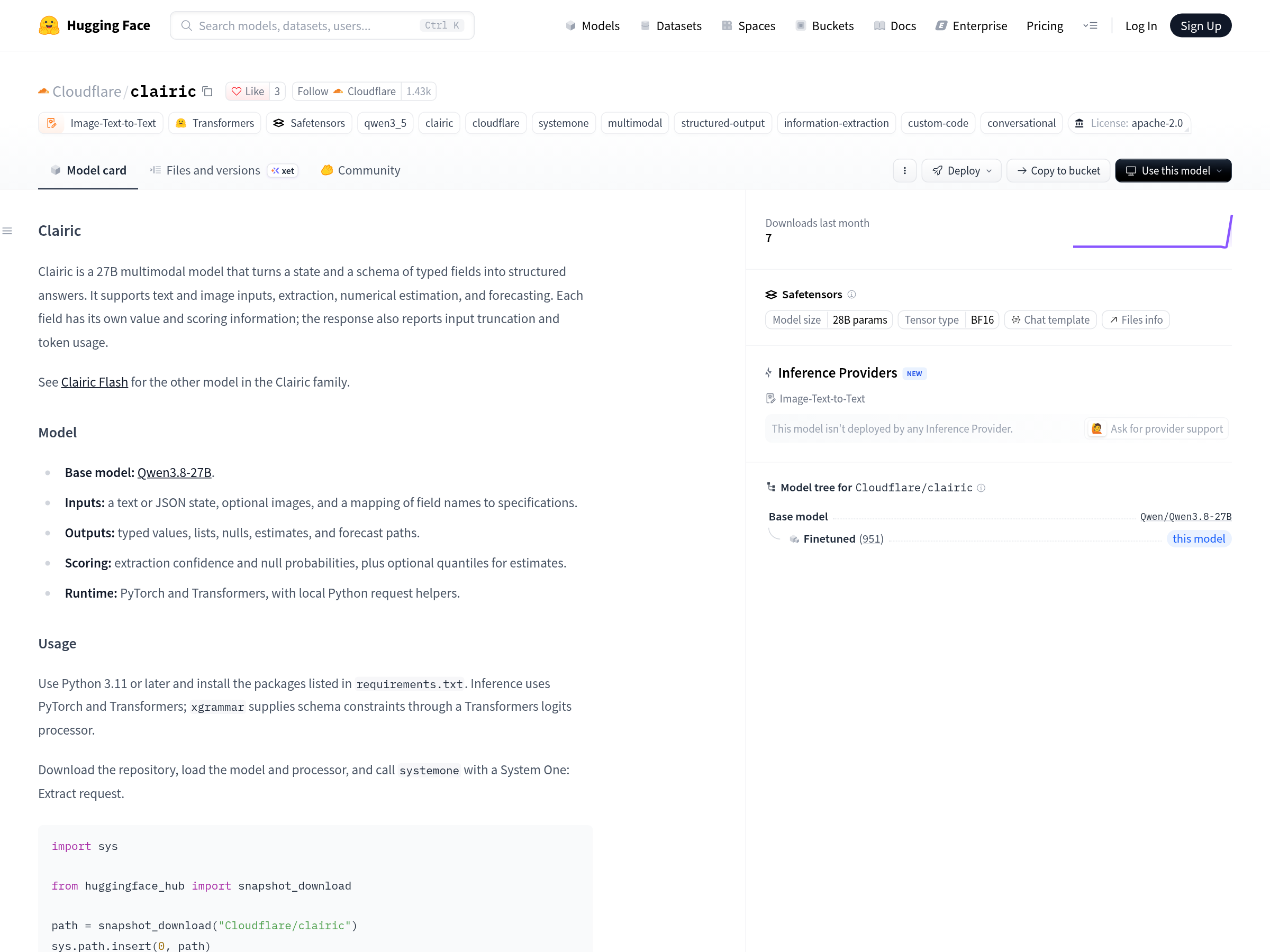
A request carries a state, which can be text or JSON plus optional images, and a schema that maps field names to specifications. The response returns each field with its value and its scoring information, plus input truncation status and token usage. Clairic handles 27 billion parameters and Clairic-flash 9 billion, and the model cards name Qwen3.8-27B and Qwen3.5-9B as their base models.
That shape explains the use cases Cloudflare lists: receipts, support tickets, supplier documents, loan pricing, commercial leases and traffic forecasting. In each case the hard part is reading a layout, holding a schema steady across requests, and reporting enough confidence that a downstream rule can decide what to do with a low-scoring field.
How parallel slot generation changes the loop
The preview decoded every requested field in one forward pass. The current model generates fields as separate slots: each field conditions on the tokens it has already written and stops at its own end marker, while the serving batch advances all fields together. Cloudflare reports that the change improved extraction accuracy on text and images, and that the small latency cost was offset by the accuracy gain.
Specialised heads handle the cases that a plain field-extraction loop handles badly: estimates, forecasts, durations, calculated dates and explicit arithmetic. This is the part of the release worth taking seriously for document work. A general model asked for a lease end date will usually produce one with an opaque derivation. A dedicated head makes arithmetic a distinct output with its own confidence.
The eval table Cloudflare published
The post prints four eval rows for the preview, Clairic and Clairic-flash, alongside two other commercial extraction models. Fresh text fields: 295 of 336 for the preview, 335 for Clairic, 328 for Clairic-flash. Mixed-input fields on an internal eval: 207 of 226, then 221 and 213. Tracked customer assertions across 139 request shapes: 1,033 of 1,263, then 1,263 for both new models. Synthetic receipt fields in text and images: 369 of 576, then 576 for both.
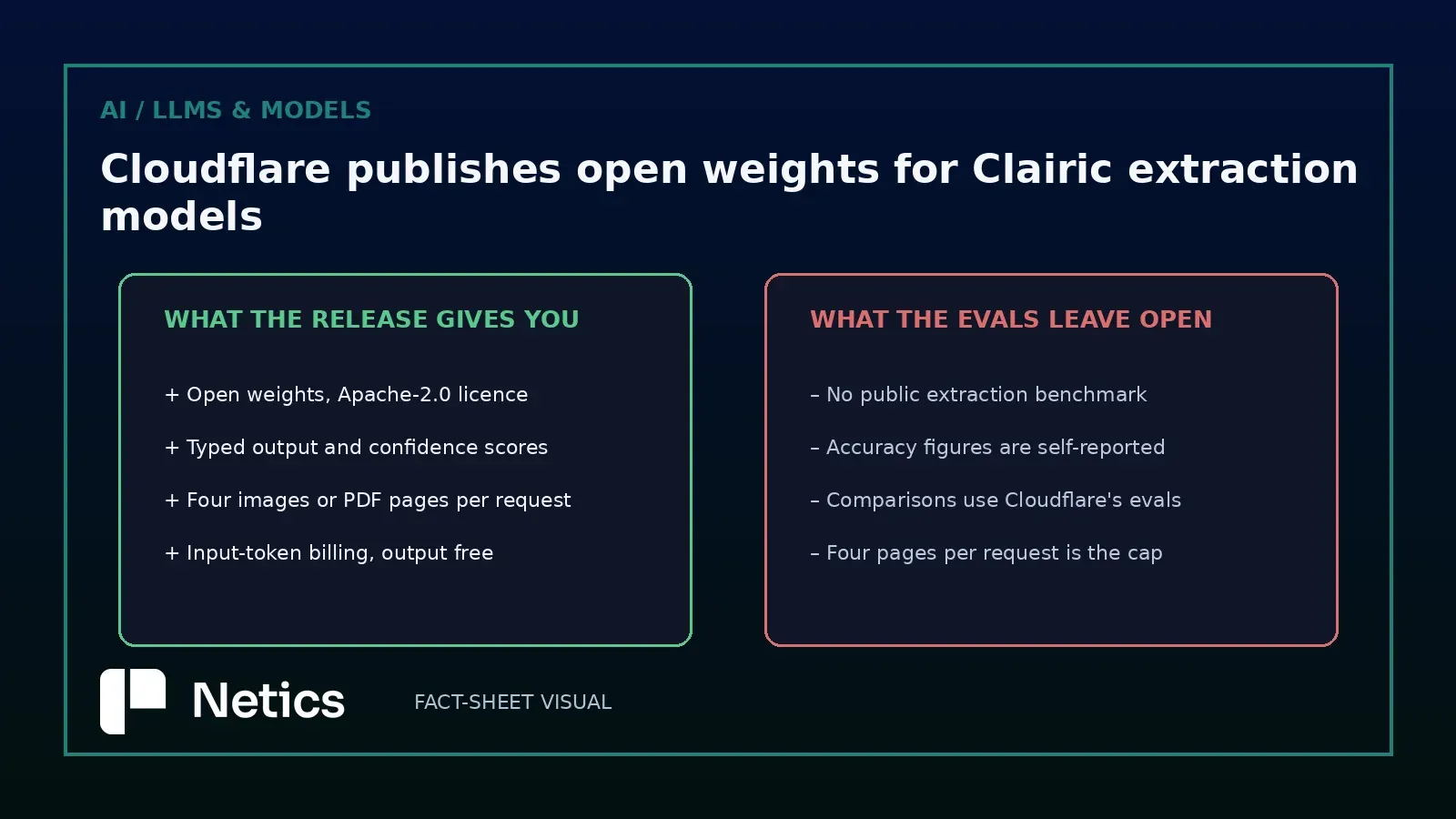
Cloudflare states the limitation itself: no public extraction benchmark exists yet, and the numbers are its own. The two comparison models, Liquid AI's D1.2 pipelined with Apple Vision for optical character recognition and ScaleDown's Extract, were scored on Cloudflare's request shapes with Cloudflare's harness, which limits the table to a directional comparison. Read it as a vendor saying which cases it optimised for.
Latency on six eval sets
The latency table measures the complete HTTP response from a self-hosted server, all fields included, across six eval sets. Fresh text fields: 358 milliseconds p50 and 736 p95 for Clairic, 155 and 328 for Clairic-flash. Fresh image fields: 453 and 976, then 305 and 605. Commercial leases: 691 and 803, then 379 and 519. Loan pricing: 395 and 407, then 188 and 192. Traffic forecasting: 532 and 585, then 243 and 261. Expense audit: 632 and 742, then 393 and 512.
Two things stand out for anyone sizing an ingestion pipeline. The image path costs roughly a hundred milliseconds more at p50 than the text path, which matches the extra decoding work. And Clairic-flash runs at about half the latency of the 27B model on most sets, which is the number that matters when a queue of documents has to clear overnight.
What the typed API keeps from the preview
The interface that made the preview usable survived the redesign. Every response still carries confidence scores, character spans and probabilities, so a caller can map an extracted value back to the characters it came from and gate on uncertainty. A request can include up to four images or PDF pages, which covers a receipt with a second page or a lease with an annex, and line items come back as rows that keep description, quantity and price together.
The four-page ceiling is a design constraint worth planning around. Documents that run longer have to be split before the call, and the split has to respect where the fields live, so a pipeline that ingests arbitrary PDFs needs a page classification step in front of the extraction step.
Pricing, endpoints and the open-weight release
The 27-billion-parameter model sits at @cf/cloudflare/clairic and the 9-billion-parameter model at @cf/cloudflare/clairic-flash. Pricing is $0.24 and $0.10 per million input tokens respectively, with both at $0.10 until 1 December 2026, and Cloudflare bills input tokens only, absorbing the output cost. Applications already pointed at the preview endpoint receive the new model in place.
The open-weight release is the more consequential half. Weights for both models are on Hugging Face under Apache-2.0, with the tokenizer, processor files and Python helpers in the repositories, which allows local inference through Transformers on hardware a company already owns. For a French or Moroccan organisation with documents that cannot leave its own infrastructure, local deployment requires choosing and provisioning a suitable GPU.
What the evals leave open
Four questions stay unanswered by the release. Accuracy on scanned documents with skew, stamps and handwriting appears only as a receipt example, and the OCR-heavy end of document processing is where extraction models usually lose their advertised numbers. Throughput under concurrency is published as latency from a self-hosted server without a stated batch size. The confidence scores have no published calibration curve, so a team has to measure what a score of 0.8 means on its own documents. And the arithmetic heads have no error breakdown, which matters because a wrong calculated date is a silent failure in a contract workflow. Those four gaps define what a team must test on its own corpus before treating the vendor benchmark as an acceptance test.
Those limitations define the conditions for adoption. It shapes the pilot: run a representative set of your own documents through both sizes, record field-level accuracy against a human-checked answer key, and measure how often the confidence score would have caught the misses. An extraction model belongs inside a workflow that re-checks the fields it cannot afford to get wrong, which is the same place a self-hosted AI agent platform puts the tools an agent calls.
The interesting claim in the release sits past the parameter count: a narrow model with a typed contract and open weights can be the cheapest way to get structured data out of documents, provided the team that deploys it measures its own accuracy first.
Sources
- An updated Clairic and Clairic-flash are now open-weight, from the new Workers AI Superintelligence team — Cloudflare blog, 18 November 2026
- Cloudflare/clairic — Hugging Face model card
- Cloudflare/clairic-flash — Hugging Face model card
- Workers AI model documentation
Source: "An updated Clairic and Clairic-flash are now open-weight, from the new Workers AI Superintelligence team" — blog.cloudflare.com, 2026-11-18, https://blog.cloudflare.com/open-clairic/, retrieved 2026-11-18, with the Hugging Face model cards at https://huggingface.co/Cloudflare/clairic and https://huggingface.co/Cloudflare/clairic-flash, all saved under sources/2026-11-19/clairic/.