
Proxmox vs VMware After Broadcom: Choose the Operating Model
Proxmox can reduce licensing opacity, but migration is not automatically cheaper. Choose with a workload pilot, an operating model, and a tested rollback.

TL;DR • A price comparison is necessary but insufficient: Proxmox deserves a serious pilot when the estate is compatible and the team can own Linux, KVM, storage, backup, and support decisions. • Compare dependencies, not matching feature names: VMware can remain the lower-risk choice when operations depend on its integrated platform, advanced features, vendor integrations, or existing skills. • Use a migration workload test and a decision sequence that survives procurement pressure: dependency fit, production proof, and like-for-like commercial comparison.
The direct answer: do not leave VMware because Broadcom made you angry, and do not renew because migration feels difficult. For a straightforward virtual estate, Proxmox can offer a more inspectable licensing model and a smaller management stack. For an estate built around VMware-specific operations, moving the hypervisor may be the easiest part of the project.
This is not a contest between two feature pages. It is a choice between operating models. The winner is the one your team can support during an outage, audit honestly, and reverse when the design proves wrong.
The price comparison is necessary — and insufficient
Broadcom's current VMware Cloud Foundation terms define subscription licensing per physical core, with a minimum of 16 cores per processor. VMware's current vSphere product matrix also says standalone vSphere Standard and Enterprise Plus are available only through 8 Update 3; current 9.1 capabilities sit inside VMware vSphere Foundation and VMware Cloud Foundation. Broadcom's portfolio notice separately says smaller estates can still buy subscriptions to vSphere Standard and Essentials Plus. Ask which offer fits the actual estate before treating full VCF as the only renewal path.
Proxmox publishes a different model. Its production subscriptions are priced per occupied CPU socket, core count does not change the price, and every subscription level includes the same product features. The published net annual prices are €370 for Basic, €550 for Standard, and €1,100 for Premium per socket. The plans differ mainly in ticket allowance and response time, not in whether HA, migration, backup, storage, or networking features are unlocked.
That pricing transparency is useful, but it still does not produce a fair total by itself.
A serious comparison puts the actual VMware renewal quote beside a Proxmox design that includes:
- production support and any local partner coverage;
- backup software, retention, restore testing, and off-site copies;
- storage and network redesign where VMware-specific components are in use;
- monitoring, patching, identity integration, automation, and audit evidence;
- team training, parallel capacity, migration labour, application testing, and rollback.
If one side is a transaction quote and the other is only a hypervisor subscription, the spreadsheet is theatre.
Compare dependencies, not matching feature names
Both platforms can run virtual machines, cluster hosts, move workloads, apply role-based access, and integrate with shared storage. That does not make them operationally equivalent.
| Decision area | VMware is stronger when… | Proxmox is stronger when… | Evidence to demand |
|---|---|---|---|
| Platform scope | You rely on VMware-specific lifecycle, distributed networking, storage, operations, or Kubernetes capabilities | You want KVM and LXC with clustering, backup, storage, network, CLI, and API in a compact open-source stack | A dependency map, not a feature checklist |
| Licensing | The quoted bundle matches capabilities you actively use and the renewal remains defensible | Per-socket pricing and feature-complete subscription tiers fit the hardware and support model | Both commercial quotes on the same term and scope |
| Operations | The team and suppliers already operate vCenter and the surrounding ecosystem well | The team can own Debian, KVM, Corosync, storage, networking, and automation | An on-call runbook exercised by the real operators |
| Support | Existing VMware escalation and partner paths meet business obligations | Proxmox or a qualified partner can meet response, language, and coverage requirements | Written entitlement, hours, severity, and escalation terms |
| Reversibility | Remaining avoids a risky platform transition | A pilot proves export, restore, rebuild, and rollback before commitment | Successful exit tests, not assurances |
One VMware detail belongs in the operating model, not in procurement footnotes. In connected VCF 9.1 deployments, licensing usage is transmitted and refreshed every 24 hours. Disconnected mode uses a manual 180-day process. Broadcom's May 2026 terms separately require version 9 compliance reporting every 180 days and say missed reports can degrade or block management-plane functions and suspend support entitlements. A regulated or disconnected environment needs an owner and evidence for both workflows.
Proxmox shifts the work rather than removing it. Its multi-master cluster management avoids a dedicated manager node, and it supports granular permissions plus PAM, LDAP, Active Directory, and OpenID Connect. Somebody still owns quorum, fencing, certificates, repositories, backup integrity, storage health, and upgrade sequencing. Open source reduces one kind of dependency. It does not abolish operations.
Migration is a workload test, not an importer demo
Proxmox provides an integrated ESXi importer, and its documentation says imports were tested from ESXi 6.5 through 8.0. That is a useful starting point. The same documentation lists the caveats that matter more than the headline.
VMs backed by VMware vSAN cannot be imported directly without first moving their disks. Encrypted VM disks need their encryption policy removed before import. VMware vTPM state cannot currently be migrated. Snapshots can slow imports. Even the live-import path leaves the source ESXi VM switched off, so there is still downtime. If that import fails, writes made after it began can be lost.
Those are not edge cases to discover during a change window. They are inventory fields.
Before estimating a migration, classify every workload by boot method, disk controller, network design, storage location, encryption, vTPM use, snapshot state, backup agent, recovery objective, application owner, and rollback path. Then select representatives from each class. A successful import of the easiest Linux VM proves almost nothing about the encrypted Windows workload attached to a VMware-specific storage policy.
The same control problem appears elsewhere: buying a platform before mapping what depends on it reverses the order. Inventory first. Architecture second. Product choice third.
When staying on VMware is the rational answer
Renewing VMware is defensible when the business uses capabilities that would need replacement, not just the ESXi hosts. The current VMware matrix includes vMotion, HA, DRS, distributed switching, vSAN, Kubernetes services, VCF Operations, compliance management, logging, and application-dependency features across its offers. Your estate may use only a fraction of them. That fraction needs to be measured.
Staying for the current commercial cycle can be rational under any of these conditions:
- the renewal cost is acceptable against the cost and risk of replacing active dependencies;
- an application, appliance, support contract, or hardware certification requires VMware;
- the team lacks time or skill to own the replacement stack safely;
- rollback cannot be demonstrated before the commercial deadline;
- the migration exists only as a licensing reaction, with no target operating model.
Staying is not surrender. An evidence-backed renewal can buy time to remove dependencies methodically. The weak choice is an automatic renewal with no exit work and no record of what made renewal necessary.
When Proxmox deserves a production-shaped pilot
Proxmox is a credible candidate when the workload estate is conventional, Linux and KVM skills are available, and the organization wants a simpler entitlement model with full features at each support tier. Its architecture combines KVM virtual machines and LXC containers, integrated clustering, backup, HA, API access, multiple identity realms, and broad storage options. Version selection is part of the pilot: the current Proxmox FAQ lists Proxmox VE 8 end of life as 2026-08, while the Proxmox VE 9 date is still to be announced.
The production design is larger than the installer. The HA guide assumes at least three cluster nodes, shared storage, and hardware redundancy. The backup guide recommends running Proxmox Backup Server on a dedicated host. The SDN guide says VXLAN alone provides no encryption and points to a secure inter-site connection such as a site-to-site VPN. Those requirements belong in the bill of materials.
A production-shaped Proxmox pilot deserves funding when these conditions are true inside the organization:
- the team can support the underlying Linux, network, storage, and cluster layers;
- critical VMware-only dependencies have been identified rather than assumed away;
- the required support window can be contracted with Proxmox or a qualified partner;
- backup, restore, HA, patching, monitoring, and access control are in the test plan;
- procurement will fund parallel capacity and rollback rather than demand a one-way cutover.
Do not build the pilot around a feature tour. Break a node. Restore a representative workload. Rotate a certificate. Remove an administrator. Test the identity provider being unavailable. Upgrade the cluster. Export a guest and prove you can recover it somewhere else. The pilot should make the uncomfortable work visible.
A decision sequence that survives procurement pressure
Use three gates.
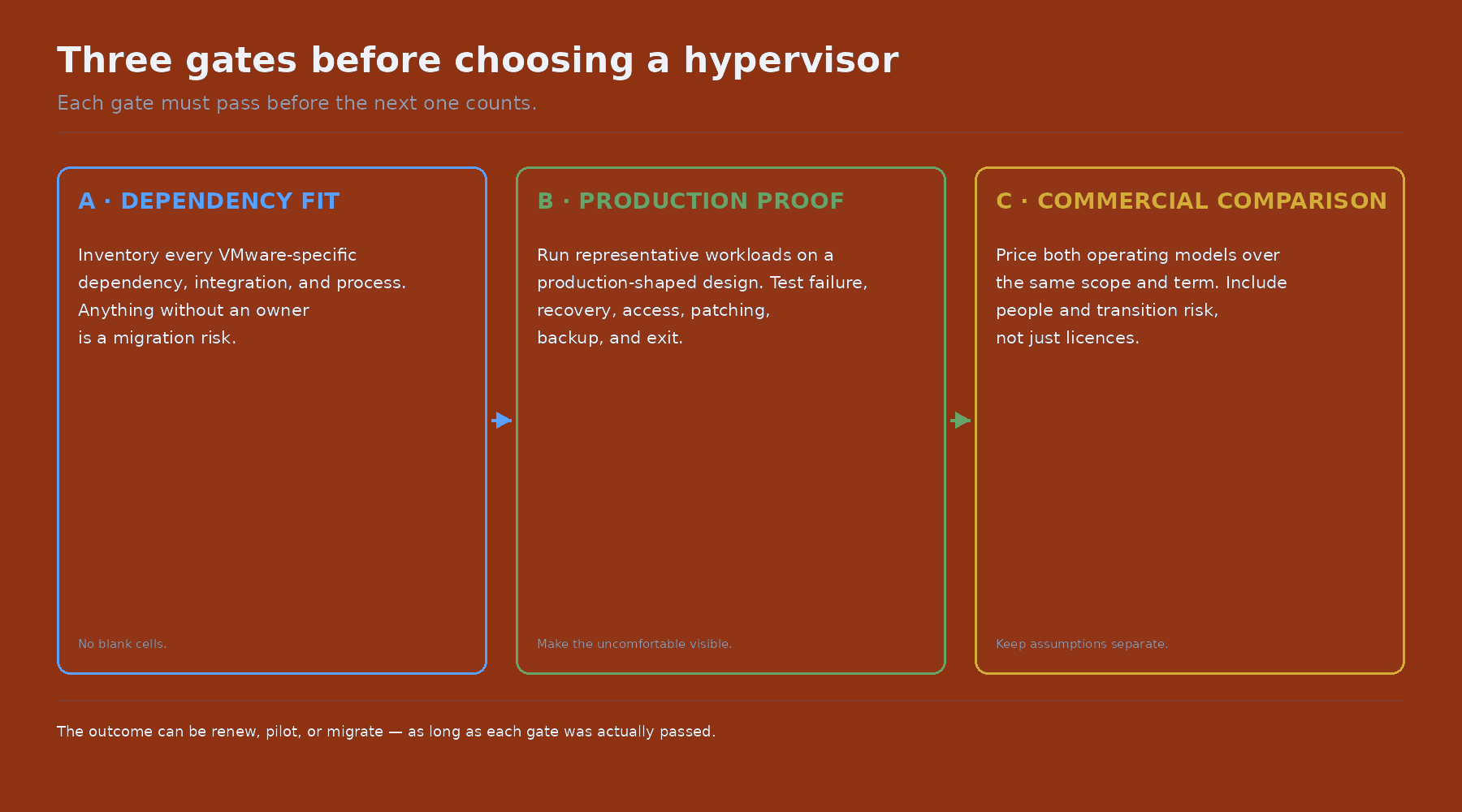
Gate A — dependency fit. Document every VMware-specific capability, integration, support condition, and operational process. Anything without an owner is a migration risk, not a blank cell.
Gate B — production proof. Run representative workloads on a production-shaped Proxmox design. Test failure, recovery, access, patching, monitoring, backup, and exit. Record what failed and what required manual intervention.
Gate C — commercial comparison. Price both supported operating models over the same scope and term. Include people and transition risk. Keep assumptions separate from quoted costs.
The outcome does not need to be “migrate everything.” Valid results include renewing while reducing VMware dependency, using Proxmox for a new environment, or completing a migration after the blockers are removed. A mixed answer is acceptable when it is deliberate; accidental dual-platform operations are just two on-call burdens.
FAQ
Is Proxmox cheaper than VMware?
Proxmox publishes lower-friction, per-socket subscription prices, while VMware uses per-core subscription terms and commercial transaction documents. That does not prove a lower total cost. Compare equivalent support, storage, backup, operations, migration, training, and rollback—not the hypervisor line alone.
Can Proxmox import VMware virtual machines?
Yes. Proxmox documents an integrated ESXi importer tested from ESXi 6.5 through 8.0. It also documents limits for vSAN-backed disks, encrypted disks, vTPM state, snapshots, downtime, and failed live imports. Test every workload class before committing.
Should an SMB leave VMware after Broadcom?
Not automatically. Leave when the target operating model is demonstrably safer or more economical and the migration is reversible. Renew when active dependencies and transition risk outweigh the benefit—but use the renewal period to map and reduce lock-in.
What should a Proxmox pilot test?
Test representative workload import, backup and restore, HA behaviour, identity failure, administrator removal, monitoring, patching, certificate operations, storage failure, vendor escalation, and export. A pilot that only boots VMs is not a decision test.
Bottom line
VMware offers a broad private-cloud platform. Proxmox offers an open, feature-complete virtualization stack with transparent subscription tiers. Neither description chooses for you.
Choose VMware when its active capabilities and support path justify the contract. Choose a Proxmox pilot when your team can own the stack and the estate fits. Migrate only after the pilot proves recovery and exit. The logo is the last decision, not the first.
Book a free 30-minute infrastructure decision review if you want a dependency map and pilot scorecard before the renewal clock makes the choice for you.
Source: Proxmox VE pricing, Proxmox migration, HA, backup, SDN, and lifecycle FAQ; VMware portfolio, vSphere product comparison, VCF 9.1 licensing, and VCF Specific Program Documentation — official vendor sources retrieved 2026-08-16.
Explore Netics for practical infrastructure and AI operations guidance.