
NVIDIA Buys Hugging Face: Can Open AI Stay Open Under Chipmaker Ownership?
NVIDIA says Hugging Face will stay open. Netics examines whether provider neutrality and portability can survive chipmaker ownership.

TL;DR
NVIDIA’s acquisition promise is open; Netics argues that openness must become testable through portability, provider neutrality, and exportable evidence. Coverage: What NVIDIA announced; The asset is the distribution layer; The open-platform promise has a precise test; Ownership changes the incentive map; The deal is also a vertical-stack decision; What buyers should verify; What the ecosystem should demand; The Netics position; What a neutral platform would publish.
What NVIDIA announced
NVIDIA announced an agreement to acquire Hugging Face for $12,930,300,000. The company’s announcement presents the transaction as an infrastructure and access story: Hugging Face would gain NVIDIA’s infrastructure, engineering, and global reach while remaining an open platform for models, frameworks, clouds, inference providers, and computing platforms. That is the source claim. It is also the promise that deserves the most operational scrutiny. A platform can remain technically open while becoming strategically shaped by the incentives of its owner.
The asset is the distribution layer
The headline price is large, but the strategic asset is not only a model registry. NVIDIA describes a platform with more than 18 million developers, researchers, and creators; more than 3 million models; 500,000 datasets; 1 million applications; and more than 200,000 companies. Those numbers come from NVIDIA’s announcement and should be read as the company’s own description of the platform’s scale. The important point for buyers is the position between discovery, evaluation, customization, and deployment. Hugging Face is where technical choices become visible before they become infrastructure commitments.
The open-platform promise has a precise test
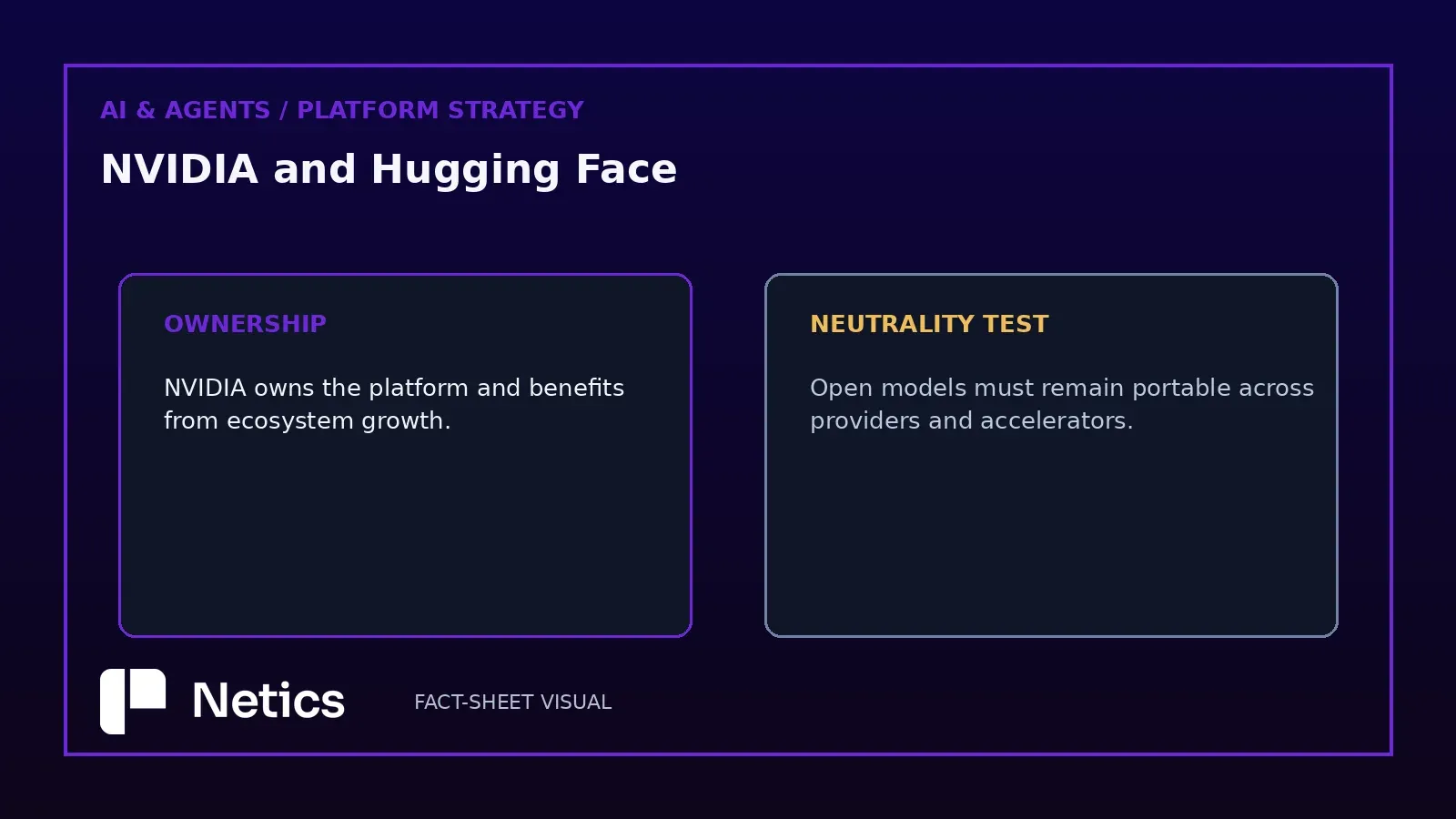
NVIDIA says developers will choose the models, frameworks, clouds, inference providers, and computing platforms they want, and that NVIDIA compute will not be required. That is a meaningful commitment because it names the dimensions on which neutrality could be tested. Netics would not treat the sentence as proof; it is a policy claim that needs observable behavior. Can a model hosted on a competing accelerator receive the same documentation, discoverability, deployment path, and performance transparency? Can a customer leave NVIDIA inference without losing the evaluation history and artifacts that made the platform useful?
Ownership changes the incentive map
The concern is not that NVIDIA must immediately close Hugging Face. It is that ownership changes the incentives around defaults, integrations, capacity, and roadmap attention. NVIDIA can benefit when more models are developed and deployed on its hardware. Hugging Face can benefit when more infrastructure makes the platform reliable and easier to use. Those interests can align while still creating pressure at the boundary between neutral distribution and preferred execution. The open ecosystem needs governance that makes the boundary visible.
The deal is also a vertical-stack decision
NVIDIA already supplies critical compute and software layers for AI development and inference. Hugging Face adds a community, model, dataset, and application distribution layer. TechCrunch’s independent account frames the strategic logic directly: NVIDIA gains control of a major open-AI hub while promising support for competing models and providers. That is why the acquisition should be read as a vertical-stack move, not simply a vendor buying a popular developer website. The question is who controls the path from model discovery to production infrastructure.
What buyers should verify
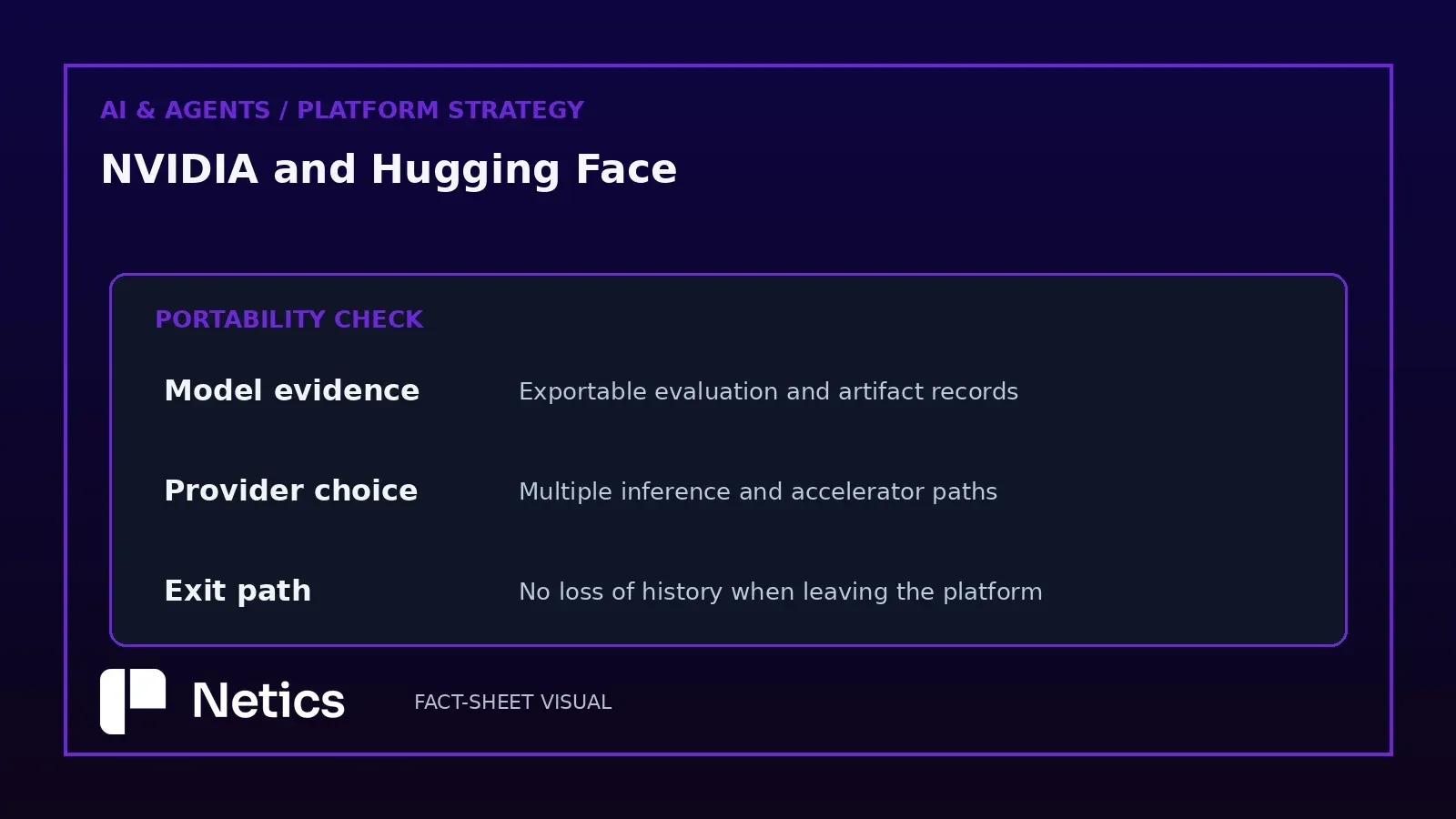
A company evaluating an open model should keep its own model inventory, evaluation results, artifact references, and deployment manifests outside any single platform. Record the model license, weights location, tokenizer, evaluation dataset, runtime, accelerator assumptions, and fallback provider. Verify that an inference endpoint can be replaced without losing the evidence used to approve the model. The more useful Hugging Face becomes, the more important this external record becomes. Convenience should increase discovery, not erase portability.
What the ecosystem should demand
Netics has made the same control-plane argument in its AI-agent access analysis. The open-platform promise becomes credible through durable controls: published provider-neutral APIs, exportable metadata, transparent ranking and recommendation criteria, documented multi-accelerator support, and clear separation between hosted services and community artifacts. The platform should make it possible to see when a recommendation is based on technical fit, availability, or a commercial relationship. An open ecosystem does not require every service to be free. It requires the rules of access and preference to be legible.
The Netics position
NVIDIA buying Hugging Face could strengthen the infrastructure behind open models. It could also make the distribution layer more strategically important than the announcement’s optimistic language suggests. Our opinion is not that ownership automatically invalidates openness. It is that openness has moved from a brand value to an architecture and governance requirement. Keep the platform open, keep the evidence portable, and make provider neutrality testable. If the ecosystem can do that, NVIDIA gains a powerful channel without owning the meaning of open. If it cannot, the acquisition will turn the community’s front door into another control point. For an architecture review, visit Netics or Book a free 30-minute audit.
What a neutral platform would publish
A credible neutrality program would publish a compatibility matrix, not only a mission statement. It would show which model formats, runtimes, clouds, inference providers, and accelerators are supported, where behavior differs, and which features remain experimental. It would also publish an appeals path for ranking or access decisions and an export format for model metadata, evaluations, and deployment references. These controls do not prevent NVIDIA from selling infrastructure. They let users distinguish an infrastructure advantage from a hidden platform requirement. That distinction is the difference between an open ecosystem and an ecosystem that merely contains open artifacts.
Sources
- NVIDIA: NVIDIA to Acquire Hugging Face — primary source, September 3, 2026.
- TechCrunch: Nvidia confirms it will buy Hugging Face — independent context, September 3, 2026.