
NVIDIA’s Cybersecurity Agents Need a Human-Controlled Blast Radius
NVIDIA’s agentic security examples show useful triage acceleration, but the real architecture question is where autonomous investigation must stop.

TL;DR
NVIDIA’s agentic security examples show useful triage acceleration, but the real architecture question is where autonomous investigation must stop. The article covers: The attractive demo is not the security boundary; Why the multi-agent split matters; Deterministic steps should carry the expensive guarantees; Accuracy is not the same as operational safety; The right blast radius for a first deployment; Evaluation needs an adversarial lane; The Netics position; A practical adoption checklist.
The attractive demo is not the security boundary
NVIDIA presents agentic cybersecurity through two concrete workflows: server-alert triage and vulnerability analysis for containers. The pattern is familiar to any overloaded security team. An event arrives, an agent interprets it, tools collect context, a specialized agent analyzes a slice of that context, and a report is produced for a human review step. NVIDIA reports 84.6% multiclass accuracy for its labeled alert-triage evaluation, an estimated 5 to 30 minutes saved per vulnerability, and an 8.3x runtime improvement that reduced a larger workload from 20 minutes to 3 minutes. These are useful signals. They are not, by themselves, authorization to let an agent change production.
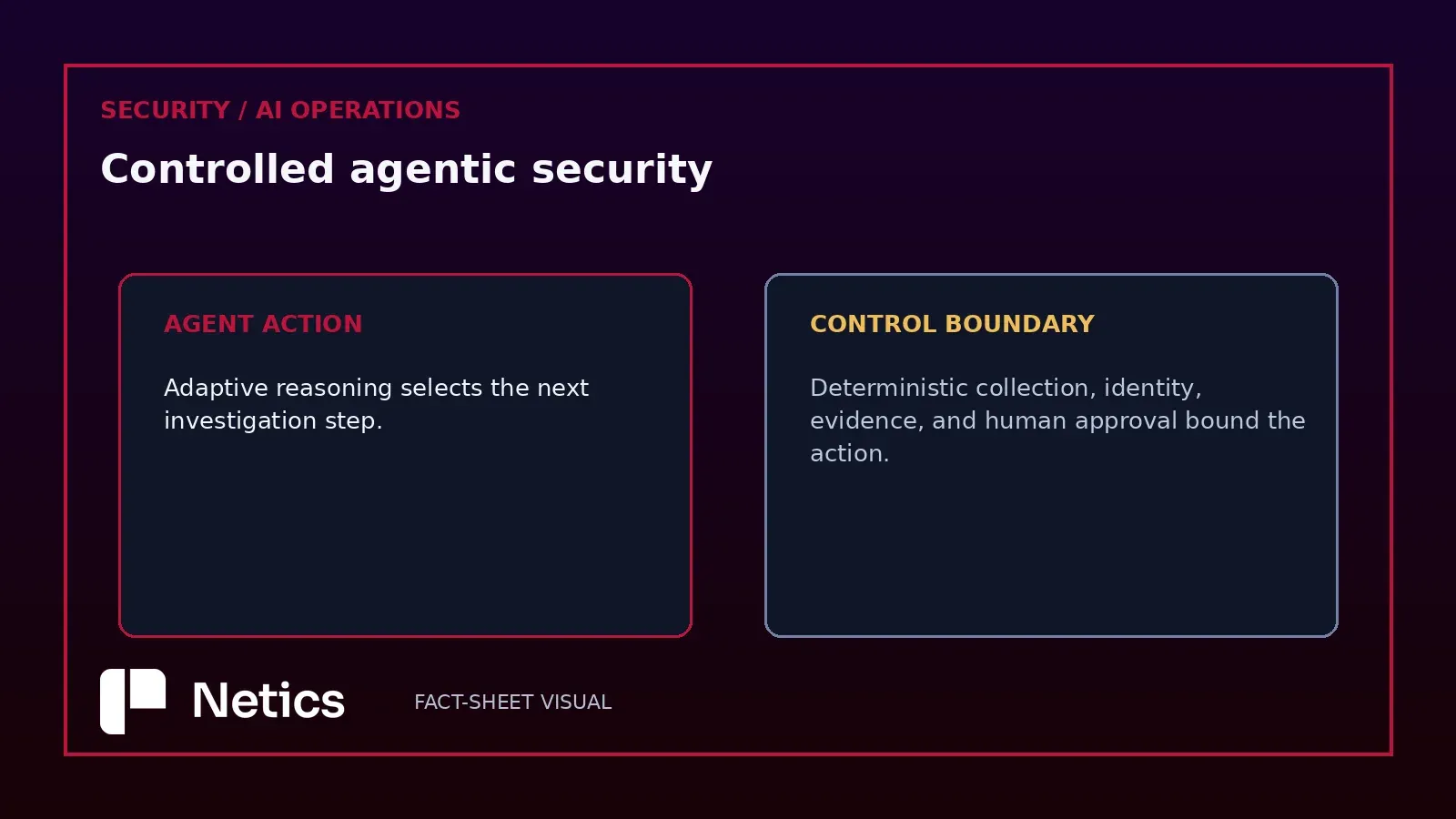
Figure: The attractive demo is not the security boundary.
Why the multi-agent split matters
The architecture separates an Alert Triage Agent from a Cloud Metric Analysis Agent. The main agent owns the investigation path; the sidekick queries and analyzes metrics only when needed. This is more than a diagram choice. Disjoint toolsets reduce the number of actions any one prompt can reach, and separate prompts make evaluation more precise. A platform team can ask whether the metric agent returned a valid analysis without confusing that question with whether the triage agent selected the right next step. The boundary is still only useful if identities, tool permissions, and data access are separated in the deployment, not merely described in the article.
Deterministic steps should carry the expensive guarantees
NVIDIA’s own recommendation to combine deterministic logic for fixed steps with adaptive agents for dynamic decisions is the strongest part of the source. Security operations contain both kinds of work. Parsing an alert, fetching a known metric range, checking a container image against a policy, and formatting an evidence record should be deterministic. Choosing which hypothesis to investigate next can be adaptive. The danger is allowing the model to reinterpret a fixed guarantee as a suggestion. If an agent can decide whether a mandatory evidence check is optional, the system has moved the control boundary into a probabilistic component.
Accuracy is not the same as operational safety
An 84.6% classification result answers one evaluation question. It does not answer whether the system can distinguish an unknown incident, preserve evidence, avoid leaking sensitive telemetry, or fail safely when a tool times out. Vulnerability triage has a similar gap: saving analyst minutes is valuable only when the generated conclusion remains traceable to the inputs and the human can inspect the reasoning path. The production metrics should therefore include abstention, evidence completeness, false escalation, tool-error handling, and rollback—not only the average time saved.
The right blast radius for a first deployment
Start with read-only investigation. Let the agent retrieve alerts, metrics, package data, and vulnerability context, but require a human to approve every state-changing action. Record the exact event, tool calls, returned evidence, model version, prompt policy, and final reviewer decision. Then introduce one bounded action, such as opening a ticket or attaching a report, before allowing containment or remediation. Each step should have a kill switch and a replayable test set. That sequence turns autonomy into a capability that can be expanded, rather than a permission that must later be clawed back.
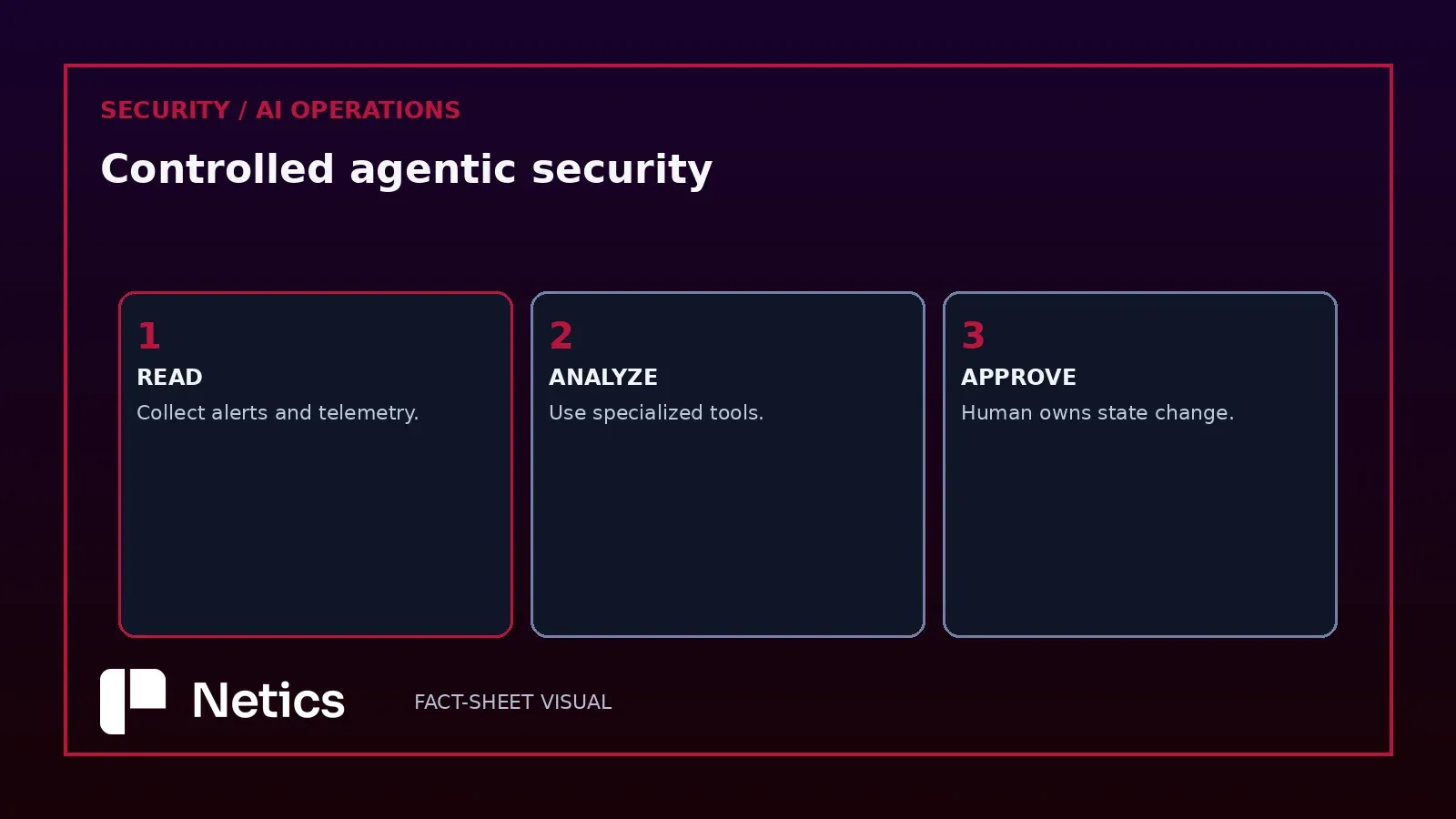
Figure: The right blast radius for a first deployment.
Evaluation needs an adversarial lane
NVIDIA points to LLM-as-a-judge and RAGAS-style evaluation support. That can help compare outputs, but a security workflow cannot rely on a judge that shares the same blind spots as the agent. Build human-labeled cases for ambiguous alerts, missing metrics, contradictory indicators, prompt injection in telemetry, and malicious package metadata. Test whether the system cites the evidence it actually used. A judge can accelerate regression review; it should not become the only authority deciding that a dangerous action is safe.
The Netics position
Agentic security operations are credible when the agent is an investigator inside a controlled evidence path—not when it becomes an unbounded SOC operator. NVIDIA’s examples make the productivity case, especially for repetitive triage and vulnerability context gathering. Our position is that the durable design is hybrid: deterministic collection and policy gates around an adaptive reasoning loop, explicit identities for every tool, a human approval boundary for state changes, and metrics that reward correct abstention. The question for an enterprise is not whether the agent can act. It is whether the organization can explain, replay, and stop every action that matters.
A practical adoption checklist
Before connecting an agent to a security platform, define the events it may read, the tools it may call, the data it may retain, and the actions it may request. Create a test fixture with normal alerts, noisy alerts, missing context, and hostile fields. Require a structured evidence report with source identifiers and timestamps. Set a budget for tool calls and tokens, then alert when the agent exceeds it. Finally, rehearse a failed model response and a revoked credential. For an architecture review, visit Netics.
For an architecture review, visit Netics or Book a free 30-minute audit.
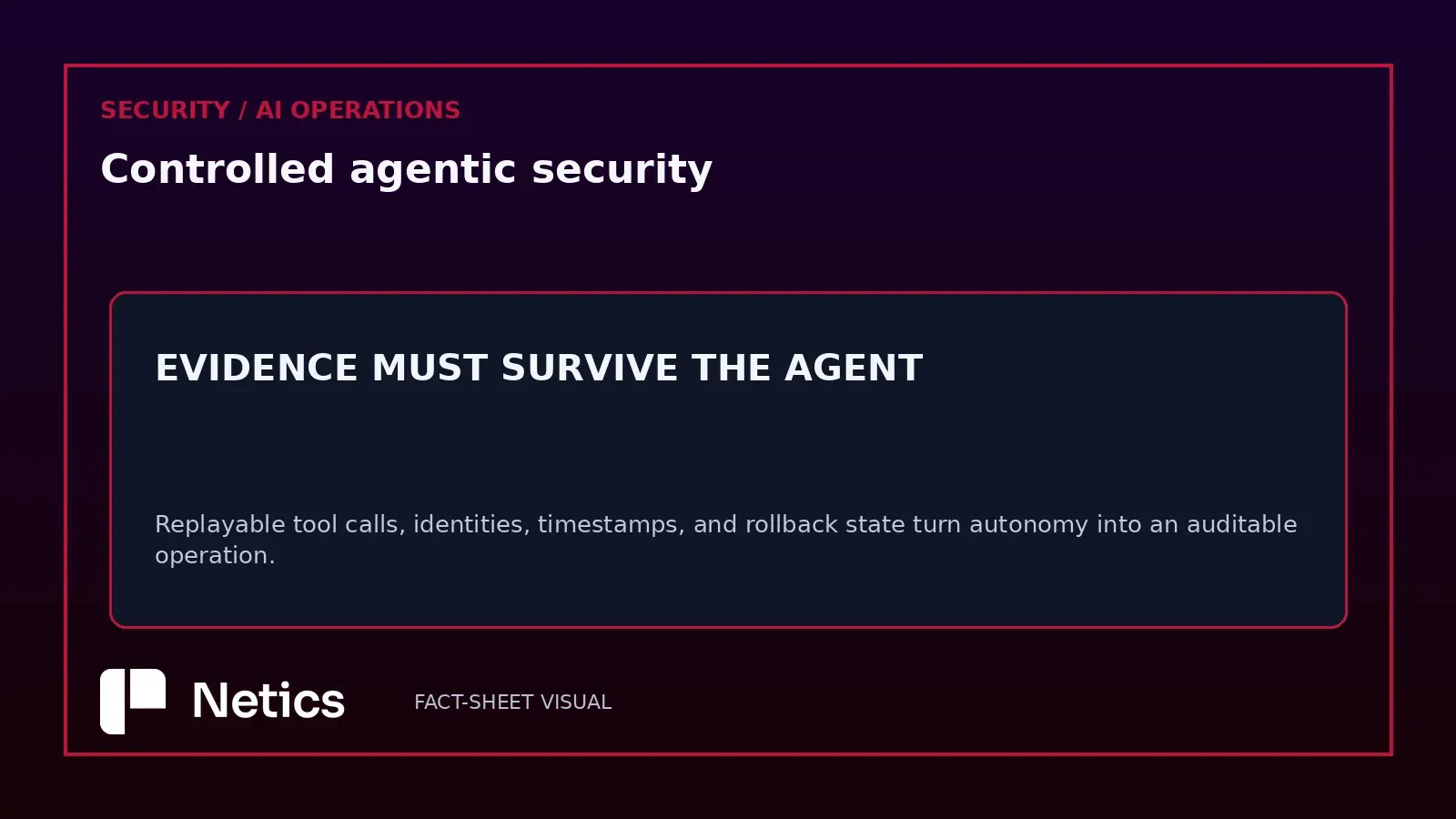
Evidence must survive the agent
Keep alert identifiers, tool calls, timestamps, model version, policy version, and rollback state beside the final report. Separate observed evidence from agent interpretation so a reviewer can replay the decision.
Sources
- Primary source: https://developer.nvidia.com/blog/advancing-cybersecurity-operations-with-agentic-ai-systems — accessed for this draft.