
NetBSD 9.5 Closes the 9.x Branch: Plan the Migration Before the Pullups Stop
NetBSD 9.5 is the final 9.x release. The practical decision is no longer whether to upgrade, but how to move systems without losing operational control.

TL;DR
- NetBSD 9.5 is the fifth and final release from the NetBSD 9 stable branch. It brings a selected set of fixes considered important for security or stability since 9.4 and remains fully compatible with NetBSD 9.0, but the lifecycle message is the more important one: support for netbsd-9 and all NetBSD 9.x releases ends here, with no further security pullups. Teams still operating 9.x should treat migration to a newer series, such as NetBSD 10 or NetBSD 11, as an infrastructure project. The work is not only installing a new image; it is inventory, compatibility testing, rollback planning, monitoring, and ownership. Netics' position is simple: use 9.5 as a controlled checkpoint and migration trigger, not as a reason to postpone the decision. For businesses, the practical work is to turn that trigger into an owned migration plan.
Reading the 9.5 release notes correctly
NetBSD 9.5 is easy to misread as a routine maintenance release because the release notes list familiar categories: system improvements, hardware support, security and reliability, and third-party components. The project describes it as a selected subset of fixes judged important for security or stability since NetBSD 9.4. That is a narrower and more useful description than calling it a broad feature refresh.
The release notes identify fixes across several layers. They include build fixes for newer compilers and non-NetBSD platforms, aarch64 thread-local storage support, x86 MSI/MSI-X configuration, display brightness controls on certain machines, additional USB-to-serial and USB Wi-Fi support, and improvements for several IDE controllers. The security and reliability section includes an IPv6 parsing fix for a remotely triggerable null pointer dereference, a kernel-stack data leak through TCP timestamps, a mitigation for TCP SegmentSmack, ZFS data-corruption fixes, and corrections in components such as BPF, audio configuration checks, filesystem checking, syslogd, and telnetd.
Third-party maintenance also matters to operators who treat the base system as a dependency boundary. The release applies upstream security fixes to Xorg components, OpenSSL, and SSH; it includes an upstream fix for CVE-2025-11411 in Unbound; and it updates tzdata to 2026b and xkbcomp to 1.5.0. Those details are not a promise that every deployment has the same exposure. They are evidence of what this final branch release is intended to consolidate.
NetBSD 9.5 is fully compatible with NetBSD 9.0, according to the project. That compatibility is helpful for the immediate update path, but it should not be confused with continued lifecycle support. Compatibility tells you that the final 9.x release can serve as a safer landing point within the branch. It does not create another maintenance horizon after the branch ends.
The lifecycle boundary changes the risk calculation
The decisive sentence is not the list of fixes. NetBSD 9.5 marks the end of support for the netbsd-9 branch and all NetBSD 9.x releases. There will be no further security pullups to that branch. For an infrastructure team, that changes the meaning of a local success story. A service that is stable on 9.4 may still be stable after a maintenance window, but the organisation has lost the upstream path for future security maintenance on that series.
This is why “we have not had an incident” is not a migration strategy. A quiet host can still accumulate exposure, and a team that waits for a visible failure is allowing the failure mode to choose the schedule. The end-of-support announcement gives the schedule a name and a source. It also removes an easy excuse: there is no later 9.x pullup to wait for.
The NetBSD Project recommends moving to a newer release series, naming NetBSD 11 or NetBSD 10 as examples. The recommendation leaves room for an architecture decision. A team may have application constraints, hardware dependencies, package availability questions, or a need to coordinate a broader maintenance window. Those are legitimate reasons to plan the route carefully. They are not reasons to reinterpret 9.5 as a supported long-term destination.
Netics reads this as a control-plane event. The important artifact is not the downloaded installer; it is the migration record around each host. That record should state the current release, the target series, the workload owner, the hardware and driver assumptions, the backup and restore test, the maintenance window, the rollback boundary, and the evidence that the service works after the change.
Turning the deadline into an owned migration plan
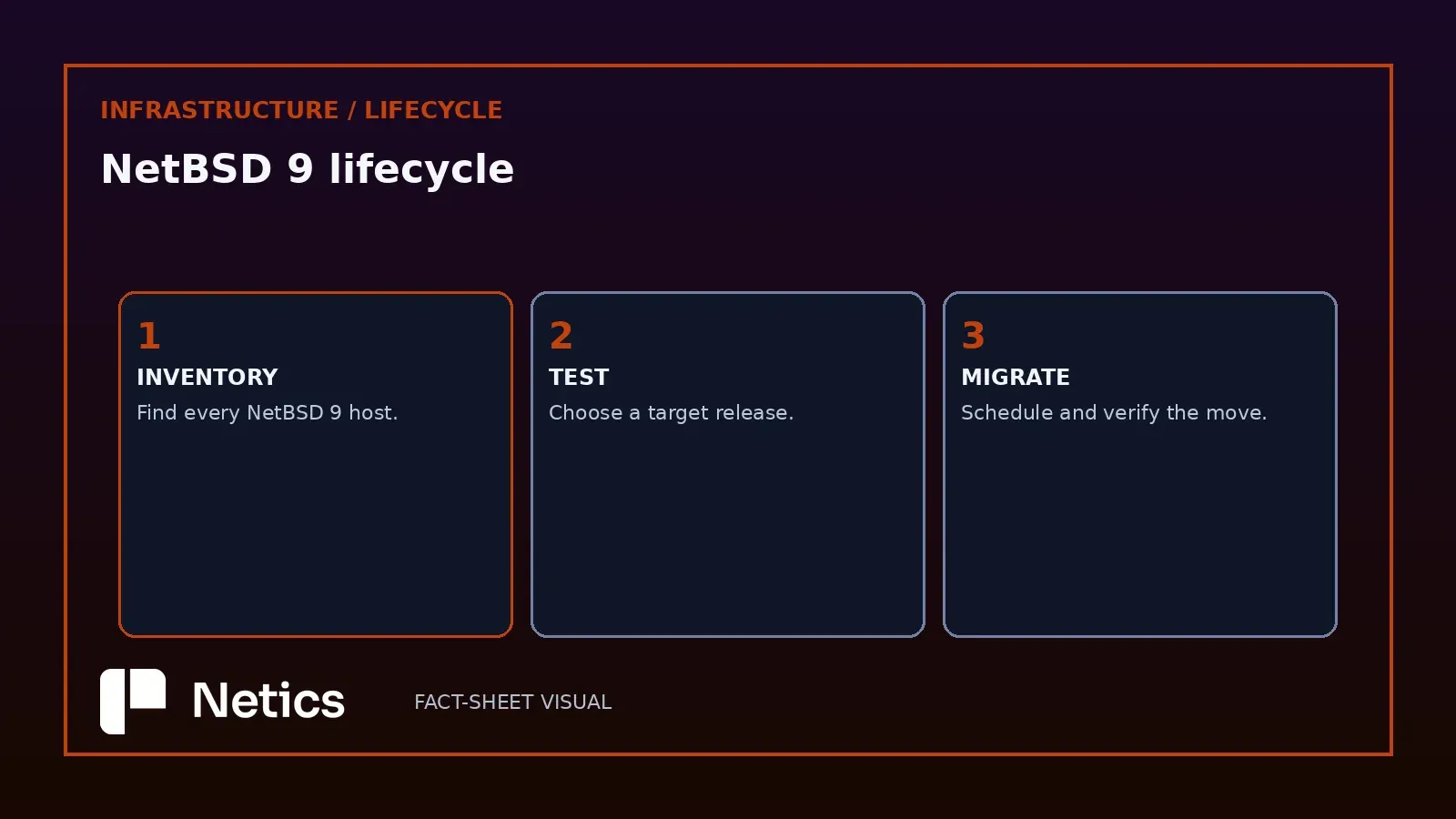
Start with an estate inventory rather than a target-release argument. Record every NetBSD 9.x system, its role, boot method, storage layout, network interfaces, attached peripherals, applications, package dependencies, monitoring checks, backup method, and recovery owner. The release notes call out architecture and device-level fixes, including aarch64, x86, USB serial adapters, Wi-Fi adapters, and storage-related corrections. That is a reminder to test the actual hardware in the estate, not only a generic virtual machine.
Next, choose a target newer release series and define the decision criteria. The primary source recommends newer series such as NetBSD 11 or NetBSD 10; it does not provide a universal answer for every workload. Keep the choice explicit. A target should be evaluated against application compatibility, required packages, device support, operational tooling, and the team's ability to recover if the first boot or service validation fails.
Build a rehearsal that is close enough to production to reveal assumptions. Restore a representative system or clone its configuration into a controlled environment, then exercise the real service path: boot, storage, network, name resolution, scheduled jobs, logging, backups, monitoring, and the application itself. Mark every result as tested, not tested, or blocked. “The operating system booted” is only one test in a migration; it says little about whether the business service is reachable or recoverable.
Keep rollback concrete. Define what state is preserved, how the previous boot environment is selected, how application data is protected, and who has authority to stop the cutover. Do not promise that every rollback is automatic. The safe claim is narrower: a rehearsed and documented rollback gives operators a better boundary than an improvised rescue during an outage.
This is the same operational principle behind mapping what infrastructure automation is allowed to touch before adding another control layer. The technology differs, but the discipline is familiar: inventory first, name ownership, constrain the change, and leave a recoverable path.
Operating after the branch is closed
After moving to a newer series, preserve the evidence that justified the change. Capture the installed release, package state, kernel and hardware observations, service checks, backup result, and any exception that remains. Feed those observations back into monitoring and maintenance planning. A migration that ends with a successful login but no record is difficult to audit and difficult to repeat.
The same discipline applies to systems that cannot move immediately. Do not describe them as covered by NetBSD 9.5 support; the primary source says support has ended. Instead, assign an owner, document the reason for the delay, isolate the workload where appropriate, restrict unnecessary exposure, confirm backups and restoration, and set a dated decision point for the next review. These are compensating operations, not a substitute for upstream security pullups.
Avoid turning the release-note list into an unprioritized security panic. The source identifies selected fixes, including specific network, kernel, filesystem, authentication, and third-party maintenance. Use those details to ask which components exist in your estate and which systems are exposed. Do not claim that a listed fix proves a particular local host was vulnerable without local evidence. Precision is more useful than alarm.
A checkpoint, not a permission slip
NetBSD 9.5 is a responsible final checkpoint, not a permission slip to remain on 9.x. The project's compatibility statement makes the branch update practical; the end-of-support statement makes the next decision unavoidable. Those two facts belong together. Upgrade within the branch where it reduces immediate change risk, then use that stable checkpoint to execute the move to a newer supported series.
For infrastructure leaders, the quality of the migration process matters more than the drama of the deadline. An inventory, a representative rehearsal, service-level validation, a tested restore, and a named rollback owner will tell you more than a generic assurance that the new release is compatible. If your team is not ready to answer those questions, the gap is operational readiness, not a missing release note.
What to do this quarter
NetBSD 9.5 closes the netbsd-9 story with selected security and stability fixes, compatibility with NetBSD 9.0, and a clear end-of-support boundary for every 9.x release. There will be no further security pullups. Move to a newer release series, and make the migration measurable: inventory the estate, test real workloads and hardware, validate recovery, and record the exceptions that remain. For infrastructure architecture and migration planning, visit Netics or discuss your migration with the Netics team.
Sources
- NetBSD 9.5 release notes — NetBSD Project, 2026-08-31.
- NetBSD 9.5 released and EOL for netbsd-9 — NetBSD Blog, 2026-09-06.