
The Browser Becomes an AI Distribution Point: What Mozilla and Mistral Actually Changed
Mistral Small 4 is now inside Firefox Smart Window, with France first for official French-language support. The real story is distribution — and whether user choice survives the integration.

TL;DR
- On September 16, 2026, Mozilla and Mistral announced that Firefox Smart Window (beta) is now powered by Mistral Small 4, with the United States, Canada, and France at launch and the UK and Germany expected later this year.
- France is the first new market for Smart Window with official French-language support — a deliberate multilingual-market move, not an English-first port.
- The deal's stated thesis is distribution: "open technology needs open distribution," and a browser "shouldn't be a one-way funnel."
- The operational commitments that matter: conversations aren't saved on Mozilla's servers by default, Mistral agrees to zero data retention, and Firefox users keep choosing among multiple models.
- What still needs proving: whether switching and zero retention survive the integration's data flows — a promise at announcement is not yet a verifiable control.
- Three questions before any fleet rollout: policy-level model switching, verifiable zero-retention traffic paths, and French-language coverage in real workflows — not only in the consumer UI.
Why a model inside a browser is a distribution event
The AI competition has moved from "which model is best" to "which models people can actually reach, through which products." That is the shift Mozilla names directly: "Practically overnight, competition has expanded from 'which AI model is best?' to a new high-stakes battle over which models people can access, through which products, and whether people have meaningful choice about AI at all." A browser is the chokepoint where that battle gets decided, because the browser sits between the user and almost every AI product they touch. Putting Mistral Small 4 into Firefox Smart Window is therefore not a feature integration; it is a distribution decision.
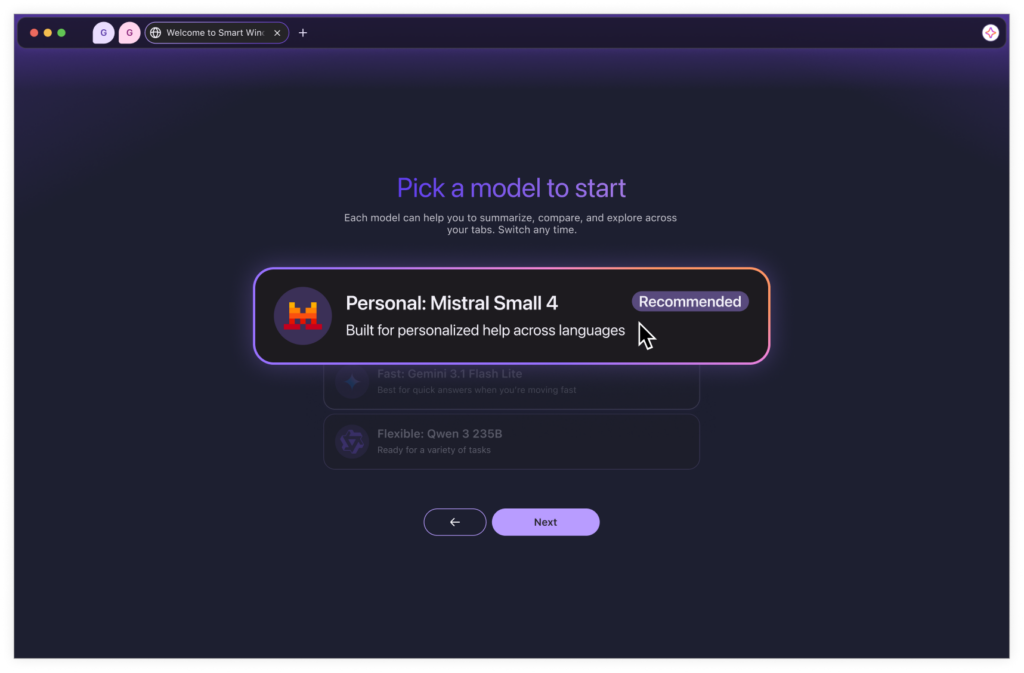
Smart Window is Mozilla's AI browsing assistant: it makes sense of complex search trails, remembers something important you clicked away from, and presents the sources behind its answers. With this deal, those tasks in the US, Canada, and France run on Mistral Small 4, a model Mozilla says it selected after evaluating multilingual performance for the beta. The detail worth pausing on is the market order. France comes first among new markets, with official French-language support. That is the practical form of the companies' stated approach: "AI optimized for local countries and cultures, not exported to them," with models fine-tuned on regional languages and dialects rather than an English-first experience being adapted afterward.
The one-way funnel test
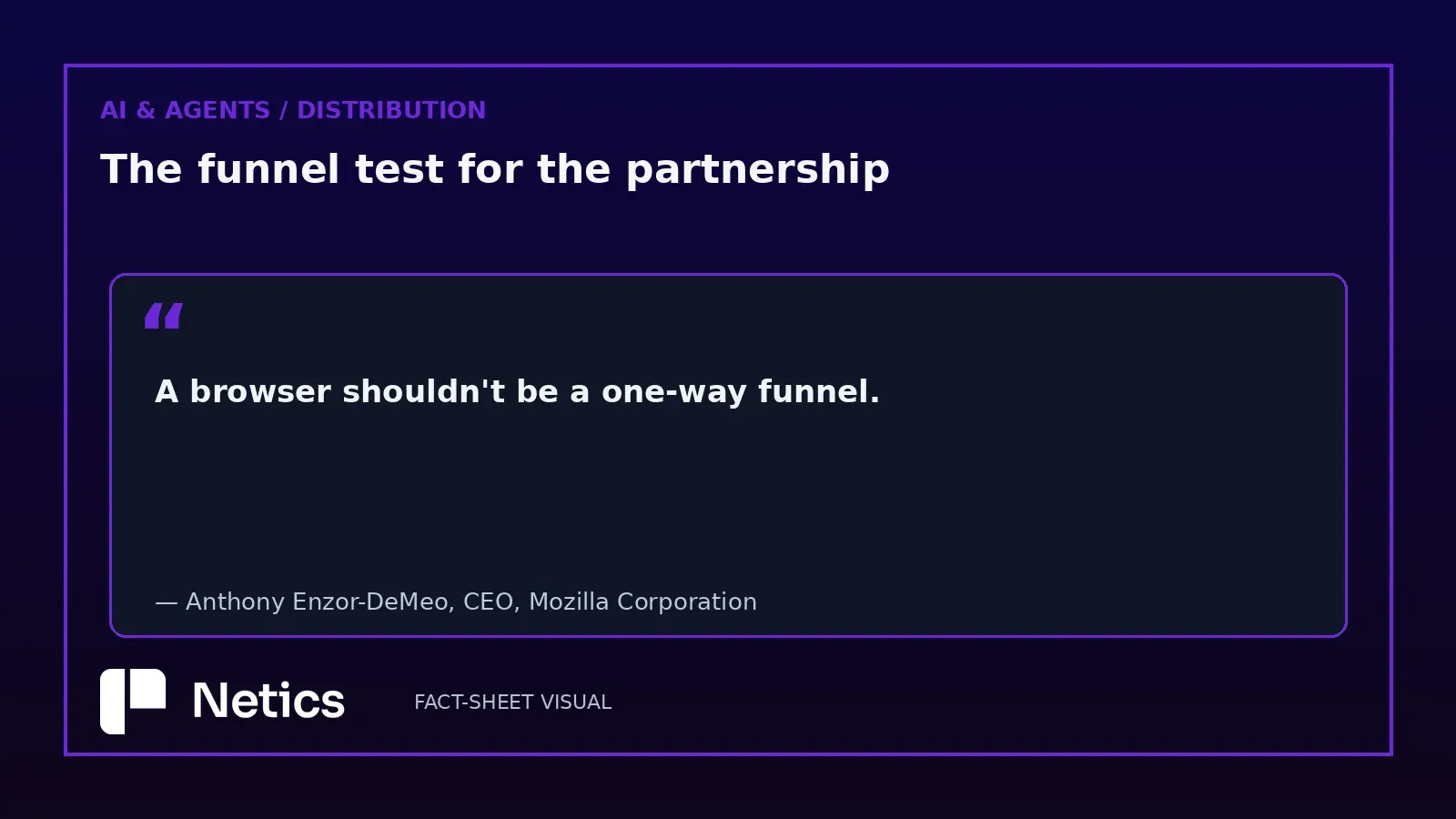
Mozilla's CEO Anthony Enzor-DeMeo put the frame directly: "With the browser sitting at the heart of the web and online experience, it should be a place where different AI providers can compete and open source has a seat at the table." And the sharper line: "A browser shouldn't be a one-way funnel." The test of that sentence is operational, not rhetorical. Mozilla commits that "across all markets where Smart Window beta is available, Firefox users can still choose from a multitude of other AI models." That keeps the model layer swappable, which is the correct architecture for a distribution point. The moment integration stops being a recommendation and becomes the only path, the funnel is closed regardless of press language.
The strategic bet is bigger than one model. Mozilla describes a scenario where "a handful of closed-model companies" control the browser, the search engine, the model, and the surrounding services together. Mistral is the counterweight: a frontier European AI company reaching consumers without owning a browser, and a browser integrating a model without becoming a model company. That division of ownership is what makes the partnership structurally interesting — neither party can close the funnel by itself.
Zero data retention is a data-flow claim, not a slogan
The privacy commitments are specific. "Conversations aren't saved on Mozilla's servers by default, and partners like Mistral agree to zero data retention." Treat that as a contract to verify, not a headline. Zero retention only means something if the request path actually avoids logging, caching, and model-provider telemetry, and if the browser's own session stores behave the same way. The architecture should be auditable: where the conversation travels, what the model provider receives, what the browser keeps locally, and what happens to the input when the assistant is disabled. For European users, this intersects with GDPR expectations around purpose limitation and storage limitation — the announcement's commitments align with the regulation's direction, but alignment at announcement time is not enforcement at runtime.
There is an honest counterpoint here. Mistral's own framing of the fourth reason — "putting sovereign AI in everyone's hands" — is consumer-facing language for something the company has mostly sold to enterprises. This deal extends Mistral beyond its business base, which is a real expansion but also a new attack surface: consumer browser behavior is a different trust boundary than a contractual enterprise deployment. The zero-retention commitment is precisely what makes that boundary survivable; it is also what makes it worth verifying.
What Netics would check before rolling this out
For an organization deciding whether Firefox with Smart Window belongs in its fleet, the questions are concrete. First, can the default model be changed or the assistant disabled at the policy level, not just in a per-user setting? Second, can we verify the zero-retention claim in the deployment — does the traffic path show what the announcement promises? Third, does French-language support extend to the organization's actual workflows, or only to the consumer UI?
The distribution thesis is sound: an independent browser carrying an open-weight European model is a meaningful alternative to the closed-funnel scenario Mozilla warns about. But distribution points earn trust through verifiable switches and auditable data flows, not through partnership announcements. Those are separate workstreams, and only one of them is done. Netics' own work on alternative AI architecture choices is summarized on neticslabs.com.
Sources
Source: Mistral and Mozilla are bringing open, private and multilingual AI to your web browser — mistral.ai/news, 2026-09-16. Source: Mozilla and Mistral: Partnering to expand AI competition and preserve user choice — blog.mozilla.org, 2026-09-16. Internal linkage: the Samsung–Mistral fab-AI analysis covers Mistral's enterprise on-premises bet, and the European AI sovereignty skills-gap piece sets out why operational capability, not model access, is the EU's binding constraint.
Source: Mistral and Mozilla are bringing open, private and multilingual AI to your web browser — mistral.ai/news, 2026-09-16, plus the Mozilla blog partnership post of the same date.