
Europe's AI Sovereignty Problem Isn't Model Access — It's the Skills to Run What You Deploy
Europe's 2026 tech talent data shows the real AI bottleneck: 48% cybersecurity understaffing and 32% Ray deployment, not model licensing.

The 2026 State of Tech Talent Europe report, published by Linux Foundation Europe and Northern Arizona University researcher Marco Gerosa, is being read as good AI-jobs news: a +27% net hiring effect for European IT in 2026. That headline is accurate but it is not the report's most consequential finding. Based on 157 European respondents surveyed online in February 2026, the data shows organisations are understaffed across the infrastructure AI actually depends on, not simply short of AI-labelled talent. Cybersecurity and compliance understaffing sits at 48%, and 61% of organisations report a capability gap in AI security and risk management specifically. For European teams treating AI adoption as a sovereignty question, this report says the constraint is not which model you can license — it is whether your own staff can run, secure, and monitor it once it's deployed.
TL;DR
The Linux Foundation’s Europe survey points to an operational sovereignty gap. Hiring intent is positive, but entry-level hiring is weaker while security, AI operations, and distributed-compute capabilities remain difficult to staff. The practical question is therefore not only which model Europe can access, but whether teams can secure, observe, and operate the systems around it. This market analysis covers the measured sample, the capability gaps, the role of upskilling, and the implications for infrastructure teams.
The roadmap of this article explicitly covers: What the report actually measured, The hiring headline is real, but concentrated and uneven, The gap isn't AI skills — it's the full stack under AI, Upskilling, not hiring, is the report's actual answer, What this means for a European SME or infrastructure team. Coverage: What the report actually measured, The hiring headline is real, but concentrated and uneven, The gap isn't AI skills — it's the full stack under AI, Upskilling, not hiring, is the report's actual answer, What this means for a European SME or infrastructure team.
What the report actually measured
The survey drew 398 global participants responsible for hiring, training, and managing technical talent, with 157 from Europe and 241 from the rest of the world, run online in February 2026. It is a self-reported perception survey, not a measurement of AI's causal effect on employment, and the report flags this itself: respondents likely skew toward organisations already investing in AI, and the data doesn't isolate AI's contribution from broader economic conditions. That caveat should discount how much weight the headline hiring numbers carry. It does not weaken the staffing-gap and capability-gap figures, which describe what these 157 European respondents report having in place today, independent of any causal claim about AI.
The hiring headline is real, but concentrated and uneven
Europe's net hiring effect in IT reached +27% for 2026, smaller than the rest of the world's comparable figure for the same year. The one segment bucking the positive trend is the largest enterprises, which report negative net hiring effects concentrated at that scale, while smaller organisations report strongly positive effects. The more uncomfortable detail sits in the role-level breakdown: entry-level technical positions show a -3% net hiring effect in Europe, moving in the opposite direction from the rest of the world's positive figure for the same category. The report's own reading is that AI may be automating the tasks that traditionally served as entry points into the profession — a dynamic that, if sustained, produces a mid-to-senior talent shortage several years out rather than this one.
The gap isn't AI skills — it's the full stack under AI
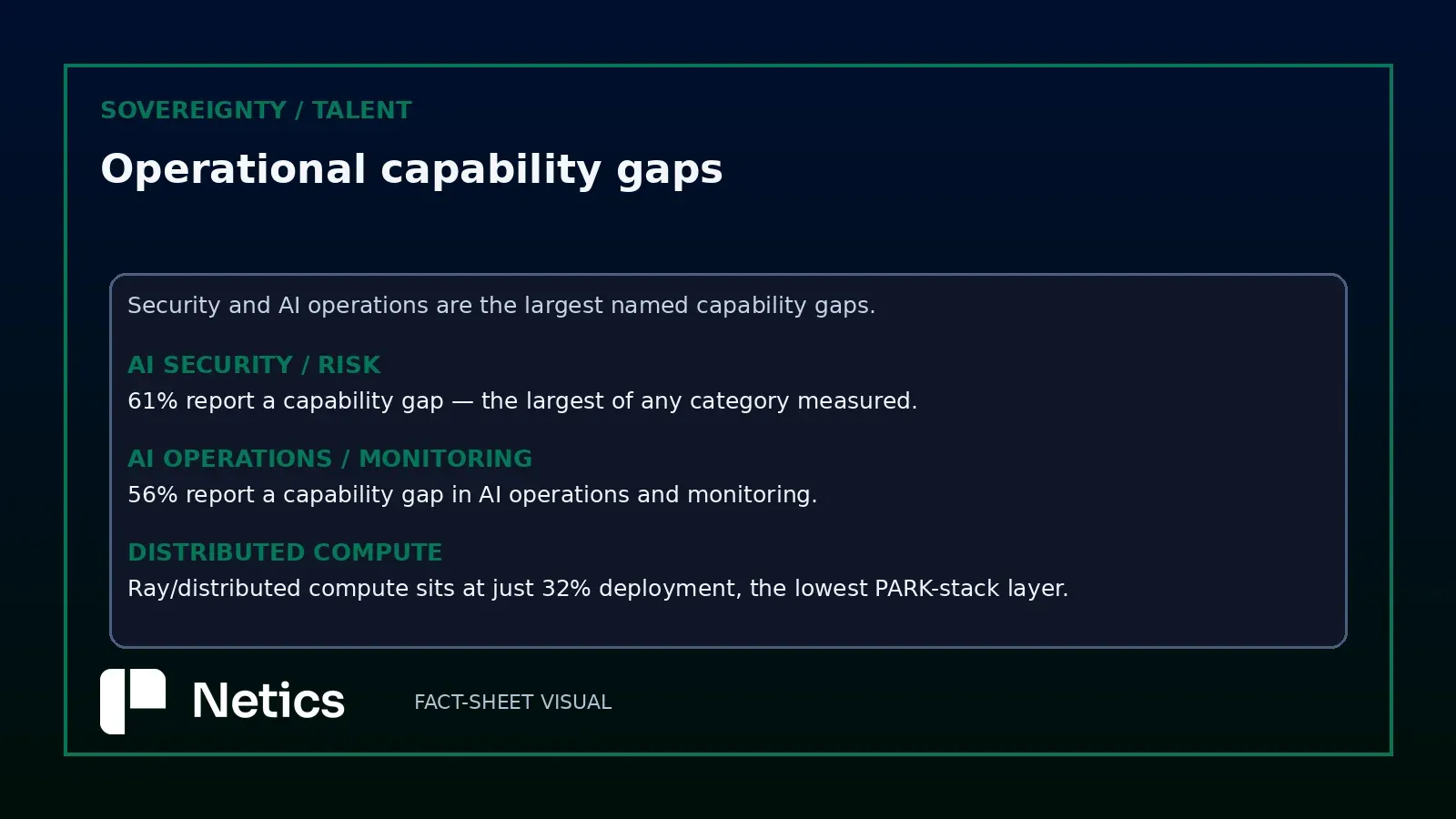
The report's strongest finding is that understaffing in Europe is broadest in cybersecurity and compliance, alongside AI and ML engineering and operations, each at 48%. That shortage sits directly upstream of the AI security and risk management capability gap reported by 61% of organisations — the largest capability gap of any category measured — followed closely by AI operations and monitoring at 56%. Both figures describe the same underlying problem from two angles: organisations don't have enough staff assigned to security and operations work, and as a direct result they report they cannot execute it well.
The PARK stack breakdown, covering PyTorch and equivalent ML frameworks, AI foundation models, Ray and distributed compute, and Kubernetes and containers, makes the same point in infrastructure terms. Distributed compute engineering — the layer needed to scale AI workloads beyond a single-node experiment — sits at just 32% deployment among European respondents, the lowest of the four layers. An organisation can license a frontier model in an afternoon; standing up distributed serving, cost governance, and security hardening around it takes a team that already has those skills, or the time to build them. That gap, not model access, is where AI programmes actually stall.
Upskilling, not hiring, is the report's actual answer
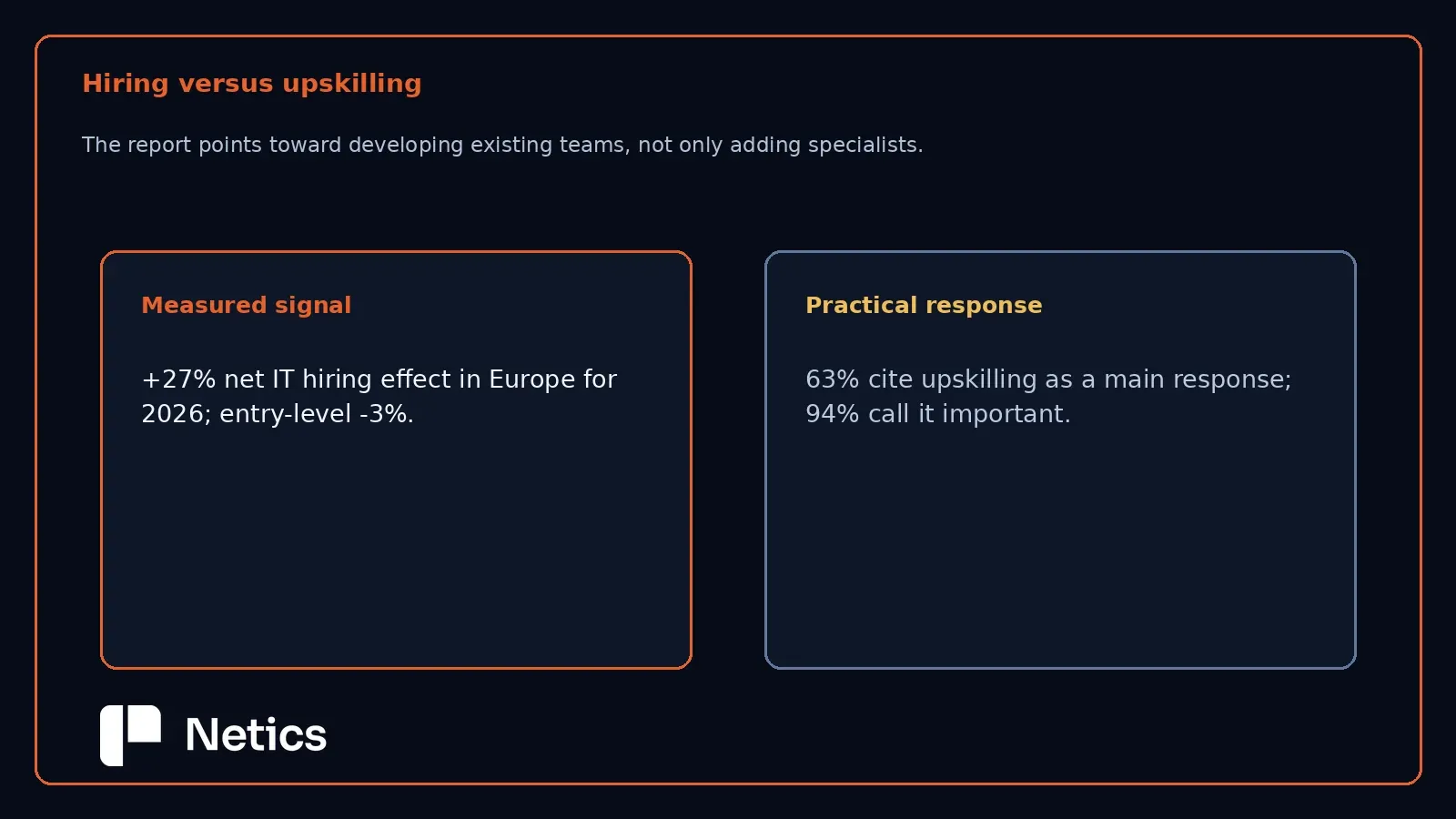
Given a staffing shortfall spanning security, operations, and distributed compute, the response these 157 European respondents favour is internal, not external. Upskilling existing staff is cited by 63% of organisations as the primary response to talent gaps, and 94% rate upskilling as at least important to their organisation. The report quantifies why hiring is the weaker option: new external hires take 53% longer to reach productivity than upskilled internal staff, and 23% leave within six months — a churn cost that compounds against an already-thin bench. That combination of slower ramp and higher attrition risk is a direct, reported reason organisations lean inward rather than outward when closing security and operations gaps.
What this means for a European SME or infrastructure team
None of this argues against adopting AI. It argues against treating model access as the finish line. If cybersecurity understaffing sits at 48% among European respondents and AI security capability gaps sit at 61%, the realistic sequence for a mid-sized organisation is to inventory what is actually running in production, staff or train for monitoring and access control before scaling agentic use cases, and treat distributed-compute skills as a near-term priority rather than a deferred one. A cost-conscious approach to private and hybrid infrastructure starts from the same premise this report reaches independently: sovereignty and safety are staffing and operations problems before they are procurement decisions, and closing them starts with the team you already have, not the vendor you're about to sign.
Given the security, operations, and distributed-compute gaps identified in the report, book a 30-minute infrastructure review with Netics before scaling an AI workload.
Source: Linux Foundation Europe, June 2026 — https://www.linuxfoundation.org/hubfs/Research%20Reports/State-of-Tech-Talent-Europe-2026-REV-1.pdf?hsLang=en