
Samsung and Mistral Put On-Prem AI Inside the Fab Boundary
Samsung and Mistral are bringing customized on-prem AI to semiconductor operations. The real test is whether data boundaries and yield claims become measurable controls.


TL;DR
Samsung and Mistral AI have announced a strategic partnership focused on customized on-prem AI across Samsung's semiconductor operations. The announcement names Mistral services including Mistral Large, sensitive technology and operational data kept within Samsung's infrastructure, and applications such as defect detection and equipment optimization. It also says Samsung led Mistral's Series D funding round. The Netics reading is narrower than the headline: on-prem AI can make a fab's data boundary more enforceable, but it does not by itself prove that a model is accurate, that a yield improvement is causal, or that an automated recommendation is safe to apply.
This is a same-day company announcement, not an independent production benchmark. Its value is in the operating questions it exposes. Semiconductor data is commercially and operationally sensitive, so the location of inference matters. Yet a model that never leaves the site can still be poorly evaluated, over-privileged, or allowed to turn a correlation into an equipment change. The interesting work begins after the boundary is drawn.
What Samsung and Mistral actually announced
Samsung says the partnership was announced during a state summit in Paris between South Korea and France. Under the agreement, Samsung will integrate Mistral's AI services and solutions, including Mistral Large, across its semiconductor operations. The stated objective is to develop customized on-prem models optimized for what the release calls intelligence-driven infrastructure.
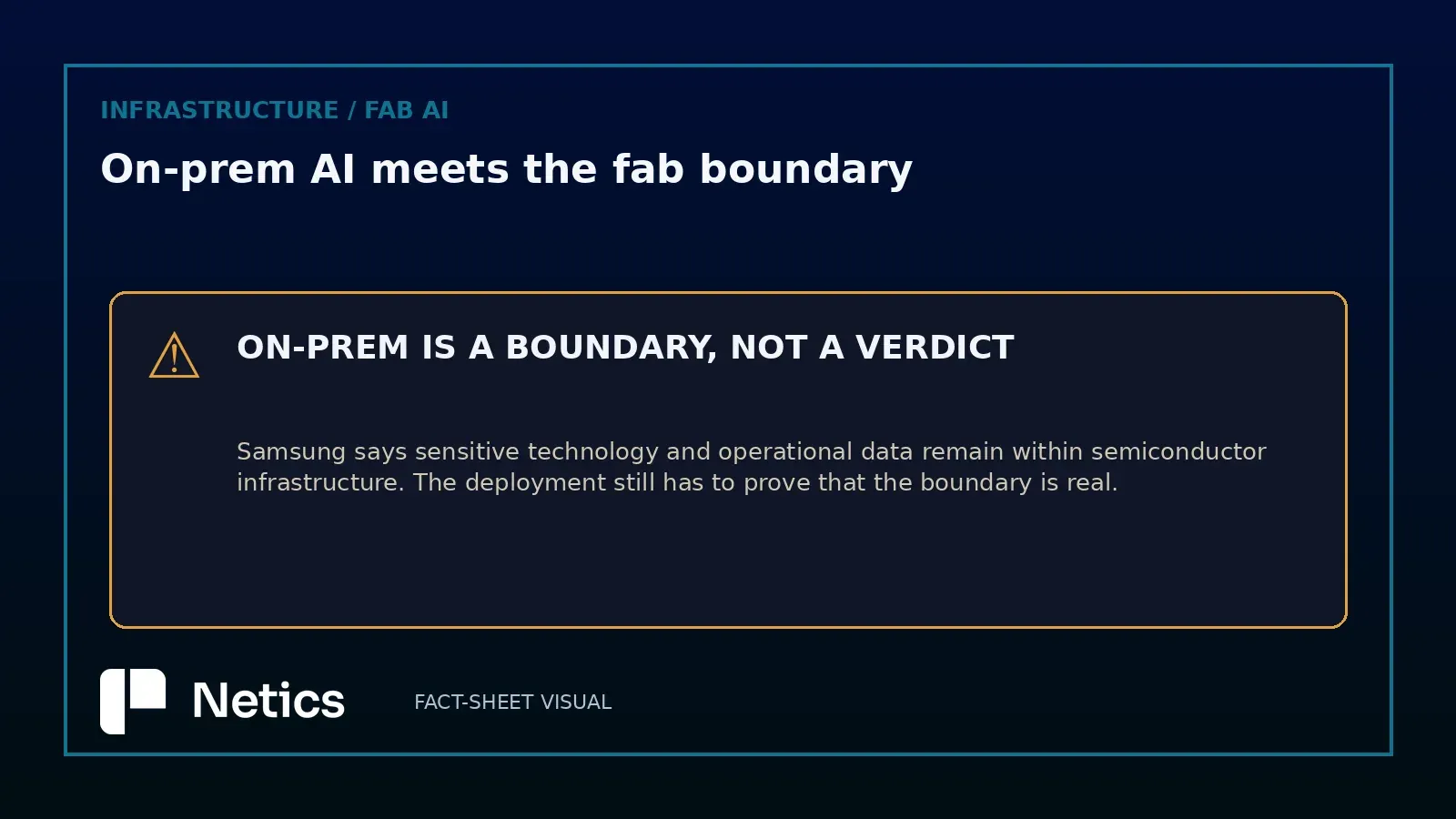
The announcement describes security and flexibility as central reasons for the on-premises approach. Sensitive technologies and operational data are meant to be processed entirely within the boundaries of Samsung's semiconductor infrastructure, maintaining control over mission-critical technologies. Samsung also says the partnership will target rapid data analysis in the fab, with defect detection and equipment optimization intended to accelerate development cycles, manufacturing precision and yield stabilization across advanced memory and logic chips.
There are two signals here, and they should not be collapsed. The first is an infrastructure decision: place model services and data processing closer to the operational environment. The second is a business and ecosystem decision: Samsung is not only a customer or integration partner; it led Mistral AI's Series D funding round and took a strategic equity stake. That financial relationship may support longer-term collaboration, but it does not turn an announcement into evidence that a particular model has improved a particular line.
The release's language is ambitious. It says Mistral's platform can transform how semiconductors are designed and manufactured, and the executives frame the relationship as part of progress across the semiconductor and AI value chain. Those are legitimate statements of intent. They are not measurements of false-positive rates, downtime avoided, defect escape rates, or yield change.
On-prem AI is a data-boundary decision
For a fab, keeping data inside its own infrastructure can be materially useful. Process recipes, equipment telemetry, inspection imagery, maintenance records and production context can reveal technology and operating conditions that should not be sent casually to an external service. A customized on-prem model can reduce one category of exposure: the need to export that data for every inference or analysis request.
But “on-prem” is not a security control in isolation. It is a boundary that needs a map. Which data is allowed to reach the model? Which model artifacts are stored locally? Can prompts, logs, embeddings, evaluation traces or error reports leave the environment? Which administrators can retrieve them? How are model updates delivered, and can a vendor support process introduce a different path? A fab boundary that covers the GPU but not the observability pipeline is an incomplete boundary.
The same applies to identity. A model server may be local, while the people and services invoking it have broad permissions. A defect-detection workflow may read inspection data, a recipe reference and equipment history. An optimization workflow may additionally propose a parameter change. Those are different authority levels and should not be represented by one generic “AI service” role.
Netics' practical position is simple: treat the on-prem model as a new production component, not as a sealed appliance. Give it an explicit data inventory, network policy, identity, retention rule and access review. Record which inputs were used for a recommendation. Preserve enough evidence to reproduce a decision without copying every sensitive image into an ungoverned analytics store. Local processing narrows the perimeter; governance defines it.
Yield stabilization is a hypothesis until the line measures it
The source names yield stabilization as an intended benefit. That is the right operational target and the wrong place to stop reading. “Yield” is not a single model output. It is a production result shaped by process conditions, product mix, sampling, equipment state, engineering changes and time. A system that flags more anomalies may improve attention without improving yield. A system that suppresses noisy alerts may make a dashboard look healthier while allowing defects to escape.
The distinction matters because vendor announcements often move quickly from capability to outcome. Samsung says targeted models for defect detection and equipment optimization aim to accelerate precision and stabilize yield. It does not publish, in this announcement, a baseline, a measured change, a test population, a confidence interval or an independent validation method. We should therefore read the yield language as a program objective, not as a reported result.
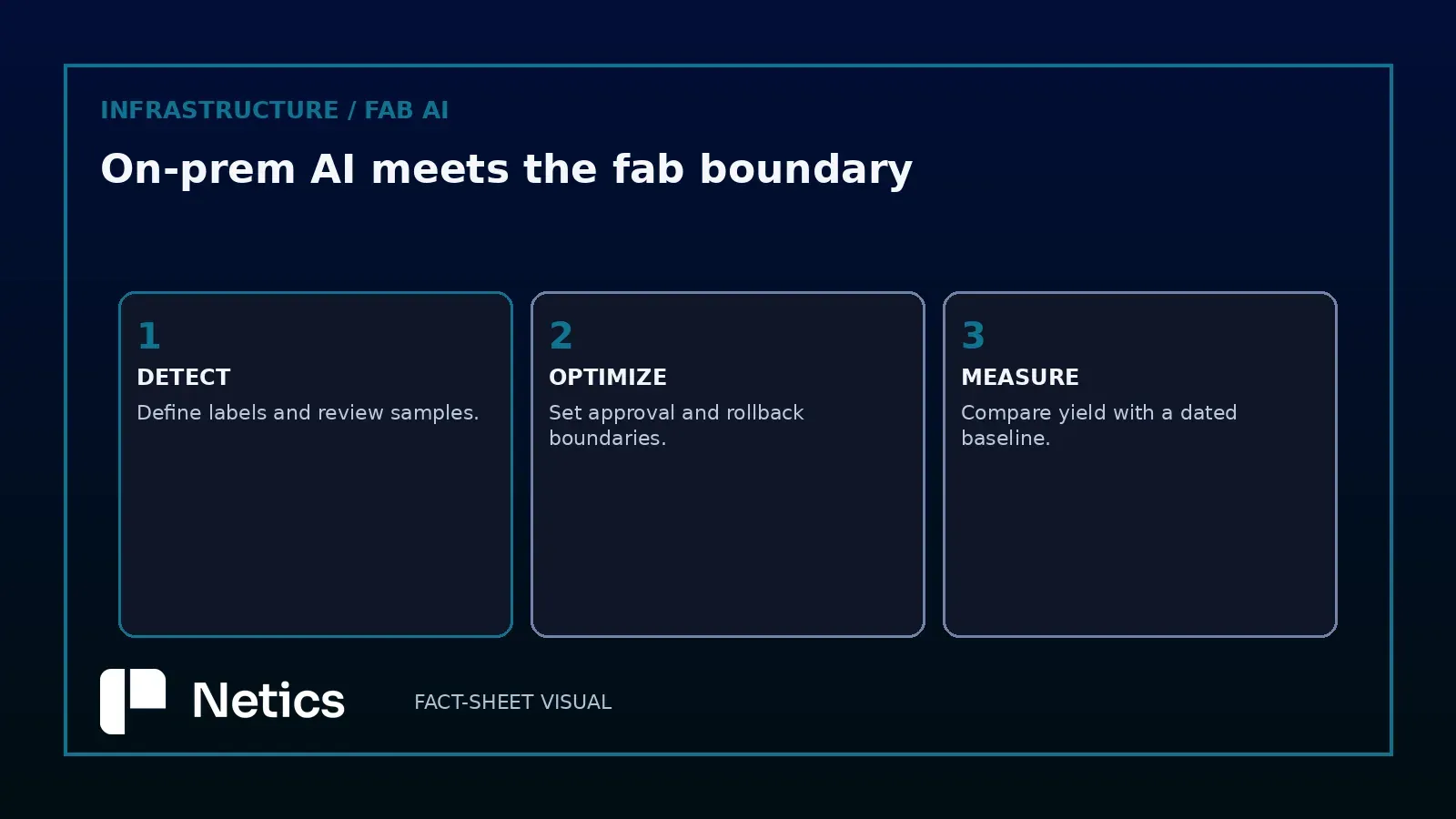
A credible evaluation would separate at least four questions. First, does the model detect the relevant defect classes at a useful precision and recall? Second, does it identify equipment conditions early enough to change an operator decision? Third, do approved interventions improve a defined production measure rather than merely correlate with one? Fourth, does the result hold across products, tools, shifts and process changes?
Consider a hypothetical fab workflow. An on-prem model watches equipment telemetry and inspection results, then recommends a maintenance review. The recommendation is not allowed to change a recipe automatically. An engineer reviews the evidence, records the disposition and links any approved intervention to a change window. Later, the team compares the relevant baseline with matched production periods. This is not a claim about Samsung's process; it is a safer pattern for converting a model promise into an operational experiment.
The measurement design should also track what the model gets wrong. False alarms consume scarce engineering attention. Missed defects create a different risk. Drift can arrive when a tool is refurbished, a sensor is replaced, a process node changes or a new product mix enters the line. A yield dashboard without these error measures can reward a model for producing a convenient story.
From detection to equipment action, the approval boundary matters
Defect detection is usually easier to govern than equipment optimization because its immediate output can be an alert or ranked queue. Equipment optimization approaches a control boundary. The moment a model can recommend or apply a change to a tool, the system needs more than a confidence score. It needs a permitted action set, a named approver, a rollback path and a record of the evidence available at decision time.
This is where on-prem AI should connect to operational governance. Separate read-only analysis from change execution. Keep a model from writing directly to a controller unless the action is explicitly approved for automation. Require a human or a deterministic policy gate for changes outside the tested envelope. Version the model, prompt or workflow, input schema and decision policy together. When an outcome worsens, operators need to know which artifact made the recommendation and which signals it saw.
The approach is not anti-automation. It is how automation earns a larger mandate. A model that begins with read-only defect triage can graduate to bounded recommendations when its error profile is known. A recommendation that is reversible and observable can be tested more safely than a vague promise of “intelligent optimization.” The fab becomes the place where the model proves its operating contract, not merely where it receives privileged data.
The partnership's real test is operational evidence
Samsung's lead investment in Mistral's Series D gives the relationship strategic weight. The deployment ambition also makes sense: a major semiconductor operation has sensitive data, complex equipment and a reason to reduce latency between observation and engineering action. Customized models running on site could be a better fit for that context than a generic external endpoint.
Still, the partnership should be judged by evidence that a press release cannot provide. Can Samsung show that data paths stay inside the intended boundary, including logs and support tooling? Can engineering teams reproduce model decisions? Can they distinguish a yield change from a coincident process change? Can they stop or roll back an AI-assisted workflow without interrupting the line? Can the model be updated without weakening the original controls?
Those questions are not obstacles to the Samsung–Mistral plan. They are its acceptance criteria. The strongest outcome would not be a claim that AI transformed semiconductor manufacturing. It would be a documented operating model in which sensitive fab data stays controlled, model performance is measured against production reality, and every automated recommendation has a clear owner.
For more practical analysis of AI infrastructure boundaries and operating controls, explore the Netics homepage.
Sources
- Samsung and Mistral AI Announce Strategic Partnership for Intelligence-Driven Semiconductor Infrastructure — Samsung Newsroom, September 9, 2026.
Source: Samsung and Mistral AI Announce Strategic Partnership for Intelligence-Driven Semiconductor Infrastructure — Samsung Newsroom, September 9, 2026.