
OpenAI's GPT-5.6 in Kiro Cuts Token Cost — It Doesn't Cut the Review Work
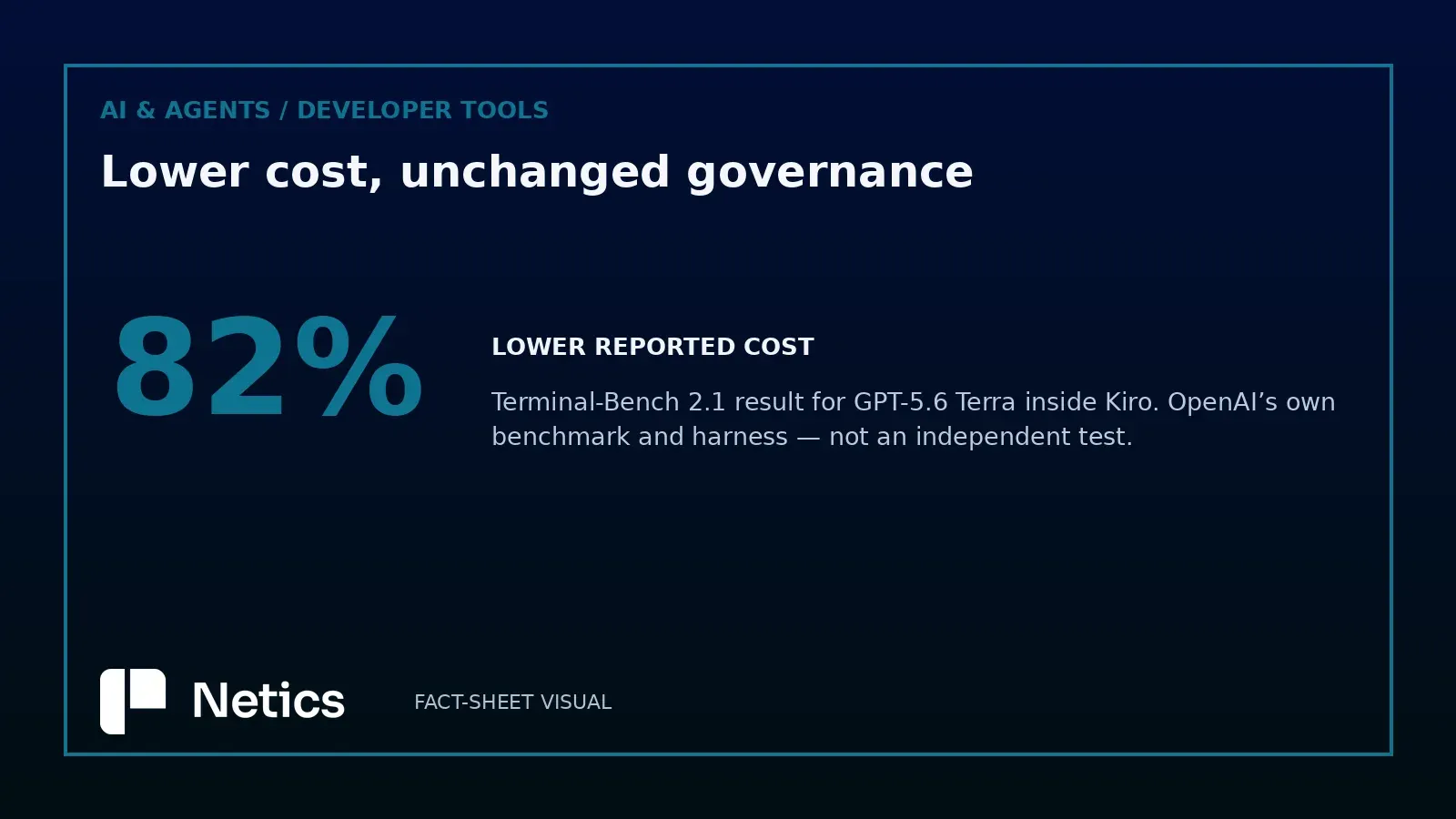
OpenAI reports GPT-5.6 Terra finishing Terminal-Bench 2.1 tasks in Kiro at roughly 82% lower cost. That is a real number about tokens, not a statement about how much human review agentic cod

Source: OpenAI: Advancing price-performance for developers with GPT-5.6 in Kiro
TL;DR
OpenAI has rolled the GPT-5.6 model family — Sol, Terra, and Luna — into Kiro, its agentic development environment, and reports that GPT-5.6 Terra completed Terminal-Bench 2.1 tasks inside Kiro at roughly 82% lower cost than its comparison point. Kiro's own pitch has never been raw model output; it is a workflow built from requirements, technical designs, executable tasks, codebase and team standards, checkpoints, and property-based testing. That distinction matters more than the headline number. A cheaper model changes the unit economics of running an agentic coding loop. It does not change how much of that loop still needs a human to define requirements, gate checkpoints, and read the diff before merge.
OpenAI’s GPT-5.6 Kiro announcement frames lower token cost inside a governed workflow; this position piece examines the review queue, rollout boundary, and Netics reading.
What OpenAI announced
OpenAI's post frames GPT-5.6 in Kiro as a price-performance release rather than a pure capability release. The three variants — Sol, Terra, Luna — are now available across Kiro's agentic workflow, and OpenAI attributes the cost improvement specifically to GPT-5.6 Terra on Terminal-Bench 2.1, a benchmark suite built around realistic terminal and coding tasks. The roughly 82% figure is OpenAI's own reported result from that comparison, not an independent or third-party benchmark, and it applies to that specific test suite rather than to coding work in general.
The more structurally interesting part of the announcement, for anyone actually running an agentic coding system, is what Kiro is built from. OpenAI describes a workflow with requirements, technical designs, executable tasks, codebase and team standards, checkpoints, and property-based testing layered around the model. None of those are model capabilities. They are process controls — the scaffolding that decides what the agent is allowed to attempt, how its output gets checked, and where a human signs off before code ships.
Why the cost number is not the whole story
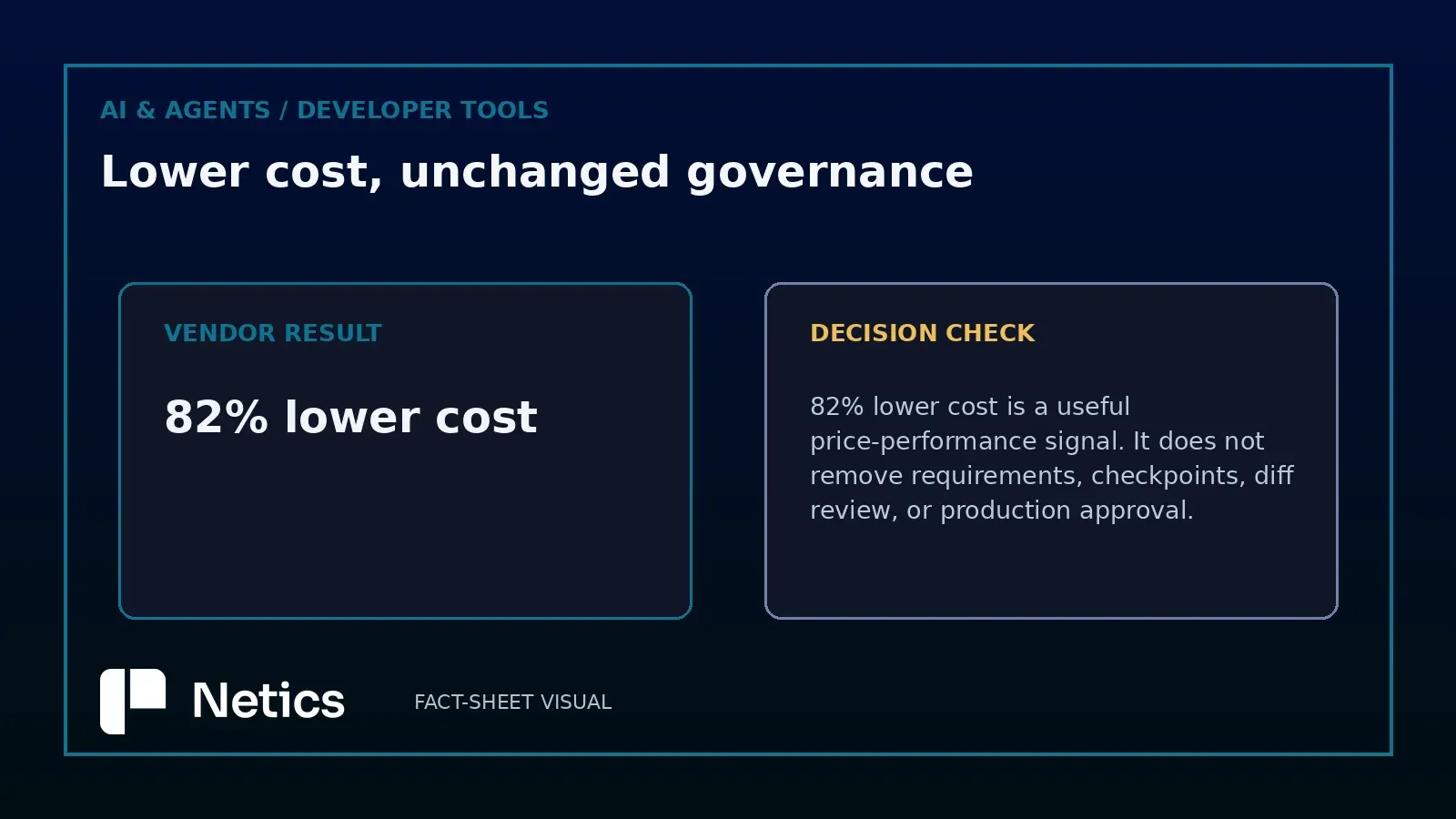
Price-performance numbers are genuinely useful for procurement. If a task that used to burn a fixed token budget now costs a fifth as much, that changes what becomes economically viable to automate, and it is worth taking seriously as a planning input. But a benchmark result on Terminal-Bench 2.1 tells you about that benchmark, run inside Kiro's specific harness, under OpenAI's specific test conditions. It does not tell you what GPT-5.6 Terra will cost or how it will behave against your own repository, your own test suite, or your own definition of "done."
That gap is exactly where Kiro's scaffolding earns its place — and exactly where teams get the framing wrong. The instinct after seeing an 82% cost reduction is to conclude that agentic coding just got proportionally cheaper to operate. It didn't. The requirements have to be written by someone who understands the system. The checkpoints have to be defined with enough precision that "the agent passed the checkpoint" actually means something. The property-based tests have to encode the invariants that matter for that specific codebase, not a generic notion of correctness. Cheaper tokens make the model calls inside that loop cheaper. They do not write the requirements, define the checkpoints, or review the merge.
What actually constrains agentic coding cost
The real cost center in a governed agentic coding workflow was never purely inference spend. It is the human attention required to keep requirements accurate, checkpoints meaningful, and review honest as the volume of agent-generated changes scales up. A team that adopts a cheaper model without also scaling its review capacity will not save money — it will generate more agent output at the same review bottleneck, which either slows delivery or degrades review quality, neither of which shows up in a Terminal-Bench score.
This is the same failure mode Netics has flagged in agentic code review specifically: automated review can surface a defect, but agentic source code review still needs a human in the loop to validate what the tool actually found before it is trusted as a merge gate. A cheaper generation model changes the input side of that pipeline. It leaves the validation side exactly where it was.
What Netics recommends for teams evaluating this
Before treating a lower per-task cost figure as a green light to expand agentic coding scope, three questions are worth answering directly. First: is the cost reduction measured against your own repository and test suite, or against a public benchmark that may not reflect your codebase's complexity, dependency depth, or legacy constraints? Second: does your current requirements-and-checkpoint discipline scale with a higher volume of agent-generated changes, or does it assume the current, more expensive, lower-volume baseline? Third: who reviews the property-based tests themselves — because a test suite an agent also wrote is not automatically a trustworthy gate.
None of this is an argument against adopting cheaper, more capable models in a structured harness like Kiro. It is an argument against reading a cost benchmark as a governance result. The two are separate claims, and OpenAI's own framing — requirements, checkpoints, property-based testing — implicitly agrees: those exist because the model output, however cheap, still needs to be constrained and checked. The lesson generalizes beyond Kiro. Teams evaluating any agentic coding platform should treat search-and-iteration quality, not raw generation cost, as the harder problem to solve — the same distinction Netics drew in looking at why iterative search producing verified improvements matters more than one-shot code generation.
Netics' conclusion
GPT-5.6 in Kiro is a legitimate price-performance improvement, and OpenAI is transparent that the number comes from a specific benchmark under specific conditions. The mistake would be letting a falling cost curve quietly stand in for a governance decision. Cheaper tokens buy more attempts. They do not buy better requirements, meaningful checkpoints, or reviewers with time to read what got merged. Budget for the model. Budget separately, and honestly, for the review
For an architecture review, visit Netics..