
Kernel Optimization Across Hardware Needs a Search Loop
Meta’s KernelEvolve treats accelerator-kernel optimization as a measured search loop across hardware, models, and operators—not as one-shot code generation.


Source: Meta Engineering — KernelEvolve: How Meta’s Ranking Engineer Agent Optimizes AI Infrastructure
TL;DR
Meta’s KernelEvolve frames kernel optimization as a search problem across hardware, model architectures, and operators. It generates candidates, compiles them, checks correctness, profiles performance, and uses diagnostics to guide the next search step. Netics’ recommendation is to copy the control logic, not the headline metric: every optimization must prove correctness across representative shapes, explain its hardware assumptions, preserve rollback, and pass human review before deployment. The combinatorial problem is real, search beats one candidate, correctness is a performance metric, and performance claims must stay precisely attributed.
The combinatorial problem is real
Meta describes a fleet that includes NVIDIA GPUs, AMD GPUs, Meta’s MTIA silicon, and CPUs. The kernel matrix grows across hardware generations, model architectures, and operator types. A kernel that performs well on one accelerator or input shape may fail or underperform on another. Standard libraries cover important operations, but production workloads also contain preprocessing and model-specific operators that do not fit a one-size-fits-all path.
This is why one-shot code generation is a weak fit. The optimization target is not a plausible program. It is a program that is correct, fast, observable, and maintainable for a defined workload and hardware boundary.
Search beats the single-candidate mindset
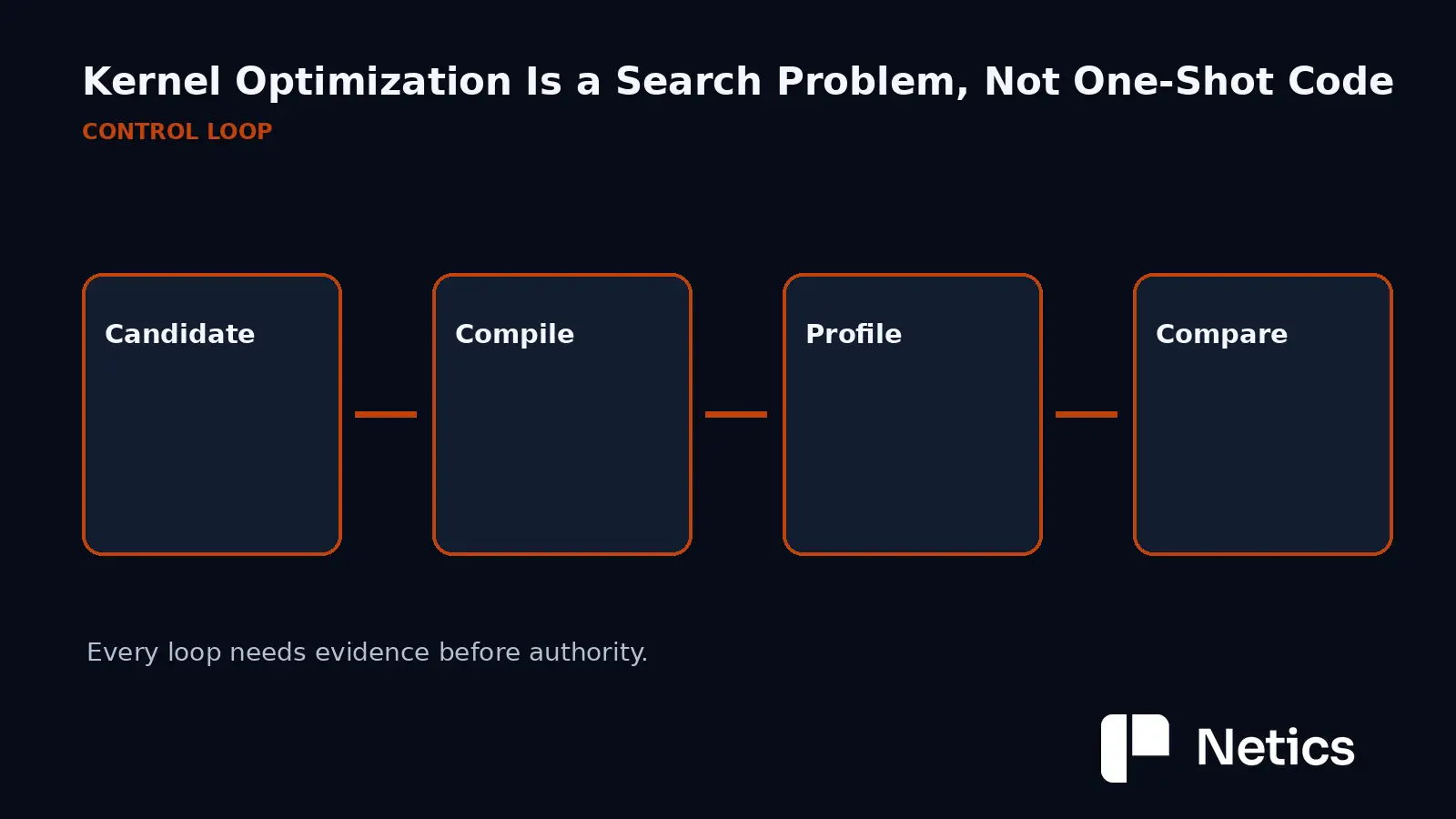
Meta describes an LLM synthesizer, a tree-search engine, a retrieval-augmented knowledge base, and an automated evaluation framework. Search algorithms explore alternatives and decide when to refine a promising branch, compare siblings, or restart. Runtime diagnostics are fed back into the next generation step.
The retrieval layer provides correctness constraints, platform-agnostic optimization guidance, and hardware-specific documentation. That is important for proprietary accelerators and new chip generations: the system can inject the relevant architecture and memory rules without pretending that a general model already knows every target.
Netics recommends separating candidate generation from candidate acceptance. The model may propose code; the benchmark and profiler decide whether the proposal has earned another iteration.
Correctness is a first-class performance metric
KernelEvolve’s evaluation checks numerical correctness against reference implementations and measures performance across production input shapes. Meta references TritonBench, PyTorch Profiler, NVIDIA Nsight Compute, Proton, and MTIA Insight for different levels of evidence.
A single runtime number is not enough. Teams should check output equivalence, edge shapes, launch overhead, memory behavior, occupancy, service-level latency, and failure behavior. If the optimization changes precision, data layout, or synchronization, the acceptance test must expose that change instead of hiding it behind an average benchmark.
Attribute performance claims precisely
Meta reports more than 60% inference throughput improvement for the Andromeda ads model on NVIDIA GPUs and more than 25% training throughput improvement for an ads model on MTIA. The source also describes a 100% pass rate on its KernelBench evaluation. These are Meta-reported results for defined workloads, baselines, and environments. They are not a generic promise that an agentic optimizer will deliver the same result elsewhere.
A credible internal benchmark records the baseline kernel, compiler version, device generation, input-shape distribution, precision, warm-up policy, sample count, variance, and service-level impact. Without that context, “faster” is a marketing adjective rather than an engineering result.
The operational recommendation
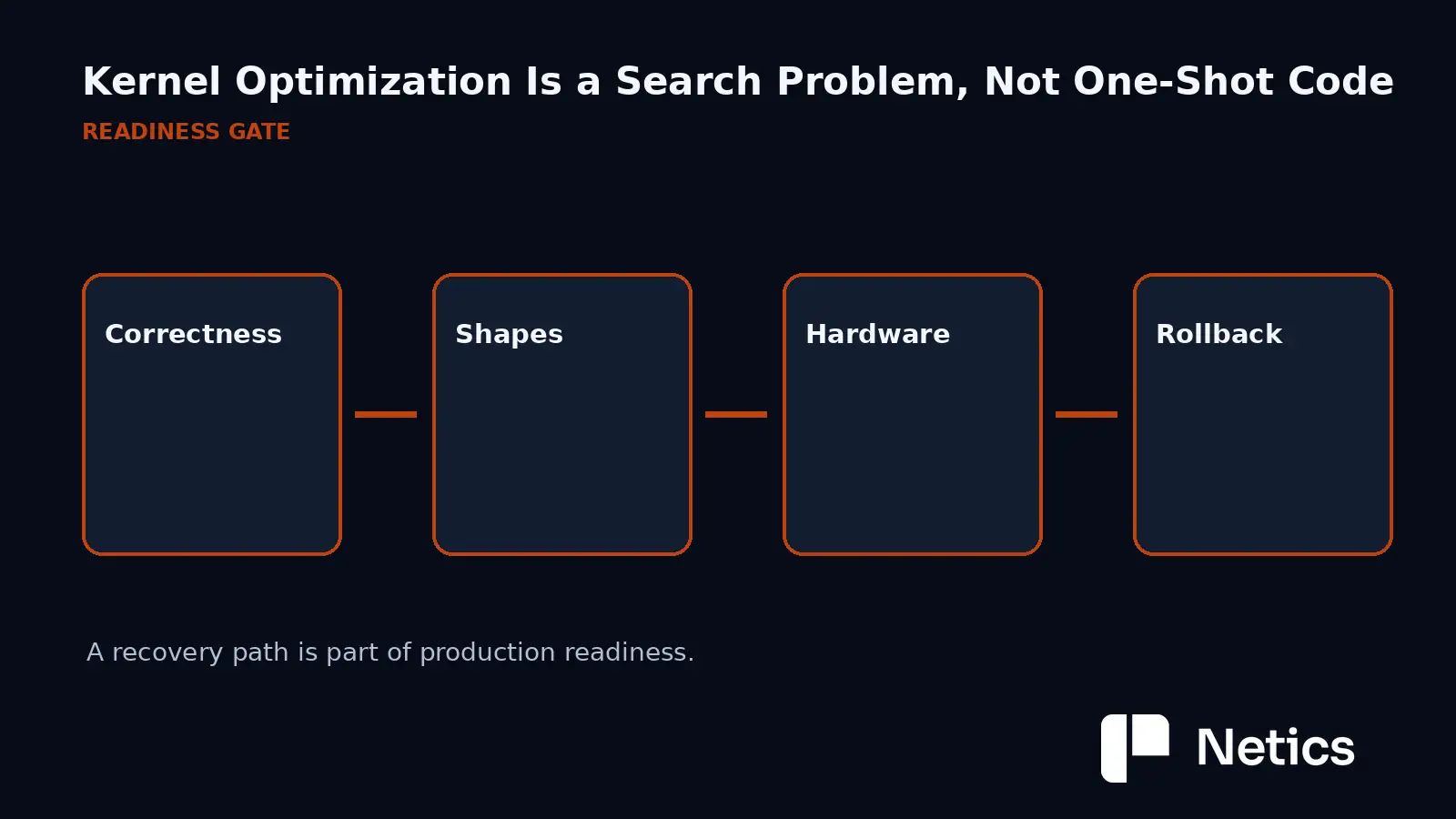
Treat the optimizer as a controlled change system. Give it a narrow operator and hardware scope. Keep reference implementations immutable. Require a passing correctness suite before performance comparison. Store candidate code, diagnostics, profiling traces, and selected rationale. Use a human approval gate before deployment, and keep an immediate rollback to the last known-good kernel.
The shared data foundation described by Meta is also an operational asset. Successful transformations, failure patterns, and hardware-specific lessons can shorten future searches. Store them with provenance: device generation, compiler and driver context, input shapes, correctness evidence, and the baseline that made the speedup meaningful. Otherwise, the system accumulates anecdotes rather than reusable engineering knowledge.
This memory needs boundaries. A speedup that depends on one driver, one compiler build, or one narrow shape is not a universal improvement. Keep the context with the result, and make promotion conditional on the same evidence being available during rollback.
A production team should also define the stopping rule before the search starts. A target speedup, a fixed evaluation budget, or a stalled branch is more defensible than accepting the first result that compiles. The model proposes; the benchmark, profiler, and release process decide.
FAQ
Is kernel optimization just code generation?
No. It is a search and measurement problem involving candidate generation, compilation, correctness, profiling, comparison, and selection.
Why retrieve hardware documentation?
Hardware-specific memory, instruction, and execution constraints determine whether a candidate is valid and efficient on the target accelerator.
What should block deployment?
Incorrect output, incomplete input-shape coverage, unverified hardware assumptions, weak profiling evidence, missing rollback, or absent human review should block deployment.
Conclusion Netics
For teams evaluating AI infrastructure architecture, optimization needs evidence across workloads and hardware.
The lesson from KernelEvolve is not that an LLM writes better kernels alone. It is that search, evidence, and hardware-aware evaluation can turn generation into an engineering process. That process is what makes optimization repeatable for each target workload.
Source: Meta Engineering, KernelEvolve — https://engineering.fb.com/2026/04/02/developer-tools/kernelevolve-how-metas-ranking-engineer-agent-optimizes-ai-infrastructure/