
AI Studio vs. Gemini Enterprise Agent Platform: When to Move to Production
Google AI Studio or Agent Platform? A practical migration guide for credentials, users, spend, security, and capacity.

TL;DR
Google AI Studio is the right starting point when the problem is still changing and the goal is to prove an idea quickly. A prototype should move toward Gemini Enterprise Agent Platform—formerly Vertex AI—before an API key leaves the laptop, multiple people depend on it, paying users arrive, meaningful spend appears, or a security review begins. The important decision is not which Google product is “best.” It is when experimentation must become accountable operation.
The short answer: start fast, define the exit early
Google’s own production guidance makes the distinction clear: AI Studio with the Gemini Developer API is designed to get an idea to working code quickly, while Gemini Enterprise Agent Platform surrounds the same model family with enterprise controls.[1] That makes “AI Studio versus Agent Platform” a sequencing question, not a permanent platform choice.
Use AI Studio while you are testing the problem, the prompt, the workflow, and the value proposition. Define the migration trigger before you have real users and before credentials, billing, and operational assumptions spread through the codebase.
If the prototype is already handling customer data or production credentials, the question is no longer whether migration is convenient. It is whether the team is willing to operate without a proper identity and audit boundary.
What Google actually distinguishes
AI Studio removes setup friction. The source describes a browser-based starting point, an API key, and no initial cloud-project configuration.[1] That is valuable when speed is the constraint.
Gemini Enterprise Agent Platform is presented as the enterprise-control surface around Gemini and other model options. The named controls include IAM and service-account authentication, VPC Service Controls, Cloud Logging and Monitoring, reserved capacity, regional endpoints, and a compliance surface for enterprise review.[1]
The code change may be small. Google shows a unified google-genai SDK targeting both surfaces. The operational change is not small: production requires a project, billing ownership, identities, roles, logging, capacity decisions, and someone responsible for the boundary.
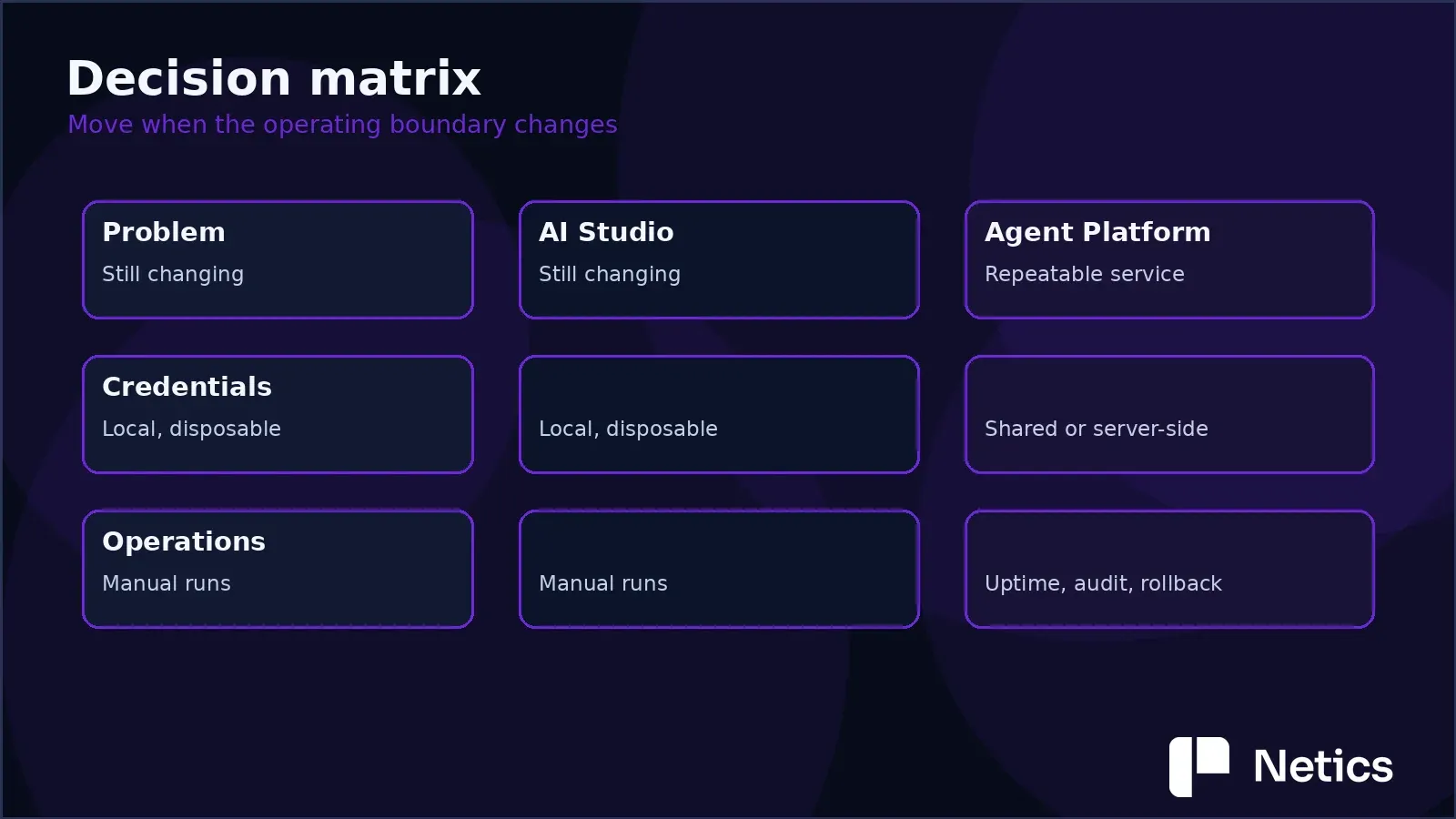
The migration decision matrix
| Question | AI Studio is still reasonable | Move toward Agent Platform |
|---|---|---|
| Problem shape | Prompt and workflow are changing | A repeatable service is emerging |
| Credentials | Key stays local and disposable | Key reaches a repository, client, CI job, or server |
| Team | One developer experiments | Multiple developers or services need access |
| Users | Internal test only | Paying customers or external users depend on it |
| Spend | Small, actively watched experiment | Material spend or billing exposure |
| Security | No formal review yet | Customer, procurement, or compliance review is approaching |
| Operations | Occasional manual runs | Uptime, latency, audit, and rollback matter |
| Capacity | Prototype traffic | Quota, regional routing, retry, or reserved-capacity decisions matter |
This is not a feature-count table. It is a reversibility table. The earlier the identity and project boundary is defined, the cheaper it is to change the implementation without changing the whole operating model.
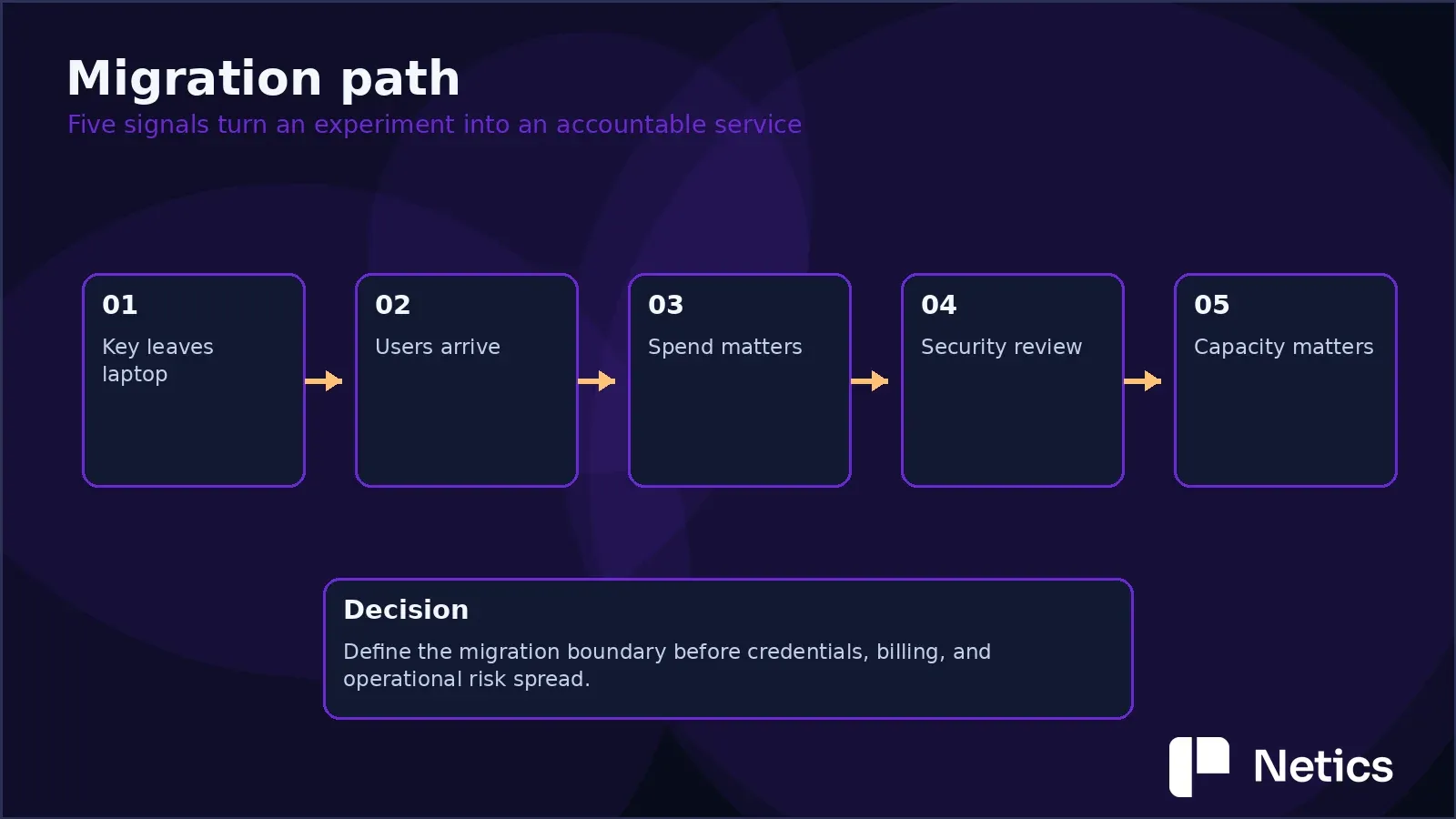
Five triggers that should end the “temporary” phase
If you only remember five triggers, remember these:
- The key left the laptop. Google’s source explicitly treats raw keys as dangerous in production because they are easy to leak and can grant access until someone notices.[1]
- A second person needs access. Shared credentials are not a team operating model.
- A paying user is arriving. Customer dependency changes the cost of an outage, billing surprise, or untraceable action.
- Spend is no longer experimental. Google highlights spend and credential control as part of the transition.
- A security review is scheduled. IAM, service identities, logging, and environment separation are no longer optional conversation topics.
The transition does not require pretending that every prototype needs a large platform. It requires naming the risk that makes the simple path insufficient.
What remains inconvenient
The migration is not magic. Someone still has to create the project, attach billing, enable services, choose roles, configure regional behavior, add retry and backoff, and decide who owns the logs. Google’s guidance is useful precisely because it exposes those unglamorous tasks.[1]
That is also where teams should resist over-granting. The source warns that role suggestions can be broader than necessary and recommends asking for the narrowest access. The same principle applies to model access, storage, tools, and deployment identities.
For a broader Netics treatment of permissions before platform selection, see why AI agents need controlled access before another cloud platform.
Netics’ recommendation
Choose AI Studio when you are still discovering whether the product should exist. Choose Agent Platform when the product has an accountable identity, a real user, material spend, or an operational promise. In between, create a migration checklist and test the boundary before the deadline forces it.
The mistake is not prototyping with a simple API key. The mistake is allowing a prototype credential and a production dependency to become the same thing.
Sources
Source: Google Cloud: 10 questions every startup should answer before moving to production with their AI prototype — cloud.google.com, 2026-08-21
Explore Netics for practical infrastructure and AI operations guidance.