
Gemini 3.8 Flash Cyber Gives Defenders a Faster Patch Loop, Not a Free Pass
Google says Gemini 3.8 Flash Cyber can find vulnerabilities and generate patches. Netics examines the access, evidence and controls a security team still needs.


TL;DR
Google says Gemini 3.8 Flash Cyber reaches frontier-level performance in vulnerability discovery and automated patching, and it reports results from CyberGym, CWE-Bench, Google code, and an internal penetration-testing benchmark. Those are Google claims from a vendor announcement, not a substitute for evidence from your repositories.
The model is available through Google’s Fairwind Program to trusted government authorities, critical-infrastructure operators, and software maintainers. That access boundary is itself a signal: this is a powerful defensive capability with a controlled deployment model, not an ordinary API feature. A security team still needs to test false positives, isolate execution, require human review, collect telemetry, preserve rollback, and price the full operating workflow before buying.
What Google announced and what it did not
In its September 2, 2026 announcement, Google describes Gemini 3.8 Flash Cyber as a cybersecurity model for vulnerability detection and automated patching. Google says the model is built on the same foundational intelligence as Gemini 3.8 Flash and is accelerated by long-running agentic loops that recursively evaluate and refine the underlying models. Google also says it prioritized vulnerability fixing over offensive capabilities such as exploitation.
Google reports that Gemini 3.8 Flash Cyber demonstrates frontier-level performance on CyberGym, surpassing Gemini 3.5 Flash Cyber and significantly larger frontier models in autonomous vulnerability discovery. Google also says an internal benchmark spanning complex codebases and 20 programming languages produced a success rate exceeding 70%. For patching, Google cites the external CWE-Bench: a pass@1 of 47.2%, compared with 47.8% for a leading frontier model, at what Google says is significantly lower cost.
Those figures are useful signals, but each has a narrow meaning. A benchmark success rate is not recall on your asset inventory. pass@1 is not the probability that the first proposed patch can be merged. “Exceeding 70%” does not explain the benchmark’s labels, severity mix, reproducibility, or false-positive policy in the announcement. Procurement should treat the numbers as hypotheses to test, not as service-level commitments.
Trusted-defender access is a security control, not a trust certificate
Google says Gemini 3.8 Flash Cyber is available to trusted defenders through the Fairwind Program. It names trusted government authorities, critical-infrastructure operators, and software maintainers as the groups receiving prioritized access. Google also says the model uses a more permissive set of cybersecurity mitigations than standard Gemini 3.8 Flash, which is why access is limited to trusted defenders requiring more comprehensive cyber capabilities.
The important reading is not that a Fairwind participant has been certified as safe. The announcement does not provide a public eligibility checklist, an authorization model, or a statement that Fairwind access transfers responsibility for the customer’s own controls. “Trusted” describes Google’s access decision. It does not describe the permissions inside your organization.
A team should therefore keep its own trust boundary. Put the model behind an identity that has only the repository, build artifacts, tickets, and test environments needed for a defined task. Separate read access from write access. Make production credentials unavailable to the discovery and patching loop by default. Require an explicit, logged approval before any change crosses from a sandbox into a shared branch or release process.
This is not distrust of the model. It is the normal consequence of granting an agent the ability to alter security-sensitive code. A trusted defender may still operate a compromised workstation, select the wrong repository, misunderstand a dependency, or approve a result under time pressure. Access control must assume those ordinary failure modes.
Discovery results need a false-positive budget
Google’s announcement emphasizes discovery performance and gives examples from real-world use. Google says the Chrome Security team found that Gemini 3.8 Flash Cyber produced 2.6 times more correct patches to Chrome vulnerabilities than the best commercial models that were much larger. Google also says Wiz found 7.5–9.7% higher recall on its internal penetration-testing benchmark at 2.3–5.2 times lower cost than other leading frontier models. Finally, Google says its Cloud Vulnerability Research team used the model to find a critical foundational vulnerability in less than two hours, where research and discovery usually takes months.
These are important Google claims, but they are not interchangeable. Correct-patch volume, recall, cost, and elapsed discovery time answer different questions. None, as presented in the announcement, tells a buyer the rate of false alarms, duplicate findings, exploitable-but-low-priority findings, or missed regressions. A tool that finds more candidates can still make a security program worse if analysts cannot separate useful signal from an expanding queue.
Before deployment, define a false-positive budget by workflow. For triage, a higher noise level may be acceptable if findings are cheap to dismiss and richly explained. For automatic patch creation, the threshold must be stricter because every incorrect assumption creates review work or risk. Measure findings against a labelled sample from your own languages and frameworks. Record duplicates, rejected hypotheses, severity disagreements, and the reason a human accepted or discarded each result.
Do not collapse that evidence into one accuracy number. Security teams need a confusion matrix by vulnerability class and repository type, plus the time required to validate a finding. Google’s public announcement does not provide that operational detail. Your evaluation must.
Automated patching stops at the merge boundary
Google presents Gemini 3.8 Flash Cyber as a model for automated patching and says it focused on giving defenders expert capabilities. A patch benchmark can tell a team whether a model often produces a candidate that satisfies a benchmark’s test conditions. It cannot, on its own, establish that the patch preserves business behavior, satisfies internal security policy, avoids a performance regression, or handles an undocumented compatibility contract. The merge boundary remains a governance boundary even when a patch passes automated tests.
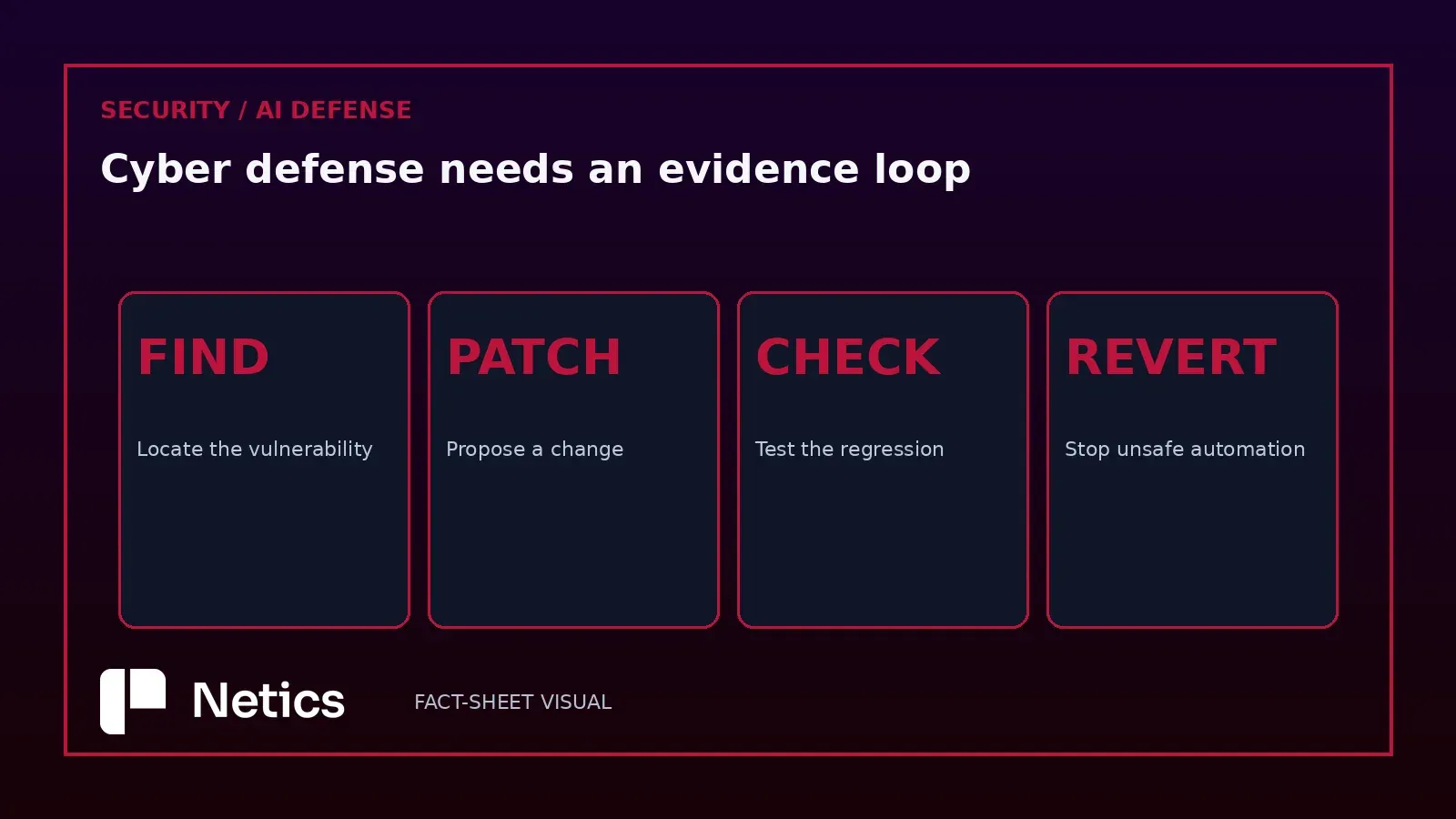
The safe pattern is an evidence-producing loop. The model proposes a minimal diff, names the suspected root cause, identifies tests it ran, and records any assumptions. A separate pipeline runs static analysis, unit and integration tests, dependency checks, and targeted regression tests. A human reviewer compares the finding, the diff, and the test evidence. Only then does a maintainer decide whether the change can enter a protected branch.
That distinction aligns with Netics’ earlier analysis of why agentic code review still needs a human validation gate. Automation can increase the number of candidate fixes. It does not make the approval decision disappear; it makes the approval queue a more important system to design.
Sandboxing, telemetry, and rollback are part of the product decision
Google says Gemini 3.8 Flash Cyber has more permissive cyber mitigations and that Gemini 3.8 models made a significant leap in prompt-injection robustness as measured by Gray Swan. That is relevant to misuse and malicious instructions, but it is not a complete sandboxing or observability guarantee. The announcement does not specify execution isolation, network egress policy, secret handling, customer-visible logs, retention, or a rollback mechanism.
Those omissions are not accusations. They are procurement questions. A cyber agent should inspect code and run tools in an ephemeral environment whose filesystem, network, package installation, and credentials are explicit. Prompts, tool calls, diffs, test output, approvals, and final dispositions should be retained according to the team’s incident and compliance requirements. Telemetry must show not only what the model produced, but what it actually accessed and which human authorized the next step.
Rollback must be designed before automation expands. Keep immutable references to the original commit, the model-generated patch, the tests run, and the approval event. Make reversal a normal operation rather than an emergency reconstruction. Test what happens when a patch passes tests but causes an application-level regression, when an agent loops, and when a prompt injection attempts to redirect tool use. A model’s stated robustness is valuable evidence; it is not a substitute for exercising your own controls.
Procurement should buy a controlled capability, not a benchmark headline
Google’s announcement makes Gemini 3.8 Flash Cyber sound economically interesting. Google says its patching result is close to a larger frontier model at lower cost, and it reports lower costs for Wiz’s internal benchmark comparison. But the model’s unit price is only one line in the security budget. Add environment isolation, repository indexing, test infrastructure, storage for telemetry, analyst triage, maintainer review, incident response, and the cost of reverting a bad change.
Ask Google for the evaluation protocol behind each claim that matters to your decision: dataset construction, language distribution, vulnerability severity, duplicate handling, external reproducibility, pass criteria, and whether human intervention was allowed. Ask how Fairwind access is governed, what customer telemetry is available, how data is retained, and what controls exist for model or service failure. If those answers are not available, record the uncertainty instead of converting a marketing claim into a requirement.
Run a bounded pilot on representative repositories. Start with discovery-only mode, then candidate patches in isolated environments, then human-approved changes to a non-production branch. Compare the model with your current scanner and review process on recall, false positives, time to validate, patch acceptance, rollback frequency, and cost per resolved issue. Keep the pilot narrow enough that a person can inspect the evidence.
The practical conclusion for security teams
Google has announced a serious defensive model and supplied credible-looking signals across discovery, patching, internal evaluations, and Google’s own code. The strongest conclusion available today is that Gemini 3.8 Flash Cyber may reduce the cost and time of generating vulnerability hypotheses and patch candidates for trusted defenders. The announcement does not establish autonomous production remediation, universal accuracy, or a complete safety case for your environment.
Treat Fairwind access as permission to evaluate a capable system, not as proof that your own governance is finished. Build the sandbox, telemetry, review queue, and rollback path first. Then measure where the model genuinely improves the loop and where it merely creates more work. For a security architecture discussion in English, visit the Netics homepage.
Sources
- Google — Introducing Gemini 3.8 Flash and 3.8 Flash Cyber, published September 2, 2026.
Source: Primary source links are listed in the Sources section above.