
Cloudflare Workers vs AWS Lambda: Choosing Where Your Compute Actually Lives
Cloudflare Workers vs AWS Lambda is compared through operational boundaries, permissions, execution, migration, and decision criteria.

TL;DR
Cloudflare Workers and AWS Lambda are both "serverless," but they draw the network boundary in different places. Workers run your code at the edge inside a V8 isolate with fast cold starts and CPU-time billing that excludes I/O wait time, per Cloudflare's limits documentation [1]. Lambda runs your code in a dedicated, container-based execution environment with an Init → Invoke → Shutdown lifecycle, per AWS's runtime environment docs [2]. Neither is a strict upgrade of the other — the right pick depends on how close to the user your logic needs to sit and how deep into AWS's event ecosystem you already are. Netics' Position, Pros and Cons, the Decision Matrix, and A Hypothetical Example are covered below, followed by Where to Go Next.
Netics' Position
We don't think this is an edge-versus-cloud religious debate. It's a question of where the state your function needs actually lives. If your logic is stateless-ish, latency-sensitive, and touches lightweight APIs (auth checks, header rewrites, A/B routing, geolocation logic), Workers' isolate model removes an entire class of cold-start problems. If your logic needs deep, low-latency access to AWS-native state — RDS, DynamoDB transactions, Step Functions orchestration, long-running batch jobs — Lambda's container model and IAM-native integration will save you more engineering time than the edge latency wins you back. Most teams we advise end up running both, deliberately, rather than picking one platform as a house style.
How the runtime and network boundary actually differ
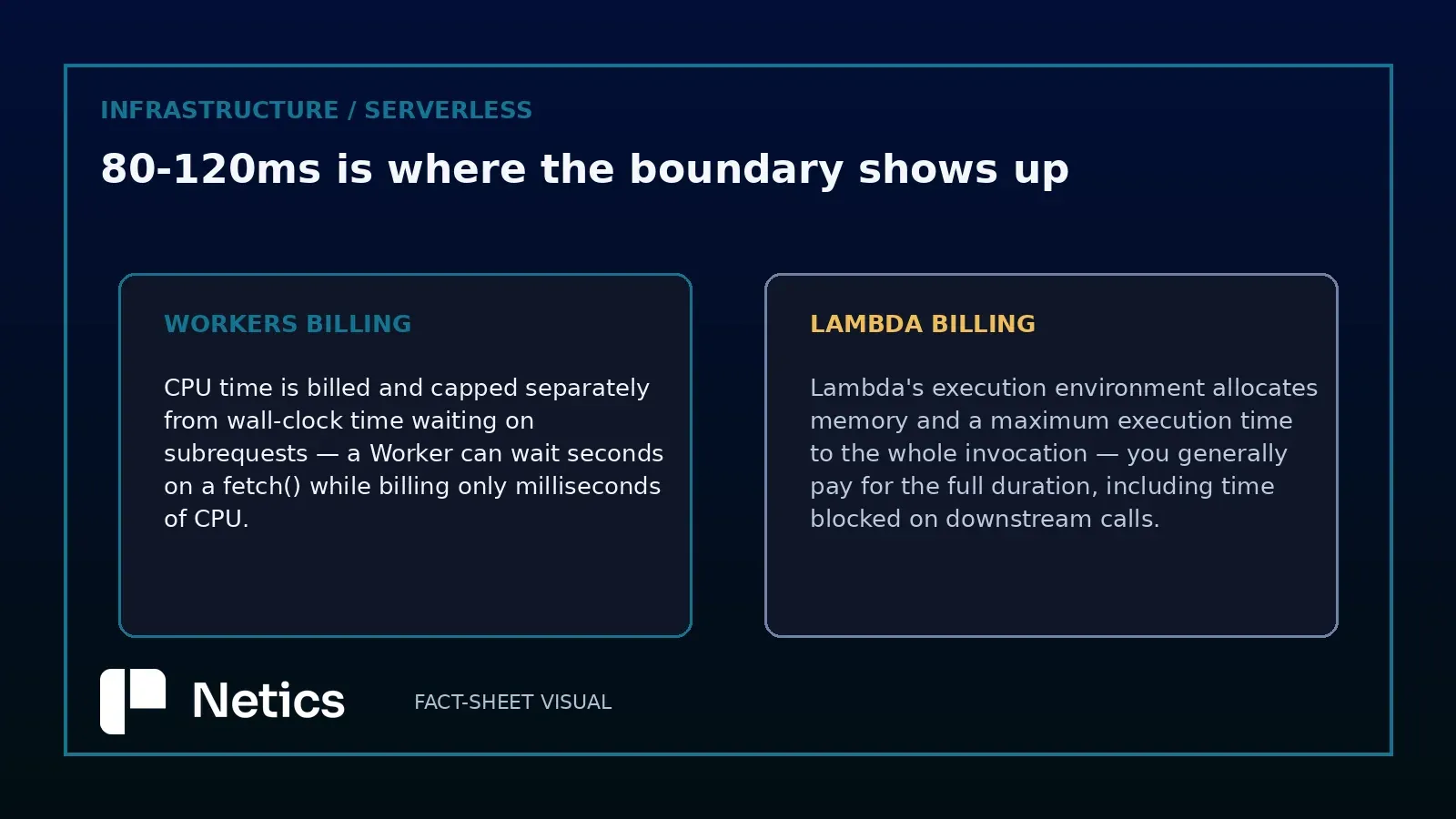
Workers execute inside isolates on Cloudflare's edge network. Per the platform limits page [1], CPU time is billed and capped separately from wall-clock time spent waiting on subrequests — a Worker can be "open" for seconds waiting on a fetch() to an origin while consuming only milliseconds of billable CPU. This is fundamentally different from Lambda, where the execution environment lifecycle [2] allocates memory and a maximum execution time to the whole invocation, and (outside of provisioned concurrency nuances) you are generally paying for the full duration a function is actively processing, including time blocked on downstream calls.
Practically: a Worker proxying to a slow third-party API is cheap. A Lambda function doing the same thing pays for every second it waits, unless you offload the wait (e.g., async patterns, Step Functions, or increasing memory to also increase allotted CPU).
Lifecycle and cold starts
Lambda's lifecycle is explicit: Init (bootstrap the runtime and your code), Invoke (run your handler), and Shutdown (environment reused or torn down), as described in AWS's runtime environment guide [2]. Init is where cold-start latency accumulates, especially for runtimes with heavier bootstrap (JVM, .NET) or large deployment packages.
Workers, running as V8 isolates rather than containers, avoid most of that bootstrap tax by design — there's no OS-level container to spin up. This is a genuine architectural advantage for latency-critical, globally distributed request paths. It is not, however, a free pass on discipline: Workers still enforce script size, subrequest counts, and per-request CPU ceilings documented on the limits page [1], and exceeding them fails the request rather than degrading gracefully.
Deployment compatibility: a Workers-specific risk
One difference teams underestimate: Cloudflare Workers uses compatibility dates [3] to gate runtime behavior changes. A Worker pinned to an old compatibility date can silently diverge from a newly deployed one if you're not managing that field as part of your release process. Lambda has no equivalent per-function dial — you select a runtime version explicitly (e.g., Node.js 20.x) and AWS deprecates it on a published schedule. Both models require active maintenance; Workers' compatibility date is a lighter-weight lever but an easy one to forget in CI/CD.
Event integration and observability
Lambda's core value proposition, per AWS's Lambda overview [4], is deep native integration with the rest of AWS: EventBridge, SQS, DynamoDB Streams, S3 events, Step Functions, and IAM-scoped permissions per function. If your architecture already lives in AWS, this integration is Lambda's strongest argument — you get event sourcing, retries, dead-letter queues, and X-Ray tracing largely "for free" as configuration rather than code.
Workers integrate primarily with Cloudflare's own edge products (KV, Durable Objects, R2, Queues, D1) and with any HTTP-reachable service. That's broad in practice — Workers can call any API — but it lacks the fine-grained, IAM-native event plumbing AWS offers for internal AWS-to-AWS event flows.
Pros and cons
- Cloudflare Workers
- Pros: near-zero cold starts via isolates; CPU-time billing excludes network wait (per the limits doc [1]); global edge placement by default; predictable flat pricing tiers per the pricing page [5].
- Cons: request/CPU/subrequest ceilings are stricter and less configurable than Lambda's memory-driven CPU scaling; compatibility dates add a maintenance surface; native integrations are Cloudflare-ecosystem-specific.
- AWS Lambda
- Pros: mature, deep integration with the broader AWS event and IAM ecosystem per the Lambda overview [4]; configurable memory/CPU/timeout per function; strong tooling (Step Functions, X-Ray, provisioned concurrency) for complex workflows.
- Cons: container-based Init phase means real cold-start risk on heavier runtimes; you generally pay for time spent waiting on downstream calls, per the runtime environment doc [2]; regional by default unless you explicitly build multi-region.
Decision matrix
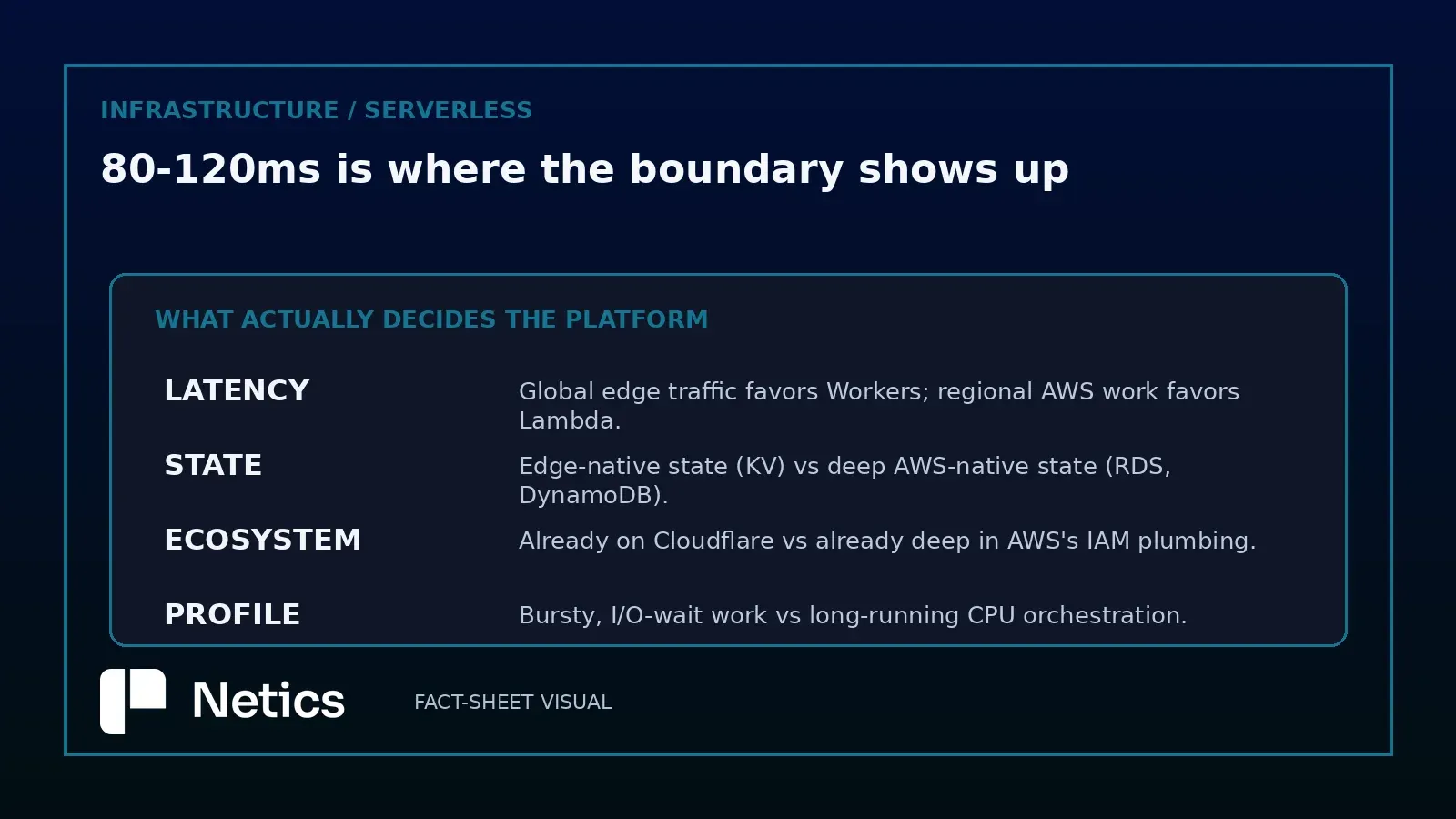
| Factor | Favor Cloudflare Workers | Favor AWS Lambda |
|---|---|---|
| Latency to end user | Global, edge-first traffic (auth, redirects, personalization) | Regional/backend workloads already near AWS services |
| State dependency | Stateless or edge-native state (KV, Durable Objects) | Deep AWS-native state (RDS, DynamoDB, S3) |
| Execution profile | Short, bursty, I/O-wait-heavy | Long-running, CPU-heavy, orchestrated workflows |
| Ecosystem lock-in | Already on Cloudflare (DNS, CDN, WAF) | Already deep in AWS (VPC, IAM, EventBridge) |
| Cost predictability | Flat-rate paid tier, minimal surprise scaling costs | Pay-per-GB-second, needs monitoring at scale |
| Team familiarity | Comfortable with V8 isolate constraints | Comfortable with container/runtime lifecycle |
(Pricing figures referenced here are as published on the Cloudflare Workers pricing page [5], dated to that documentation rather than restated as fixed numbers, since terms change over time.)
A hypothetical example
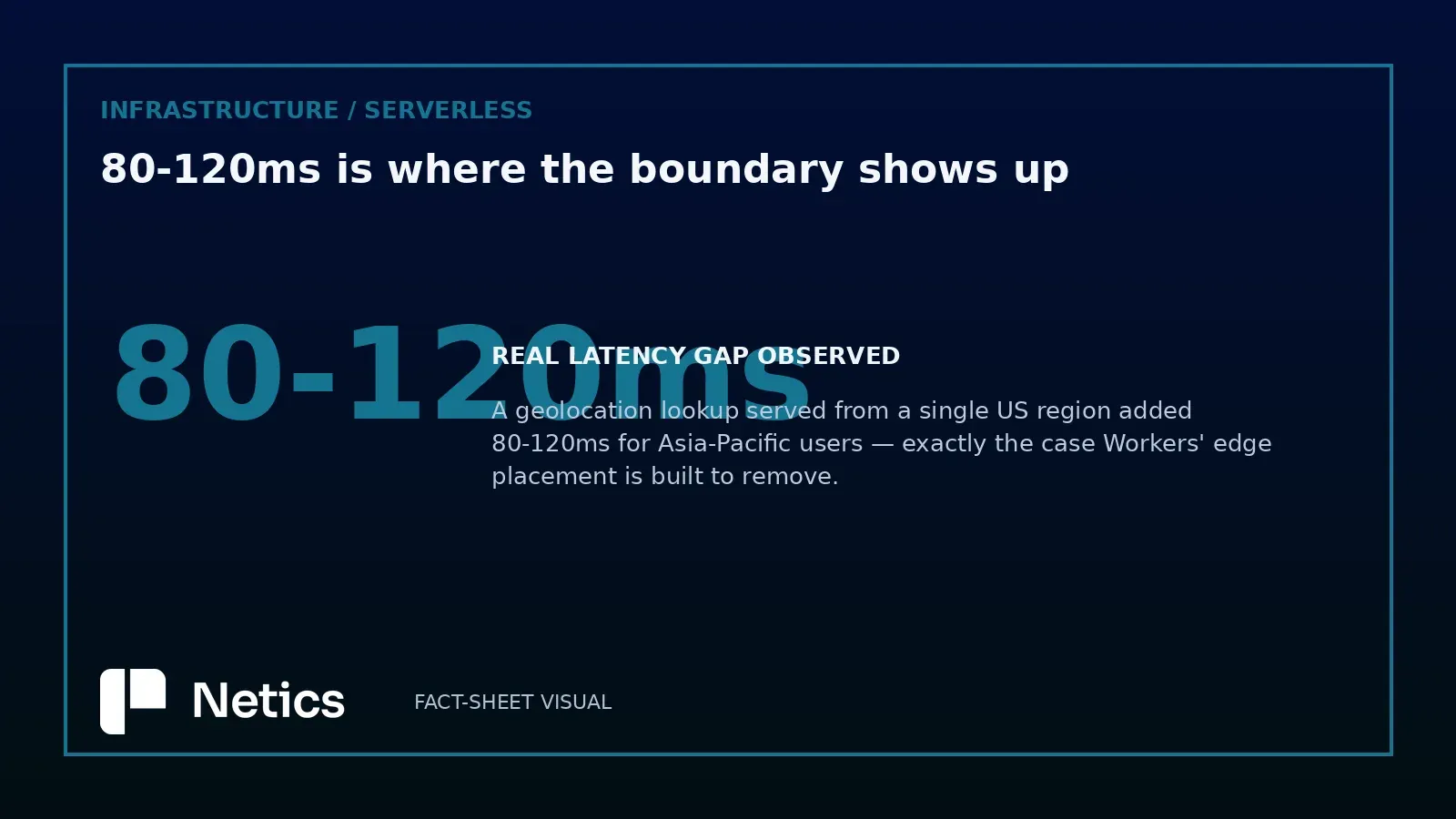
Say a mid-sized e-commerce company runs its checkout flow on AWS (RDS for orders, DynamoDB for cart state, Step Functions for fraud checks) but has recently noticed that its geolocation-based currency and tax-rate logic — a lightweight lookup executed on every page load — adds 80–120ms of latency for users in Asia-Pacific because it's served from a single US region.
A pragmatic split: keep the checkout and fraud orchestration on Lambda, where it already benefits from tight IAM scoping and Step Functions retries. Move the currency/tax lookup to a Cloudflare Worker sitting in front of the same origin, using KV to cache exchange rates at the edge. The Worker absorbs the latency-sensitive, high-frequency, low-compute part of the request; Lambda keeps the stateful, AWS-integrated part. Neither platform is replaced — the boundary is drawn at the point where latency sensitivity and state depth diverge.
Where to go next
For teams evaluating this split seriously, the two documents worth reading end-to-end before committing to an architecture are Cloudflare's platform limits [1] page and AWS's Lambda execution environment [2] guide — both are more load-bearing for real capacity planning than either vendor's marketing comparisons.
For more infrastructure comparisons like this one, visit the Netics homepage or book a free 30-minute audit.