
Worker Previews Give Every Change a Place to Prove Itself
Cloudflare Worker Previews give each Git branch its own production-like environment — URL, state, and observability included. Netics on why this is the missing evidence loop for agent-writte

TL;DR
- Cloudflare launched Worker Previews on September 22, 2026: every Git branch gets a production-like environment with its own code, configuration, URL, observability, and state.
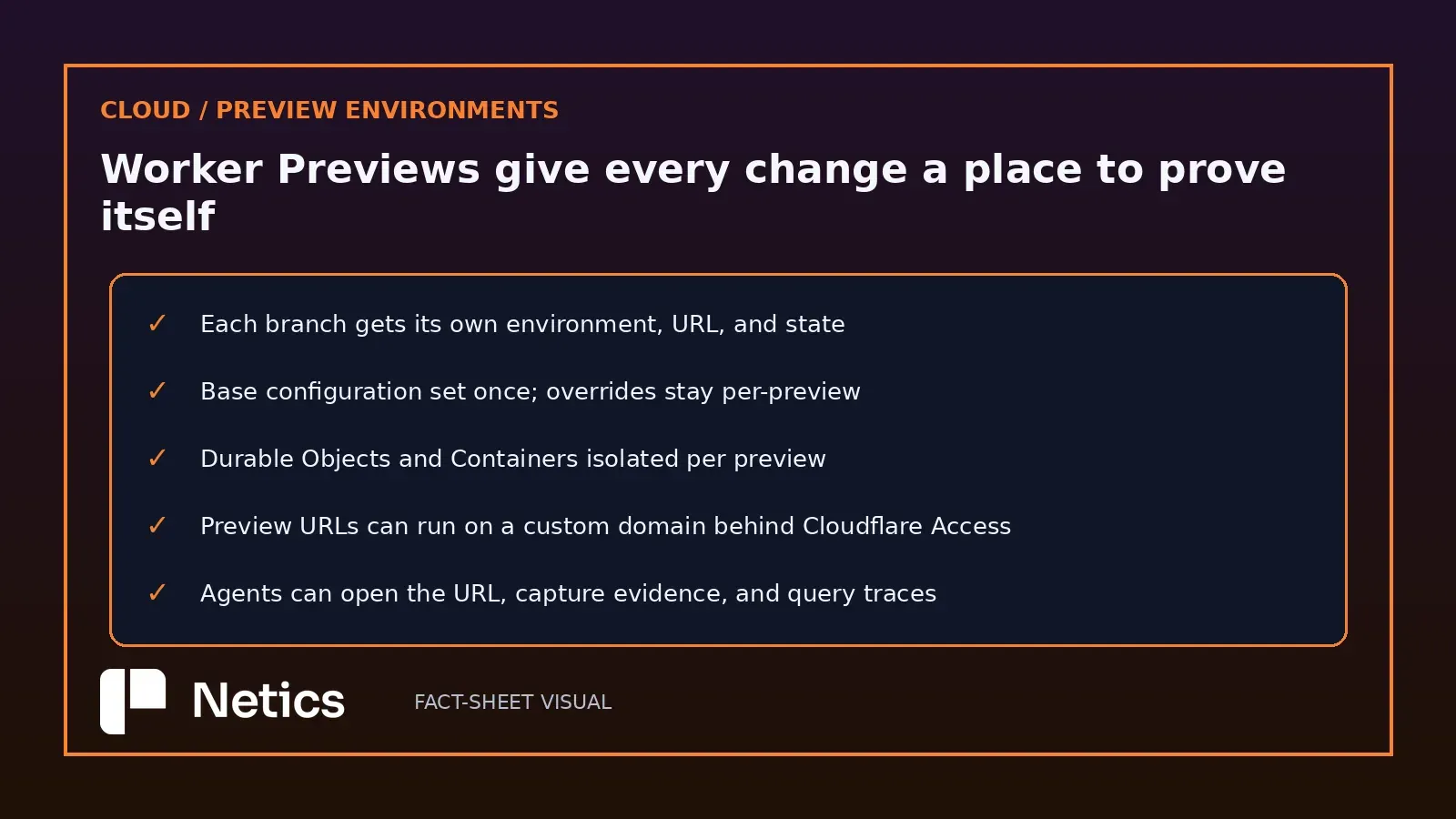
npx wrangler previewcreates an isolated Preview per branch — separate variables, secrets, and bindings — with Durable Objects and Containers scoped to that branch only.- Preview URLs are stable per branch, can sit on a custom domain, and can be protected with Cloudflare Access.
- Observability is scoped per Preview: logs, errors, metrics, and traces; agents can open the URL, capture evidence, and close the loop without touching production.
- Netics' take: the real product is not another staging environment — it is an evidence loop that lets agent-written code prove itself before merge.
The environment is the missing half of code review
Code review answers "is this code right?" by reading it. Worker Previews answers a different question, one that reading cannot answer: "does it behave correctly while actually running?" Cloudflare's launch post frames it as extending the branch model beyond code — each branch gets its own environment and URL, so contributors stop fighting over a shared staging site and validate runtime behavior before production sees it.
That framing matters more than the feature list. Preview environments turn every pull request into a running system, not a patch that will be judged by review alone. Cloudflare is explicit about why this matters right now: agents are pushing more code than ever, and larger changes mean more ground needs to be tested before release. The environment is the layer that absorbs that extra testing without slowing the agent down.
State isolation is the part that actually protects you
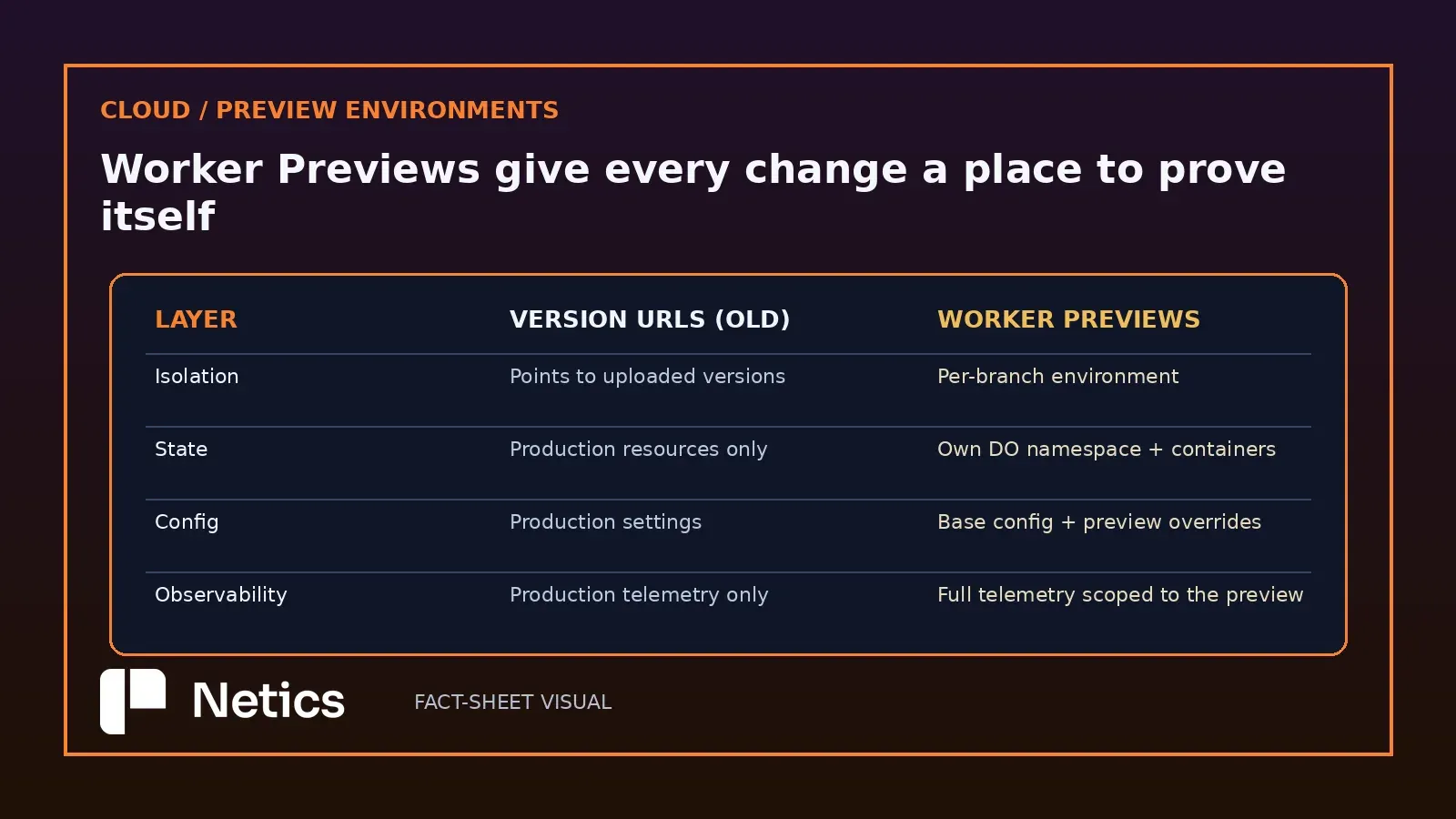
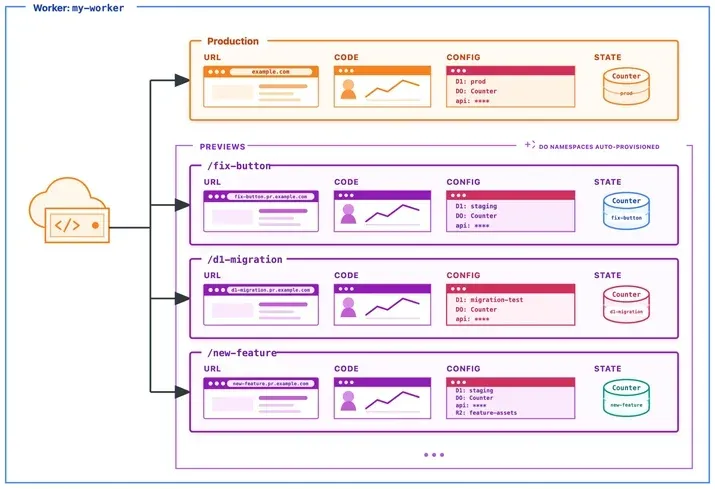
The design detail worth stopping on is Durable Objects. A Durable Object runs on a singleton model: one instance owns a given object ID and its storage. If a Preview shared the production DO namespace, a failed migration or a bad schema change would not just read stale data — it could mutate the same instance serving live traffic. Cloudflare therefore creates a new DO namespace and Container application for every Preview, resolved through ctx.exports so code stays identical while the namespace differs per environment.
The same logic extends to configuration. You set a base configuration once — variables, secrets, bindings, bucket names — and every Preview starts from a copy of it, exactly like a branch starts from main. Then you override per Preview when needed: point a migration branch at its own database or its own test API key, without touching production, the base, or other Previews. This is the configuration model that makes "hundreds of simultaneous Previews" safe, because no two Previews share stateful resources by default.
Observability scoped to the change, not the fleet
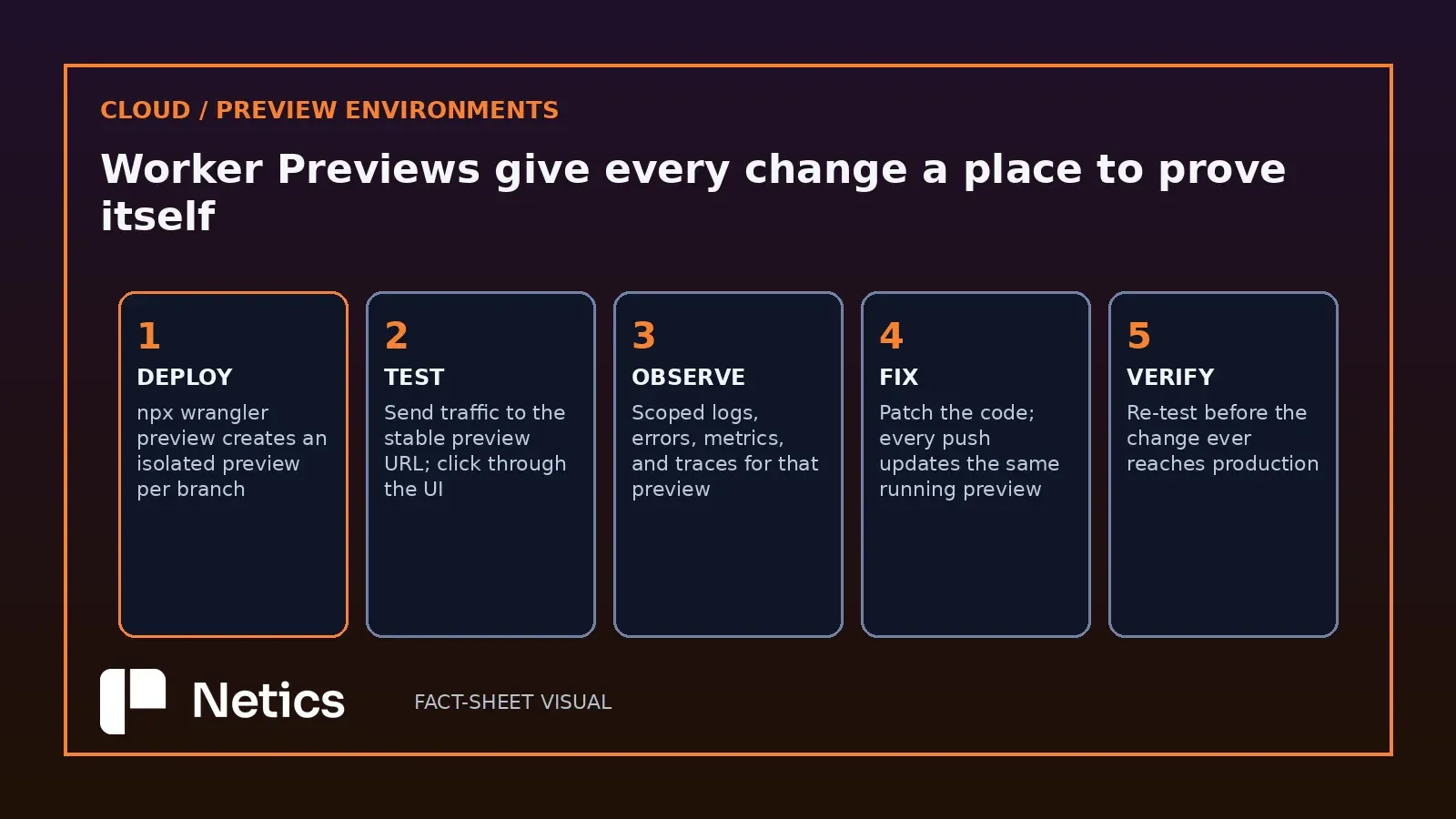
A preview environment that cannot be inspected is only half useful. Cloudflare scopes Workers Observability per Preview: events, errors, and traces show the full lifecycle of each request — fetch calls, binding operations, handler invocations — without sorting through production traffic or other changes. For an agent, that scoped telemetry is a feedback channel: open the Preview URL in a headless browser via Browser Run, capture what rendered, connect a failed request to its trace, patch, redeploy, and verify. Every iteration stays scoped to the branch.
Custom domains close the remaining gap with production behavior: OAuth redirects, cookies, CORS, and auth providers behave the same on feature-login.previews.example.com as they will on the real domain — and Cloudflare Access can keep private previews signed-in only. Teams that test login flows know exactly why this matters: callback URLs that differ between staging and production are a classic "works in staging, breaks in prod" trap, and this is the fix at the platform level rather than the config level.
What this changes for teams running agents
The agent angle is where the launch becomes strategic rather than convenient. Cloudflare dogfoods the product on exactly this use case: CloudflareOS, its open-source platform connecting agents to company systems, deploys an isolated Preview of Gatekeeper changes for every change under review, because a bug in a Gatekeeper could expose data or permit an action that should never have been allowed. Some failures only appear when OAuth callbacks, permissions, approval flows, and application state run together — which is precisely what a full-environment preview exercises and what unit tests cannot.
Three patterns are worth taking from this. First, treat the Preview URL as the agent's own QA environment: the agent opens it, clicks through, queries the traces, and iterates until the evidence is clean. Second, use Preview isolation as a blast-radius boundary: schema migrations, configuration experiments, and cold-start tuning all get a playground that cannot touch production state. Third, protect previews that touch sensitive flows with Cloudflare Access rather than hoping they stay undiscovered.
The older "preview URLs" are now called Version URLs, and the distinction is the article's quiet thesis: a Version URL points at an uploaded artifact that still runs against production resources, while a Preview is a real isolated environment. If you already run Cloudflare Sandboxes for agent execution, Worker Previews slot in one layer up: Sandboxes isolate what the agent runs in, Previews isolate where the change gets validated. Both are control-plane primitives, and together they make agent-written code testable without trusting the agent. For a practical pass over isolating your own agent-driven deploys, the Netics homepage is where we start.
Sources
- Introducing Worker Previews: isolated preview environments for every change your agent makes — Cloudflare Blog, September 22, 2026.
- Worker Previews documentation — Cloudflare Developers, accessed September 23, 2026.
Source: "Introducing Worker Previews: isolated preview environments for every change your agent makes" — blog.cloudflare.com, September 22, 2026.