
Vulnerability Remediation Needs Production Context, Not Another Bigger Scanner
Cloudflare’s context-aware remediation service points to a better security priority: prove exposure, controls, and validation before asking teams to patch.

TL;DR
Cloudflare’s early-access Vulnerability Discovery and Remediation service makes a useful argument: a vulnerability finding is not yet a remediation priority. The real problem is triage after detection, and a practical evaluation checklist should test the evidence chain. The service combines customer-authorized code with route, traffic, security, and WAF context; uses Web Assets and Workers Observability; sends reconnaissance and hunter agents through an OpenAI Daybreak path including GPT-5.6 Cyber; corroborates findings against source code; and uses synthetic validation before proposing a patch or mitigation. The model does not apply patches, and the proposed rule scope is conservative. The Netics position is that this evidence-first pattern is more valuable than another race to produce findings, provided customers can inspect and challenge every step.
The real problem is triage after detection
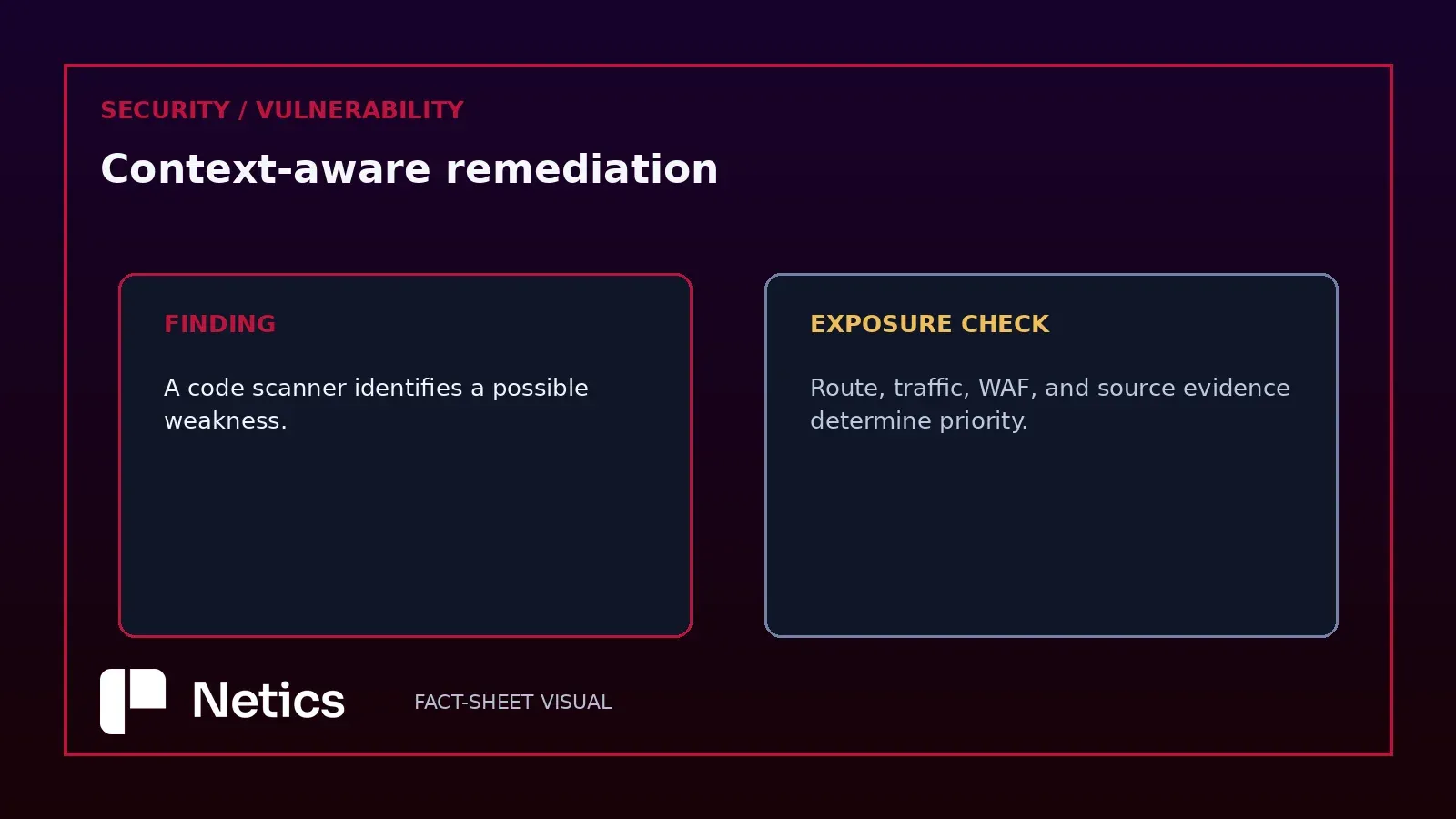
The Cloudflare announcement starts with an uncomfortable operational question: what should a team fix when a scanner produces 4,000 new vulnerabilities, including 78 marked critical? The arithmetic is not the point. The bottleneck is deciding which result describes meaningful production risk and which result is merely a weakness in code that is unreachable, unused, or already constrained by another control.
The distinction matters because modern discovery tools are becoming very good at increasing the size of the queue. More findings can look like more security while leaving the decision process unchanged. A security lead still needs to know whether the affected code is deployed, whether its route is active, whether attackers are probing it, and whether a WAF rule already limits the path. A list without that context transfers work to humans; it does not remove the work.
Cloudflare is adding context to the finding
Cloudflare’s early-access service sits inside Managed Defense and is described as invitation-only. Customers authorize access to their codebases. The service then joins code-level investigation with signals available through Cloudflare’s network and security products.
The combination is the important design choice. Route activity, traffic volume, surrounding security events, and existing WAF protections can change how a finding should be prioritized. A handler that exists in a repository is a different problem from the same handler running on a heavily used route with recent attack activity and no relevant protection. The underlying weakness may be identical; the operational response should not be.
Web Assets and Workers Observability matter because inventory is evidence
The named product context is not decorative. Web Assets helps establish what internet-facing assets and routes exist, while Workers Observability supplies operational visibility around Workers workloads. Together with traffic and security telemetry, they give the investigation a chance to answer questions that static scanning cannot answer by itself.
The lesson for buyers is broader than Cloudflare’s product boundary. Vulnerability management should have an evidence chain from repository to deployed asset to observed behavior. If those layers are kept in separate dashboards, the prioritization meeting becomes an exercise in manual correlation. If they are connected, the team can ask a sharper question: what is exposed, what is being exercised, and what protection is already operating?
This still requires discipline. Visibility is not proof of exploitability. A route can be active without the vulnerable branch being reached. Traffic can be legitimate. A WAF event can be related without being a complete mitigation. Context improves judgment; it does not eliminate the need for it.
Reconnaissance and hunter agents should produce leads, not authority
Cloudflare describes reconnaissance and hunter agents working through the OpenAI Daybreak Defense Network, including the external OpenAI Daybreak model path and GPT-5.6 Cyber. The use of named agents is meaningful because it frames the models as parts of a pipeline rather than as an oracle that returns a final answer.
Reconnaissance can map the relevant surface. Hunter agents can look for suspicious or vulnerable patterns. Neither role should be allowed to silently turn a model hypothesis into a production change. The useful output is a lead with enough context for another stage to test it.
The separation is especially important when the same system is given access to customer-authorized code. Authorization to inspect code is not authorization to change it. A mature service treats access scope, investigation scope, and remediation scope as separate permissions.
Source-code corroboration is the trust boundary
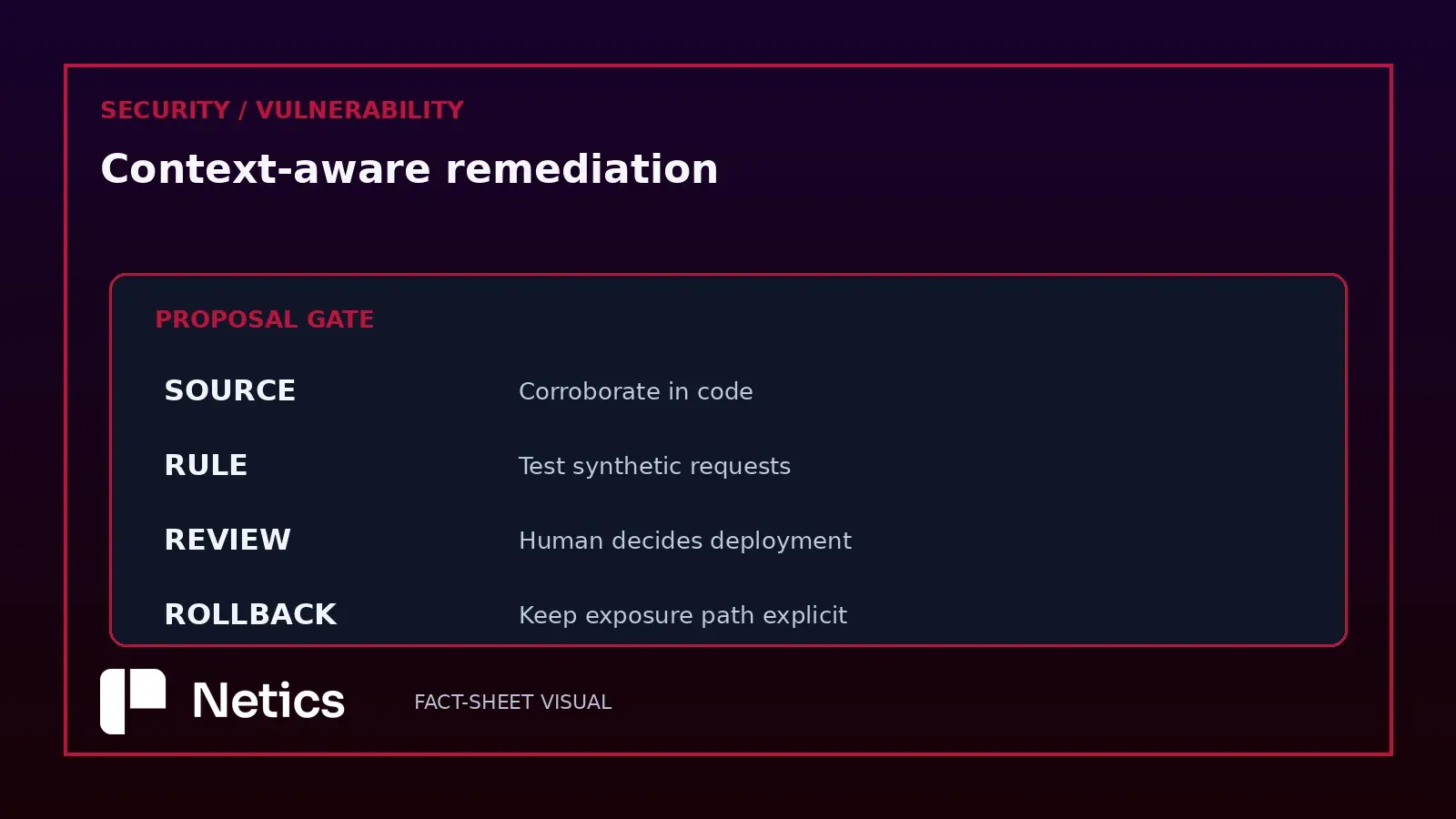
The announcement says findings are corroborated against source code before they become remediation proposals. That is the right direction. A model may notice a suspicious request flow or infer that a route is exposed, but the final claim should be tied back to the actual code path and its conditions.
Corroboration should answer concrete questions: which function or handler is involved, which input reaches it, what sanitization or authorization occurs first, and which deployment path contains the code? It should also be honest when the evidence is incomplete. A plausible explanation is not the same as a demonstrated path.
For Netics, this is the minimum standard for AI-assisted security work. Keep the model’s discovery separate from the evidence that supports the claim. Store the relevant code reference, observed asset, and reasoning trail so an engineer can reproduce the conclusion without trusting the model’s confidence score.
Synthetic validation is where a hypothesis meets behavior
Cloudflare also describes synthetic validation of proposed findings and mitigations. This is the bridge between static reasoning and runtime evidence. A proposed fix should be exercised in a controlled way to test whether the vulnerable behavior is actually blocked and whether the intended application behavior remains available.
Synthetic validation is not permission to conduct uncontrolled exploitation. Its value comes from bounded tests, explicit authorization, and a clear stop condition. The test should be designed around the proposed change, not around a desire to produce a dramatic exploit narrative. A useful report distinguishes three outcomes: the finding was reproduced, the finding was not reproduced under the available conditions, or the test was inconclusive.
The vocabulary matters. Security programs lose time when “not observed” is reported as “safe,” or when a model-generated exploit sketch is treated as proof. Validation should reduce uncertainty, not hide it behind a green badge.
No model-applied patches is a necessary constraint
Cloudflare says the service may propose code patches and other mitigations, but customers decide whether they are implemented. That human decision point is not a weakness in the workflow. It is the control that keeps a probabilistic system from becoming an unreviewed deployment actor.
A patch proposal still needs normal engineering review: tests, ownership, dependency awareness, rollback, and evidence that the change addresses the identified path. The same applies to a custom WAF mitigation. A rule can reduce exposure while introducing false positives, hiding an application defect, or creating a maintenance burden.
The service’s value should therefore be measured by the quality of decisions it supports, not by how many patches it can generate. Faster suggestions are useful only when the review boundary remains explicit.
Conservative rule scope beats theatrical blocking
The source emphasizes proposed custom WAF mitigations tailored to the customer’s systems. Netics’ view is that conservative scope should be the default. Start with the affected route, method, parameter, or attack shape that the evidence supports. Do not block an entire class of traffic merely because a model found one plausible weakness.
A narrowly scoped rule can be observed, tested, expanded, or removed. A broad rule can create a second incident while the original vulnerability is still being investigated. Teams should record why the rule exists, what signal activates it, which legitimate flows were tested, and when it will be revisited.
The principle also protects the application team from a false choice between “patch immediately” and “accept the risk.” A temporary, measurable mitigation can buy time for a code fix without pretending that the code is repaired.
The business decision is evidence quality, not model branding
The Cloudflare announcement names OpenAI Daybreak and GPT-5.6 Cyber, but buyers should not reduce the decision to a model leaderboard. The durable question is whether the service connects model output to authorized data, production context, source-code corroboration, synthetic validation, and a customer-controlled remediation step.
Those controls are portable. A different model could fill the discovery role tomorrow. The evidence contract should remain the same. If a vendor cannot show how it limits access, preserves provenance, tests findings, and exposes proposed changes for review, the model name is an insufficient reason to trust the workflow.
The Netics position
Context-aware vulnerability remediation is a better direction than indiscriminate scanning, but it is not an excuse to automate judgment away. Cloudflare’s Managed Defense service is most compelling where it joins Web Assets, Workers Observability, route and traffic signals, security activity, WAF state, source-code corroboration, and synthetic validation into one reviewable chain.
Our position is simple: let agents investigate broadly, but require evidence to narrow the claim and humans to authorize the change. Keep code access customer-authorized. Keep patches model-proposed rather than model-applied. Keep WAF rules conservative and observable. The winning security platform will not be the one that reports the most vulnerabilities. It will be the one that helps a team defend a smaller, better-supported list of decisions.
A practical evaluation checklist
Before adopting a context-aware remediation service, ask for a demonstration using a safe, customer-authorized repository and a non-production environment. Check whether the workflow identifies the deployed asset, route activity, traffic, surrounding security events, and existing WAF coverage. Ask to see the source-code evidence behind a finding and the exact synthetic validation performed.
Then inspect the handoff. Can engineers reject a proposal? Are code patches and WAF mitigations separate choices? Is rule scope explicit? Can the team reproduce the reasoning and roll back the mitigation? Those questions matter more than a claim that an agent found a vulnerability in minutes.
For a broader infrastructure and security architecture discussion, visit Netics. To review an evidence-first remediation workflow, book a free 30-minute audit.
Sources
- Cloudflare Blog: Introducing context-aware vulnerability discovery and remediation with Cloudflare Managed Defense and OpenAI Daybreak models — published September 3, 2026; source captured for this draft.