
Bot Preference Sync Defines a Governance Boundary
Cloudflare’s Bot Preference Sync can reduce robots.txt drift, but AI crawler governance still needs enforcement, exceptions, and evidence.

Source: Cloudflare: Say it once: introducing Bot Preference Sync
TL;DR
Cloudflare’s Bot Preference Sync keeps robots.txt aligned with configured Search, Agent, and Training preferences. It can reduce policy drift and preserve existing directives, but robots.txt remains a cooperative signal. Category-wide defaults do not replace edge enforcement, exception handling, or evidence that a crawler followed the policy. Netics’ position is simple: synchronize the declaration, then verify the control. The article explains what Cloudflare synchronizes, the governance gap between categories and exceptions, and what European teams should verify.
What Cloudflare actually synchronizes
Cloudflare’s announcement addresses a practical operations problem. A site can declare one preference in robots.txt while its enforcement rules do something else. That gap makes policy difficult to explain and gives crawlers an excuse to treat the declaration as unreliable.
Bot Preference Sync connects the AI bot configuration in a Cloudflare zone to the corresponding robots.txt preferences. The feature covers three categories: Search, Agent, and Training. Cloudflare describes options such as allowing a category, blocking it on pages that serve ads, or blocking it everywhere. For Training, the Disallow option writes a no-training preference into robots.txt.
The mechanism is intentionally simple. Cloudflare generates or updates the relevant lines and prepends them to an existing robots.txt file, preserving the directives already present. The goal is not to replace the site owner’s file with a new one. It is to make the declared preference reflect the configuration that already exists at the edge.
Why robots.txt is not enforcement
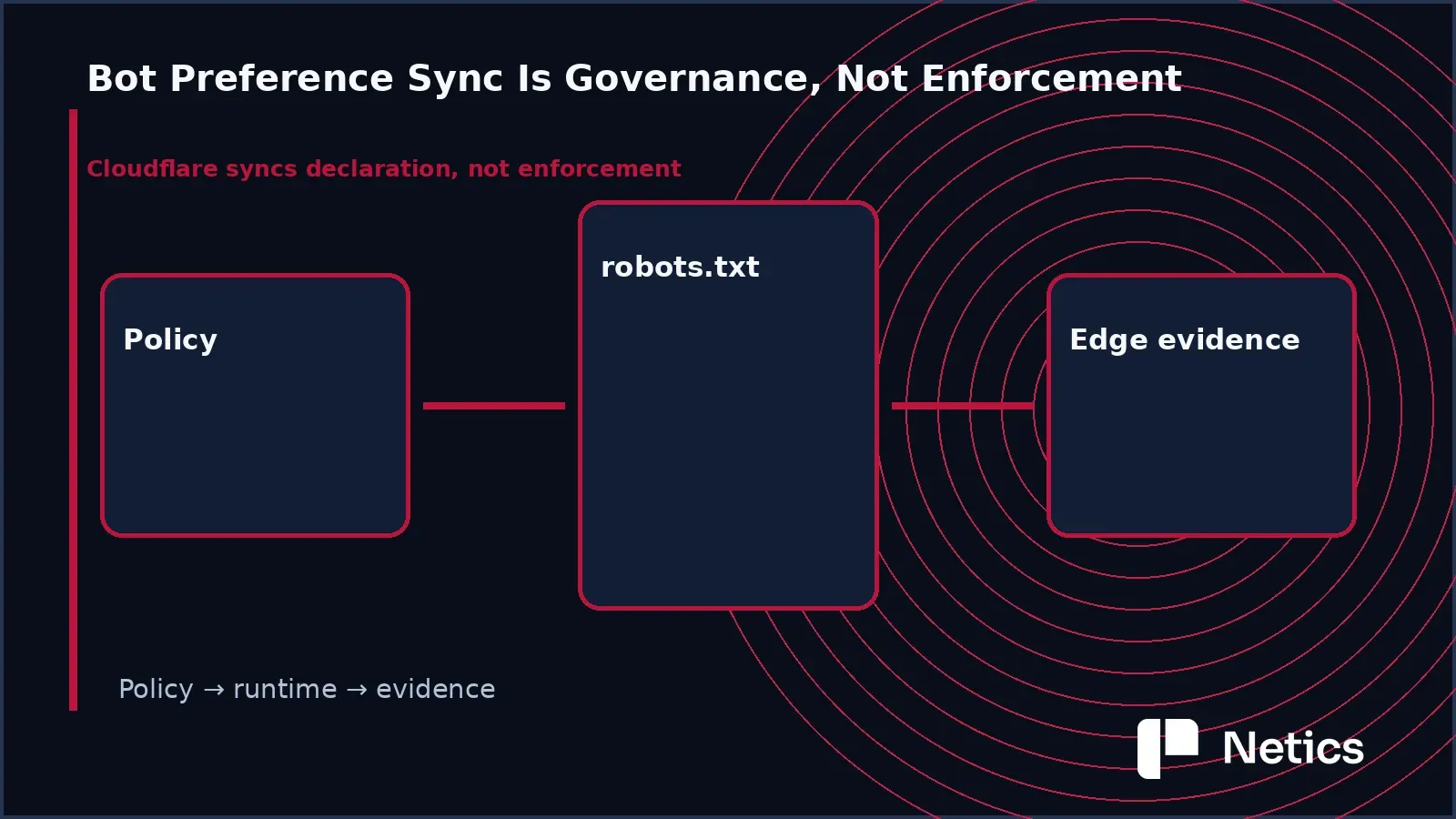
A robots.txt directive is a request to cooperating crawlers. It is not an access-control system. A crawler may ignore it, misidentify itself, or combine search, agent, and training behavior behind one identity.
Cloudflare itself distinguishes stated preferences from mechanisms that actually block traffic. That distinction matters for AI governance. A synchronized file can reduce contradiction, but it cannot guarantee that an uncooperative crawler will stop. If the content is sensitive, the enforcement layer must still sit at the edge, application, origin, or identity boundary.
This is also why “AI crawler control” is too broad a label for a single file. Search visibility, agent access, and model training are different business decisions. A publisher may want to remain discoverable in search while disallowing training. An ecommerce company may want product pages visible to assistants but limit automated extraction elsewhere. A single Allow or Disallow label cannot express every exception.
The governance gap between categories and exceptions
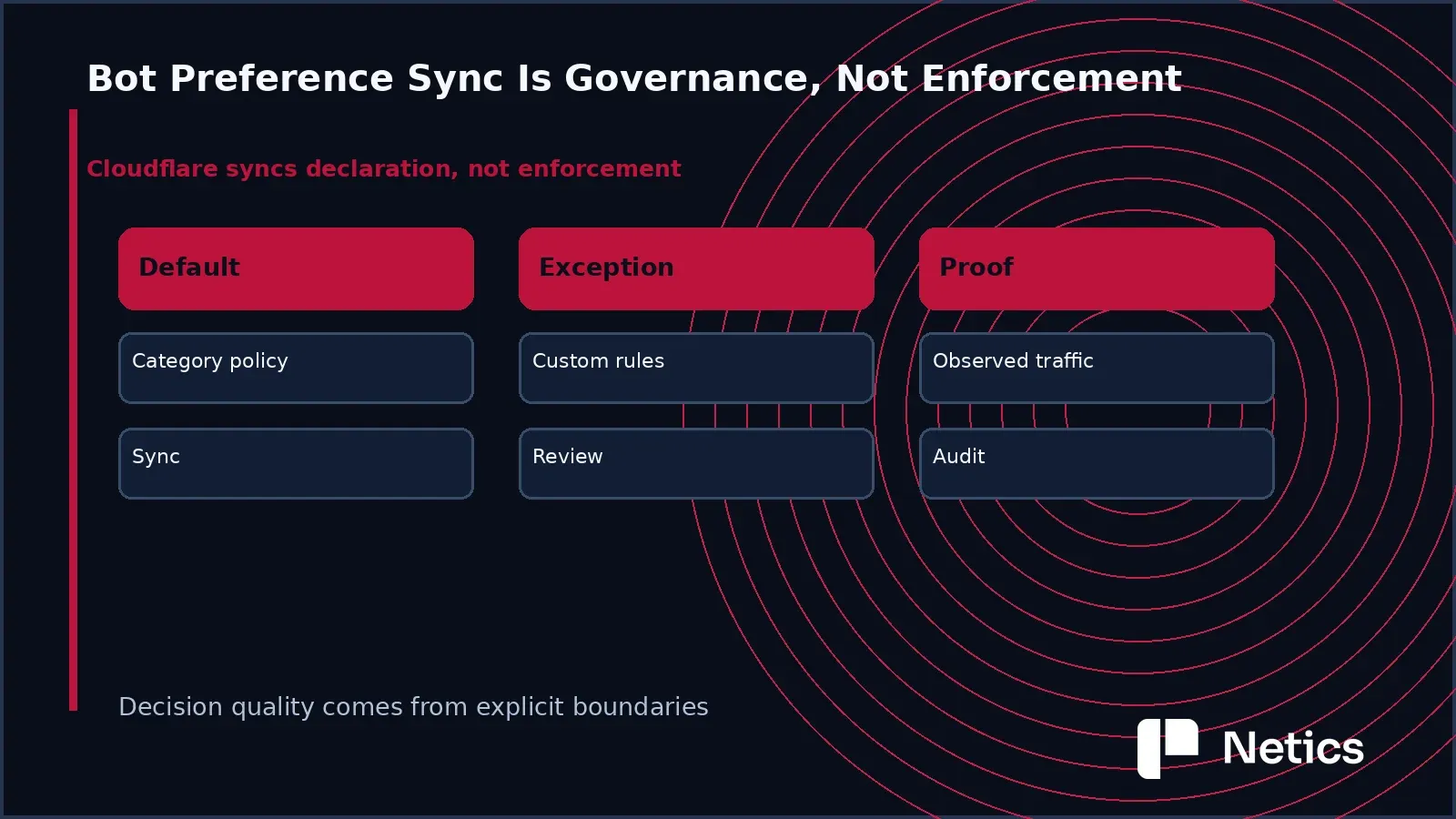
Bot Preference Sync works at category level. Cloudflare says it will not directly read individual custom rules with more complex logic. Customers with finer policies can turn off the synchronization and maintain a custom file that matches their security policy.
That is a healthy boundary, but it creates an operational decision. Teams need to decide which policy is authoritative when the category default and an exception disagree. They also need ownership: who approves a new crawler classification, who reviews the exception, and what evidence proves that the exception is still valid?
A synchronized default without an exception process can become another form of drift. The file stays technically current while the business policy becomes stale.
A Netics operating model for AI crawler policy
Netics recommends treating AI crawler governance as four linked records:
- Intent: what should Search, Agent, and Training traffic be allowed to do?
- Declaration: what does robots.txt tell cooperating crawlers?
- Enforcement: what happens at the edge when a crawler ignores the declaration?
- Evidence: what logs, classifications, and reviews show that the policy worked?
The first useful test is not “does robots.txt contain the right line?” It is “can the team explain the path from a business decision to a crawler response?”
For a new policy, test both a cooperative and an uncooperative crawler. Verify the generated file, the edge rule, the identity classification, and the audit record. If the organization cannot connect those four artifacts, the policy is a preference, not a control.
This complements Netics’ broader view that AI systems should be governed by explicit permissions rather than vague platform promises. AI agents need controlled access before another cloud platform is the same argument applied to crawlers: define what may happen before optimizing the interface.
What European teams should verify
European publishers and SMEs should verify five things before enabling a synchronized policy:
- whether the default matches the commercial model;
- whether Search, Agent, and Training have separate owners;
- whether existing robots.txt directives are preserved and reviewed;
- whether edge enforcement covers non-cooperating traffic;
- whether crawler decisions and exceptions are auditable.
The legal and commercial question is not solved by a new line in a file. It is solved when the organization can demonstrate what it intended, what it published, what it enforced, and what it observed.
FAQ
Does Bot Preference Sync block AI crawlers?
Not by itself. It synchronizes preferences into robots.txt. Blocking requires enforcement mechanisms and a crawler that respects the published policy.
Can a publisher stay visible in search while disallowing training?
Cloudflare describes that configuration for cooperating mixed-use crawlers that provide the required transparency and honor the robots.txt preference.
Is the synchronized file suitable for complex exceptions?
No. Cloudflare positions the feature around category-wide policy. Complex individual rules may require synchronization to be turned off and a custom policy to be maintained.
Conclusion Netics
For teams reviewing AI crawler governance, the useful test is whether declaration, enforcement, and evidence agree.
Bot Preference Sync is useful because policy drift is real. But synchronization is governance hygiene, not proof of enforcement. A serious implementation keeps the declaration, edge control, exception process, and evidence tied together. Otherwise the organization has made its preference easier to publish—not necessarily harder to ignore.
Source: Cloudflare, Say it once: introducing Bot Preference Sync — https://blog.cloudflare.com/bot-preference-sync/