
Cisco SD-WAN Manager Auth Bypass: Actively Exploited, No Workaround (CVE-2026-76504)
Cisco disclosed CVE-2026-76504, a CVSS 9.8 auth bypass in Catalyst SD-WAN Manager, on September 30, 2026 — and confirmed active exploitation. A URI-encoded character defeats the login rule,

TL;DR
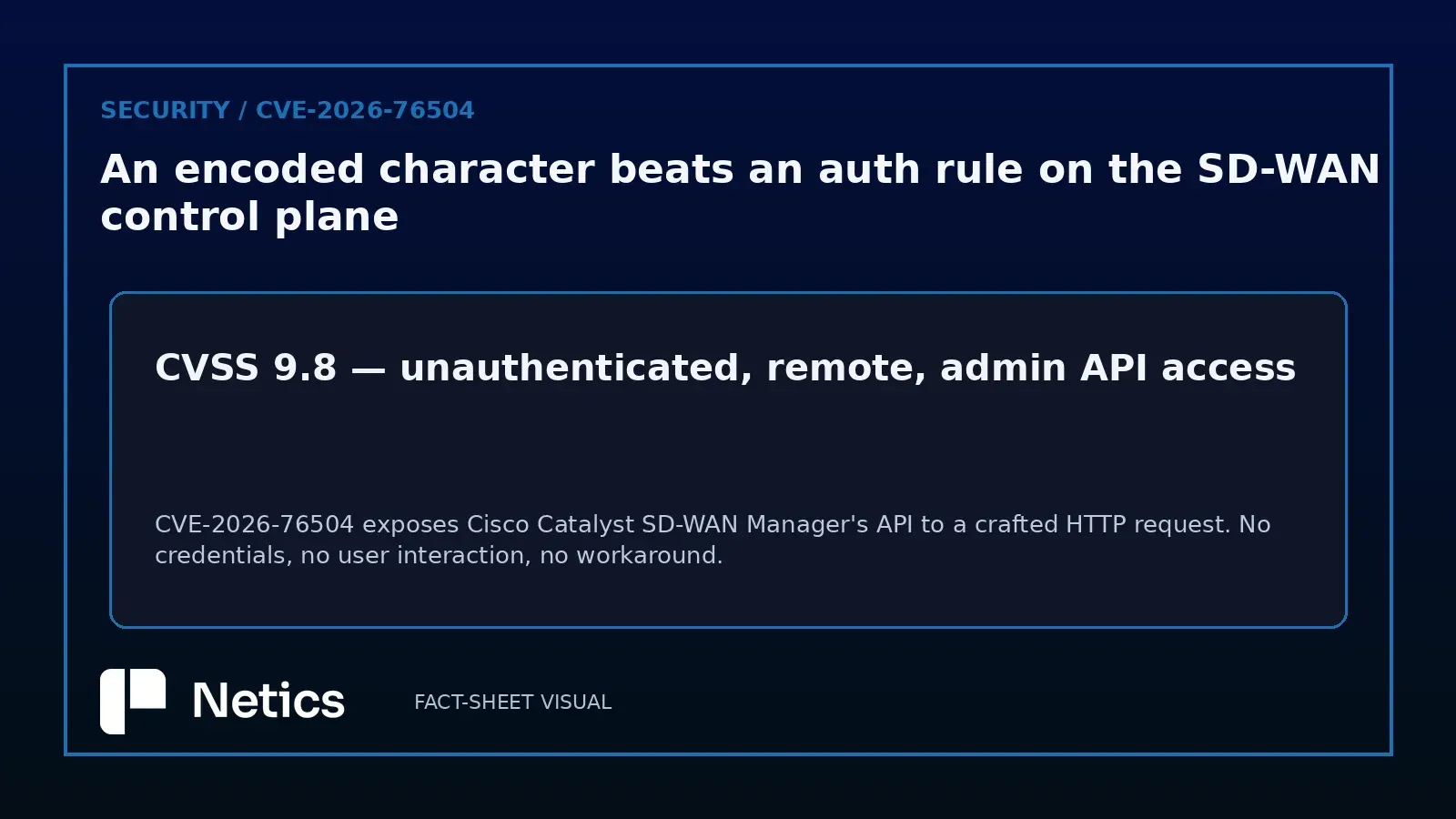
- On September 30, 2026, Cisco published the advisory cisco-sa-sdwan-webauth-xr8beuuU for CVE-2026-76504: a critical authentication bypass in Catalyst SD-WAN Manager, formerly Viptela vManage. Base CVSS score 9.8, CWE-177.
- The cause is narrow and mechanical: improper handling of URI encoding in an HTTP request allows the request to bypass an authentication rule intended to restrict access to a specific API endpoint. No credentials, no user interaction — the endpoint being bypassed is the session-login API of the Manager itself.
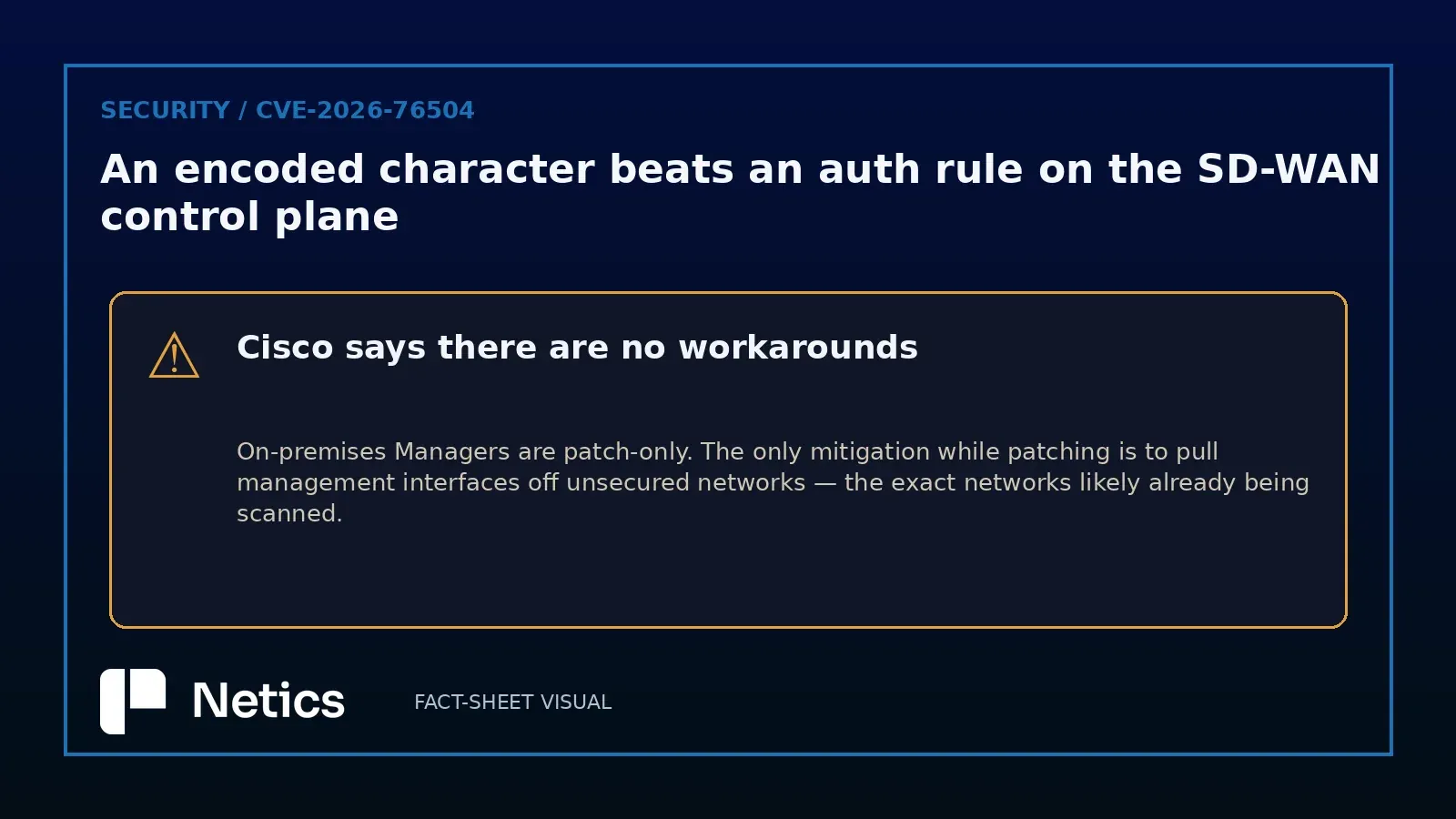
- Cisco explicitly said there are no workarounds, and confirmed that its PSIRT became aware of active exploitation in September 2026.
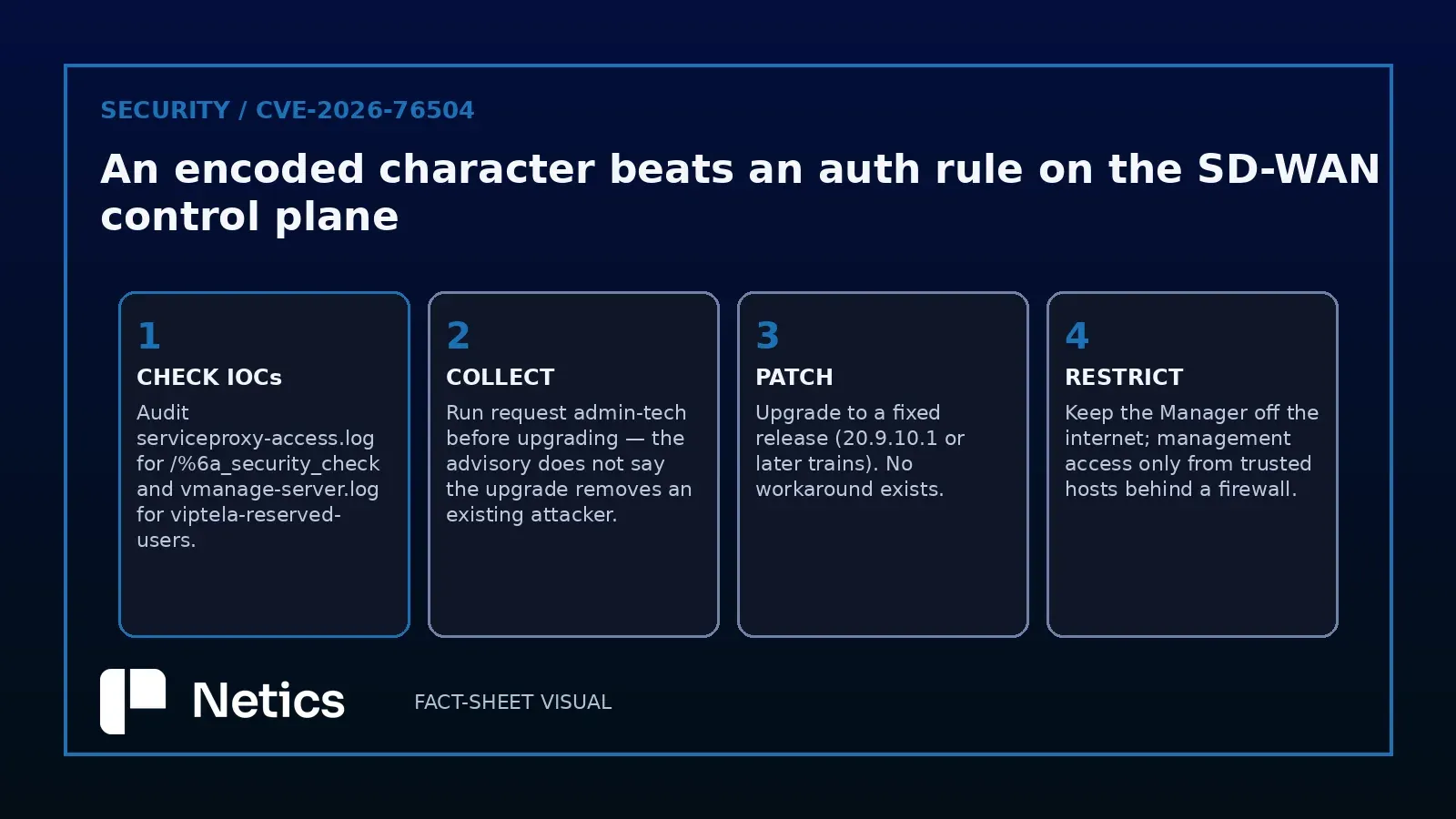
- The response procedure matters more than the patch: Cisco asks operators to run
request admin-techbefore upgrading, and to hunt two log patterns — encodedj_security_checkpaths andviptela-reserved-system accounts. - This is the eighth Cisco SD-WAN flaw CISA has added to its Known Exploited Vulnerabilities catalog in 2026. The management plane of your WAN is a standing target.
What is being bypassed
Catalyst SD-WAN Manager is not a router you configure once. It is the control node for the whole SD-WAN estate: it provisions devices, pushes policies, manages controllers, monitors infrastructure, and coordinates connectivity across every site. Compromise of that node hands an attacker the same reach an administrator has — routing policies, segmentation rules, device configurations, administrative accounts, and site connectivity can all be rewritten from a single pane.
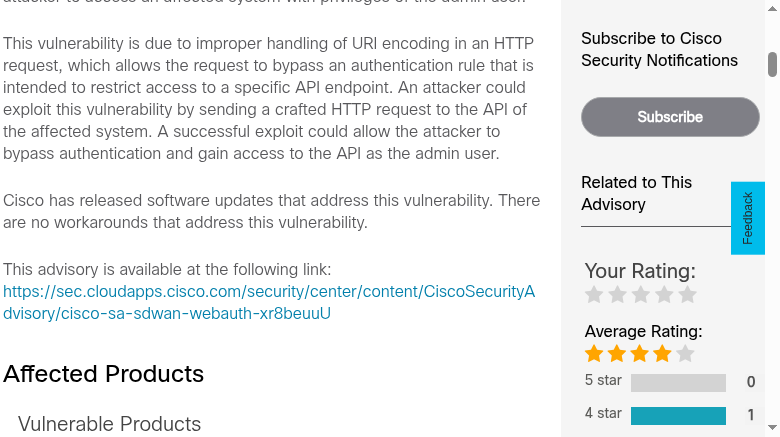
The vulnerability is an authentication-rule bypass on the Manager's API. The flaw sits in "the API session-based authentication management": something in request processing mishandles URI encoding, and a crafted HTTP request can slip past the check that guards one specific API endpoint. Because the affected endpoint is reachable through the Manager's session-login machinery, an attacker who can send the request obtains access with the privileges of the admin user.
The most uncomfortable part is what the advisory does not contain. Cisco lists no detection rule and does not say whether upgrading removes an attacker who already has access. For the company's earlier SD-WAN advisories this year, Cisco told customers an update alone would not resolve a confirmed compromise, and asked them to collect the admin-tech file before upgrading. The same discipline applies here: patch, but treat the patch as prevention, not as remediation of a possible ongoing intrusion.
The mechanism: one character, encoded
The IOC guidance makes the mechanism concrete. Cisco's example shows a request to /%6a_security_check — the letter j, URI-encoded, inside a path the Manager's authentication normally protects. j_security_check is the login path used for session-based authentication; %6a is just the encoded form of j. Cisco is explicit that the example is illustrative: "the vulnerability will allow any one character that is encoded in the request to be used to exploit this."
The detail is the whole story. The authentication rule matches a literal string; the application's request parser decodes the URI before the rule sees it; the two disagree about what the path is. This is the same family of parser-mismatch bugs that shows up in WAF bypasses and proxy edge cases — and it is why the fix cannot be a configuration change. The rule that was bypassed is still the rule; the parser simply no longer feeds it the strings it expects. Only an upgrade to a release where the parser and the rule agree closes the gap.
The IOCs every SD-WAN operator should check tonight
Cisco published two log patterns to audit, and both are checkable without waiting for a package upgrade:
- In
/var/log/nms/containers/service-proxy/serviceproxy-access.log: entries related toj_security_checkfrom unknown or unauthorized IP addresses. Cisco's example shows aPOST /%6a_security_check HTTP/1.1returning a200from an external address pair. - In
/var/log/nms/vmanage-server.log:j_security_checkactivity "for users that include names starting withviptela-reserved-". Those are internal system service accounts — legitimate operators never log in as them, so their appearance in an authentication path is a strong signal the bypass fired.
Why "no workaround" changes the response
Security teams are used to advisories that offer a mitigation: disable a feature, tighten a firewall rule, revoke a token. Cisco publishes none here. The exemption Cisco does give is deployment-specific rather than config-specific — on-premises Managers must be pulled off unsecured networks, and Cisco SD-WAN Cloud Hosted environments already carry the fix.
That is a small comfort on a platform whose entire job is coordinating connectivity across sites. Field Effect's summary of the downstream impact is the realistic one: with administrative access, an attacker can modify routing policies, network segmentation rules, device configurations, administrative accounts, and site connectivity settings — in the worst case, taking control of the system used to manage connectivity across multiple locations. When the fix is patch-only, the upgrade window is the exposure window, and the only lever left is access restriction to trusted management networks and approved administrative hosts.
Order the response deliberately: audit the two log files first because they can be checked now; run request admin-tech and store the output before upgrading; then upgrade to a fixed release and tighten management-plane access. The advisory's fixed-release table runs from 20.9.10.1 through 26.2.1 across six release trains, with 20.15.605 for Cisco SD-WAN Cloud — every supported train has a landing point.
The 2026 pattern behind a single advisory
This advisory is not an isolated incident. As of September 30, CISA's Known Exploited Vulnerabilities catalog listed eight Cisco SD-WAN flaws added in 2026. The pattern across them is the same: flaws in the management plane of a widely deployed enterprise networking product, discovered in the wild, disclosed with exploitation already underway. Importing this into a threat model means the SD-WAN control node is not a low-probability target — it is the highest-value single console in most branch networks, and it is being hunted.
That is also why this advisory deserves the same management-plane scrutiny we gave the NVIDIA Infrastructure Controller hard-coded-credentials disclosure: when a product's control plane becomes the trust boundary, the question stops being "is the product secure" and becomes "can we detect and expel someone already inside." The log IOCs Cisco published here are the detection half. The admin-tech-before-upgrade instruction is the honest admission that the second half depends on operational discipline, not on the vendor's patch.
The practical takeaway for anyone running Cisco SD-WAN — or any centrally managed network fabric — is that the control plane needs the same assumptions as a crown-jewel server: never internet-facing, strictly limited administrative access, and a pre-agreed procedure for the moment the vendor says exploited, patch-only, and — as Cisco's own advisory leaves open — possibly still occupied. The encoded character is the trigger; the missing workaround is the plan you need to have written before the advisory lands.
Sources
Source: Cisco Security Advisory cisco-sa-sdwan-webauth-xr8beuuU — CVE-2026-76504, Cisco Catalyst SD-WAN Manager API Authentication Bypass Vulnerability, sec.cloudapps.cisco.com, first published 2026-09-30 (captured 2026-10-01; all numbers, IOC examples and fixed releases quoted verbatim). Source: Active exploitation of Cisco Catalyst SD-WAN Manager auth. bypass — fieldeffect.com, 2026-09-30. Source: Cisco Warns of Attackers Exploiting Critical Authentication Bypass in SD-WAN Manager — thehackernews.com, 2026-09-30. Internal linkage: NVIDIA Infrastructure Controller hard-coded credentials, Oracle PeopleSoft encoded-character WAF bypass. More security engineering analysis on neticslabs.com.
Source: Cisco Security Advisory cisco-sa-sdwan-webauth-xr8beuuU — 2026-09-30. Screenshots: official Cisco advisory and documentation pages, captured 2026-10-01.