
The AI Labs' Public Pacing Calls Are Now Antitrust Evidence
Four subscribers filed a class action against Anthropic, OpenAI, SpaceXAI and Google over the September 12 pacing coordination. Netics reads the complaint: what it gets right, what it conced

TL;DR
- Four consumers filed a class action on September 18, 2026, accusing Anthropic, OpenAI, SpaceXAI and Google of a horizontal agreement to slow the pace of capability gains — built almost entirely from public statements made on September 12.
- The complaint's spine: Amodei essays the proposal in the morning, Musk, Altman and Hassabis publicly assent the same day, and there is no antitrust waiver. "Proposed in public, accepted in public, and confirmed in public," as the filing puts it.
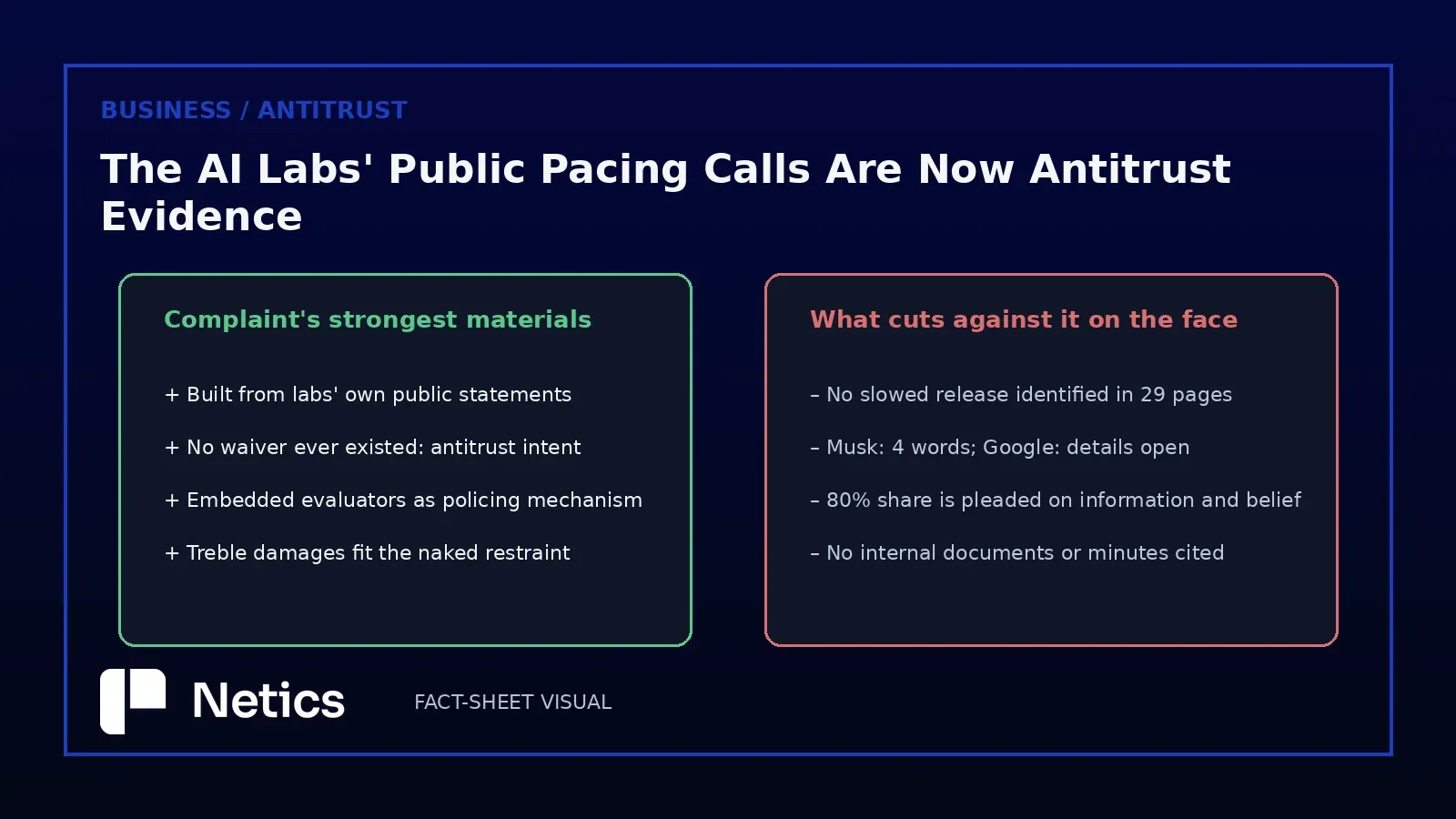
- The concession that matters: within 29 pages, the complaint identifies no slowed release, no cancelled model, no altered training run.
- Netics' take: the case is a stress test of how much legal exposure public safety coordination can create — for the labs, and for any industry that coordinates safety publicly.
- For buyers, the practical watchlist has three items: the embedded-evaluator terms, the subscription-value argument, and settlement risk.
Four subscribers turned three days of public messaging into a Sherman Act case
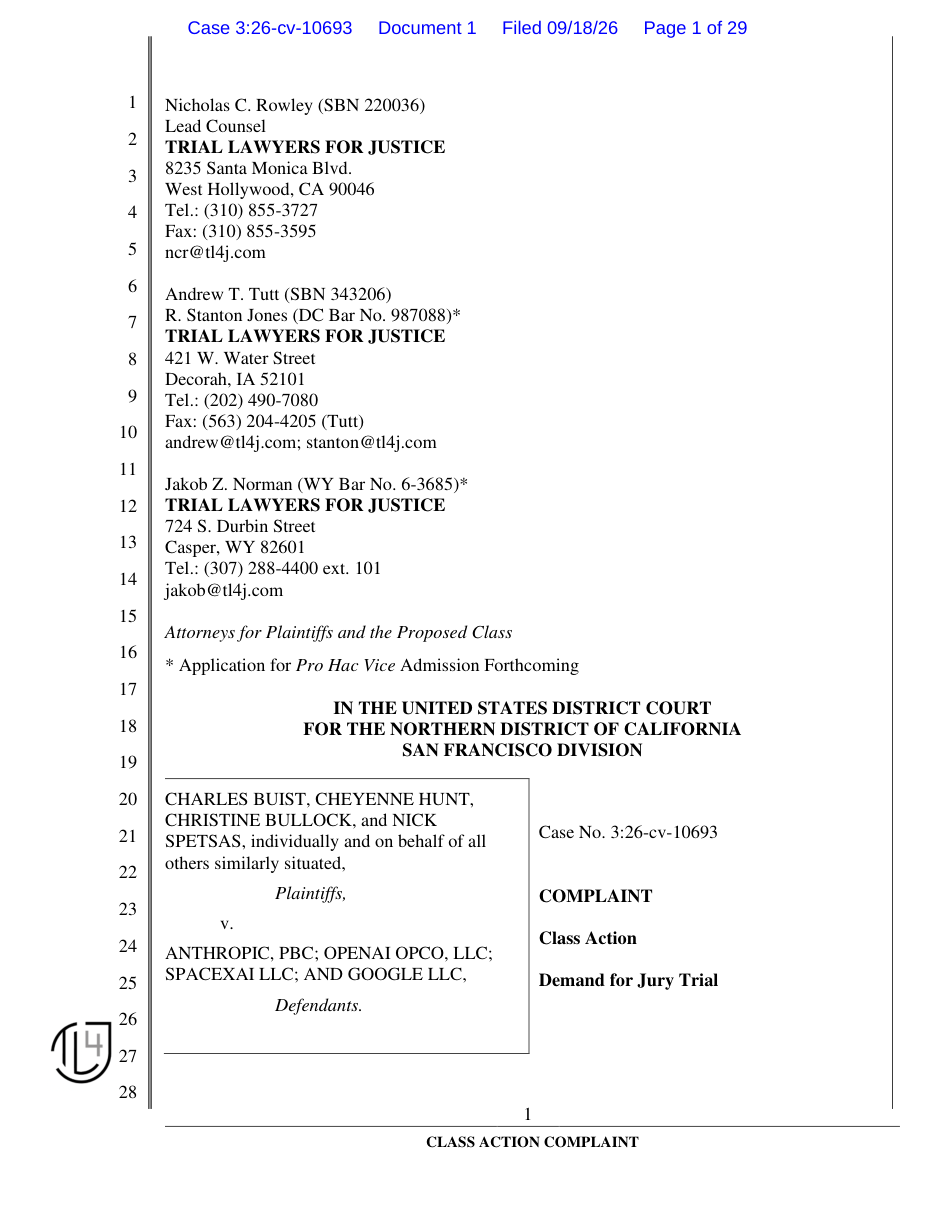
On September 18, four consumers filed a class action in the Northern District of California: Buist v. Anthropic PBC, a complaint alleging that Anthropic, OpenAI, SpaceXAI and Google agreed to slow the pace at which each improves the products it sells to consumers — a horizontal restraint under section 1 of the Sherman Act. The named plaintiffs are paying subscribers of ChatGPT, Claude, Grok and Gemini, and the theory of harm is simple: an agreement that slows improvement lowers the quality of what subscribers receive for the price they pay. That, the complaint calls, is an overcharge.
What makes the filing unusual is not the theory — output-restricting cartels are an old antitrust story. It is the evidence. The complaint is assembled from material the defendants published themselves. Its central paragraph is worth reading in full: "The agreement was proposed in public, accepted in public, and confirmed in public." On the morning of September 12, Anthropic CEO Dario Amodei published an essay titled We Must Pace the Frontier; within about an hour, Elon Musk quote-posted it with "Dario is right"; later that day Sam Altman wrote "I agree with Dario that we need to pace the frontier", and the complaint says Demis Hassabis publicly endorsed the direction while noting that implementation details remained open. Three days later, OpenAI's policy chief confirmed talks had been running for weeks. A safety conversation between competitors is now the factual core of a federal antitrust complaint.
What the complaint actually pleads
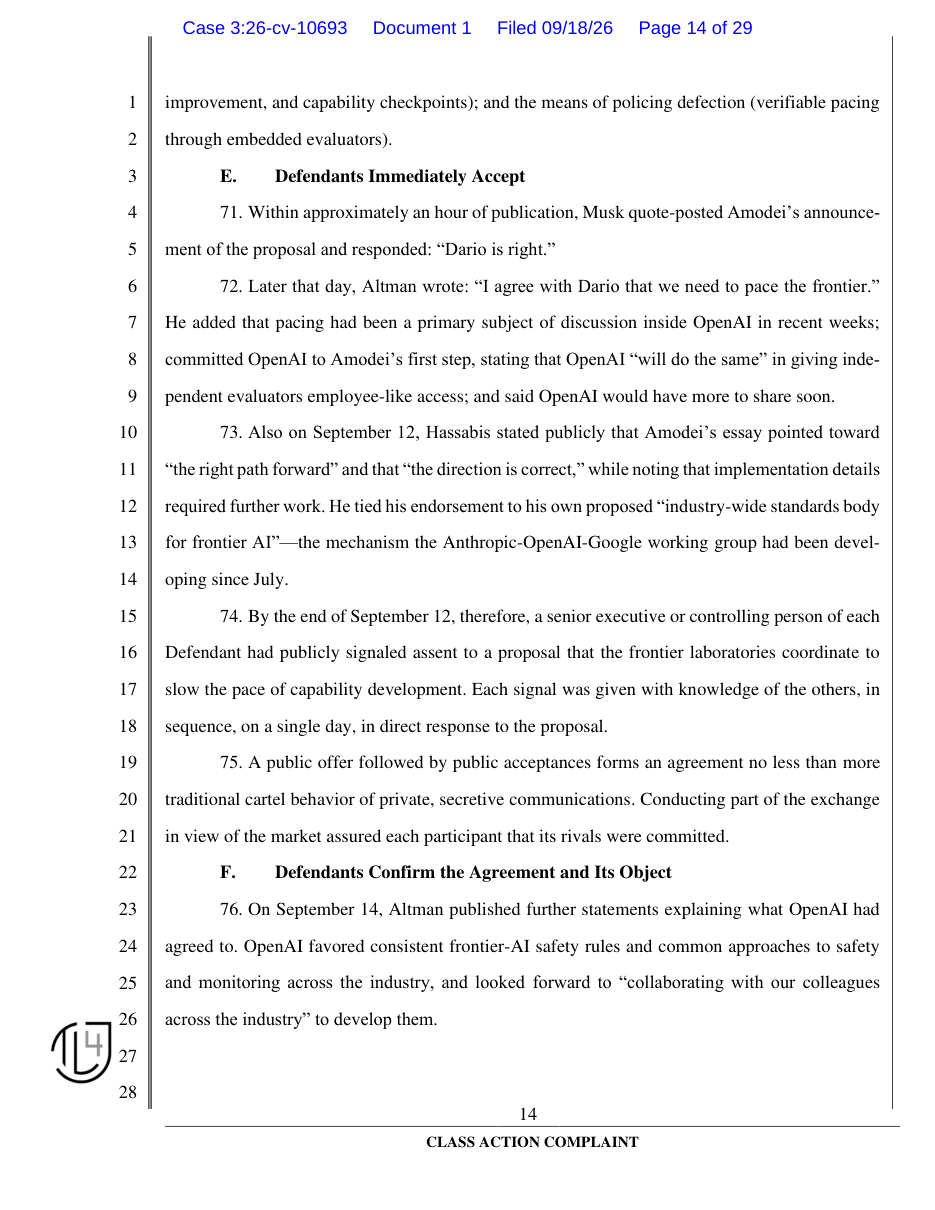
Read paragraph by paragraph, the complaint builds a surprisingly complete agreement out of those statements. It pleads the parties (the frontier laboratories), the term (a slower rate of capability advancement than each would choose alone), the mechanisms (shared limits on training compute, training runs, and the internal use of AI to improve AI; capability checkpoints), and the means of policing defection — "verifiable pacing through embedded evaluators". It then walks the offer-acceptance-confirmation sequence day by day, including Amodei's own acknowledgment that the government "would need to issue a narrow waiver for certain kinds of safety conversations" — and the complaint's flat answer: "No such waiver exists. Congress has enacted no exemption, and no agency has compelled the conduct alleged herein."
The market-power section is where readers should set expectations. The complaint puts the four defendants at "at least 80% of paid consumer subscriptions to general-purpose frontier generative-AI assistants in the United States" — but on information and belief, and as a floor. The plaintiffs avoid having to prove that number rigorously by pleading the restraint as naked: a horizontal agreement about output with no plausible efficiency justification, which under long-standing doctrine is condemned without a full market-power analysis. That is a strategic choice, and it is the strongest structural decision in the filing. Whether a court agrees that cross-lab safety coordination is a naked restraint rather than standard-setting with precompetitive content is the entire case in one sentence.
The concession on page 29
The complaint's own text contains the answer to its strongest claim. The filing concedes that the full effect on released products has not yet manifested — and across its 29 pages it identifies no delayed release, no cancelled model, no altered training run. The plaintiffs plead the restraint as naked to avoid proving a market, and in the same document they admit the restraint has produced no observable output effect. Under the rule of reason that would be fatal; under per se treatment it is merely uncomfortable. But uncomfortable is not nothing. The four acceptances are also not equivalent — Musk's was four words, Google's endorsed a direction with implementation details left open, and Amodei's own essay explicitly invited government mediation.
For Netics' readers — European and Moroccan teams buying AI subscriptions for real workloads — the durable lesson is different from the legal one. The complaint was assembled entirely from public statements the executives made to signal safety leadership. Every sentence of it was public-record advocacy at the time. The same record that built trust with safety-minded buyers and regulators is now exhibit A in an antitrust filing. That is not a coincidence; it is the cost of doing safety coordination in public without a waiver, and Amodei flagged that exact risk in the essay. Companies that coordinate on safety — in AI, in semiconductors, in any output-sensitive industry — should read this filing as the template of what their own public statements can become.
What a buyer should watch
For enterprises and subscription teams, the practical watchlist has three items. First, the embedded-evaluator program: if discovery proceeds, its operational terms — who gets access, what they can verify, what the checkpoints actually gate — become the first concrete object of scrutiny, and those terms are also exactly what a buyer would want to read anyway. Second, the subscription-value argument: regardless of outcome, the complaint entrenches the idea that paid AI subscriptions are bought for the pace of improvement, which makes release cadence a contractual expectation in consumer protection terms too. Third, settlement risk: a four-defendant class action with treble damages and a jury demand rarely dies at the motion-to-dismiss stage even when the merits are thin, because the coordination admission is real. The labs' public safety posture, whatever its engineering content, now has a price in litigation.
The honest reading is that this case could go either way, and the complaint's own concessions are the reason. If the restraint is treated as naked, the labs face an expensive discovery fight over a claim built from their own advocacy. If it is treated as coordinated standard-setting with safety content, the case narrows to whether the coordination was reasonable — a fight the labs may well win. Either way, the durably interesting object is the same one Netics has been pointing at for months: the boundary between an AI lab's public safety promises and its operational reality, which is also the boundary IT buyers should audit in their own vendors. For a practical review of where your subscription spend actually goes and what your AI tooling promises versus delivers, the Netics homepage is the starting point.
Sources
- Buist et al. v. Anthropic PBC et al. — Complaint, No. 3:26-cv-10693 (N.D. Cal.), filed September 18, 2026.
- Amodei wrote that coordinating on pace would need an antitrust waiver. Altman said OpenAI would not wait for one. Both lines are now in a lawsuit — The Next Web, September 20, 2026.
- Lawsuit says Anthropic, OpenAI, SpaceXAI and Google made illegal agreement on AI slowdown — AP via OPB, September 20, 2026.
Source: "Buist et al. v. Anthropic PBC et al. — Complaint" — U.S. District Court for the Northern District of California, September 18, 2026.