
Three Clouds Converge on Managed Private Interconnect, With Different GA Regions
"AWS, Microsoft and Google Cloud now each sell a managed private path between two clouds. The ordering console decides whether your pair is GA or preview, and address planning, routing and s


TL;DR
- A managed multicloud interconnect is a private network path between two clouds that both providers provision and then operate for the customer through one logical resource, and AWS, Microsoft and Google Cloud each sell one as of 17 November 2026.
- Microsoft made Azure Multicloud Interconnect generally available with AWS and opened a public preview with Google Cloud, AWS announced general availability of Interconnect - multicloud with Azure, and Google Cloud placed its partner Cross-Cloud Interconnect for Azure in preview.
- The same cloud pair carries different maturity depending on which console orders it: Azure orders AWS at general availability and Google Cloud at preview, while Google Cloud orders Azure at preview and AWS at general availability.
- Each side offers its pair in three Regions: Google Cloud's Azure preview runs in us-east4, us-west2 and europe-west3, and AWS Interconnect with Azure runs in us-east-1, ap-southeast-2 and eu-central-1.
- Providers take on circuit ordering, one activation flow, joint monitoring, maintenance and recovery of the path; Google Cloud also states that traffic stays off the public internet and is automatically encrypted between the Google Cloud and Azure edge routers.
- Address planning, route intent, security controls, application design and the recovery strategy stay with the customer, and Microsoft names them as customer-held in its own list.
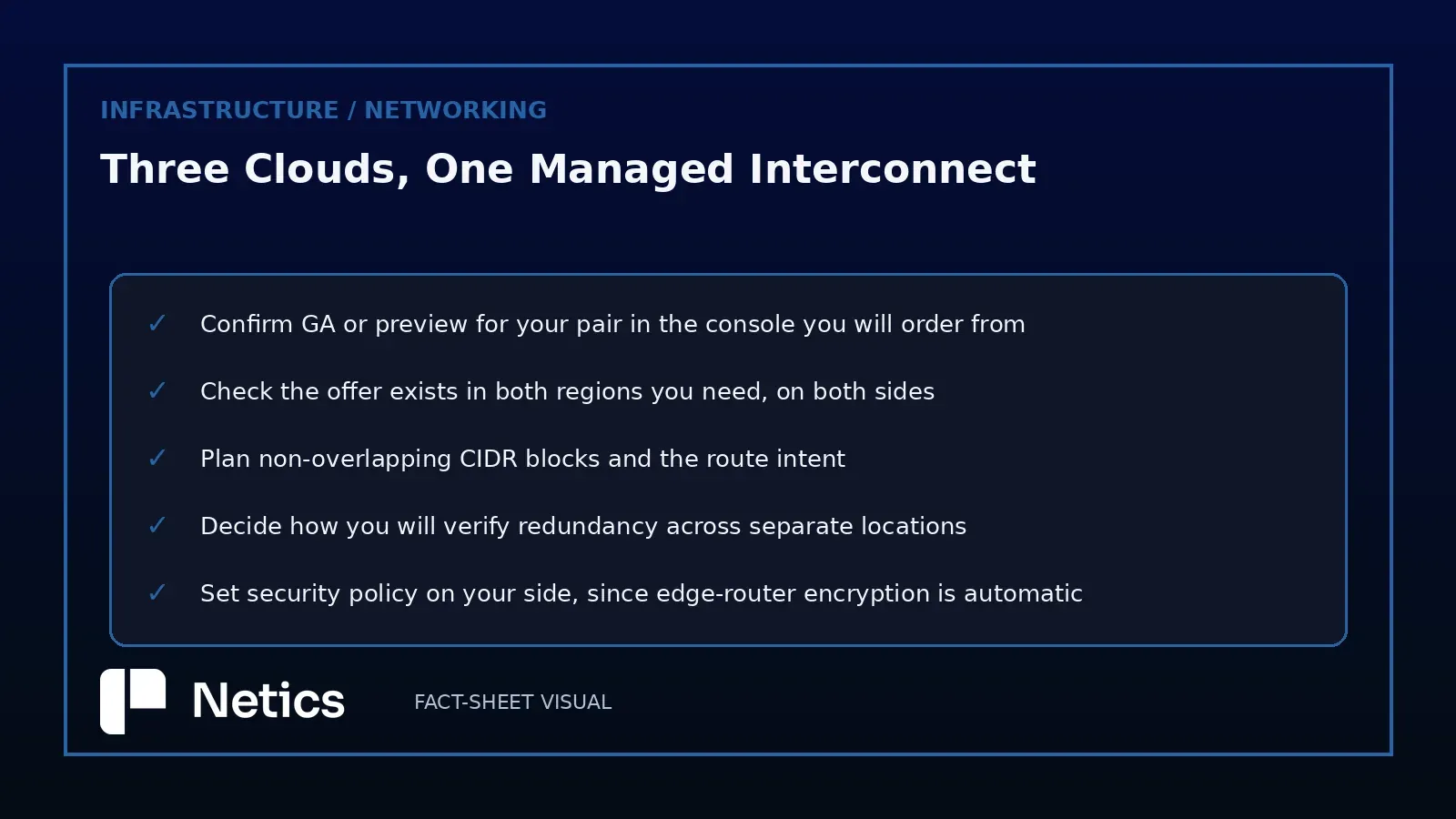
- Redundancy is the shared promise, described on both sides as paths across physically separate locations, which makes the location pair a procurement question as much as a network question.
- The interoperable specification behind the service is published and adoptable by other providers, which is the part with a longer reach than any single announcement.
- A team can validate bandwidth, availability and security profiles in staging before production traffic, and pin the GA or preview status in writing before the contract is signed.
Three announcements landed on 17 November 2026 and they describe one model from three directions. Microsoft made Azure Multicloud Interconnect generally available with AWS and put its Google Cloud counterpart into public preview. AWS listed Interconnect - multicloud with Microsoft Azure as generally available in three Regions. Google Cloud extended partner Cross-Cloud Interconnect to Azure in preview, in three Regions of its own.
Together, the three posts describe a market where the network between two clouds has become a product with a common shape. A buyer still has to check which console sells the pair, in which Regions, and which responsibilities the providers have taken off the customer's plate.
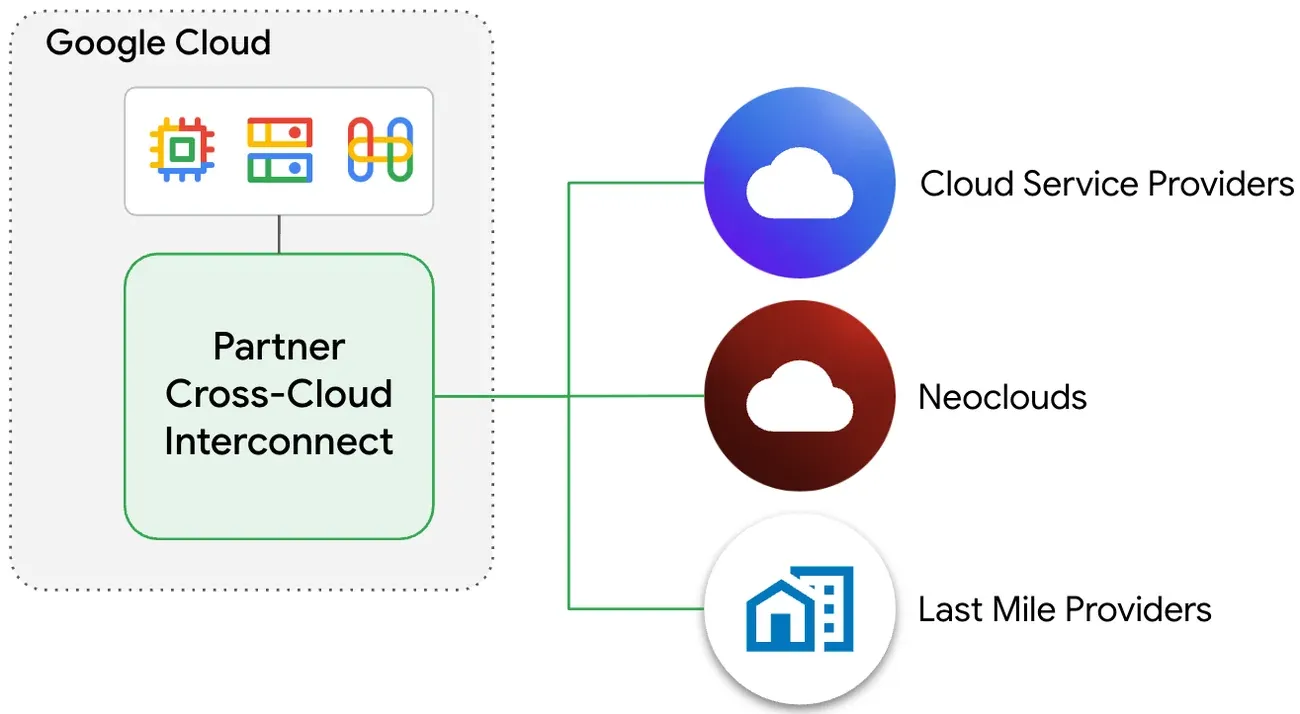
What the three announcements change
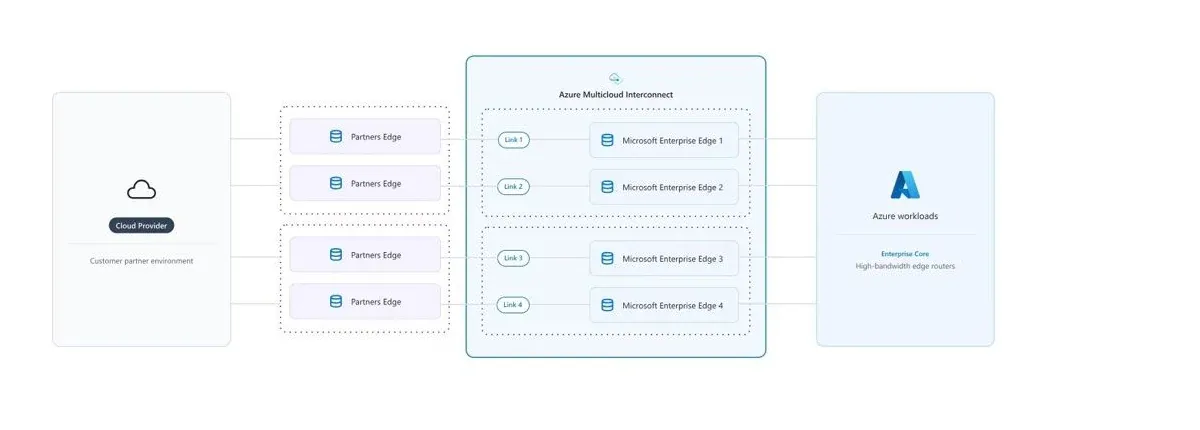
Before August, connecting two clouds was a project assembled by the customer. Microsoft's post describes that previous state precisely: circuits ordered from each provider, routers configured on both sides, Border Gateway Protocol sessions built and maintained, encryption arranged, and coordination across several teams. The August preview replaced most of that assembly with one logical resource and an integrated activation workflow, and the November announcements extend the same pattern.
Google Cloud's version is a partner service jointly supported by both companies, created from the console or the API in what the post calls minutes, with no hardware to order. AWS frames its own service as the first purpose-built product of this kind and points out that customers can now use one experience for workloads on Azure, Google Cloud and Oracle Cloud Infrastructure.
Provisioning got faster. The structural change concerns ownership of the inter-provider path. Microsoft describes clearer operational ownership, and both Microsoft and Google Cloud say the providers coordinate maintenance and recovery of the managed connection.
The console you order from decides GA or preview
This is the detail that surprises procurement teams. Azure describes its Google Cloud connection as a public preview while its AWS connection is generally available. Google Cloud describes its Azure connection as a preview while its AWS and OCI connections are generally available. AWS describes its Azure connection as generally available and points at the same experience for Google Cloud and OCI.
The two descriptions are consistent, because each provider is describing its own ordering path. A company that orders the Azure to Google Cloud path from the Azure console gets the preview described by Microsoft. A company that orders the same pair from the Google Cloud console gets the preview described by Google. Neither side has published a general-availability date for that pair.
Region sets are equally specific. Google Cloud's Azure preview runs in us-east4 (Northern Virginia), us-west2 (Los Angeles) and europe-west3 (Frankfurt), and the post says more Regions follow general availability. AWS Interconnect with Azure runs in us-east-1 (Northern Virginia), ap-southeast-2 (Sydney) and eu-central-1 (Frankfurt). A workload in two Regions that are not on these lists has no managed path today, whatever the marketing page suggests.
Address space, route intent and security policy stay with you
Microsoft's post spends a section on what the customer keeps, and it is the most useful paragraph in the three announcements: customers continue to own their virtual networks, route intent, security controls, application design and recovery strategy.
That list is the real scope of the project. Microsoft therefore tells customers to confirm addressing with their account teams and cloud-provider contacts before proceeding. Route intent has to be written down as policy, since a managed connection happily carries whatever both sides advertise. Security controls stay in the customer's hands, which is where a review of the traffic that now bypasses the public internet belongs.
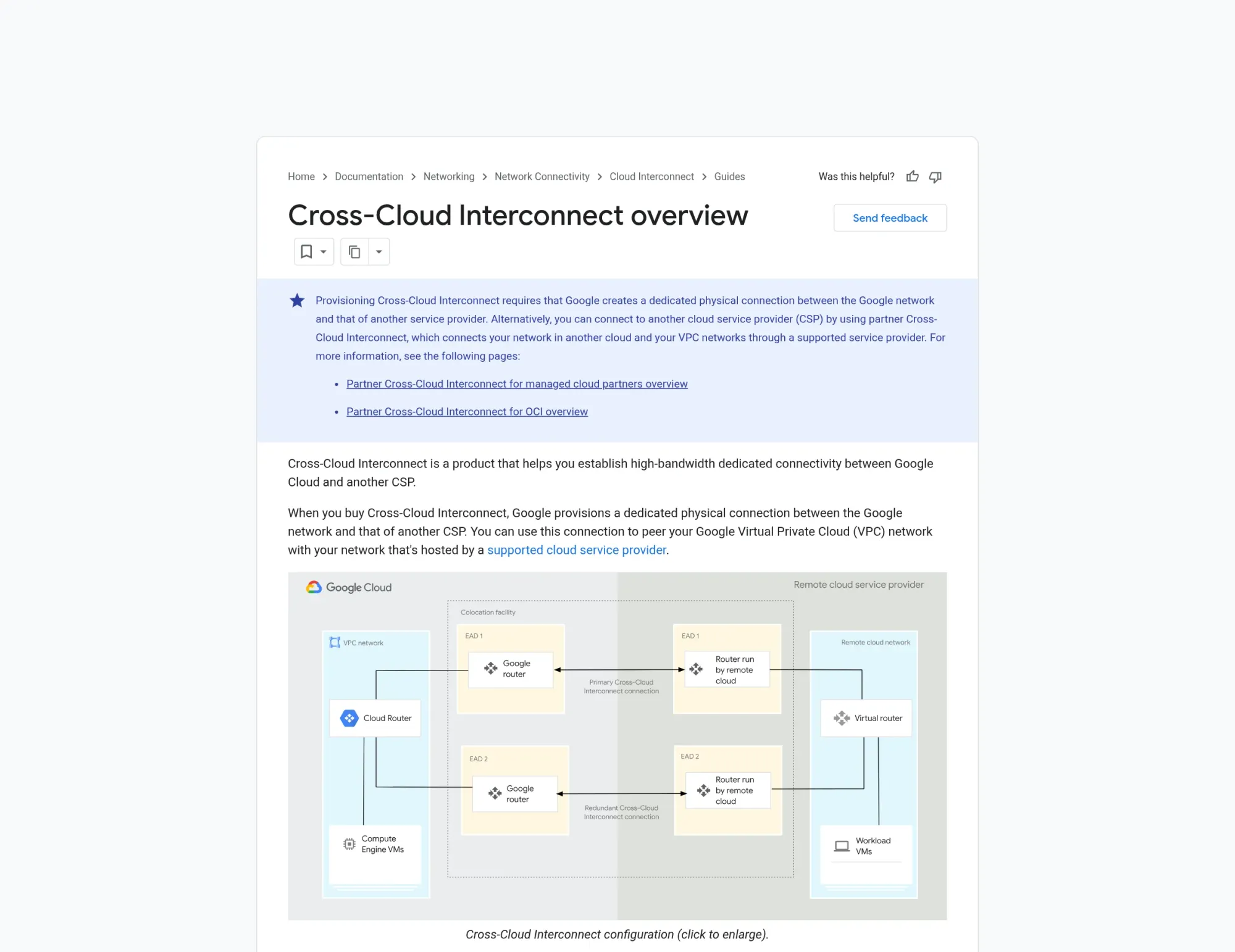
Redundancy across separate locations is the shared promise
Both posts describe the same redundancy model, and the wording is close enough to be a specification. Microsoft says redundant paths across physically separate locations reduce exposure to an isolated device, link or site failure, and that the two providers coordinate maintenance and recovery of the underlying connection. Google Cloud says the connection runs across physically separate locations and that both companies monitor it and handle maintenance.
Physically separate locations is the phrase to underline. A pair of links that terminate in the same building survives a cable cut and fails a fire, and the service description will not tell an architect which case they bought. That has to come from the provider's documentation for the specific cities involved, and it belongs in the design record next to the address plan.
Pricing models differ in shape as well. Google Cloud states a fixed price for the connection's bandwidth, which makes the cost of a given capacity predictable. The AWS and Microsoft posts describe availability and Region scope without rates, so the number has to come from the pricing pages and the account team for each side.
Microsoft advises customers to confirm bandwidth and commercial requirements with its account team and cloud-provider contacts. On the provider side the work is genuinely shared, and on the customer side it stays as distributed as it was before the product existed.
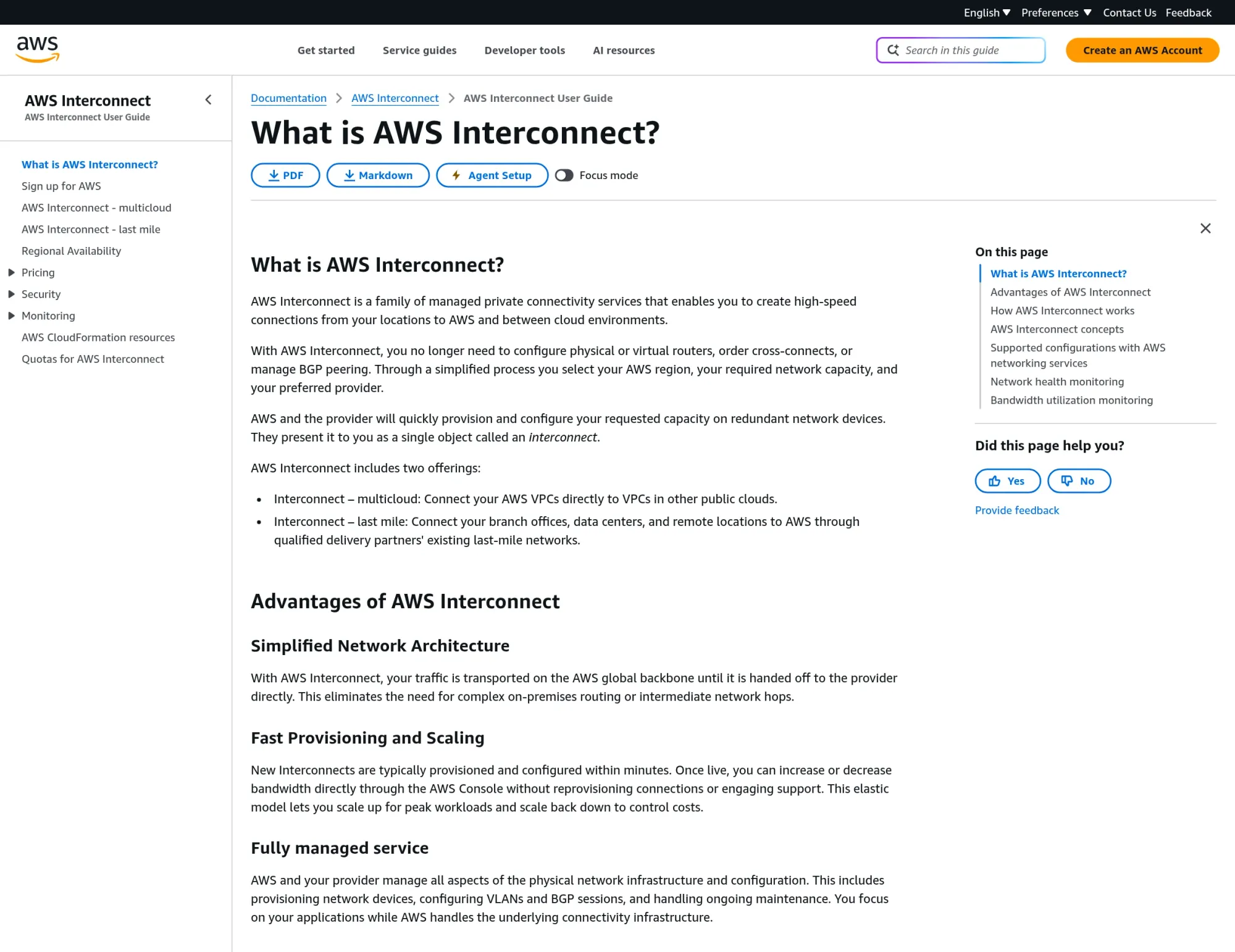
A validation plan for a representative workload
Microsoft's guidance is to pick a representative workload and confirm locations, bandwidth, addressing, security, commercial and recovery requirements with both account teams. That is a sensible brief for a short proof, and the sequence matters more than the duration.
A short proof also has a natural stopping rule. When the address plan holds, the route intent passes traffic and the maintenance behaviour has been observed once, the connection is understood well enough to order at production bandwidth.
Start with the pair and the console, because that decision sets the maturity level. Then fix the address plan and the route intent, since both are prerequisites for anything to pass traffic. Create the logical interconnect and authorise the intended cloud account, which is the step that lets the two providers coordinate the path. Then measure: latency and throughput for the workload's real traffic shape, behaviour during a maintenance event, and whether the automatic encryption Google Cloud describes between the Google Cloud and Azure edge routers satisfies the compliance question the security team will ask.
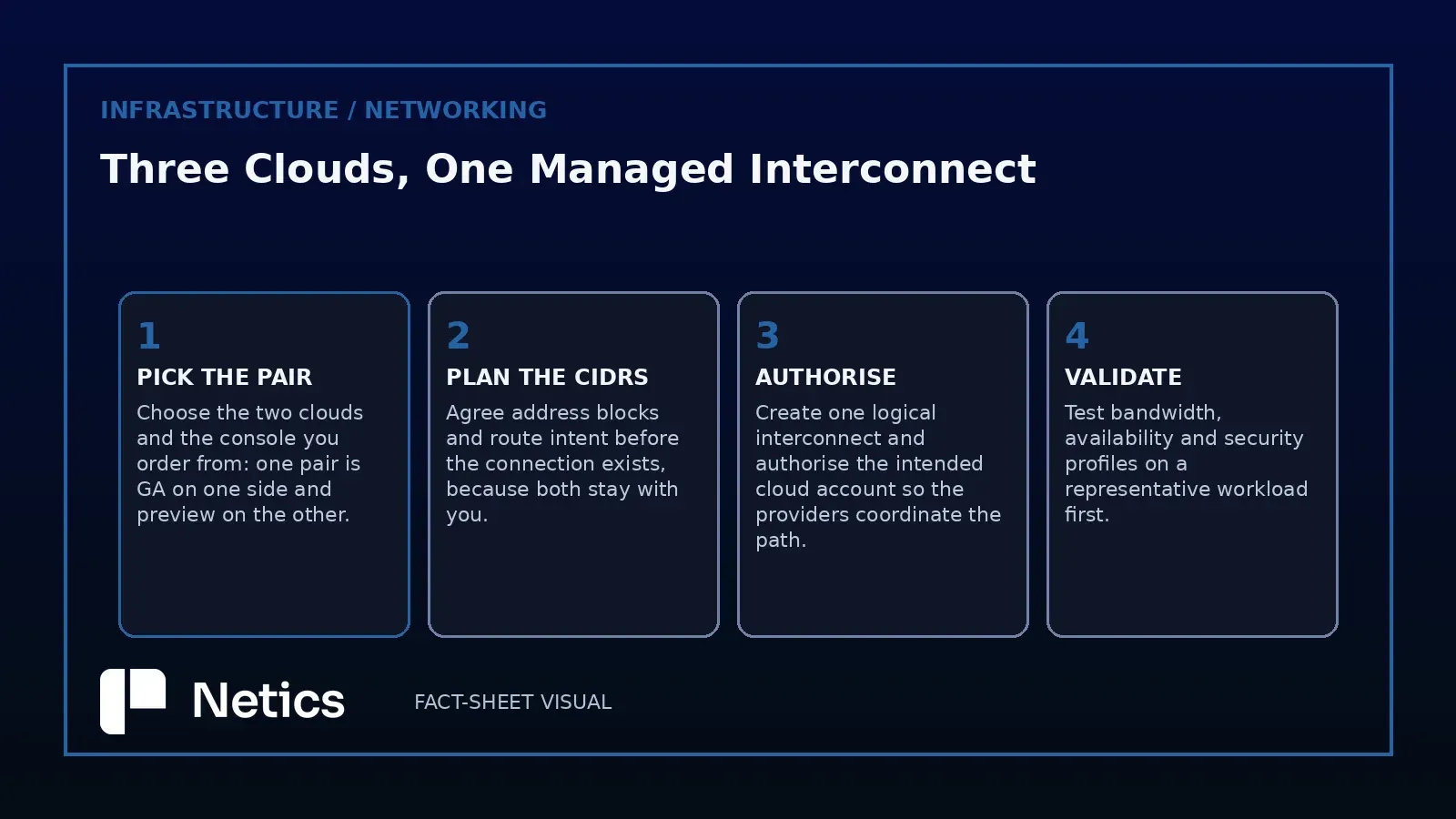
The address plan is a prerequisite for that loop. Renumbering across two organisations requires a longer schedule, which should be acknowledged before the bandwidth reservation is ordered.
Where the open specification leaves room for a fourth provider
Google Cloud states that partner Cross-Cloud Interconnect is built on an open specification for network interoperability, published with AWS the year before, and that any provider can adopt it. AWS describes Azure adopting the same specification when it launched support in August.
This is the part of the story with the longest reach. A specification implemented by more than two hyperscalers gives another provider a published interface it can adopt. For a buyer, that argues for asking a specific question during selection: does the contract let the same logical resource type connect to a provider that joins the specification next year?
That question is also the cheapest form of future-proofing available here. Recording that question in the requirements keeps the possible addition of another provider visible during selection.
The last mile is moving at the same time. Google Cloud has partner Cross-Cloud Interconnect for last mile with Lumen in preview, aimed at private clouds, on-premises sites and neoclouds. Microsoft describes its Lumen collaboration as an integrated provisioning experience on top of ExpressRoute, and states that customers are not required to adopt a third-party routing or orchestration platform.
For teams planning this year's architecture, the useful conclusion is narrow and practical. The providers manage the inter-cloud path and document the responsibility split. The customer chooses the ordering console and the two required cities, which determine the path's maturity and availability. Teams working through that choice as part of wider cloud infrastructure planning will find the address plan and the route intent do most of the work.
Sources
- Simplifying multicloud networking to Azure with partner Cross-Cloud Interconnect — cloud.google.com/blog/products/networking, 17 November 2026
- Connecting clouds and the last mile with Azure — techcommunity.microsoft.com/blog/azurenetworkingblog, 17 November 2026
- AWS announces general availability of AWS Interconnect - multicloud connectivity with Microsoft Azure — aws.amazon.com/about-aws/whats-new, 17 November 2026
- Cross-Cloud Interconnect overview — cloud.google.com/network-connectivity/docs/interconnect/concepts/cci-overview
- What is AWS Interconnect? — docs.aws.amazon.com/interconnect/latest/userguide
Source: "Simplifying multicloud networking to Azure with partner Cross-Cloud Interconnect" — cloud.google.com, 2026-11-17, https://cloud.google.com/blog/products/networking/cross-cloud-interconnect-for-microsoft-azure, read against the Microsoft Azure Networking post at https://techcommunity.microsoft.com/blog/azurenetworkingblog/connecting-clouds-and-the-last-mile-with-azure/4573283, the AWS What's New entry at https://aws.amazon.com/about-aws/whats-new/2026/11/aws-announces-AWS-interconnect-multicloud-azure-ga/, the Cross-Cloud Interconnect overview at https://cloud.google.com/network-connectivity/docs/interconnect/concepts/cci-overview and the AWS Interconnect documentation at https://docs.aws.amazon.com/interconnect/latest/userguide/what-is-interconnect.html; all fetched and saved on 2026-11-22 under sources/2026-11-22/interconnect/.