
What the AWS AI Security Framework Actually Verifies
AWS's new AI Security Framework maps controls across three use cases, three layers, and three phases — a genuinely useful map, but not proof that any given workload is actually secure.

AWS published its AI Security Framework on May 26, 2026, organizing AI security into three use cases, three layers, and three phases. It's a genuinely useful map. It is not, on its own, evidence that a given AI workload is secure — and AWS's own numbers say why the gap matters.
TL;DR
The AWS AI Security Framework is best read as a control inventory: it maps answering, connecting, and acting workloads across infrastructure, identity and data, and application controls, then stages them from foundational to advanced. Its value is sequencing, not certification. Teams still have to test configuration, enforce tool boundaries, monitor behaviour, and prove that controls work in their own account. This article explains what happened, how the three axes fit together, where the Netics editorial view differs from a vendor checklist, and what remains to be verified before production.
The roadmap of this article explicitly covers: The gap the framework is answering, Three use cases, cumulative controls, Three layers of defense-in-depth, Three phases, and what "day 1" really covers, What this means for teams outside AWS's own compliance claims, Where Netics fits. Coverage: The gap the framework is answering, Three use cases, cumulative controls, Three layers of defense-in-depth, Three phases, and what "day 1" really covers, What this means for teams outside AWS's own compliance claims, Where Netics fits.
The gap the framework is answering
AWS opens with two cited statistics that frame the problem, not the solution: 80% of organizations have adopted AI, but only 10% govern it (McKinsey), and 97% of organizations that reported AI-related security incidents lacked proper AI access controls (IBM). Those numbers describe an adoption-governance gap, not a tooling gap — most of the named AWS services in this framework (IAM, KMS, CloudTrail, GuardDuty) already existed before generative AI. The framework's job is to tell teams which existing controls to extend and where the genuinely new ones sit.
AWS is explicit about what changes with AI workloads versus traditional deterministic ones: the same prompt can produce a compliant response one time and a non-compliant one the next; prompts mix user input with instructions, which is what makes prompt injection possible; agents learn and adapt, so a one-time launch review isn't sufficient; and agents have autonomy — they call APIs and make independent decisions. Each of these four points drives a specific control recommendation later in the framework, from output validation to continuous behavioral monitoring.
Three use cases, cumulative controls
The framework's first axis asks what you're building. "AI that answers" covers chat agents and summarizers with no external data connections — AWS's baseline controls here are Nitro System isolation, IAM, KMS, Bedrock Guardrails for prompt-injection and PII filtering, and CloudTrail audit logging. "AI that connects" adds retrieval-augmented generation against enterprise data — the framework's stated risk is that "every query is an implicit access request against your data estate," which is a sharper way of saying that a RAG pipeline without fine-grained access control will happily surface data the requesting user was never authorized to see. "AI that acts" covers agents that take actions — processing transactions, calling APIs, coordinating with other agents via A2A or MCP — plus physical AI (IoT, robotics, industrial control systems), where the framework adds physical-safety bounds to the permission model.
The cumulative design is the framework's strongest structural idea: each use case inherits every control from the one before it, so a team building an agent doesn't get to skip the identity and data-layer controls that a simple chat assistant would already need. AWS also names Amazon Bedrock AgentCore Cedar Policies as the mechanism meant to enforce least-privilege at the tool-call level — authorization decided outside the model's own reasoning, which is the architectural point worth sitting with regardless of vendor. We've made the same argument about zero-trust boundaries for AI agents: a hard boundary the model cannot argue its way past is what actually stops a compromised or manipulated agent, not another layer of prompting.
Three layers of defense-in-depth
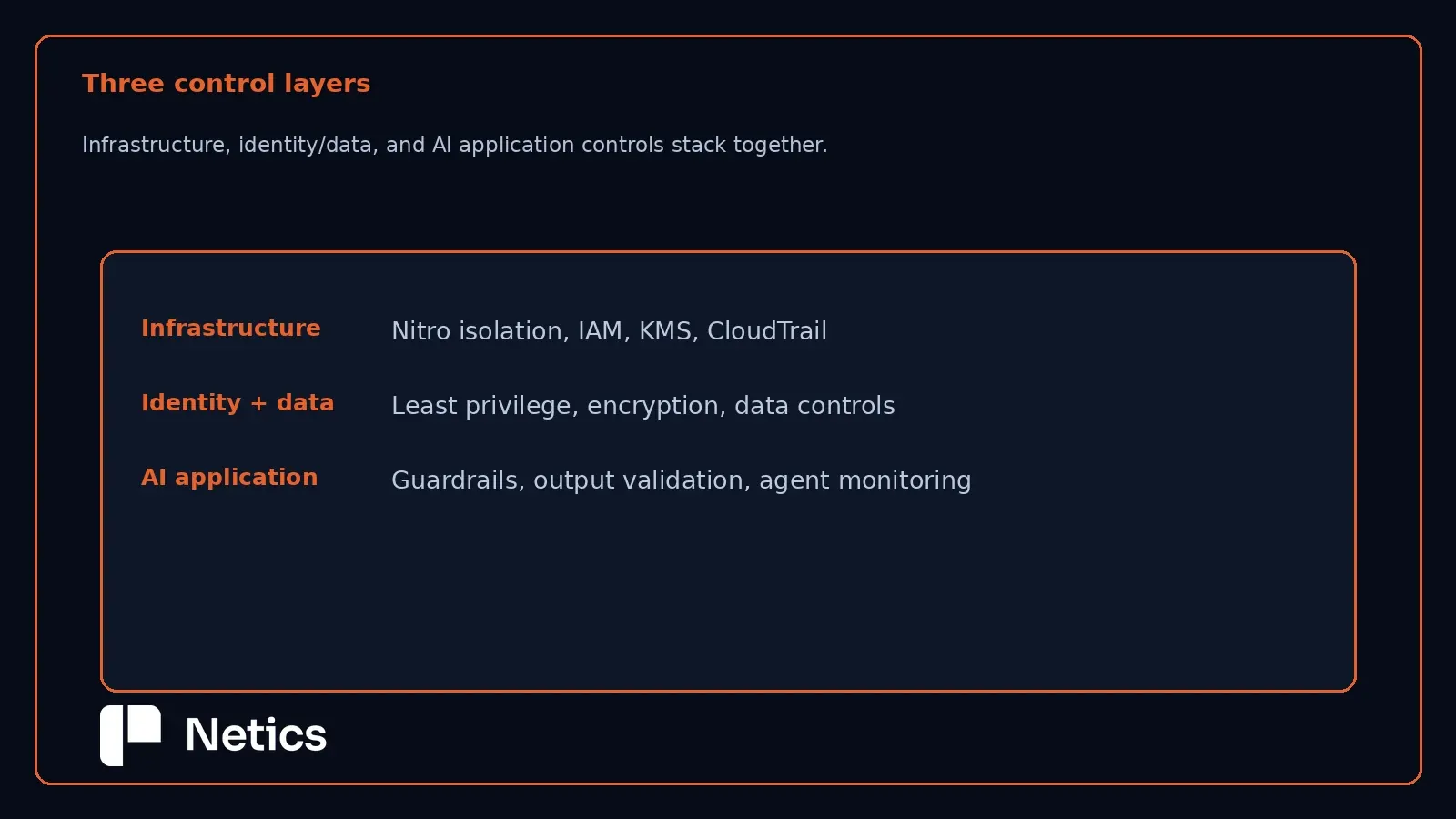
The second axis is where controls operate: infrastructure (Nitro System hardware isolation, VPC, Shield, Network Firewall), identity and data (IAM, KMS, Secrets Manager, CloudTrail, Cognito, plus AgentCore Identity for scoped, non-human agent credentials), and AI application security (Bedrock Guardrails, Automated Reasoning checks, CloudWatch, SageMaker Clarify and Model Monitor). AWS's own framing is useful here: the first two layers are extensions of controls most cloud teams already run. The third layer — content filtering, output validation, behavioral monitoring — is the one that's genuinely new to AI workloads, because "traditional security controls don't inspect prompts, validate model outputs, or detect when an agent exceeds its behavioral scope."
The framework's worked example — ten controls across four stages catching a prompt-injection attempt that tries to extract credit card data by impersonating a CEO — is a legitimate illustration of layered defense, and it's worth reading in full in the source post. But it's worth being precise about what the example proves: it shows how the controls are designed to interact if every one of them is correctly configured. It does not show a red-team test against a live account, and AWS doesn't claim it does.
Three phases, and what "day 1" really covers
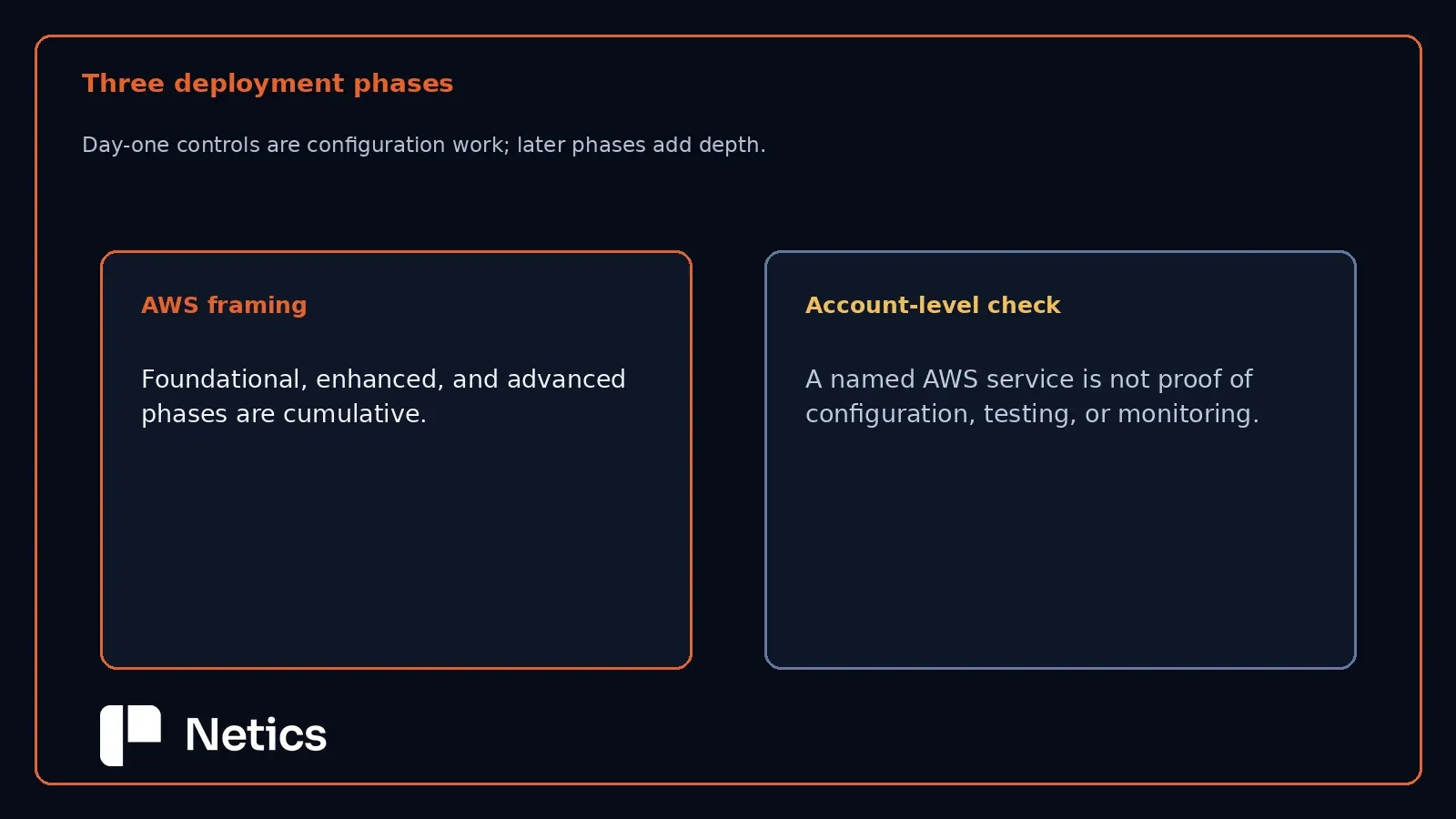
The third axis maps to deployment maturity. Phase 1 (foundational) is described as configuration changes rather than architecture changes — deploying Bedrock Guardrails in front of a chat endpoint, AWS says, "can be done in minutes." Phase 2 (enhanced) adds WAF, GuardDuty Extended Threat Detection, Security Hub, and IAM Access Analyzer as production hardens. Phase 3 (advanced) moves governance and incident response toward automation with Control Tower, Config, and AWS's Security Agent. AWS frames this as controls that compound — "you never start over" — which matches how security maturity models generally work: you add layers, you don't replace the foundation.
The caveat is proportionate to how the framework is written, not a rejection of it. AWS states outright that the services listed at each use case and phase are "non-exhaustive" and depend on your specific architecture — that's an honest disclosure, not a marketing gloss. But it means the framework is a checklist of what's available and roughly when to reach for it, not a certification that a specific workload meets a specific bar. Model selection illustrates the same limit: AWS says CISOs should be directly involved because "each model is trained on different data and comes with different built-in guardrails," and that guardrails, jailbreak resistance, and IP indemnity vary by provider on Bedrock. That's a real distinction the framework surfaces — and one it leaves entirely to the customer to evaluate, model by model.
What this means for teams outside AWS's own compliance claims
AWS backs the framework with real certifications — ISO/IEC 42001:2023 for AI management systems, and Bedrock meeting over 20 compliance standards including SOC 2 Type II and HIPAA eligibility. Those are audited claims, not marketing language, and they matter for procurement conversations. What they don't do is transfer to your account automatically. ISO 42001 certifies AWS's AI management system; it says nothing about whether your team enabled CloudTrail logging for Bedrock API calls, scoped an agent's IAM role correctly, or configured Guardrails' denied-topics list before launch. The framework itself makes this distinction when it lists "know where AI is running" and "audit all AI workloads — approved and shadow AI" as the first governance action item, not an afterthought. An inventory you haven't run against your own environment is not a security posture; it's a reading list.
That's the practical takeaway for teams evaluating this framework rather than AWS's target executive audience: use the three-by-three grid to find what you're missing, then treat each named service as a claim to verify — is Guardrails actually deployed on this endpoint, is this agent's IAM role actually scoped to the one system it needs — rather than a box to tick because AWS listed it under your use case.
FAQ
Does using AWS's named services automatically make an AI workload compliant? No. The framework names services (Bedrock Guardrails, AgentCore, IAM, KMS) mapped to use cases and phases, but AWS states these lists are non-exhaustive and depend on the specific workload. Compliance certifications like ISO 42001 apply to AWS's own AI management system, not automatically to how a customer configures these services.
What's actually new about AI application security versus traditional cloud security? AWS's own distinction: infrastructure and identity-layer controls (Nitro isolation, IAM, KMS, CloudTrail) extend existing cloud security practices to AI workloads. The AI application layer — prompt-injection detection, output validation via Automated Reasoning checks, and agent behavioral monitoring — has no direct traditional-security equivalent, because it inspects model inputs and outputs rather than network traffic or access requests.
Why does the framework treat agent identity differently from user identity? Because agents can be autonomous and multi-tenant, AWS recommends giving every agent its own scoped, temporary credential rather than copying a human user's permissions, which it notes is "probably overly permissive" for the agent's actual task. Bedrock AgentCore Identity and Cedar Policies are the named mechanisms for enforcing that authorization independently of the model's own reasoning.
Where Netics fits
Netics writes on AI infrastructure, security, and sovereignty for European technical teams. If your organization is mapping AI workloads against a framework like this one and wants a second set of eyes on where the gaps actually sit, book a session with our team.
Source: AWS Security Blog, 26 May 2026 — https://aws.amazon.com/blogs/security/the-aws-ai-security-framework-securing-ai-with-the-right-controls-at-the-right-layers-at-the-right-phases