
Arm AI Portal makes optimized software machine-discoverable — but benchmarks still need a chain of evidence
Arm AI Portal makes optimized models, performance data and workflows easier for developers and agents to find. Netics asks what makes those claims portable and reproducible.

TL;DR
Arm’s AI Portal connects more than 22 million developers and their agents to optimized models, performance data, code and deployment workflows across cloud, edge and physical AI. Netics’ reading is more cautious: making resources machine-discoverable can remove search friction, but it does not remove the need to understand benchmark conditions, preserve portability, or reproduce a result outside the portal. Arm’s reported over 4x Qwen3-TTS speedup and over 40% YOLO26n improvement are useful signals; they are not universal performance guarantees. The portal can also become a software lock-in surface if its optimization evidence cannot travel with the workflow.
The announcement is a search problem disguised as a performance problem
Arm’s announcement starts from a problem every AI team recognizes. Building an application can involve searching for a model, finding a compatible runtime, comparing target hardware, reading performance claims, and assembling a deployment path. As development becomes more agentic, a person is no longer the only one doing that work. A coding agent also needs resources it can locate and use without relying on an undocumented expert memory.
The portal responds by putting task-specific, pre-optimized models alongside performance and accuracy data, latency, memory and size comparisons, code examples, and workflows. Arm says those resources span language, speech, vision and neural graphics, with launch examples including Alibaba Qwen, Google Gemma and Ultralytics YOLO. The portal also connects with Hugging Face, and its resources are accessible to coding agents through MCP.
That is a meaningful shift in distribution. A model can be technically available and still be operationally invisible if a developer or agent cannot identify the right runtime, target, or evidence. Machine discoverability turns the catalogue and its metadata into part of the development surface. The risk is that teams start treating catalogue placement as a substitute for engineering judgment.
A search result is not a deployment decision. The useful question is not only whether an agent can find a model, but whether it can find the assumptions that make the model a sensible choice.
Performance numbers are coordinates, not destinations
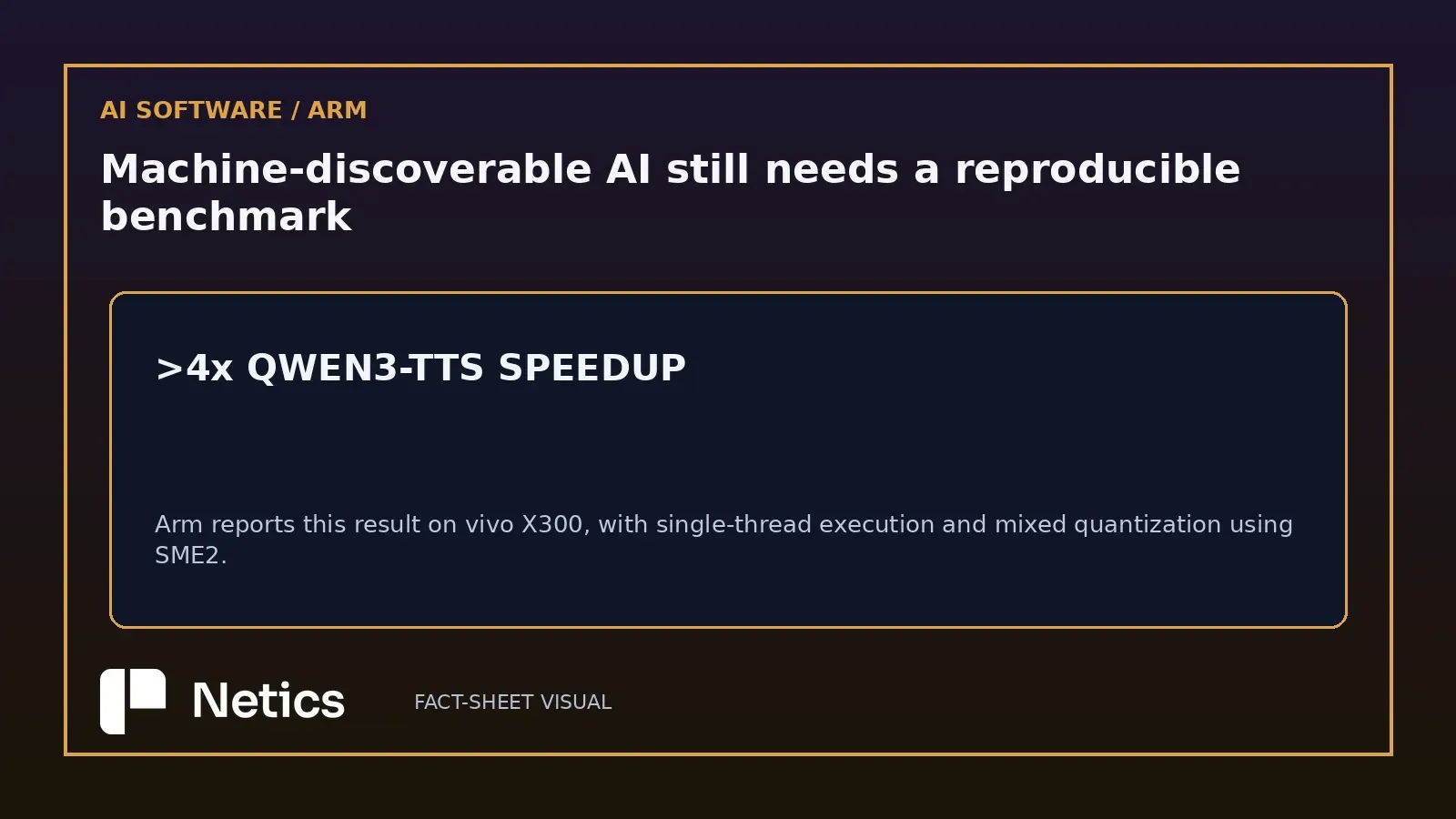
Arm highlights two results. Qwen3-TTS achieved an over 4x speedup on a vivo X300 using single-thread execution and mixed quantization, with a Q8_0 talker and a code predictor, accelerated by SME2. Ultralytics YOLO26n achieved an over 40% performance improvement in stated tests: FP16 versus FP32 on a vivo X300 with SME2, and FP16 plus INT8 mixed quantization versus FP32 on Raspberry Pi 5 with NEON.
Those details are not fine print. They are the result. The hardware, execution model, runtime path, precision choices and acceleration features define what the number means. Remove them and “over 4x” becomes a marketing-shaped token that an agent can repeat but cannot responsibly compare.
The same principle applies to the portal’s promised comparisons of latency, memory, size and accuracy. A fast model that consumes more memory may be unsuitable for an edge target. A smaller model that loses accuracy may change the product decision. An accuracy number measured on a different task or dataset does not settle the question. Optimization is a multi-dimensional trade, and a portal that exposes several dimensions is more useful than one that exposes a single speed score.
Netics’ standard is simple: every performance result should travel with its conditions. A machine-discoverable resource should make the model, runtime, hardware target, execution mode, quantization, comparison baseline and accuracy context available as structured evidence. Without that chain, agents are discoverable but not safely steerable.
Optimization can become a software lock-in surface
Arm says AI Portal will soon let developers bring their own models, including proprietary models, for performance analysis and optimization on Arm. That is potentially the most important part of the launch. Pre-optimized public models help teams start faster; optimization tooling for a private model can influence where a team builds, tests and deploys its most valuable software.
This does not make the portal a bad choice. It makes the boundary worth naming. An optimization workflow can accumulate platform-specific runtime settings, quantization decisions, code examples, hardware assumptions and evaluation records. If those artifacts are exportable, versioned and usable with another toolchain, the portal is an accelerator. If they exist only as portal entries and undocumented actions, the acceleration can turn into dependency.
The same question applies to MCP access. Giving agents a machine-readable path to models and workflows is convenient, but discoverability increases the importance of provenance and permissions. An agent should know whether it is reading a benchmark, a deployment recipe, a recommendation, or an early-access resource. It should also retain enough context to explain why it selected a model and which target constraints it considered.
A hypothetical team building speech features for a smartphone might use the portal to identify Qwen3-TTS, compare a pre-optimized path, and validate a local deployment. The healthy version of that workflow exports the model reference, runtime configuration, quantization choices, target assumptions and measured outputs into the team’s own repository. The unhealthy version records only that “Arm Portal recommended this model.” The first creates evidence; the second creates memory held by a vendor interface.
That distinction is software lock-in in practical form. It is not merely a licensing question. It is whether another engineer can understand, rerun, challenge and replace the optimization path.
Reproducibility should be an agent-facing feature
Arm’s portal is designed for developers and agents to meet where they already build. That makes reproducibility part of machine discoverability, not a separate academic virtue. An agent that can retrieve a model but cannot retrieve the benchmark recipe is being given an answer without the means to verify it.
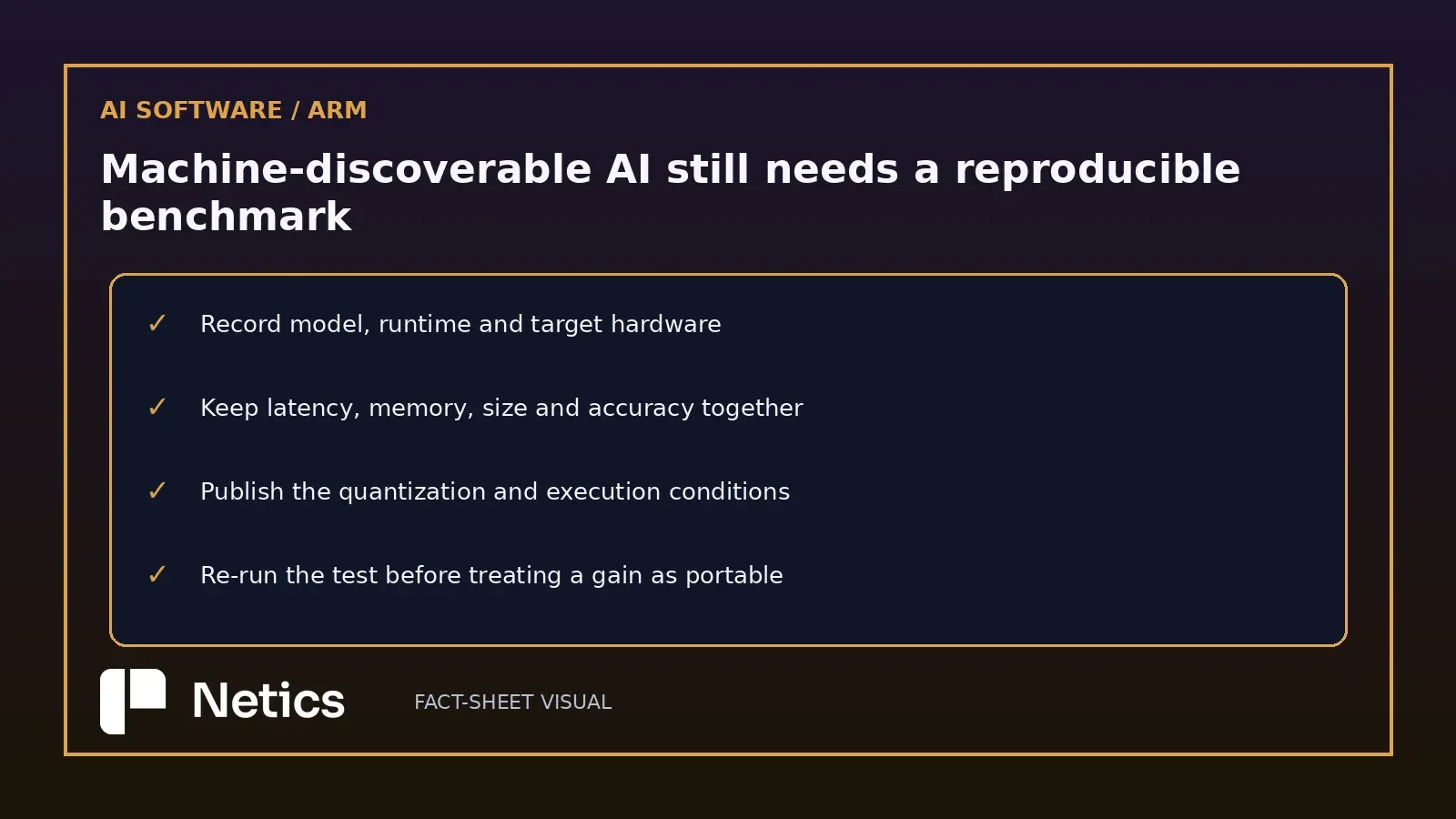
For each candidate resource, teams should preserve a small evidence packet: model identity and version, runtime, target hardware, execution mode, precision and quantization, baseline, workload, latency, memory, size, accuracy and any caveat supplied by the publisher. The packet should distinguish an Arm-reported result from an internal rerun. It should also record the date and the exact resource link, because portals evolve and optimization claims can be refreshed.
The goal is not to force every team to reproduce every vendor result before shipping. It is to make the boundary visible. A quick prototype can accept a published result as a starting signal. A production decision involving proprietary data, a physical device or a long-lived runtime should require a rerun on the actual target or a documented reason why that is not possible.
This is where Arm’s breadth creates both value and complexity. The portal spans cloud, edge and physical AI, and the right optimization for a cloud CPU is not automatically the right optimization for a smartphone or a Raspberry Pi. Cross-target coverage makes discovery easier, but it also makes careless transfer easier. The evidence packet keeps a recommendation attached to its target instead of letting an agent generalize from one device to another.
The adoption test is whether the portal leaves evidence behind
Arm AI Portal is solving a real distribution problem. More than 22 million developers and their agents cannot efficiently navigate every model card, runtime repository and hardware note by hand. Pre-optimized resources, comparison data and deployment workflows can reduce the time between an idea and a meaningful first test. Early-access agent-ready resources and MCP access make the direction clear: software discovery is becoming an interface for machines as well as people.
Netics would adopt that interface with four checks. First, can a team export enough metadata to reproduce a selected result without depending on a hidden portal state? Second, can it compare a portal recommendation with a direct Hugging Face or runtime workflow? Third, can it retain the accuracy and resource trade-offs alongside latency rather than optimizing a single headline metric? Finally, can it replace the optimization path later without losing the model history and evidence used to approve it?
If the answer is yes, the portal is doing something more valuable than promoting Arm software. It is making optimization knowledge legible, searchable and reusable. If the answer is no, machine discoverability may simply move the first vendor conversation earlier in the stack while leaving the organization with a new opaque dependency.
For a practical discussion of AI-agent boundaries before adopting another platform, see Netics’ analysis of permissions before platforms. To discuss a machine-discoverable AI workflow for your organization, visit the Netics homepage.
Sources
- Arm AI Portal, launched September 8, 2026; primary source for the portal, model, benchmark, MCP and ecosystem claims discussed here.